← Voltar para a lista de provas Universidade Virtual do Estado de São Paulo (UNIVESP) · Supervisor Pedagógico — Área de Atuação 7: Letras, Linguística e Áreas de Língua Inglesa 25 questões nesta prova · página 1 de 2 · 24 com gabarito Gabarito disponível Gabarito disponível Gabarito disponível 'Diverged' = 'branched' (bifurcaram-se). 'Diverge' significa separar-se a partir de um ponto comum, que é o sentido de 'branch' (ramificar-se). Duas estradas que divergem se bifurcam. A) 'appeared' = aparecer. B) 'intersected' = cruzar-se, o oposto. C) 'aligned' = alinhar-se. D) 'merged' = unir-se, o oposto. Referência: Vocabulário; Frost, The Road Not Taken. Resolução comentada do VaiConcursos. Gabarito disponível 'Bent' é passado simples de 'bend'. 'Bend' é verbo irregular, e seu passado simples é 'bent'. Em 'where it bent in the undergrowth', o verbo narra o ponto em que a estrada curvava no passado. A) Presente simples seria 'bends'. B) Present perfect seria 'has bent'. C) Past perfect seria 'had bent'. E) Past continuous seria 'was bending'. Referência: Irregular verbs; past simple. Resolução comentada do VaiConcursos. Gabarito disponível Present perfect: ação passada com relevância presente. Em 'that has made all the difference', a escolha feita no passado ainda tem efeito no presente do falante. O present perfect liga o passado ao presente. A) Não expressa continuidade de ação específica, mas sim resultado. B) Não é hipotético. C) Descrever ação anterior a outra seria past perfect. E) Enfatizar o momento da decisão exigiria past simple. Referência: Present perfect. Resolução comentada do VaiConcursos. Gabarito disponível 'Looked down' = verbo regular + preposição de direção. 'Looked down one' significa que ele olhou ao longo de um dos caminhos, e 'down' indica direção. Assim, é verbo comum seguido de preposição, não phrasal verb idiomático. B) e C) Errada: não há sentido figurado de reflexão ou julgamento negativo (como em 'look down on'). D) Errada: a voz é ativa. E) Errada: 'down' aqui é preposição de direção, não advérbio que forme verbo composto. Referência: Verbs with prepositions vs. phrasal verbs. Resolução comentada do VaiConcursos. Gabarito disponível 'Should' expressa incerteza. Em 'I doubted if I should ever come back', o eu lírico duvida de que voltaria, e 'should' aparece em contexto de dúvida sobre o futuro (do passado). Expressa, assim, incerteza. A) Impossibilidade: ele não diz que era impossível voltar. B) Conselho: não há recomendação. C) Improbabilidade: o verbo 'doubted' sugere dúvida, não uma avaliação de baixa probabilidade em si. D) Obrigação: não há dever expresso. Referência: Modal verbs; Robert Frost, The Road Not Taken. Resolução comentada do VaiConcursos. Gabarito disponível 'Inextricably' = sufixação; 'goldsmith' = composição. 'Inextricably' é formada por prefixo in-, raiz extric(ate) e sufixo -ably, mas entre as alternativas a que se encaixa é sufixação (-ly). 'Goldsmith' junta dois radicais livres, gold + smith, o que é composição (compounding). A) Back formation e derivação: não se aplica a nenhuma das duas. B) 'goldsmith' não é conversão. C) Nenhuma das palavras é neologismo ou blend. E) Nenhuma é empréstimo ou cunhagem. Referência: Word formation: suffixation, compounding. Resolução comentada do VaiConcursos. Gabarito disponível 'Which' é pronome relativo. Em 'and which offered access to new ways of seeing', 'which' retoma 'forms of representation' e introduz uma oração relativa, ou seja, é pronome relativo. A) 'breakthroughs' é composto (break + through), não cunhagem (coinage). B) 'that' em 'that were uniquely theirs' é pronome relativo, não demonstrativo. D) 'itself' é pronome enfático, que reforça 'thought', não se refere a 'foundations'. E) 'these' é demonstrativo, não quantificador. Referência: Relative pronouns; demonstratives. Resolução comentada do VaiConcursos. Gabarito disponível As três palavras são formadas por sufixação. 'Printed' = print + -ed; 'carving' = carve + -ing; 'producing' = produce + -ing. Em todos os casos, houve acréscimo de sufixo a um verbo, ou seja, sufixação. A) Falta de relação: a questão trata de formação de palavras, não de tipo de frase. B) Errada: não há prefixo. D) Embora 'printed' funcione como adjetivo, 'carving' é substantivo e 'producing' é verbo no gerúndio, logo a generalização é falsa. E) Errada: 'producing' introduz uma oração reduzida, mas as outras palavras não. Referência: Word formation: suffixation (-ed, -ing). Resolução comentada do VaiConcursos. Gabarito disponível 'That' introduz oração que funciona como objeto direto de 'believe'. Em 'we believe that our own information age is defined...', a oração iniciada por 'that' completa o verbo 'believe' e funciona como objeto direto (noun clause). Portanto, E está correta. A) 'as' em 'as inextricably bound' não introduz oração apositiva. B) Não há orações independentes coordenadas, pois a frase é complexa, formada por subordinação. C) 'we' é sujeito nas duas ocorrências. D) 'If' introduz oração adverbial condicional subordinada, não a principal. Referência: Noun clauses; conditional clauses. Resolução comentada do VaiConcursos. Questão anulada Gabarito disponível A frase tem oração subordinada substantiva objetiva direta. Em 'I think that the way ... is interesting...', a oração 'that the way the art scene reacted ... stupid' completa o verbo transitivo 'think' e funciona como objeto direto. Trata-se, portanto, de período composto por subordinação (complex sentence). B) Errada: há mais de uma oração, e há subordinação. C) Errada: não há objeto indireto. D) Errada: a frase não começa com oração subordinada, pois começa com a principal 'I think'. E) Errada: 'that' introduz oração completiva (nominal), não relativa. A oração 'the art scene reacted' é que modifica 'way'. Referência: Noun clauses as direct object. Resolução comentada do VaiConcursos. Gabarito disponível 'Who' introduz oração relativa restritiva (defining). Em 'a man who had ... been an insider', 'who' é pronome relativo que retoma 'man' e introduz uma oração que o identifica, ou seja, uma oração relativa restritiva (defining relative clause). A) 'an' é artigo indefinido, não numeral. B) 'for' em 'for part of the previous decade' é preposição indicando duração, não conjunção de finalidade. C) 'Here' é advérbio de lugar, não preposição. D) 'a' é artigo (determinante) que acompanha 'man'. Porém, a banca considerou E correta, pois o item descreve com precisão a função de 'who'. Referência: Defining relative clauses. Resolução comentada do VaiConcursos. Gabarito disponível Voz passiva com o agente expresso por 'with the help of'. A frase original é ativa: 'computers helped to produce text and music'. A versão E coloca o objeto como sujeito ('poetic text and music were being produced') e mantém os adjetivos na ordem original, com concordância correta. 'With the help of' conserva o papel dos computadores. A) Errada: 'production ... were' não concorda em número (o sujeito é singular) e há redundância. B) Errada: 'who' não pode se referir a coisas, e 'I find' altera o sentido. C) Errada: falta a oração relativa ('that were amazing...'), logo a estrutura fica agramatical. D) Errada: a ordem dos adjetivos está alterada, falta vírgula, e 'digital' ficou fora de lugar ('digital, expensive, large amazing'). Referência: Passive voice; ordem dos adjetivos em inglês. Resolução comentada do VaiConcursos. Gabarito disponível 'When...' introduz oração adverbial de tempo. A oração iniciada por 'when' situa a ideia de que as ideias de Butler seguem ressoando no momento em que muitos buscam esperança ou um caminho. Trata-se de oração adverbial de tempo. A) Proporção: usaria 'the more... the more' ou 'as' proporcional. B) Finalidade: usaria 'so that' ou 'in order to'. C) Razão: usaria 'because', 'since' ou 'as'. E) Concessão: usaria 'although' ou 'though'. Referência: Adverbial clauses of time (when, while, as soon as). Resolução comentada do VaiConcursos. Gabarito disponível 'As Butler often noted' é oração adverbial de modo. Em 'as Butler often noted', a conjunção 'as' indica a maneira como a afirmação se dá: do modo como Butler costumava observar. Cebraspe classifica essa oração como adverbial de modo. A) Comparação: não há termo comparado, como 'as ... as' ou 'than'. B) Lugar: não há 'where'. D) Condição: seria introduzida por 'if' ou 'unless'. E) Resultado: seria introduzida por 'so that' ou 'so ... that'. Referência: Adverbial clauses of manner (as, as if, as though). Resolução comentada do VaiConcursos. Gabarito disponível Octavia Butler é considerada precursora do Afrofuturismo. Octavia Butler, autora negra de ficção científica, abordou raça, gênero, poder e futuros possíveis, sendo uma das principais precursoras do Afrofuturismo. Esse movimento une ficção científica, perspectiva da diáspora africana e especulação sobre o futuro. A) Colonial Literature: não se relaciona à obra de Butler. B) Gothic Literature: é outro movimento, centrado em horror e mistério. D) Southern Modernism: está associado a autores como Faulkner. E) Surrealism: movimento de vanguarda europeu, sem relação com Butler. Referência: Texto 7A3-I; Butler, Kindred, Parable of the Sower. Resolução comentada do VaiConcursos. Gabarito disponível Audiolingual: memorização de diálogos por drills repetitivos. O método audiolingual se baseia na teoria behaviorista (estímulo-resposta-reforço), por isso usa a memorização de diálogos e exercícios repetitivos (pattern drills) para formar hábitos linguísticos. Assim, a alternativa B descreve corretamente o método. A) Errada: a pronúncia correta é muito valorizada desde o início. C) Errada: a fala é estimulada desde o começo, com ênfase em ouvir e falar. D) Errada: a tradução é evitada, como no Método Direto, e a língua materna é desencorajada. E) Errada: a gramática é ensinada de forma indutiva apenas no sentido de que as regras emergem dos padrões praticados, sem explicação explícita; ainda assim, o traço mais característico e inequívoco do método é a memorização por drills. Referência: Richards & Rodgers, Approaches and Methods in Language Teaching; Larsen-Freeman, Techniques and Principles in Language Teaching. Resolução comentada do VaiConcursos. Gabarito disponível As características descrevem o método gramática-tradução. Aulas na língua materna, listas de vocabulário isolado, regras gramaticais, tradução de frases e pouca atenção à pronúncia caracterizam o método gramática-tradução. A) Audiolingual enfatiza repetição e drills orais. B) O método direto evita a língua materna. C) A abordagem comunicativa foca na interação. E) TPR usa comandos e movimento físico. Referência: Métodos de ensino de língua estrangeira. Resolução comentada do VaiConcursos.UNIVESP 2025 — PSS Supervisores Pedagógicos — Área de Atuação 7: Letras, Linguística e Áreas de Língua Inglesa — Conhecimentos Específicos
Text 7A1-I
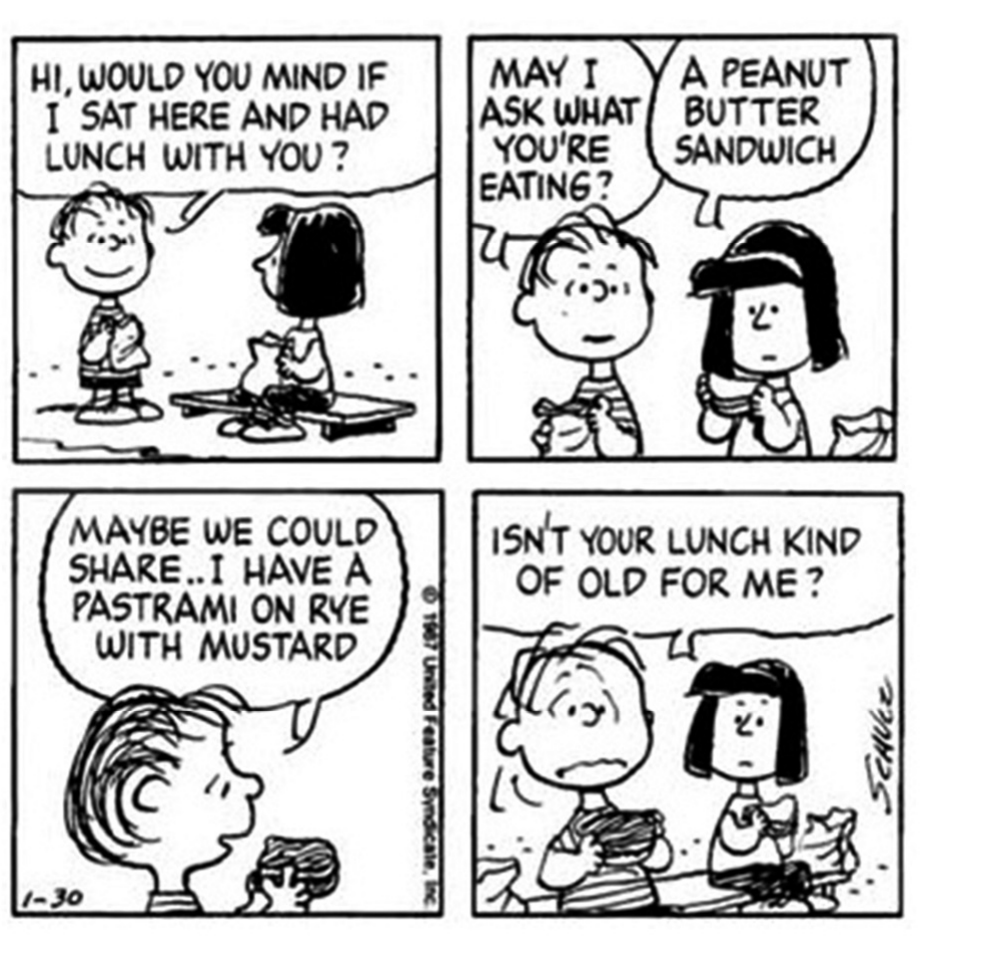
Charles Schulz. Peanuts. January 30, 1987. Internet: <www.gocomics.com> (adapted).
In text 7A1-I, the modal verb “would” (first panel)
Text 7A1-I
Charles Schulz. Peanuts. January 30, 1987. Internet: <www.gocomics.com> (adapted).
Certain words are cognates across English and Portuguese, while some are false cognates. Considering these two languages and text 7A1-I, it is correct to affirm that the words “lunch” (first panel), “sandwich” (second panel) and “mustard” (third panel) are, respectively,
Text 7A1-II
Two roads diverged in a yellow wood,
And sorry I could not travel both
And be one traveler, long I stood
And looked down one as far as I could
To where it bent in the undergrowth;
Then took the other, as just as fair,
And having perhaps the better claim,
Because it was grassy and wanted wear;
Though as for that the passing there
Had worn them really about the same,
And both that morning equally lay
In leaves no step had trodden black.
Oh, I kept the first for another day!
Yet knowing how way leads on to way,
I doubted if I should ever come back.
I shall be telling this with a sigh
Somewhere ages and ages hence:
Two roads diverged in a wood, and I—
I took the one less traveled by,
And that has made all the difference.
Robert Frost. The Road Not Taken. 1916 (adapted).
Considering text 7A1-II, choose the option that offers an appropriate synonym for “diverged” (first verse).Resolução comentada
Análise das alternativas
Text 7A1-II
Two roads diverged in a yellow wood,
And sorry I could not travel both
And be one traveler, long I stood
And looked down one as far as I could
To where it bent in the undergrowth;
Then took the other, as just as fair,
And having perhaps the better claim,
Because it was grassy and wanted wear;
Though as for that the passing there
Had worn them really about the same,
And both that morning equally lay
In leaves no step had trodden black.
Oh, I kept the first for another day!
Yet knowing how way leads on to way,
I doubted if I should ever come back.
I shall be telling this with a sigh
Somewhere ages and ages hence:
Two roads diverged in a wood, and I—
I took the one less traveled by,
And that has made all the difference.
Robert Frost. The Road Not Taken. 1916 (adapted).
In text 7A1-II, the verb “bent”, in “To where it bent in the undergrowth” (fifth verse), is correctly conjugated in theResolução comentada
Análise das alternativas
Text 7A1-II
Two roads diverged in a yellow wood,
And sorry I could not travel both
And be one traveler, long I stood
And looked down one as far as I could
To where it bent in the undergrowth;
Then took the other, as just as fair,
And having perhaps the better claim,
Because it was grassy and wanted wear;
Though as for that the passing there
Had worn them really about the same,
And both that morning equally lay
In leaves no step had trodden black.
Oh, I kept the first for another day!
Yet knowing how way leads on to way,
I doubted if I should ever come back.
I shall be telling this with a sigh
Somewhere ages and ages hence:
Two roads diverged in a wood, and I—
I took the one less traveled by,
And that has made all the difference.
Robert Frost. The Road Not Taken. 1916 (adapted).
In the last verse of text 7A1-II, the author uses the present perfect tense toResolução comentada
Análise das alternativas
Text 7A1-II
Two roads diverged in a yellow wood,
And sorry I could not travel both
And be one traveler, long I stood
And looked down one as far as I could
To where it bent in the undergrowth;
Then took the other, as just as fair,
And having perhaps the better claim,
Because it was grassy and wanted wear;
Though as for that the passing there
Had worn them really about the same,
And both that morning equally lay
In leaves no step had trodden black.
Oh, I kept the first for another day!
Yet knowing how way leads on to way,
I doubted if I should ever come back.
I shall be telling this with a sigh
Somewhere ages and ages hence:
Two roads diverged in a wood, and I—
I took the one less traveled by,
And that has made all the difference.
Robert Frost. The Road Not Taken. 1916 (adapted).
In the 4th verse of text 7A1-II, the fragment “looked down” is classified as aResolução comentada
Análise das alternativas
Text 7A1-II
Two roads diverged in a yellow wood,
And sorry I could not travel both
And be one traveler, long I stood
And looked down one as far as I could
To where it bent in the undergrowth;
Then took the other, as just as fair,
And having perhaps the better claim,
Because it was grassy and wanted wear;
Though as for that the passing there
Had worn them really about the same,
And both that morning equally lay
In leaves no step had trodden black.
Oh, I kept the first for another day!
Yet knowing how way leads on to way,
I doubted if I should ever come back.
I shall be telling this with a sigh
Somewhere ages and ages hence:
Two roads diverged in a wood, and I—
I took the one less traveled by,
And that has made all the difference.
Robert Frost. The Road Not Taken. 1916 (adapted).
In text 7A1-II, the modal verb “should”, in “I doubted if I should ever come back.” (fifteenth verse), expressesResolução comentada
Análise das alternativas
Text 7A2-I
If we believe that our own information age is defined by the digital structures of electronic communication, we must take early modern culture as inextricably bound to the medium of print. Printed text and image arose within a few years of each other in the mid-fifteenth century, credited to the German goldsmith Johannes Gutenberg, who seemingly drew together a series of extant yet disparate technologies into a new machine that could print several thousand sheets a day. The ancient oil or wine press, the goldsmith’s craft in fine metal carving, the late-medieval development of plentiful rag paper, and the recent formulation of more stable oil-based inks enabled Gutenberg’s ‘revolution’.
Similarly, early photography developed from a coming together of two otherwise disparate technologies: on the one hand, the pinhole camera through which capture a refected view of the world as an image, and on the other the chemical means to fix the effects of light exposure on paper. In both cases, these technologies shared aesthetic resources with other media available at the time, while also producing forms of representation that were uniquely theirs, and which offered access to new ways of seeing, and enabled new forms of subjectivity. The greatly expanded flow of visual information facilitated by these technological breakthroughs worked to quicken the circulation of knowledge, and the foundations of thought itself.
Genevieve Warwick and Richard Taws. After Prometheus: Art and Technology in Early Modern Europe. In: Art History – Journal of the Association of Art Historians. Special Edition: Art and Technology in Early Modern Europe. p. 201 (adapted).
The words “inextricably” (first sentence of text 7A2-I) and “goldsmith” (second sentence of text 7A2-I) are respectively formed by the word formation processes known asResolução comentada
Análise das alternativas
Text 7A2-I
If we believe that our own information age is defined by the digital structures of electronic communication, we must take early modern culture as inextricably bound to the medium of print. Printed text and image arose within a few years of each other in the mid-fifteenth century, credited to the German goldsmith Johannes Gutenberg, who seemingly drew together a series of extant yet disparate technologies into a new machine that could print several thousand sheets a day. The ancient oil or wine press, the goldsmith’s craft in fine metal carving, the late-medieval development of plentiful rag paper, and the recent formulation of more stable oil-based inks enabled Gutenberg’s ‘revolution’.
Similarly, early photography developed from a coming together of two otherwise disparate technologies: on the one hand, the pinhole camera through which capture a refected view of the world as an image, and on the other the chemical means to fix the effects of light exposure on paper. In both cases, these technologies shared aesthetic resources with other media available at the time, while also producing forms of representation that were uniquely theirs, and which offered access to new ways of seeing, and enabled new forms of subjectivity. The greatly expanded flow of visual information facilitated by these technological breakthroughs worked to quicken the circulation of knowledge, and the foundations of thought itself.
Genevieve Warwick and Richard Taws. After Prometheus: Art and Technology in Early Modern Europe. In: Art History – Journal of the Association of Art Historians. Special Edition: Art and Technology in Early Modern Europe. p. 201 (adapted).
In the last two sentences of text 7A2-I, the wordResolução comentada
Análise das alternativas
Text 7A2-I
If we believe that our own information age is defined by the digital structures of electronic communication, we must take early modern culture as inextricably bound to the medium of print. Printed text and image arose within a few years of each other in the mid-fifteenth century, credited to the German goldsmith Johannes Gutenberg, who seemingly drew together a series of extant yet disparate technologies into a new machine that could print several thousand sheets a day. The ancient oil or wine press, the goldsmith’s craft in fine metal carving, the late-medieval development of plentiful rag paper, and the recent formulation of more stable oil-based inks enabled Gutenberg’s ‘revolution’.
Similarly, early photography developed from a coming together of two otherwise disparate technologies: on the one hand, the pinhole camera through which capture a refected view of the world as an image, and on the other the chemical means to fix the effects of light exposure on paper. In both cases, these technologies shared aesthetic resources with other media available at the time, while also producing forms of representation that were uniquely theirs, and which offered access to new ways of seeing, and enabled new forms of subjectivity. The greatly expanded flow of visual information facilitated by these technological breakthroughs worked to quicken the circulation of knowledge, and the foundations of thought itself.
Genevieve Warwick and Richard Taws. After Prometheus: Art and Technology in Early Modern Europe. In: Art History – Journal of the Association of Art Historians. Special Edition: Art and Technology in Early Modern Europe. p. 201 (adapted).
Used in text 7A2-I, the words “Printed” (second sentence of the first paragraph) “carving” (third sentence of the first paragraph), and “producing” (second sentence of the second paragraph)Resolução comentada
Análise das alternativas
Text 7A2-I
If we believe that our own information age is defined by the digital structures of electronic communication, we must take early modern culture as inextricably bound to the medium of print. Printed text and image arose within a few years of each other in the mid-fifteenth century, credited to the German goldsmith Johannes Gutenberg, who seemingly drew together a series of extant yet disparate technologies into a new machine that could print several thousand sheets a day. The ancient oil or wine press, the goldsmith’s craft in fine metal carving, the late-medieval development of plentiful rag paper, and the recent formulation of more stable oil-based inks enabled Gutenberg’s ‘revolution’.
Similarly, early photography developed from a coming together of two otherwise disparate technologies: on the one hand, the pinhole camera through which capture a refected view of the world as an image, and on the other the chemical means to fix the effects of light exposure on paper. In both cases, these technologies shared aesthetic resources with other media available at the time, while also producing forms of representation that were uniquely theirs, and which offered access to new ways of seeing, and enabled new forms of subjectivity. The greatly expanded flow of visual information facilitated by these technological breakthroughs worked to quicken the circulation of knowledge, and the foundations of thought itself.
Genevieve Warwick and Richard Taws. After Prometheus: Art and Technology in Early Modern Europe. In: Art History – Journal of the Association of Art Historians. Special Edition: Art and Technology in Early Modern Europe. p. 201 (adapted).
In the first sentence of text 7A2-I,Resolução comentada
Análise das alternativas
Text 7A2-II
In October 1971, a gentleman called Frieder Nake published a note entitled, There Should Be No Computer Art, which I quote here. “Soon after the advent of computers, it became clear that there was a great potential application for them in the area of artistic creation”, he began. “Before 1960, amazing, large, expensive, digital computers helped to produce poetic text and music. Analog computers, or only oscilloscopes, generated drawings of sets of mathematical curves and representations of oscillations. It was not before the first exhibitions of computer produced pictures were held in 1965 that a greater public took notice of this threat, as some said, progress, as some thought. I was involved in this development from its beginning.
I think that the way the art scene reacted to the new creations is interesting, pleasing, and stupid. I stated in 1970 that I was no longer going to take part in exhibitions. I find it easy to admit that computer art did not contribute to the advancement of art if we compare the computer products to all existing works of art. In other words, the repertoire of results of aesthetic behavior has not been changed by the use of computers. This point of view, namely, that of art history, is shared and held against computer art by many art critics. There is no doubt in my mind”, Frieder Nake said, “that interesting new methods have been found in the last decade which can be of some significance for the creative artist”.
As you might imagine, this was a bit of a controversial take. Here was a man who had for part of the previous decade been an insider, an advocate for the use of algorithmic and generative processes to create art. However, he was now seeing things from another perspective. I’ll just finish with another piece from what he posted in that article: “Questions like ‘is a computer creative’, or ‘is a computer an artist’, or the like, should not be considered serious questions, period. In the light of what we are facing at the end of the 20th century, those irrelevant questions do not matter”.
Where is the Art? A History in Technology. Internet: <https://www.infoq.com> (adapted).
Each of the following options presents a different version of the last sentence of the second paragraph of text 7A2-II. Choose the option in which not only are the correctness and the original meaning of the fragment maintained, but also is the reported indirect speech used correctly.
Text 7A2-II
In October 1971, a gentleman called Frieder Nake published a note entitled, There Should Be No Computer Art, which I quote here. “Soon after the advent of computers, it became clear that there was a great potential application for them in the area of artistic creation”, he began. “Before 1960, amazing, large, expensive, digital computers helped to produce poetic text and music. Analog computers, or only oscilloscopes, generated drawings of sets of mathematical curves and representations of oscillations. It was not before the first exhibitions of computer produced pictures were held in 1965 that a greater public took notice of this threat, as some said, progress, as some thought. I was involved in this development from its beginning.
I think that the way the art scene reacted to the new creations is interesting, pleasing, and stupid. I stated in 1970 that I was no longer going to take part in exhibitions. I find it easy to admit that computer art did not contribute to the advancement of art if we compare the computer products to all existing works of art. In other words, the repertoire of results of aesthetic behavior has not been changed by the use of computers. This point of view, namely, that of art history, is shared and held against computer art by many art critics. There is no doubt in my mind”, Frieder Nake said, “that interesting new methods have been found in the last decade which can be of some significance for the creative artist”.
As you might imagine, this was a bit of a controversial take. Here was a man who had for part of the previous decade been an insider, an advocate for the use of algorithmic and generative processes to create art. However, he was now seeing things from another perspective. I’ll just finish with another piece from what he posted in that article: “Questions like ‘is a computer creative’, or ‘is a computer an artist’, or the like, should not be considered serious questions, period. In the light of what we are facing at the end of the 20th century, those irrelevant questions do not matter”.
Where is the Art? A History in Technology. Internet: <https://www.infoq.com> (adapted).
In text 7A2-II, the fragment ‘I think that the way the art scene reacted to the new creations is interesting, pleasing, and stupid’ (first sentence of the second paragraph)Resolução comentada
Análise das alternativas
Text 7A2-II
In October 1971, a gentleman called Frieder Nake published a note entitled, There Should Be No Computer Art, which I quote here. “Soon after the advent of computers, it became clear that there was a great potential application for them in the area of artistic creation”, he began. “Before 1960, amazing, large, expensive, digital computers helped to produce poetic text and music. Analog computers, or only oscilloscopes, generated drawings of sets of mathematical curves and representations of oscillations. It was not before the first exhibitions of computer produced pictures were held in 1965 that a greater public took notice of this threat, as some said, progress, as some thought. I was involved in this development from its beginning.
I think that the way the art scene reacted to the new creations is interesting, pleasing, and stupid. I stated in 1970 that I was no longer going to take part in exhibitions. I find it easy to admit that computer art did not contribute to the advancement of art if we compare the computer products to all existing works of art. In other words, the repertoire of results of aesthetic behavior has not been changed by the use of computers. This point of view, namely, that of art history, is shared and held against computer art by many art critics. There is no doubt in my mind”, Frieder Nake said, “that interesting new methods have been found in the last decade which can be of some significance for the creative artist”.
As you might imagine, this was a bit of a controversial take. Here was a man who had for part of the previous decade been an insider, an advocate for the use of algorithmic and generative processes to create art. However, he was now seeing things from another perspective. I’ll just finish with another piece from what he posted in that article: “Questions like ‘is a computer creative’, or ‘is a computer an artist’, or the like, should not be considered serious questions, period. In the light of what we are facing at the end of the 20th century, those irrelevant questions do not matter”.
Where is the Art? A History in Technology. Internet: <https://www.infoq.com> (adapted).
In the sentence “Here was a man who had for part of the previous decade been an insider, an advocate for the use of algorithmic and generative processes to create art.” (second sentence of the third paragraph of text 7A2-II),Resolução comentada
Análise das alternativas
Text 7A2-II
In October 1971, a gentleman called Frieder Nake published a note entitled, There Should Be No Computer Art, which I quote here. “Soon after the advent of computers, it became clear that there was a great potential application for them in the area of artistic creation”, he began. “Before 1960, amazing, large, expensive, digital computers helped to produce poetic text and music. Analog computers, or only oscilloscopes, generated drawings of sets of mathematical curves and representations of oscillations. It was not before the first exhibitions of computer produced pictures were held in 1965 that a greater public took notice of this threat, as some said, progress, as some thought. I was involved in this development from its beginning.
I think that the way the art scene reacted to the new creations is interesting, pleasing, and stupid. I stated in 1970 that I was no longer going to take part in exhibitions. I find it easy to admit that computer art did not contribute to the advancement of art if we compare the computer products to all existing works of art. In other words, the repertoire of results of aesthetic behavior has not been changed by the use of computers. This point of view, namely, that of art history, is shared and held against computer art by many art critics. There is no doubt in my mind”, Frieder Nake said, “that interesting new methods have been found in the last decade which can be of some significance for the creative artist”.
As you might imagine, this was a bit of a controversial take. Here was a man who had for part of the previous decade been an insider, an advocate for the use of algorithmic and generative processes to create art. However, he was now seeing things from another perspective. I’ll just finish with another piece from what he posted in that article: “Questions like ‘is a computer creative’, or ‘is a computer an artist’, or the like, should not be considered serious questions, period. In the light of what we are facing at the end of the 20th century, those irrelevant questions do not matter”.
Where is the Art? A History in Technology. Internet: <https://www.infoq.com> (adapted).
In the first paragraph of text 7A2-II, the passage ‘amazing, large, expensive digital computers helped to produce poetic text and music’ (third sentence of the first paragraph) can be correctly rewritten, in terms of grammatical rules, asResolução comentada
Análise das alternativas
Text 7A3-I
As a science fiction writer, Octavia Butler forged a new path and envisioned bold possibilities. The future she wrote about is now our present moment. She wrote 12 novels and won each of science fiction’s highest honors. In 1995, she became the first science fiction writer to be awarded a MacArthur “genius” grant. She is also, increasingly, a writer recognized as one of the most important voices and visionaries of the 20th century, and now the 21st. As a Black woman and a writer, Butler demolished walls that seemed impermeable, writing on themes that seemed uncategorizable. Her ideas and characters continue to resonate with new readers when so many are looking for, if not hope, then a map for a way forward.
Her vision about the climate crisis, political and societal upheaval and the brutality and consequences of power hierarchies seems both sobering and prescient. However, as Butler often noted, being right was never the point. She didn’t want to be right — far from it. She wanted to give us time, and tools, to correct the course.
Lynell George. The Visions of Octavia Butler. Internet: <www.nytimes.com> (adapted).
In text 7A3-I, the clause “when so many are looking for, if not hope, then a map for a way forward” (last sentence of the first paragraph) is an adverbial clause that indicatesResolução comentada
Análise das alternativas
Text 7A3-I
As a science fiction writer, Octavia Butler forged a new path and envisioned bold possibilities. The future she wrote about is now our present moment. She wrote 12 novels and won each of science fiction’s highest honors. In 1995, she became the first science fiction writer to be awarded a MacArthur “genius” grant. She is also, increasingly, a writer recognized as one of the most important voices and visionaries of the 20th century, and now the 21st. As a Black woman and a writer, Butler demolished walls that seemed impermeable, writing on themes that seemed uncategorizable. Her ideas and characters continue to resonate with new readers when so many are looking for, if not hope, then a map for a way forward.
Her vision about the climate crisis, political and societal upheaval and the brutality and consequences of power hierarchies seems both sobering and prescient. However, as Butler often noted, being right was never the point. She didn’t want to be right — far from it. She wanted to give us time, and tools, to correct the course.
Lynell George. The Visions of Octavia Butler. Internet: <www.nytimes.com> (adapted).
In text 7A3-I, the clause “as Butler often noted” (second sentence of the second paragraph) is an adverbial clause that indicatesResolução comentada
Análise das alternativas
Text 7A3-I
As a science fiction writer, Octavia Butler forged a new path and envisioned bold possibilities. The future she wrote about is now our present moment. She wrote 12 novels and won each of science fiction’s highest honors. In 1995, she became the first science fiction writer to be awarded a MacArthur “genius” grant. She is also, increasingly, a writer recognized as one of the most important voices and visionaries of the 20th century, and now the 21st. As a Black woman and a writer, Butler demolished walls that seemed impermeable, writing on themes that seemed uncategorizable. Her ideas and characters continue to resonate with new readers when so many are looking for, if not hope, then a map for a way forward.
Her vision about the climate crisis, political and societal upheaval and the brutality and consequences of power hierarchies seems both sobering and prescient. However, as Butler often noted, being right was never the point. She didn’t want to be right — far from it. She wanted to give us time, and tools, to correct the course.
Lynell George. The Visions of Octavia Butler. Internet: <www.nytimes.com> (adapted).
Text 7A3-I mentions the work of Octavia Butler, an important American writer. Choose the option that correctly presents the literary movement of which Butler is considered a precursor.Resolução comentada
Análise das alternativas
Aaron Ugwu Ifeanyi. Language Teaching Methods: A Conceptual Approach. 2015 (adapted).
Considering the previous excerpt as a context, it is correct to affirm that, in the audiolingual method,Resolução comentada
Análise das alternativas
• Much vocabulary is taught in the form of lists of isolated words.
• Long elaborate explanations of the intricacies of grammar are given.
• Grammar provides the rules for putting words together.
• Reading of difficult classical texts is begun early.
• Little attention is paid to the content of texts, which are treated as exercises in translating disconnected sentences from the target language into the mother tongue.
• Little or no attention is given to pronunciation.
Aaron Ugwu Ifeanyi. Language Teaching Methods: A Conceptual Approach. 2015 (adapted).
Considering the language teaching methods, it is correct to affirm that the aspects presented in the previous text correspond to theResolução comentada
Análise das alternativas
Texto-base:
Texto-base:
Texto-base:
Texto-base:
Texto-base:
Texto-base:
Texto-base:
Texto-base:
Texto-base:
Texto-base:
Texto-base:
Texto-base:
Texto-base:
Texto-base:
Texto-base:
Texto-base:
Texto-base:
Texto-base:
The audiolingual method, also known as fundamental skill method, aural-oral method or Army method, came as a result of the need for American soldiers who were to travel overseas to communicate in foreign languages during the Second World War. To this end, bits and pieces of the Direct Method were appropriated in order to enhance this method. The audiolingual method draws its practices from linguistic and psychological theory that investigates different language using scientific descriptive analytic approach.
• Classes are taught in the mother tongue, with little active use of the target language.