← Voltar para a lista de provas Marinha do Brasil · Oficial dos Quadros Complementares (CP-QC-CA-FN) — Sistemas de Armas 51 questões nesta prova · página 1 de 3 · 48 com gabarito Gabarito disponível Gabarito disponível Verdadeiro/falso sobre a Corrente Circumpolar Antártica. O texto diz que a corrente é a mais forte do planeta, cinco vezes mais forte que a Corrente do Golfo e mais de 100 vezes mais forte que o Amazonas (V). Ela mantém a água quente afastada, protegendo as camadas de gelo, e atua como barreira a espécies invasoras (V). Ela liga os oceanos Pacífico, Atlântico e Índico, e não 'apenas' Pacífico e Índico (F). Suas consequências são profundas porque ela tem papel crucial no ecossistema antártico (V). A, C, D e E divergem da sequência V-V-F-V: A e E marcam a 2ª como falsa (ela é verdadeira); E ainda marca a 4ª como falsa; C e D marcam a 3ª como verdadeira, mas a corrente conecta os três oceanos, e não 'apenas' dois. Referência: Texto I: parágrafos sobre a Corrente Circumpolar Antártica e as consequências do seu enfraquecimento. Resolução comentada do VaiConcursos. Gabarito disponível Gabarito disponível Uso incorreto de verbo modal: 'May' em pergunta com sentido de dever. Em 'May you follow the present legislation?', 'may' indica permissão/possibilidade, e a pergunta assim formada não faz sentido; para obrigação/conselho usaria-se 'Should/Must you follow...?'. Nas demais, 'should' (expectativa), 'might' (possibilidade) e 'couldn't' (incapacidade no passado) estão bem empregados. A) 'should' indica expectativa, correto. B) 'might' indica possibilidade, correto. D) 'should' indica expectativa, como no texto. E) 'couldn't' indica incapacidade no passado, correto. Referência: Modal verbs: may, might, should, could. Resolução comentada do VaiConcursos. Gabarito disponível Questão anulada Gabarito disponível Valor semântico de 'whether' em 'discover whether...'. 'Whether' introduz uma oração que expressa dúvida entre possibilidades ('se'). Em 'HERA intends to discover whether this technique could be an effective way...', a missão ainda não sabe se a técnica é eficaz, o que indica incerteza. A) conclusão seria 'therefore/thus'. B) resultado seria 'so/as a result'. C) tempo seria 'when/while'. D) contraste seria 'but/however/although'. Referência: Conjunções subordinativas e integrantes em inglês (whether = if, 'se'). Resolução comentada do VaiConcursos. Gabarito disponível Paráfrase de oração condicional do tipo 1 (voz passiva reduzida para ativa). O trecho 'If approved by the ESA's ministerial council, the Ramses mission will launch in 2028' é uma condicional de tipo 1 (if + presente, will + verbo). A alternativa A mantém essa estrutura na voz ativa: 'If the council approves the mission, it will launch in 2028'. B) 'would approve' após 'if' é incorreto na condicional de tipo 1. C) 'approved' (passado) combina com 'would', não com 'will'. D) 'would launched' é forma ilegítima (falta 'be' e 'would' não combina com presente). E) 'will' após 'if' é incorreto, e 'would have been launched' mistura estruturas. Referência: Gramática da língua inglesa: First Conditional (if + simple present, will + infinitivo). Resolução comentada do VaiConcursos. Gabarito disponível A voz passiva de "used" (passado) é "was used". A frase ativa está no simple past, então a passiva usa was/were + particípio: "The planet's gravity was used by the spacecraft to get a 'kick'". O agente passa a ser introduzido por "by". A: "is being used" está no presente contínuo. C e D: mudam o sentido, pois a nave não chuta a gravidade nem o planeta chuta a gravidade da nave. E: "for the spacecraft to get" altera a estrutura, perdendo o agente com by. Referência: Voz passiva no simple past. Resolução comentada do VaiConcursos. Gabarito disponível O objetivo principal da HERA é investigar o local da colisão histórica. O texto diz que a espaçonave está a caminho de investigar a cena de uma colisão histórica com asteroide. A missão pretende avaliar o impacto da sonda da NASA (DART) em 2022. A e D tratam de atividades feitas de passagem por Marte, não do objetivo principal. B: Apophis é alvo de outra missão, a Ramses. E: Dimorphos é o asteroide da colisão, mas a opção é mais restrita que o objetivo de investigar a cena da colisão. Referência: Texto II, 1º parágrafo. Resolução comentada do VaiConcursos. Gabarito disponível Uma carga positiva sofre força F = qE no mesmo sentido de E. Com q > 0, F = qE tem mesma direção e sentido de E. Portanto a partícula é acelerada na direção e sentido do campo, embora a velocidade nem sempre seja nesse sentido. A: a força é não nula, então não permanece em repouso. B: a velocidade pode ter qualquer sentido, o que é determinado pela aceleração. C: a aceleração é paralela a E, não perpendicular. E: o sentido oposto a E vale para cargas negativas. Referência: Campo elétrico e força elétrica. Resolução comentada do VaiConcursos. Gabarito disponível A incorreta é a D, que define arquivo e registro de forma equivocada. Arquivo é um conjunto de registros armazenados em dispositivo de memória secundária, e a expressão "dispositivo de operações unificado" é imprecisa. Além disso, o registro é um conjunto de campos (dados) logicamente relacionados, não "pares de informação". A, B, C e E trazem definições corretas de variável, variável composta homogênea, matriz 4x4 e operações básicas sobre arquivos. Referência: FARRER (2017), Algoritmos Estruturados. Resolução comentada do VaiConcursos. Gabarito disponível O cloro vai de +1 (HClO) para −1 (HCl), ganhando 2 elétrons. No HClO o Cl tem Nox +1 e no HCl tem −1, portanto reduz-se ganhando 2 elétrons. O bromo vai de 0 (Br₂) a +5 (HBrO₃), perdendo 5 elétrons por átomo. A: o bromo perde elétrons (oxida), não ganha 3. B: o oxigênio mantém Nox −2. C: não há neutralização ácido-base. E: o hidrogênio mantém Nox +1. Referência: Oxirredução e número de oxidação. Resolução comentada do VaiConcursos. Gabarito disponível (0,0,1) não pertence a W. Todo vetor de W tem a forma a(1,0,2) + b(0,1,−1) = (a, b, 2a − b), ou seja, a terceira coordenada é 2x − y. Para (0,0,1), 2·0 − 0 = 0 ≠ 1, logo não pertence a W. A: (3,2,4) → 6−2=4. B: (2,−1,5) → 4+1=5. C: (1,1,1) → 2−1=1. E: (−1,2,−4) → −2−2=−4. Todos satisfazem z = 2x − y e pertencem a W. Referência: Subespaço gerado e combinação linear. Resolução comentada do VaiConcursos. Gabarito disponível Gabarito disponível Divisão e conquista tem três etapas: dividir, conquistar e combinar. No quicksort, divide-se A[p..r] em dois subarranjos por particionamento. Depois os subarranjos são conquistados (ordenados recursivamente) e, por fim, combinados. Como a ordenação é feita no próprio arranjo, a combinação não exige trabalho. A mistura termos da ordenação por intercalação. B, C e D trazem termos estatísticos ou alheios ao paradigma, como variância, amplitude e correlação. Referência: CORMEN (2012), cap. 7 (Quicksort). Resolução comentada do VaiConcursos. Gabarito disponível A incorreta é a E, porque a instância é a entrada, não a saída. Para Cormen, uma instância de um problema consiste na entrada (satisfazendo as restrições do problema) necessária para calcular uma solução. A alternativa E diz que é a saída, o que está errado. A, B, C e D reproduzem definições corretas de Cormen: forma de especificar um algoritmo, definição informal, algoritmo como ferramenta e algoritmo correto. Referência: CORMEN (2012), Algoritmos: Teoria e Prática, cap. 1. Resolução comentada do VaiConcursos. Gabarito disponível ω = v/r = 16,7/0,6 ≈ 28 rad/s. 60 km/h = 16,67 m/s. O raio é 0,6 m, então ω = v/R = 16,67/0,6 ≈ 27,8 ≈ 28 rad/s. A, B, C e D (10, 15, 18 e 25 rad/s) decorrem de erro na conversão de unidades ou do uso do diâmetro no lugar do raio. Referência: Movimento circular uniforme, v = ωR. Resolução comentada do VaiConcursos. Gabarito disponível Gabarito disponível O ângulo do cone de Mach é 45°, então v = 343·√2 ≈ 480 m/s, valor mais próximo de 490 m/s. O estrondo chega quando o caça está 15 km à frente e 15 km acima, então a linha avião-observador forma 45° com a trajetória. Assim sen θ = v_som/v = 1/√2, e v = 343·1,4 ≈ 480 m/s. A opção mais próxima é 490 m/s. A, B e C são menores ou próximos de 343 m/s, o que não é supersônico para esse ângulo. E (550 m/s) corresponderia a um ângulo menor que 45°. Referência: Cone de Mach, sen θ = v_som/v_objeto. Resolução comentada do VaiConcursos.Marinha do Brasil — CP-QC-CA-FN/2025 — Sistemas de Armas — Prova Amarela
Read the text below and answer questions 1 to 5.
TEXT I
The world's strongest ocean current should be getting faster - instead, it is at risk of failing.
Antarctica's remote and mysterious current has a profound influence on the climate, food systems and Antarctic ecosystems. Can we stop it weakening by 2050? The Antarctic Circumpolar Current is the strongest ocean current on the planet. It's five times stronger than the Gulf Stream and more than 100 times stronger than the Amazon River. It forms part of the global ocean "conveyor belt" connecting the Pacific, Atlantic and Indian oceans. The system regulates Earth's climate and pumps water, heat and nutrients around the globe. But fresh, cool water from melting Antarctic ice is diluting the salty water of the ocean, potentially disrupting the vital ocean current.
The Antarctic Circumpolar Current is like a moat around the icy continent. The current helps to keep warm water at bay, protecting vulnerable ice sheets. It also acts as a barrier to invasive species such as southern bull kelp and any animals hitching a ride on these rafts, spreading them out as they drift towards the continent. It also plays a big part in regulating the Earth's climate.
The influence of climate change:
Ocean currents respond to changes in temperature, salt levels, wind patterns and sea ice extent. So the global ocean conveyor belt is vulnerable to climate change on multiple fronts. Previous research suggested one vital part of this conveyor belt could be headed for a catastrophic collapse. Theoretically, warming water around Antarctica should speed up the current. This is because density changes and winds around Antarctica dictate the strength of the current. Warm water is less dense (or heavy) and this should be enough to speed up the current.
Far-reaching consequences:
The consequences of a weaker Antarctic Circumpolar Current are profound and far-reaching. As the main current that circulates nutrient-rich waters around Antarctica, it plays a crucial role in the Antarctic ecosystem. Weakening of the current could reduce biodiversity and decrease the productivity of fisheries that many coastal communities rely on. It could also aid the entry of invasive species such as southern bull kelp to Antarctica, disrupting local ecosystems and food webs.
(Adapted from: www.bbcnews/fuure/article/20250303-the-worlds-strongest-ocean-current-is-at-risck)
According to the excerpt below, mark the correct conjunction that can be replaced for another, without changing the meaning of the text.

Read the text below and answer questions 1 to 5.
TEXT I
The world's strongest ocean current should be getting faster - instead, it is at risk of failing.
Antarctica's remote and mysterious current has a profound influence on the climate, food systems and Antarctic ecosystems. Can we stop it weakening by 2050? The Antarctic Circumpolar Current is the strongest ocean current on the planet. It's five times stronger than the Gulf Stream and more than 100 times stronger than the Amazon River. It forms part of the global ocean "conveyor belt" connecting the Pacific, Atlantic and Indian oceans. The system regulates Earth's climate and pumps water, heat and nutrients around the globe. But fresh, cool water from melting Antarctic ice is diluting the salty water of the ocean, potentially disrupting the vital ocean current.
The Antarctic Circumpolar Current is like a moat around the icy continent. The current helps to keep warm water at bay, protecting vulnerable ice sheets. It also acts as a barrier to invasive species such as southern bull kelp and any animals hitching a ride on these rafts, spreading them out as they drift towards the continent. It also plays a big part in regulating the Earth's climate.
The influence of climate change:
Ocean currents respond to changes in temperature, salt levels, wind patterns and sea ice extent. So the global ocean conveyor belt is vulnerable to climate change on multiple fronts. Previous research suggested one vital part of this conveyor belt could be headed for a catastrophic collapse. Theoretically, warming water around Antarctica should speed up the current. This is because density changes and winds around Antarctica dictate the strength of the current. Warm water is less dense (or heavy) and this should be enough to speed up the current.
Far-reaching consequences:
The consequences of a weaker Antarctic Circumpolar Current are profound and far-reaching. As the main current that circulates nutrient-rich waters around Antarctica, it plays a crucial role in the Antarctic ecosystem. Weakening of the current could reduce biodiversity and decrease the productivity of fisheries that many coastal communities rely on. It could also aid the entry of invasive species such as southern bull kelp to Antarctica, disrupting local ecosystems and food webs.
(Adapted from: www.bbcnews/fuure/article/20250303-the-worlds-strongest-ocean-current-is-at-risck)
Read the excerpts about the Text I and establish if the statements are true or false and mark the correct answer.
( ) The Antarctic Circumpolar Current is the strongest on the planet and it's stronger than the Gulf Stream and the Amazon River.
( ) The current helps to keep warm water at bay, protecting even vulnerable ice sheets, as also acts as a kind of barrier to invasive species.
( ) It forms part of the global ocean “conveyor belt” a specie of continuous movement and connecting only Pacific and Indian oceans.
( ) There is a complex concern about the consequences of a weaker Antarctic Circumpolar Current, because it plays a crucial role in the Antarctic ecosystem.Resolução comentada
Análise das alternativas
Read the text below and answer questions 1 to 5.
TEXT I
The world's strongest ocean current should be getting faster - instead, it is at risk of failing.
Antarctica's remote and mysterious current has a profound influence on the climate, food systems and Antarctic ecosystems. Can we stop it weakening by 2050? The Antarctic Circumpolar Current is the strongest ocean current on the planet. It's five times stronger than the Gulf Stream and more than 100 times stronger than the Amazon River. It forms part of the global ocean "conveyor belt" connecting the Pacific, Atlantic and Indian oceans. The system regulates Earth's climate and pumps water, heat and nutrients around the globe. But fresh, cool water from melting Antarctic ice is diluting the salty water of the ocean, potentially disrupting the vital ocean current.
The Antarctic Circumpolar Current is like a moat around the icy continent. The current helps to keep warm water at bay, protecting vulnerable ice sheets. It also acts as a barrier to invasive species such as southern bull kelp and any animals hitching a ride on these rafts, spreading them out as they drift towards the continent. It also plays a big part in regulating the Earth's climate.
The influence of climate change:
Ocean currents respond to changes in temperature, salt levels, wind patterns and sea ice extent. So the global ocean conveyor belt is vulnerable to climate change on multiple fronts. Previous research suggested one vital part of this conveyor belt could be headed for a catastrophic collapse. Theoretically, warming water around Antarctica should speed up the current. This is because density changes and winds around Antarctica dictate the strength of the current. Warm water is less dense (or heavy) and this should be enough to speed up the current.
Far-reaching consequences:
The consequences of a weaker Antarctic Circumpolar Current are profound and far-reaching. As the main current that circulates nutrient-rich waters around Antarctica, it plays a crucial role in the Antarctic ecosystem. Weakening of the current could reduce biodiversity and decrease the productivity of fisheries that many coastal communities rely on. It could also aid the entry of invasive species such as southern bull kelp to Antarctica, disrupting local ecosystems and food webs.
(Adapted from: www.bbcnews/fuure/article/20250303-the-worlds-strongest-ocean-current-is-at-risck)
Read the text below and answer questions 1 to 5.
TEXT I
The world's strongest ocean current should be getting faster - instead, it is at risk of failing.
Antarctica's remote and mysterious current has a profound influence on the climate, food systems and Antarctic ecosystems. Can we stop it weakening by 2050? The Antarctic Circumpolar Current is the strongest ocean current on the planet. It's five times stronger than the Gulf Stream and more than 100 times stronger than the Amazon River. It forms part of the global ocean "conveyor belt" connecting the Pacific, Atlantic and Indian oceans. The system regulates Earth's climate and pumps water, heat and nutrients around the globe. But fresh, cool water from melting Antarctic ice is diluting the salty water of the ocean, potentially disrupting the vital ocean current.
The Antarctic Circumpolar Current is like a moat around the icy continent. The current helps to keep warm water at bay, protecting vulnerable ice sheets. It also acts as a barrier to invasive species such as southern bull kelp and any animals hitching a ride on these rafts, spreading them out as they drift towards the continent. It also plays a big part in regulating the Earth's climate.
The influence of climate change:
Ocean currents respond to changes in temperature, salt levels, wind patterns and sea ice extent. So the global ocean conveyor belt is vulnerable to climate change on multiple fronts. Previous research suggested one vital part of this conveyor belt could be headed for a catastrophic collapse. Theoretically, warming water around Antarctica should speed up the current. This is because density changes and winds around Antarctica dictate the strength of the current. Warm water is less dense (or heavy) and this should be enough to speed up the current.
Far-reaching consequences:
The consequences of a weaker Antarctic Circumpolar Current are profound and far-reaching. As the main current that circulates nutrient-rich waters around Antarctica, it plays a crucial role in the Antarctic ecosystem. Weakening of the current could reduce biodiversity and decrease the productivity of fisheries that many coastal communities rely on. It could also aid the entry of invasive species such as southern bull kelp to Antarctica, disrupting local ecosystems and food webs.
(Adapted from: www.bbcnews/fuure/article/20250303-the-worlds-strongest-ocean-current-is-at-risck)
Mark the option that presents an INCORRECT use of a modal verb.Resolução comentada
Análise das alternativas
Read the text below and answer questions 1 to 5.
TEXT I
The world's strongest ocean current should be getting faster - instead, it is at risk of failing.
Antarctica's remote and mysterious current has a profound influence on the climate, food systems and Antarctic ecosystems. Can we stop it weakening by 2050? The Antarctic Circumpolar Current is the strongest ocean current on the planet. It's five times stronger than the Gulf Stream and more than 100 times stronger than the Amazon River. It forms part of the global ocean "conveyor belt" connecting the Pacific, Atlantic and Indian oceans. The system regulates Earth's climate and pumps water, heat and nutrients around the globe. But fresh, cool water from melting Antarctic ice is diluting the salty water of the ocean, potentially disrupting the vital ocean current.
The Antarctic Circumpolar Current is like a moat around the icy continent. The current helps to keep warm water at bay, protecting vulnerable ice sheets. It also acts as a barrier to invasive species such as southern bull kelp and any animals hitching a ride on these rafts, spreading them out as they drift towards the continent. It also plays a big part in regulating the Earth's climate.
The influence of climate change:
Ocean currents respond to changes in temperature, salt levels, wind patterns and sea ice extent. So the global ocean conveyor belt is vulnerable to climate change on multiple fronts. Previous research suggested one vital part of this conveyor belt could be headed for a catastrophic collapse. Theoretically, warming water around Antarctica should speed up the current. This is because density changes and winds around Antarctica dictate the strength of the current. Warm water is less dense (or heavy) and this should be enough to speed up the current.
Far-reaching consequences:
The consequences of a weaker Antarctic Circumpolar Current are profound and far-reaching. As the main current that circulates nutrient-rich waters around Antarctica, it plays a crucial role in the Antarctic ecosystem. Weakening of the current could reduce biodiversity and decrease the productivity of fisheries that many coastal communities rely on. It could also aid the entry of invasive species such as southern bull kelp to Antarctica, disrupting local ecosystems and food webs.
(Adapted from: www.bbcnews/fuure/article/20250303-the-worlds-strongest-ocean-current-is-at-risck)

Read the text below and answer questions 6 to 10.
TEXT II
TITLE: Asteroid probe snaps rare images of Martian Moon
March 13, 2025 3:29 PM
By Agence France-Press
Paris -
On the way to investigate the scene of a historic asteroid collision, a European spacecraft swung by Mars and captured rare images of the red planet's mysterious small moon Deimos, the European Space Agency said Thursday.
Europe's HERA mission is aiming to find out how much of an impact a NASA spacecraft made when it deliberately smashed into an asteroid in 2022 in the first test of our planetary defenses.
But HERA will not reach the asteroid - which is 11 million kilometers from Earth in the asteroid belt between Mars and Jupiter - until late 2026.
On the long voyage there, the spacecraft swung around Mars on Wednesday.
The spacecraft used the planet's gravity to get a "kick" that also changed its direction and saved fuel, mission analyst Pablo Munoz told a press conference.
For an hour, HERA flew as close as 5,600 kilometers from the Martian surface, at a speed of 33,480 kilometers an hour.
It used the opportunity to test some of its scientific instruments, snapping around 600 pictures, including rare ones of Deimos.
The lumpy, 12.5-kilometer-wide moon is the smaller and less well-known of the two moons of Mars.
Exactly how Deimos and the bigger Phobos were formed remains a matter of debate.
Some scientists believe they were once asteroids that were captured in the gravity of Mars, while others think they could have been shot from a massive impact on the surface.
The new images add "another piece of the puzzle" to efforts to determine their origin, Marcel Popescu of the Astronomical Institute of the Romanian Academy said.
There are hopes that data from HERA's "HyperScout" and thermal infrared imagers - which observe colors beyond the limits of the human eye - will shed light on this mystery by discovering more about the moon's composition.
Those infrared imagers are why the red planet appears blue in some of the photos.
Next, HERA will turn its focus back to asteroid Dimorphos.
When NASA's DART mission smashed into Dimorphos in 2022, it shortened the 160-meter-wide asteroid's orbit around its big brother Didymos by 33 minutes.
Although Dimorphos itself posed no threat to Earth, HERA intends to discover whether this technique could be an effective way for Earth to defend itself against possibly existence-threatening asteroids in the future.
Space agencies have been working to ramp up Earth's planetary defences, monitoring for potential threats so they can be dealt with as soon as possible.
Earlier this year, a newly discovered asteroid capable of destroying a city was briefly given a more than 3% chance of hitting Earth in 2032.
However further observations sent the chances of a direct hit back down to nearly zero.
Richard Moissl, head of the ESA's planetary defense office, said that asteroid, 2024 YR, followed a pattern that will become more common.
As we get better at scanning the skies, "we will discover asteroids at a higher rate," he said.
The ESA is developing a secondary planetary defense mission to observe the 350-meter-wide asteroid Apophis, which will fly just 32,000 kilometers from Earth on April 13, 2029.
If approved by the ESA's ministerial council, the Ramses mission will launch in 2028, reaching the asteroid two months before it approaches Earth.
(Adapted from: https://www.voanews.com/a/asteroid-probe-snaps-rare-images-of-martian-moon/8009850.html )
HERA, DART and RAMSES are proper nouns used to identify:
Read the text below and answer questions 6 to 10.
TEXT II
TITLE: Asteroid probe snaps rare images of Martian Moon
March 13, 2025 3:29 PM
By Agence France-Press
Paris -
On the way to investigate the scene of a historic asteroid collision, a European spacecraft swung by Mars and captured rare images of the red planet's mysterious small moon Deimos, the European Space Agency said Thursday.
Europe's HERA mission is aiming to find out how much of an impact a NASA spacecraft made when it deliberately smashed into an asteroid in 2022 in the first test of our planetary defenses.
But HERA will not reach the asteroid - which is 11 million kilometers from Earth in the asteroid belt between Mars and Jupiter - until late 2026.
On the long voyage there, the spacecraft swung around Mars on Wednesday.
The spacecraft used the planet's gravity to get a "kick" that also changed its direction and saved fuel, mission analyst Pablo Munoz told a press conference.
For an hour, HERA flew as close as 5,600 kilometers from the Martian surface, at a speed of 33,480 kilometers an hour.
It used the opportunity to test some of its scientific instruments, snapping around 600 pictures, including rare ones of Deimos.
The lumpy, 12.5-kilometer-wide moon is the smaller and less well-known of the two moons of Mars.
Exactly how Deimos and the bigger Phobos were formed remains a matter of debate.
Some scientists believe they were once asteroids that were captured in the gravity of Mars, while others think they could have been shot from a massive impact on the surface.
The new images add "another piece of the puzzle" to efforts to determine their origin, Marcel Popescu of the Astronomical Institute of the Romanian Academy said.
There are hopes that data from HERA's "HyperScout" and thermal infrared imagers - which observe colors beyond the limits of the human eye - will shed light on this mystery by discovering more about the moon's composition.
Those infrared imagers are why the red planet appears blue in some of the photos.
Next, HERA will turn its focus back to asteroid Dimorphos.
When NASA's DART mission smashed into Dimorphos in 2022, it shortened the 160-meter-wide asteroid's orbit around its big brother Didymos by 33 minutes.
Although Dimorphos itself posed no threat to Earth, HERA intends to discover whether this technique could be an effective way for Earth to defend itself against possibly existence-threatening asteroids in the future.
Space agencies have been working to ramp up Earth's planetary defences, monitoring for potential threats so they can be dealt with as soon as possible.
Earlier this year, a newly discovered asteroid capable of destroying a city was briefly given a more than 3% chance of hitting Earth in 2032.
However further observations sent the chances of a direct hit back down to nearly zero.
Richard Moissl, head of the ESA's planetary defense office, said that asteroid, 2024 YR, followed a pattern that will become more common.
As we get better at scanning the skies, "we will discover asteroids at a higher rate," he said.
The ESA is developing a secondary planetary defense mission to observe the 350-meter-wide asteroid Apophis, which will fly just 32,000 kilometers from Earth on April 13, 2029.
If approved by the ESA's ministerial council, the Ramses mission will launch in 2028, reaching the asteroid two months before it approaches Earth.
(Adapted from: https://www.voanews.com/a/asteroid-probe-snaps-rare-images-of-martian-moon/8009850.html )
In the extract: “...HERA intends to discover whether this technique could be an effective way for Earth to defend itself...”, the word WHETHER conveys the idea of:Resolução comentada
Análise das alternativas
Read the text below and answer questions 6 to 10.
TEXT II
TITLE: Asteroid probe snaps rare images of Martian Moon
March 13, 2025 3:29 PM
By Agence France-Press
Paris -
On the way to investigate the scene of a historic asteroid collision, a European spacecraft swung by Mars and captured rare images of the red planet's mysterious small moon Deimos, the European Space Agency said Thursday.
Europe's HERA mission is aiming to find out how much of an impact a NASA spacecraft made when it deliberately smashed into an asteroid in 2022 in the first test of our planetary defenses.
But HERA will not reach the asteroid - which is 11 million kilometers from Earth in the asteroid belt between Mars and Jupiter - until late 2026.
On the long voyage there, the spacecraft swung around Mars on Wednesday.
The spacecraft used the planet's gravity to get a "kick" that also changed its direction and saved fuel, mission analyst Pablo Munoz told a press conference.
For an hour, HERA flew as close as 5,600 kilometers from the Martian surface, at a speed of 33,480 kilometers an hour.
It used the opportunity to test some of its scientific instruments, snapping around 600 pictures, including rare ones of Deimos.
The lumpy, 12.5-kilometer-wide moon is the smaller and less well-known of the two moons of Mars.
Exactly how Deimos and the bigger Phobos were formed remains a matter of debate.
Some scientists believe they were once asteroids that were captured in the gravity of Mars, while others think they could have been shot from a massive impact on the surface.
The new images add "another piece of the puzzle" to efforts to determine their origin, Marcel Popescu of the Astronomical Institute of the Romanian Academy said.
There are hopes that data from HERA's "HyperScout" and thermal infrared imagers - which observe colors beyond the limits of the human eye - will shed light on this mystery by discovering more about the moon's composition.
Those infrared imagers are why the red planet appears blue in some of the photos.
Next, HERA will turn its focus back to asteroid Dimorphos.
When NASA's DART mission smashed into Dimorphos in 2022, it shortened the 160-meter-wide asteroid's orbit around its big brother Didymos by 33 minutes.
Although Dimorphos itself posed no threat to Earth, HERA intends to discover whether this technique could be an effective way for Earth to defend itself against possibly existence-threatening asteroids in the future.
Space agencies have been working to ramp up Earth's planetary defences, monitoring for potential threats so they can be dealt with as soon as possible.
Earlier this year, a newly discovered asteroid capable of destroying a city was briefly given a more than 3% chance of hitting Earth in 2032.
However further observations sent the chances of a direct hit back down to nearly zero.
Richard Moissl, head of the ESA's planetary defense office, said that asteroid, 2024 YR, followed a pattern that will become more common.
As we get better at scanning the skies, "we will discover asteroids at a higher rate," he said.
The ESA is developing a secondary planetary defense mission to observe the 350-meter-wide asteroid Apophis, which will fly just 32,000 kilometers from Earth on April 13, 2029.
If approved by the ESA's ministerial council, the Ramses mission will launch in 2028, reaching the asteroid two months before it approaches Earth.
(Adapted from: https://www.voanews.com/a/asteroid-probe-snaps-rare-images-of-martian-moon/8009850.html )
Mark the correct option that presents a paraphrase for the following extract: “If approved by the ESA's ministerial council, the Ramses mission will launch in 2028”.Resolução comentada
Análise das alternativas
Read the text below and answer questions 6 to 10.
TEXT II
TITLE: Asteroid probe snaps rare images of Martian Moon
March 13, 2025 3:29 PM
By Agence France-Press
Paris -
On the way to investigate the scene of a historic asteroid collision, a European spacecraft swung by Mars and captured rare images of the red planet's mysterious small moon Deimos, the European Space Agency said Thursday.
Europe's HERA mission is aiming to find out how much of an impact a NASA spacecraft made when it deliberately smashed into an asteroid in 2022 in the first test of our planetary defenses.
But HERA will not reach the asteroid - which is 11 million kilometers from Earth in the asteroid belt between Mars and Jupiter - until late 2026.
On the long voyage there, the spacecraft swung around Mars on Wednesday.
The spacecraft used the planet's gravity to get a "kick" that also changed its direction and saved fuel, mission analyst Pablo Munoz told a press conference.
For an hour, HERA flew as close as 5,600 kilometers from the Martian surface, at a speed of 33,480 kilometers an hour.
It used the opportunity to test some of its scientific instruments, snapping around 600 pictures, including rare ones of Deimos.
The lumpy, 12.5-kilometer-wide moon is the smaller and less well-known of the two moons of Mars.
Exactly how Deimos and the bigger Phobos were formed remains a matter of debate.
Some scientists believe they were once asteroids that were captured in the gravity of Mars, while others think they could have been shot from a massive impact on the surface.
The new images add "another piece of the puzzle" to efforts to determine their origin, Marcel Popescu of the Astronomical Institute of the Romanian Academy said.
There are hopes that data from HERA's "HyperScout" and thermal infrared imagers - which observe colors beyond the limits of the human eye - will shed light on this mystery by discovering more about the moon's composition.
Those infrared imagers are why the red planet appears blue in some of the photos.
Next, HERA will turn its focus back to asteroid Dimorphos.
When NASA's DART mission smashed into Dimorphos in 2022, it shortened the 160-meter-wide asteroid's orbit around its big brother Didymos by 33 minutes.
Although Dimorphos itself posed no threat to Earth, HERA intends to discover whether this technique could be an effective way for Earth to defend itself against possibly existence-threatening asteroids in the future.
Space agencies have been working to ramp up Earth's planetary defences, monitoring for potential threats so they can be dealt with as soon as possible.
Earlier this year, a newly discovered asteroid capable of destroying a city was briefly given a more than 3% chance of hitting Earth in 2032.
However further observations sent the chances of a direct hit back down to nearly zero.
Richard Moissl, head of the ESA's planetary defense office, said that asteroid, 2024 YR, followed a pattern that will become more common.
As we get better at scanning the skies, "we will discover asteroids at a higher rate," he said.
The ESA is developing a secondary planetary defense mission to observe the 350-meter-wide asteroid Apophis, which will fly just 32,000 kilometers from Earth on April 13, 2029.
If approved by the ESA's ministerial council, the Ramses mission will launch in 2028, reaching the asteroid two months before it approaches Earth.
(Adapted from: https://www.voanews.com/a/asteroid-probe-snaps-rare-images-of-martian-moon/8009850.html )
Mark the correct option that presents a paraphrase to the following extract: “The spacecraft used the planet's gravity to get a ‘kick’.”Resolução comentada
Análise das alternativas
Read the text below and answer questions 6 to 10.
TEXT II
TITLE: Asteroid probe snaps rare images of Martian Moon
March 13, 2025 3:29 PM
By Agence France-Press
Paris -
On the way to investigate the scene of a historic asteroid collision, a European spacecraft swung by Mars and captured rare images of the red planet's mysterious small moon Deimos, the European Space Agency said Thursday.
Europe's HERA mission is aiming to find out how much of an impact a NASA spacecraft made when it deliberately smashed into an asteroid in 2022 in the first test of our planetary defenses.
But HERA will not reach the asteroid - which is 11 million kilometers from Earth in the asteroid belt between Mars and Jupiter - until late 2026.
On the long voyage there, the spacecraft swung around Mars on Wednesday.
The spacecraft used the planet's gravity to get a "kick" that also changed its direction and saved fuel, mission analyst Pablo Munoz told a press conference.
For an hour, HERA flew as close as 5,600 kilometers from the Martian surface, at a speed of 33,480 kilometers an hour.
It used the opportunity to test some of its scientific instruments, snapping around 600 pictures, including rare ones of Deimos.
The lumpy, 12.5-kilometer-wide moon is the smaller and less well-known of the two moons of Mars.
Exactly how Deimos and the bigger Phobos were formed remains a matter of debate.
Some scientists believe they were once asteroids that were captured in the gravity of Mars, while others think they could have been shot from a massive impact on the surface.
The new images add "another piece of the puzzle" to efforts to determine their origin, Marcel Popescu of the Astronomical Institute of the Romanian Academy said.
There are hopes that data from HERA's "HyperScout" and thermal infrared imagers - which observe colors beyond the limits of the human eye - will shed light on this mystery by discovering more about the moon's composition.
Those infrared imagers are why the red planet appears blue in some of the photos.
Next, HERA will turn its focus back to asteroid Dimorphos.
When NASA's DART mission smashed into Dimorphos in 2022, it shortened the 160-meter-wide asteroid's orbit around its big brother Didymos by 33 minutes.
Although Dimorphos itself posed no threat to Earth, HERA intends to discover whether this technique could be an effective way for Earth to defend itself against possibly existence-threatening asteroids in the future.
Space agencies have been working to ramp up Earth's planetary defences, monitoring for potential threats so they can be dealt with as soon as possible.
Earlier this year, a newly discovered asteroid capable of destroying a city was briefly given a more than 3% chance of hitting Earth in 2032.
However further observations sent the chances of a direct hit back down to nearly zero.
Richard Moissl, head of the ESA's planetary defense office, said that asteroid, 2024 YR, followed a pattern that will become more common.
As we get better at scanning the skies, "we will discover asteroids at a higher rate," he said.
The ESA is developing a secondary planetary defense mission to observe the 350-meter-wide asteroid Apophis, which will fly just 32,000 kilometers from Earth on April 13, 2029.
If approved by the ESA's ministerial council, the Ramses mission will launch in 2028, reaching the asteroid two months before it approaches Earth.
(Adapted from: https://www.voanews.com/a/asteroid-probe-snaps-rare-images-of-martian-moon/8009850.html )
According to the text, HERA's main objective was:Resolução comentada
Análise das alternativas
Resolução comentada
Análise das alternativas
Resolução comentada
Análise das alternativas
Resolução comentada
Análise das alternativas
Resolução comentada
Análise das alternativas
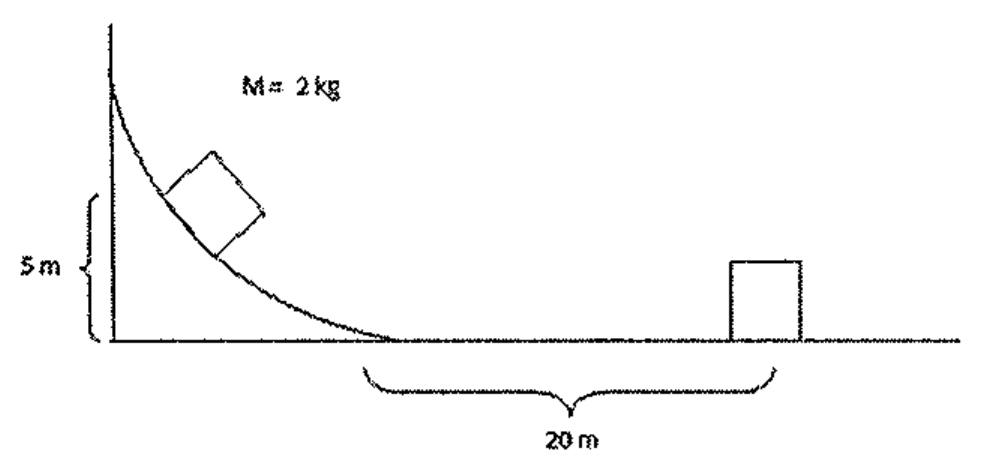
A figura acima representa um bloco de 2 kg que desliza para baixo, sobre uma rampa curva sem atrito, partindo do repouso, de uma altura de 5 m. O bloco, então, desliza sobre uma superfície rugosa por 20 m até atingir o repouso. Assim, a velocidade do bloco na base da rampa e a energia dissipada por atrito são, respectivamente:
Dado: g=10m/s²Resolução comentada
Análise das alternativas
Resolução comentada
Análise das alternativas
Resolução comentada
Análise das alternativas
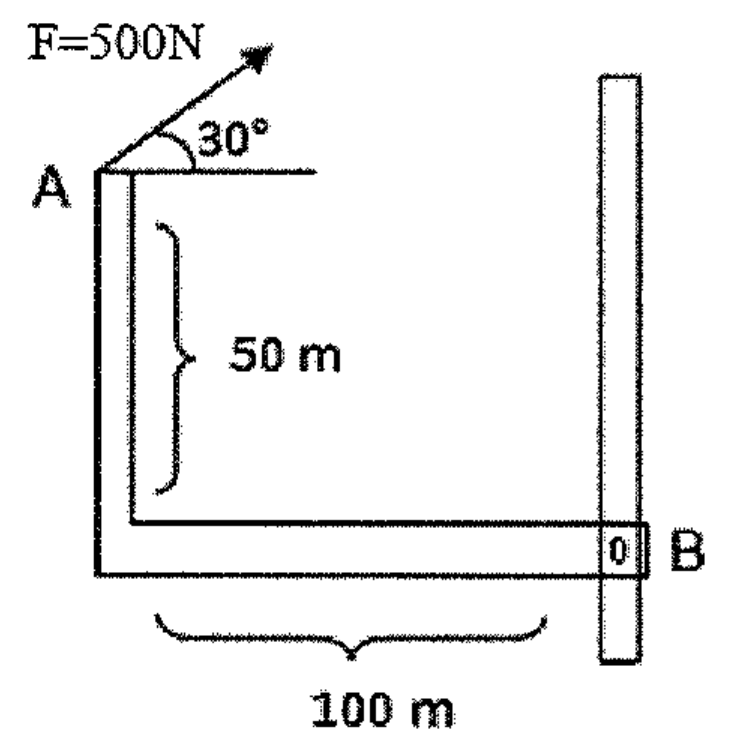
Uma força de 500N é exercida sobre o ponto A, como visto na figura acima. Determine o módulo do valor do momento da força em relação ao ponto B e assinale a opção correta.
Dados: Sen 30° = 0,5 e Cos 30° = 0,85.
Dado: √2 = 1,4.Resolução comentada
Análise das alternativas
Texto-base:
Texto-base:
Texto-base:
Texto-base:
Texto-base:
Texto-base:
Texto-base:
Texto-base:
Texto-base:
Texto-base:
Uma partícula carregada positivamente está livre para se mover em uma região de campo elétrico não nulo E. Com relação aos conceitos de campo elétrico, assinale a opção correta.
Conforme Farrer (2017), com relação à estrutura de dados, assinale a opção INCORRETA.
Com relação à reação: Br₂ + 5HClO + H₂O → 2HBrO₃ + 5HCl, assinale a opção correta.
Suponha que a Marinha do Brasil utilize um sistema de navegação baseado em vetores para controle de drones submarinos. Considere o subespaço W de R³ gerado pelos vetores V1 = (1, 0, 2) e V2 = (0, 1, -1) e assinale a opção que apresenta um vetor que NÃO pertence a W.
Examine a figura abaixo.
De acordo com Cormen (2012), o quicksort, como a ordenação por intercalação, aplica o paradigma de divisão e conquista. Assim, assinale a opção que apresenta o processo de três etapas do método de divisão e conquista para ordenar um subarranjo típico A[p .. r].
Com relação ao papel dos algoritmos na computação e às medianas e estatísticas de ordem n, de acordo com Cormen (2012), assinale a seguir a opção INCORRETA.
Sabendo que os pneus de um automóvel que se movem a 60 km/h têm 1,2 m de diâmetro, determine a velocidade angular desses pneus em relação aos respectivos eixos e assinale a opção correta.
Examine a figura abaixo.
Durante um exercício militar conjunto com o Corpo de Fuzileiros Navais e a Força Aérea Brasileira, um oficial Fuzileiro Naval observou o caça supersônico F-5 voando para leste a uma altitude de 15 km, diretamente acima do campo de seu batalhão. O estrondo sônico é escutado no campo somente quando o caça esteve a 15km a leste do ponto exato em que se localiza o campo. Dado que a velocidade do som é de 343 m/s, determine a velocidade do caça e assinale a opção correta.