← Voltar para a lista de provas Comando da Aeronáutica — Escola Preparatória de Cadetes do Ar (EPCAR) · Aluno do 1º ano do Curso Preparatório de Cadetes do Ar (CPCAR) 49 questões nesta prova · página 2 de 3 · 47 com gabarito Gabarito disponível Gabarito disponível Chamando de a o que Y deu a Z, obtém-se a = 7 e X gastou 108. Seja S a quantia inicial. Após as transferências e os gastos, X + Z = 2Y leva a −111 + 11a = −6a + 8, logo a = 7. X gastou 99 + (4 − 7)² = 99 + 9 = 108. A) Errada: 90 é menor que os 99 já gastos. B) Errada: 99 ignora o segundo gasto de 9. D) Errada: 118 não resulta da equação. Referência: Equações do 1º grau, problemas Resolução comentada do VaiConcursos. Gabarito disponível y = 12, cuja soma de divisores é 28. Seja k a constante de proporcionalidade: a(x+2) − a(x) = k·a(x+1). Para 2011: y − 5 = 6k. Para 2012: 20 − 6 = k·y. Resulta 6k² + 5k − 14 = 0, com k = 7/6 e y = 12. Os divisores de 12 somam 1+2+3+4+6+12 = 28. B, C e D estão erradas: 28 é a soma dos divisores de 12. Referência: Proporcionalidade direta e divisores Resolução comentada do VaiConcursos. Gabarito disponível Gabarito disponível Gabarito disponível Restam cerca de 13,78 litros, entre 13 e 14. De 6/8 a 1/2 foi 1/4 do tanque em 225 km, ou 25 ℓ, então o tanque tem 100 ℓ e começou com 75 ℓ. Na viagem de 551 km gastou 551/9 ≈ 61,22 ℓ. Restam 75 − 61,22 ≈ 13,78 ℓ. A, B e D estão erradas, pois 13,78 não está nesses intervalos. Referência: Razão e proporção Resolução comentada do VaiConcursos. Gabarito disponível São necessários 42 galões, mais de 41. Área = 10·4·5 m·3 m = 600 m². Tinta = 600/12·3 = 150 ℓ, o que dá 150/3,6 ≈ 41,7, ou seja, 42 galões. Logo são mais de 41 galões. B) Errada: 42·54 = R$ 2.268, mais que R$ 2.000. C) Errada: 50·24 min = 20 h. D) Errada: o pintor recebe 20·20 = R$ 400, equivalente a cerca de 7,4 galões, não 8. Referência: Unidades de medida e regra de três Resolução comentada do VaiConcursos. Gabarito disponível A diferença entre as raízes da 3ª equação é irracional, logo D é falsa. Pelos dados, a 1ª equação é −x² − 3x − 2 = 0, a 2ª é x² − 6x + 9 = 0 e a 3ª é x² − 3x + 1 = 0. As raízes da 3ª são (3 ± √5)/2, e a diferença entre elas é √5, um número irracional. Por isso D é a falsa. A) Verdadeira: −1 − 3 − 2 = −6 = 2·(−3). B) Verdadeira: soma das raízes = −3 + 6 + 3 = 6, que é o oposto de −6. C) Verdadeira: razão 1/(−2) = −1/2, que pertence a ℚ₋. Referência: Relações de Girard Resolução comentada do VaiConcursos. Gabarito disponível A área do trapézio é 62,5% da do quadrado, valor entre 62 e 64. Seja AP = t e BP = m − t. Como DP = m + (m − t) e DP² = m² + t², temos (2m − t)² = m² + t², logo t = 3m/4 e BP = m/4. O trapézio tem bases m e m/4 e altura m, com área 5m²/8, ou seja, 62,5% do quadrado. A, C e D estão erradas: 62,5 está entre 62 e 64 e fora dos demais intervalos. Referência: Teorema de Pitágoras e área do trapézio Resolução comentada do VaiConcursos. Gabarito disponível Gabarito disponível Gabarito disponível Gabarito disponível A empresa britânica não usou um inglês de fácil compreensão. Os compradores sul-coreanos acharam mais fácil entender o inglês dos franceses do que o da empresa britânica. Logo, a empresa britânica não falou um inglês fácil de entender. A) Errada: o texto não diz que os franceses sabem pouco inglês. B) Errada: os coreanos entenderam melhor os franceses, não 'perfeitamente' a empresa. D) Errada: o texto não trata de como os simuladores são projetados. Referência: Texto I, linhas 6-11 Resolução comentada do VaiConcursos. Gabarito disponível Headway é um livro didático (course book). O texto cita '(Headway Series)' entre parênteses logo após 'a small number of course books'. Isso mostra que Headway é uma série de livros de curso. B) Errada: não é descrito como curso de sucesso. C) Errada: o exame dominante citado é o TOEFL. D) Errada: o texto não o chama de programa. Referência: Texto I, linhas 21-23 Resolução comentada do VaiConcursos. Gabarito disponível É mais fácil entender o inglês falado pelos não nativos. O texto diz que o inglês dos não nativos usa vocabulário mais simples e que eles se entendem melhor entre si do que com os nativos. Um exemplo é a empresa francesa que venceu o contrato por ser mais fácil de entender. A) Errada: o texto não compara a dificuldade do inglês e do francês. B) Errada: quem usa idioms, synonyms etc. são os nativos. C) Errada: o texto não fala em fama das empresas. Referência: Texto I, linhas 7-11 e 19-27 Resolução comentada do VaiConcursos. Gabarito disponível Gabarito disponível Gabarito disponível A negativa de 'are' é 'aren't'. O verbo 'to be' forma a negativa acrescentando 'not' ao próprio verbo, sem auxiliar. Com sujeito plural fica 'aren't' (are not). A) Errada: 'not are' tem ordem invertida. B) Errada: 'isn't' é singular. C) Errada: o 'to be' não usa o auxiliar 'do'. Referência: Gramática: verbo to be, forma negativa Resolução comentada do VaiConcursos. Gabarito disponível Os verbos passam para o Simple Past: didn't see / used / didn't think / had. Na negativa do passado usa-se 'didn't' + verbo no infinitivo. Já 'use' e 'have' ficam 'used' e 'had'. A sequência é 'didn't see, used, didn't think, had'. A) Errada: 'did not thought' mantém o verbo no passado após 'did'. B) Errada: 'not saw' e 'did had' são formas inexistentes. C) Errada: 'did not saw' está errada e 'have' continua no presente. Referência: Gramática: Simple Past Resolução comentada do VaiConcursos. Gabarito disponível As frases I e II respondem 'Who speaks...?' e 'What is the term...?'. A frase I define o termo ('a term used for international English'), o que responde à pergunta III. A frase II diz que é o inglês falado por não nativos, o que responde à pergunta II. B, C e D estão erradas. I (como o falante usa) e IV (por que é falado e escrito) não são respondidas nesses trechos. As opções que as incluem ficam, portanto, incorretas. Referência: Texto I, linhas 1-4 Resolução comentada do VaiConcursos.EPCAR — Exame de Admissão ao 1º Ano do CPCAR 2014 — Provas de Língua Portuguesa, Matemática, Língua Inglesa e Redação — Versão A
O prazo que a confecção teve para a execução do trabalho foi de 4 dias. Para isso, o gerente da confecção utilizou 6 máquinas tipo α, cada uma trabalhando 6 horas por dia e todas com a mesma produtividade.
Ao final do terceiro dia, o gerente da fábrica verificou que

Sendo assim, substituiu, no início do quarto dia, as máquinas do tipo α por 3 outras do tipo β, cada uma trabalhando 8 horas por dia, e cada uma delas com o triplo da produtividade de uma máquina tipo α.
Se as 3 máquinas tipo β tivessem sido utilizadas desde o início, o serviço teria sido realizado em
X, de início, gastou 99 reais. Y deu uma parte de sua quantia para Z, e o dobro dessa parte, para X.
Com essas novas quantias em reais, as três pessoas saíram para as compras e X gastou o quadrado da diferença entre 4 reais e o que Y havia dado para Z.
Y e Z gastaram, cada uma, a diferença entre o quadrado do que Y havia dado a Z e 4 reais.
Após esses gastos, a soma das quantias de X e Z era igual ao dobro da de Y.
É correto afirmar que X gastou no total, em reais,Resolução comentada
Análise das alternativas
Os professores da EPCAR perceberam que o número de alunos que se inscreveu para esse desafio cresceu, de maneira que a diferença entre o número de alunos dos anos (x + 2) e x é diretamente proporcional ao número de alunos do ano (x + 1).
Se y é o número de alunos do CPCAR que se inscreveu nesse desafio em 2011, então a soma dos divisores naturais de y éResolução comentada
Análise das alternativas
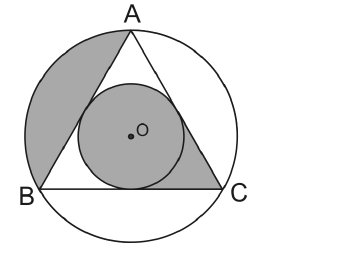
Se a circunferência menor, inscrita ao triângulo ABC, tem raio igual a 1 cm, então o número que representa a área sombreada, em cm², é igual ao número que representa
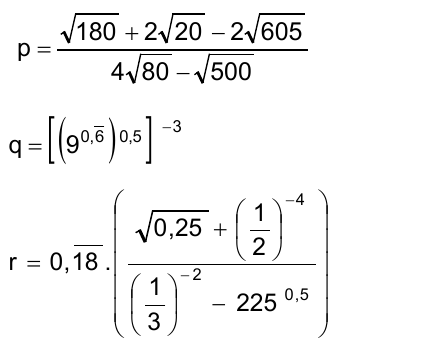
Se x é o número obtido pelo produto entre p, q e r, então x é um número
O motorista desse ônibus realizou uma viagem de 551 km.
Ao sair do local de origem da viagem, o ponteiro marcador de combustível do ônibus indicava 6/8 do tanque.
Após o motorista percorrer 225 km, o ponteiro marcador de combustível do ônibus indicou 1/2 tanque.
Com base nessa situação, é correto afirmar que, ao chegar no destino proposto, a quantidade de combustível restante no tanque do ônibus estava entreResolução comentada
Análise das alternativas
Deseja-se pintar as paredes dessas salas com tinta branca e para isso foram comprados galões de 36 dℓ por R$ 54,00 cada um.
O pintor calculou que, para pintar cada 12 m² de parede, gastará 3 ℓ dessa tinta e um tempo de 24 minutos.
Sabe-se que ele cobra R$ 20,00 por hora trabalhada.
Com base nessas informações, é correto afirmar queResolução comentada
Análise das alternativas
Ele afirmou que:
• Os coeficientes dos termos de maiores graus da 2ª e da 3ª equações são iguais ao menor número inteiro positivo.
• O conjunto solução da 1ª equação é {−1,−2} e a 2ª equação possui duas raízes reais e iguais a 3;
• O coeficiente do termo de maior grau da 1ª equação é igual ao oposto do coeficiente de maior grau da 3ª equação;
• O coeficiente de x da 3ª equação é a metade do coeficiente de x da 2ª equação.
• O produto das raízes da 3ª equação é igual a unidade.
Com base nesses dados, marque a alternativa FALSA.Resolução comentada
Análise das alternativas
A área do trapézio DCBP é x% da área do quadrado ABCD.
O número x está compreendido entreResolução comentada
Análise das alternativas
Através das alamedas 1 e 2 do parque, que são paralelas, serão construídos dois muros retilíneos, a partir dos pontos E e R, passando pelos pontos P e A, e esses muros se encontrarão no ponto C, conforme figura.
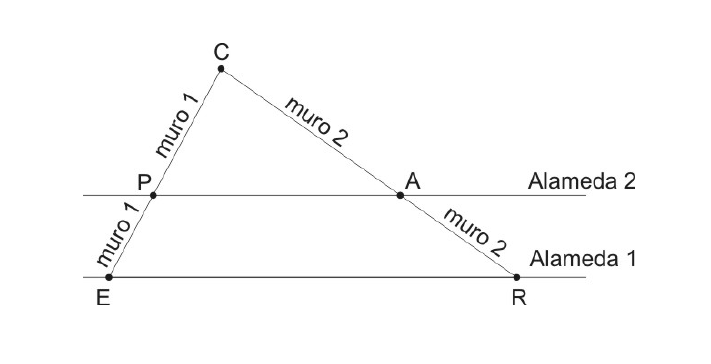
Sabe-se que
• EP = 1 km
• RA = 1,5 km
• São construídos 12 m de cada muro, por dia.
• O muro 1 será totalmente construído em 250 dias.
• As obras das construções dos muros 1 e 2 terminarão no mesmo dia.
Se a obra do muro 1 iniciou dia 1º de agosto de 2013, e sabendo ainda que as obras dos dois muros foram realizadas em dias consecutivos (ou seja, não houve dia de folga em nenhuma das obras), então a obra do muro 2 teve início dia
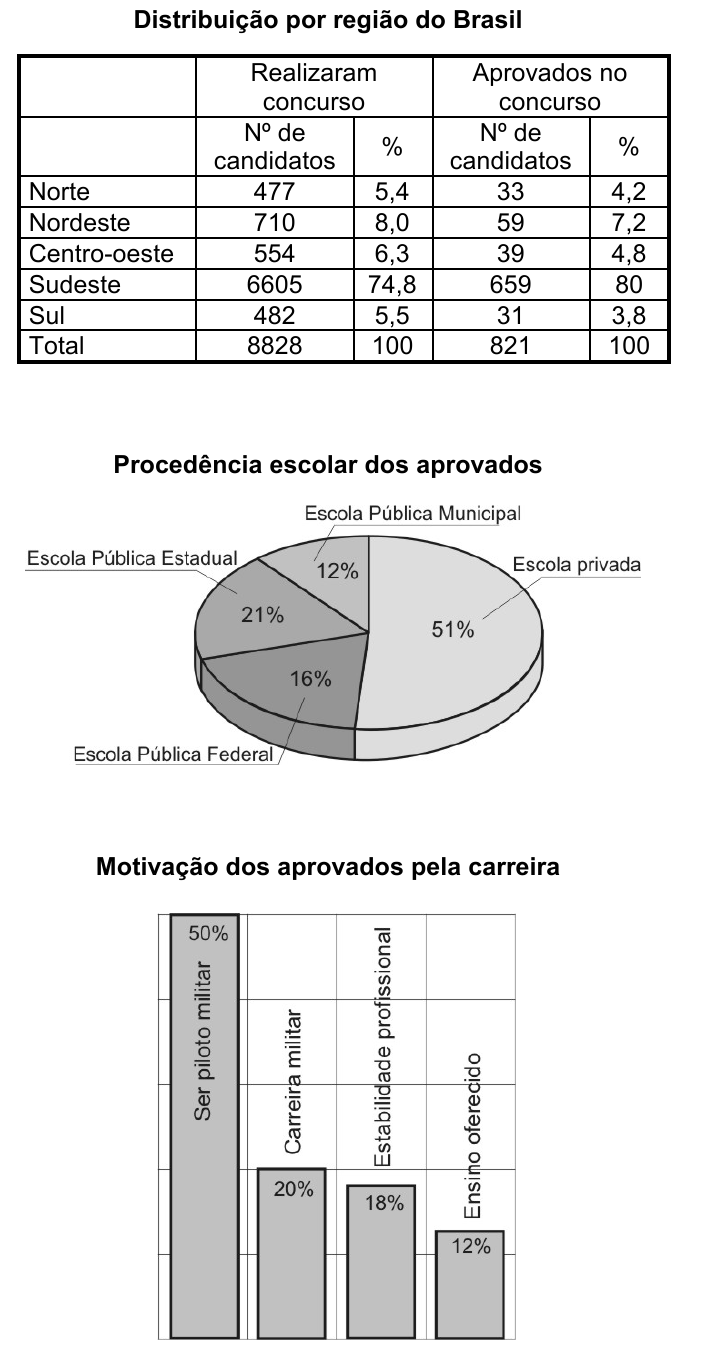
Analisando as informações acima, afirma-se sobre o Concurso CPCAR 2012:
I. Os candidatos da região Sudeste, além do maior número na realização do concurso, também tiveram maior percentual entre os aprovados.
II. Dentre os aprovados que vieram de Escola Pública Estadual, é possível não haver nenhum da Região Sudeste.
III. Dentre os aprovados que não foram motivados pelo ensino oferecido, é possível que só haja candidatos vindos da Região Sudeste.
Julgue cada afirmativa em (V) verdadeira ou (F) falsa e marque a alternativa que contém a sequência correta.
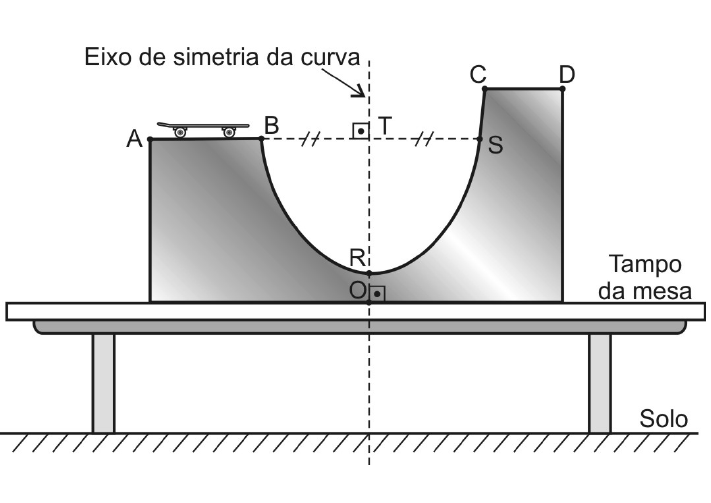
• A pista está sobre o tampo de uma mesa apoiada no solo.
• O tampo da mesa e o eixo de simetria da curva, indicados no desenho, coincidem com os eixos ↔Ox e ↔Oy, respectivamente, do sistema cartesiano ortogonal.
• O ponto O é a origem do sistema cartesiano ortogonal.
• A e B são pontos que pertencem a uma reta paralela ao eixo ↔Ox
• C e D são pontos que pertencem a uma reta paralela à reta AB e distante desta 288 mm.
• A curva da pista de B até C coincide com um arco de parábola.
• A distância de C ao eixo de simetria da parábola é 40 mm.
• O ponto R, que é o mais baixo do arco de parábola, está a 150 mm do ponto O.
• AB = 400 mm
Durante a execução de uma manobra, o skate passa por um ponto P, da parábola, que possui ordenada a 450 mm do ponto R e que está a 30 mm do eixo de simetria.
Assim, pode-se afirmar que a distância do ponto A ao eixo de simetria é, em milímetros, um número compreendido entre
TEXT I
WHAT IS OFFSHORE ENGLISH?
Offshore English is a term used by many people
for international English (I). It is the English spoken and
written by non-native speakers in international
communication (II). Many in business are starting to
5 worry that native speakers are actually at a disadvantage
in international communication. A good example of this
situation was when a company tried to sell flight
simulators to South Korea, where a French company
won the contract because the buyers found it easier to
10 understand the English that the French people spoke
than the English spoken by the British company.
Many native English speakers feel little
necessity to learn foreign languages, so they often don’t
understand the difficulties and problems learners have.
15 They also don’t see (1) the need to modify their language
for a foreign audience, so they use (2) idioms, synonyms,
colloquialisms, phrasal verbs, etc, and don’t think (3) of
the impact this has (4) on a foreign businessperson.
The English studied by non-native speakers
20 tends to use a more simple vocabulary, and considering
the similarities in courses in many parts of the world,
emphasized by a small number of course books
(Headway Series) and the domination of a few
examinations, for example TOEFL, etc. This means that
25 non-native speakers from different countries and cultures
sometimes understand each other more easily than the
native speaker. Few native speakers outside the world of
ESL (English as a Second language) teaching have
much idea of what non-native learners assimilate, and
30 think that as their English is native speaker level, they
speak it better than their non-native counterparts.
Because of this, companies are offering courses in
Offshore English to native speakers to train them to
speak the type of English that will make it easier for non-
35 native speakers to understand. So they will gain more
contracts.
Adapted from http://www.usingenglish.com/articles/what-offshore-english.html
Acessado em 14/03/2013
Glossary:
Foreign: estrangeiro
Businessperson: homem/ mulher de negócios
Counterpart: seu semelhante
To win: ganhar, vencer
Disadvantage: desvantagem
Outside: do lado de fora
Level: nível
According to the text,Resolução comentada
Análise das alternativas
TEXT I
WHAT IS OFFSHORE ENGLISH?
Offshore English is a term used by many people
for international English (I). It is the English spoken and
written by non-native speakers in international
communication (II). Many in business are starting to
5 worry that native speakers are actually at a disadvantage
in international communication. A good example of this
situation was when a company tried to sell flight
simulators to South Korea, where a French company
won the contract because the buyers found it easier to
10 understand the English that the French people spoke
than the English spoken by the British company.
Many native English speakers feel little
necessity to learn foreign languages, so they often don’t
understand the difficulties and problems learners have.
15 They also don’t see (1) the need to modify their language
for a foreign audience, so they use (2) idioms, synonyms,
colloquialisms, phrasal verbs, etc, and don’t think (3) of
the impact this has (4) on a foreign businessperson.
The English studied by non-native speakers
20 tends to use a more simple vocabulary, and considering
the similarities in courses in many parts of the world,
emphasized by a small number of course books
(Headway Series) and the domination of a few
examinations, for example TOEFL, etc. This means that
25 non-native speakers from different countries and cultures
sometimes understand each other more easily than the
native speaker. Few native speakers outside the world of
ESL (English as a Second language) teaching have
much idea of what non-native learners assimilate, and
30 think that as their English is native speaker level, they
speak it better than their non-native counterparts.
Because of this, companies are offering courses in
Offshore English to native speakers to train them to
speak the type of English that will make it easier for non-
35 native speakers to understand. So they will gain more
contracts.
Adapted from http://www.usingenglish.com/articles/what-offshore-english.html
Acessado em 14/03/2013
Glossary:
Foreign: estrangeiro
Businessperson: homem/ mulher de negócios
Counterpart: seu semelhante
To win: ganhar, vencer
Disadvantage: desvantagem
Outside: do lado de fora
Level: nível
We can say that Headway (line 22) is aResolução comentada
Análise das alternativas
TEXT I
WHAT IS OFFSHORE ENGLISH?
Offshore English is a term used by many people
for international English (I). It is the English spoken and
written by non-native speakers in international
communication (II). Many in business are starting to
5 worry that native speakers are actually at a disadvantage
in international communication. A good example of this
situation was when a company tried to sell flight
simulators to South Korea, where a French company
won the contract because the buyers found it easier to
10 understand the English that the French people spoke
than the English spoken by the British company.
Many native English speakers feel little
necessity to learn foreign languages, so they often don’t
understand the difficulties and problems learners have.
15 They also don’t see (1) the need to modify their language
for a foreign audience, so they use (2) idioms, synonyms,
colloquialisms, phrasal verbs, etc, and don’t think (3) of
the impact this has (4) on a foreign businessperson.
The English studied by non-native speakers
20 tends to use a more simple vocabulary, and considering
the similarities in courses in many parts of the world,
emphasized by a small number of course books
(Headway Series) and the domination of a few
examinations, for example TOEFL, etc. This means that
25 non-native speakers from different countries and cultures
sometimes understand each other more easily than the
native speaker. Few native speakers outside the world of
ESL (English as a Second language) teaching have
much idea of what non-native learners assimilate, and
30 think that as their English is native speaker level, they
speak it better than their non-native counterparts.
Because of this, companies are offering courses in
Offshore English to native speakers to train them to
speak the type of English that will make it easier for non-
35 native speakers to understand. So they will gain more
contracts.
Adapted from http://www.usingenglish.com/articles/what-offshore-english.html
Acessado em 14/03/2013
Glossary:
Foreign: estrangeiro
Businessperson: homem/ mulher de negócios
Counterpart: seu semelhante
To win: ganhar, vencer
Disadvantage: desvantagem
Outside: do lado de fora
Level: nível
After reading the text, we conclude thatResolução comentada
Análise das alternativas
TEXT I
WHAT IS OFFSHORE ENGLISH?
Offshore English is a term used by many people
for international English (I). It is the English spoken and
written by non-native speakers in international
communication (II). Many in business are starting to
5 worry that native speakers are actually at a disadvantage
in international communication. A good example of this
situation was when a company tried to sell flight
simulators to South Korea, where a French company
won the contract because the buyers found it easier to
10 understand the English that the French people spoke
than the English spoken by the British company.
Many native English speakers feel little
necessity to learn foreign languages, so they often don’t
understand the difficulties and problems learners have.
15 They also don’t see (1) the need to modify their language
for a foreign audience, so they use (2) idioms, synonyms,
colloquialisms, phrasal verbs, etc, and don’t think (3) of
the impact this has (4) on a foreign businessperson.
The English studied by non-native speakers
20 tends to use a more simple vocabulary, and considering
the similarities in courses in many parts of the world,
emphasized by a small number of course books
(Headway Series) and the domination of a few
examinations, for example TOEFL, etc. This means that
25 non-native speakers from different countries and cultures
sometimes understand each other more easily than the
native speaker. Few native speakers outside the world of
ESL (English as a Second language) teaching have
much idea of what non-native learners assimilate, and
30 think that as their English is native speaker level, they
speak it better than their non-native counterparts.
Because of this, companies are offering courses in
Offshore English to native speakers to train them to
speak the type of English that will make it easier for non-
35 native speakers to understand. So they will gain more
contracts.
Adapted from http://www.usingenglish.com/articles/what-offshore-english.html
Acessado em 14/03/2013
Glossary:
Foreign: estrangeiro
Businessperson: homem/ mulher de negócios
Counterpart: seu semelhante
To win: ganhar, vencer
Disadvantage: desvantagem
Outside: do lado de fora
Level: nível

TEXT I
WHAT IS OFFSHORE ENGLISH?
Offshore English is a term used by many people
for international English (I). It is the English spoken and
written by non-native speakers in international
communication (II). Many in business are starting to
5 worry that native speakers are actually at a disadvantage
in international communication. A good example of this
situation was when a company tried to sell flight
simulators to South Korea, where a French company
won the contract because the buyers found it easier to
10 understand the English that the French people spoke
than the English spoken by the British company.
Many native English speakers feel little
necessity to learn foreign languages, so they often don’t
understand the difficulties and problems learners have.
15 They also don’t see (1) the need to modify their language
for a foreign audience, so they use (2) idioms, synonyms,
colloquialisms, phrasal verbs, etc, and don’t think (3) of
the impact this has (4) on a foreign businessperson.
The English studied by non-native speakers
20 tends to use a more simple vocabulary, and considering
the similarities in courses in many parts of the world,
emphasized by a small number of course books
(Headway Series) and the domination of a few
examinations, for example TOEFL, etc. This means that
25 non-native speakers from different countries and cultures
sometimes understand each other more easily than the
native speaker. Few native speakers outside the world of
ESL (English as a Second language) teaching have
much idea of what non-native learners assimilate, and
30 think that as their English is native speaker level, they
speak it better than their non-native counterparts.
Because of this, companies are offering courses in
Offshore English to native speakers to train them to
speak the type of English that will make it easier for non-
35 native speakers to understand. So they will gain more
contracts.
Adapted from http://www.usingenglish.com/articles/what-offshore-english.html
Acessado em 14/03/2013
Glossary:
Foreign: estrangeiro
Businessperson: homem/ mulher de negócios
Counterpart: seu semelhante
To win: ganhar, vencer
Disadvantage: desvantagem
Outside: do lado de fora
Level: nível

TEXT I
WHAT IS OFFSHORE ENGLISH?
Offshore English is a term used by many people
for international English (I). It is the English spoken and
written by non-native speakers in international
communication (II). Many in business are starting to
5 worry that native speakers are actually at a disadvantage
in international communication. A good example of this
situation was when a company tried to sell flight
simulators to South Korea, where a French company
won the contract because the buyers found it easier to
10 understand the English that the French people spoke
than the English spoken by the British company.
Many native English speakers feel little
necessity to learn foreign languages, so they often don’t
understand the difficulties and problems learners have.
15 They also don’t see (1) the need to modify their language
for a foreign audience, so they use (2) idioms, synonyms,
colloquialisms, phrasal verbs, etc, and don’t think (3) of
the impact this has (4) on a foreign businessperson.
The English studied by non-native speakers
20 tends to use a more simple vocabulary, and considering
the similarities in courses in many parts of the world,
emphasized by a small number of course books
(Headway Series) and the domination of a few
examinations, for example TOEFL, etc. This means that
25 non-native speakers from different countries and cultures
sometimes understand each other more easily than the
native speaker. Few native speakers outside the world of
ESL (English as a Second language) teaching have
much idea of what non-native learners assimilate, and
30 think that as their English is native speaker level, they
speak it better than their non-native counterparts.
Because of this, companies are offering courses in
Offshore English to native speakers to train them to
speak the type of English that will make it easier for non-
35 native speakers to understand. So they will gain more
contracts.
Adapted from http://www.usingenglish.com/articles/what-offshore-english.html
Acessado em 14/03/2013
Glossary:
Foreign: estrangeiro
Businessperson: homem/ mulher de negócios
Counterpart: seu semelhante
To win: ganhar, vencer
Disadvantage: desvantagem
Outside: do lado de fora
Level: nível
“Native speakers are at a disadvantage in international communication”. The negative form of this sentence is “Native speakers ....... at a disadvantage in international communication”.Resolução comentada
Análise das alternativas
TEXT I
WHAT IS OFFSHORE ENGLISH?
Offshore English is a term used by many people
for international English (I). It is the English spoken and
written by non-native speakers in international
communication (II). Many in business are starting to
5 worry that native speakers are actually at a disadvantage
in international communication. A good example of this
situation was when a company tried to sell flight
simulators to South Korea, where a French company
won the contract because the buyers found it easier to
10 understand the English that the French people spoke
than the English spoken by the British company.
Many native English speakers feel little
necessity to learn foreign languages, so they often don’t
understand the difficulties and problems learners have.
15 They also don’t see (1) the need to modify their language
for a foreign audience, so they use (2) idioms, synonyms,
colloquialisms, phrasal verbs, etc, and don’t think (3) of
the impact this has (4) on a foreign businessperson.
The English studied by non-native speakers
20 tends to use a more simple vocabulary, and considering
the similarities in courses in many parts of the world,
emphasized by a small number of course books
(Headway Series) and the domination of a few
examinations, for example TOEFL, etc. This means that
25 non-native speakers from different countries and cultures
sometimes understand each other more easily than the
native speaker. Few native speakers outside the world of
ESL (English as a Second language) teaching have
much idea of what non-native learners assimilate, and
30 think that as their English is native speaker level, they
speak it better than their non-native counterparts.
Because of this, companies are offering courses in
Offshore English to native speakers to train them to
speak the type of English that will make it easier for non-
35 native speakers to understand. So they will gain more
contracts.
Adapted from http://www.usingenglish.com/articles/what-offshore-english.html
Acessado em 14/03/2013
Glossary:
Foreign: estrangeiro
Businessperson: homem/ mulher de negócios
Counterpart: seu semelhante
To win: ganhar, vencer
Disadvantage: desvantagem
Outside: do lado de fora
Level: nível
Consider the underlined verbs (1 to 4) in the text. Mark the alternative in which they are changed into the Simple Past Tense. They are, respectively,Resolução comentada
Análise das alternativas
TEXT I
WHAT IS OFFSHORE ENGLISH?
Offshore English is a term used by many people
for international English (I). It is the English spoken and
written by non-native speakers in international
communication (II). Many in business are starting to
5 worry that native speakers are actually at a disadvantage
in international communication. A good example of this
situation was when a company tried to sell flight
simulators to South Korea, where a French company
won the contract because the buyers found it easier to
10 understand the English that the French people spoke
than the English spoken by the British company.
Many native English speakers feel little
necessity to learn foreign languages, so they often don’t
understand the difficulties and problems learners have.
15 They also don’t see (1) the need to modify their language
for a foreign audience, so they use (2) idioms, synonyms,
colloquialisms, phrasal verbs, etc, and don’t think (3) of
the impact this has (4) on a foreign businessperson.
The English studied by non-native speakers
20 tends to use a more simple vocabulary, and considering
the similarities in courses in many parts of the world,
emphasized by a small number of course books
(Headway Series) and the domination of a few
examinations, for example TOEFL, etc. This means that
25 non-native speakers from different countries and cultures
sometimes understand each other more easily than the
native speaker. Few native speakers outside the world of
ESL (English as a Second language) teaching have
much idea of what non-native learners assimilate, and
30 think that as their English is native speaker level, they
speak it better than their non-native counterparts.
Because of this, companies are offering courses in
Offshore English to native speakers to train them to
speak the type of English that will make it easier for non-
35 native speakers to understand. So they will gain more
contracts.
Adapted from http://www.usingenglish.com/articles/what-offshore-english.html
Acessado em 14/03/2013
Glossary:
Foreign: estrangeiro
Businessperson: homem/ mulher de negócios
Counterpart: seu semelhante
To win: ganhar, vencer
Disadvantage: desvantagem
Outside: do lado de fora
Level: nível
Select the question(s) below that have (has) answer(s) in the sentences I and II (lines 1 - 4).
I. How does the speaker use Offshore English?
II. Who speaks Offshore English?
III. What is the term Offshore English?
IV. Why is Offshore English spoken and written?
Mark the right option.Resolução comentada
Análise das alternativas
Uma confecção de roupas foi contratada para confeccionar os agasalhos de todos os alunos do 1º ano CPCAR para o ano de 2014.
Três pessoas, X, Y e Z tinham a mesma quantia em reais.
O número de alunos do CPCAR que se inscreveu para um desafio de matemática na EPCAR, realizado anualmente, foi, nos anos de 2009, 2010 e 2012, respectivamente igual a 5, 6 e 20.
Considere o triângulo ABC, inscrito na circunferência de centro O abaixo, em que os menores arcos AB, BC e AC são congruentes.
Considere os números p, q e r abaixo:
Um ônibus percorre, na estrada, 9 km com 1 litro de combustível.
Uma escola tem 10 salas de aula. Em todas elas cada uma das quatro paredes mede 500 cm de comprimento e 0,3 dam de altura.
Fernando, um aluno aplicado em matemática, propôs a seus colegas o desafio de descobrirem os coeficientes e as raízes de três equações do 2º grau, todas na forma ax² + bx + c = 0.
Considere um quadrado ABCD de lado m. Seja P o ponto do lado AB tal que DP = CB + BP.
Um parque está sendo construído na cidade de Barbacena.
A tabela e os gráficos abaixo são referentes aos candidatos do Concurso CPCAR 2012.
Gustavo está brincando com seu skate de dedo numa pista que foi projetada segundo uma modelagem matemática, descrita a seguir.
Texto-base:
Texto-base:
Texto-base:
Texto-base:
Texto-base:
Texto-base:
Texto-base:
Texto-base: