← Voltar para a lista de provas Instituto Tecnológico de Aeronáutica (ITA) · Vestibular 2015 — Inglês 20 questões nesta prova · 19 com gabarito Gabarito disponível Foco narrativo e natureza do texto. O texto é narrado em primeira pessoa ('I got an email', 'I read'), pelo próprio Randy Pausch, contando fatos da sua vida. Isso o configura como texto autobiográfico. A: predomina a narração. B: o autor é narrador-personagem, não observador, e não há discurso indireto livre claro. D: a linguagem não é predominantemente coloquial. E: não é gênero dramático. Referência: Foco narrativo e tipologia textual. Resolução comentada do VaiConcursos. Gabarito disponível Informação correta sobre Robbee Kosak. Robbee viu o motorista sorrindo, batucando e curtindo o dia, e pensou 'this is the epitome of a person appreciating this day'. Ela o caracterizou como alguém satisfeito e de bem com a vida, e depois escreveu que ele parecia 'contented'. A: não foi um primeiro encontro. B: ela se aproximou ao mudar de faixa, mas o texto não fala de alta velocidade. C: o e-mail relatou o que ela viu, sem desejar reanimá-lo. E: ela é vice-presidente de Carnegie Mellon, não de empresa presidida por Pausch. Referência: Interpretação de texto em inglês. Resolução comentada do VaiConcursos. Gabarito disponível Oração sem termo qualificador. Em 'She certainly saw me as I was that evening' há 'certainly', que é advérbio de modo/intensidade. Porém, o item é o que o gabarito aponta como sem qualificador, considerando 'certainly' como advérbio de afirmação (não qualificador de substantivo) e sem adjetivos na oração, enquanto as outras trazem adjetivos ou expressões qualificadoras. A: 'warm, gorgeous, early-spring' são adjetivos. B: 'so struck' qualifica com advérbio de intensidade e particípio adjetival. C: 'contented' é adjetivo. D: 'obviously' e 'high' qualificam. Em E não há adjetivo que qualifique. Referência: Adjetivos e advérbios em inglês. Resolução comentada do VaiConcursos. Gabarito disponível Sentido de 'She had given me a window into myself'. O narrador conta que tinha dúvidas se agia por obrigação, forçando uma postura positiva. O olhar de Robbee, num momento sem guarda, mostrou-lhe como ele realmente estava: algo de que ele mesmo não se dava conta. A: é Robbee quem dá a ele uma visão dele mesmo, não de si. B: não se trata de visão reduzida. C: o momento foi autêntico, não distorcido. D: a cena indica o contrário, que ele transmitia vontade de viver. Referência: Interpretação de texto em inglês (Randy Pausch, The Last Lecture). Resolução comentada do VaiConcursos. Gabarito disponível Gabarito disponível Conversão correta do discurso indireto para o direto. Na passagem para o discurso direto, o past perfect continuous 'had been driving' vira past continuous 'was driving', 'she found' vira 'I found', 'herself' vira 'myself' e 'the night before' vira 'last night'. A opção A mantém essas correspondências. B: 'found me' exige reflexivo 'myself'. C: 'drove home yesterday night' e 'had found' alteram os tempos incorretamente e 'yesterday night' não é natural. D: mantém o past perfect e 'the night before', típicos do discurso indireto. E: 'was finding myself' é uso inadequado do contínuo com 'find oneself'. Referência: Discurso direto e indireto em inglês. Resolução comentada do VaiConcursos. Gabarito disponível Informação correta sobre o projeto Talos. O texto afirma que o time de efeitos especiais do traje do Homem de Ferro foi contratado para o projeto, e que a Legacy Effects constrói a armadura. Logo, o Talos conta com o estúdio que desenvolveu a armadura do Iron Man. A: o objetivo é uma armadura/exoesqueleto, não uma prótese. B: o texto não diz que foi idealizado há quatro anos; esse é o prazo de conclusão. C: a equipe inclui bioengenheiros e tecnólogos, sem 'pesquisadores aposentados'. E: a Legacy Effects é contratada para o Talos, que é um projeto militar. Referência: Interpretação de texto em inglês. Resolução comentada do VaiConcursos. Gabarito disponível Informação correta sobre a Legacy Effects. O texto diz que a Legacy Effects 'has previously worked on power suits for films such as RoboCop, Captain America, The Terminator and Iron Man'. Ou seja, tem experiência em criar trajes especiais para filmes americanos famosos. B: o gasto de 10 milhões é do governo militar americano, não da empresa. C: o exoesqueleto médico é da Ekso Bionics. D: a empresa apenas admite os desafios, sem garantir resultados. E: os estudos de exoesqueletos de insetos e animais são da empresa canadense. Referência: Interpretação de texto em inglês. Resolução comentada do VaiConcursos. Questão anulada Gabarito disponível Condição que a vestimenta do projeto Talos deve satisfazer. O texto afirma que a armadura terá 'agile exoskeleton' que permitirá aos soldados carregar centenas de libras de equipamento. Portanto, a condição que o texto sustenta é permitir operações carregando muito peso. A: os 10 milhões já foram gastos, não são orçamento previsto. B: nada sobre ajuste a qualquer peso ou tamanho. D: o texto não fala de aumentar o tempo em incursões não motorizadas. E: bateria e energia solar não são citadas. Referência: Interpretação de texto em inglês. Resolução comentada do VaiConcursos. Gabarito disponível Julgar as afirmações sobre o autor do texto. III está certa: o autor descreve o mercado de figurinhas e apresenta formas de obtê-las (troca no pátio, feiras, fóruns). I está errada: o roubo é citado só como possível choque de oferta (receio de falta de cartas), sem ser causa de dificuldade de compra e troca. II está errada: o autor não deprecia a Panini, apenas observa que um mercado eficiente a prejudicaria. A, D e E incluem I, falsa. B e D incluem II, falsa. Só C (apenas III) está correta. Referência: Interpretação de texto em inglês. Resolução comentada do VaiConcursos. Gabarito disponível Informação correta sobre o texto Stickernomics. O texto diz que o grupo de dez colecionadores aproveita a 'prática da Panini de vender sob encomenda as 50 últimas figurinhas faltantes'. Portanto a empresa disponibiliza a venda das 50 figurinhas faltantes. A: produz álbuns desde 1970, mais de 40 anos. B: o texto diz que feiras e trocas ajudam, mas não que seja impossível sem elas. C: 1.500 não aparece; o álbum tem 640 figurinhas (1.435 é o número de pacotes). E: as figurinhas são distribuídas aleatoriamente, mas o texto não diz que a confecção é aleatória. Referência: Interpretação de texto em inglês. Resolução comentada do VaiConcursos. Gabarito disponível Identificar a construção verbal na voz ativa. 'Panini has produced sticker albums' tem Panini como sujeito agente que pratica a ação (present perfect, voz ativa). As demais construções têm sujeito paciente ou são passivas. B: 'get filled' é passiva com get. C: 'is printed' é passiva. D: 'was borne out' é passiva. E: 'a card prized by many' tem particípio passado com valor passivo ('prized by many'). Só A está na voz ativa. Referência: Voz ativa e passiva em inglês. Resolução comentada do VaiConcursos. Gabarito disponível Gabarito disponível Gabarito disponível O que Sardy e Velenik fizeram segundo o texto. O texto diz que, na pesquisa de 2010 com álbum vendido na Suíça, os matemáticos analisaram uma amostra de 6.000 figurinhas e esperavam ver cada uma cerca de 9,09 vezes (6.000/660). O resultado confirmou isso 'broadly'. Logo, verificaram a repetição de aproximadamente 9 vezes por figurinha. A: eles calculam o benefício dos grupos de 10, mas não 'insistem' neles. B: fizeram um estudo pontual em 2010, não uma fiscalização contínua. D: são da Universidade de Genebra, não da Panini. E: concluem que o mercado analisado não parecia manipulado. Referência: Interpretação de texto em inglês. Resolução comentada do VaiConcursos. Gabarito disponível Sentido da frase final sobre o filho do autor e a figurinha de Messi. O trecho mostra que, apesar do que os pais pedem, o filho do correspondente se dispõe a arrancar a maioria das figurinhas para conseguir só a de Messi. Isso ilustra o comportamento 'não estritamente racional' dos mercados, e o autor vive esse esforço de colecionador dentro de casa, em torno de uma única figurinha. A e D: o autor não se coloca como colecionador fanático nem insensato; quem age assim é o filho. B: o filho quer a figurinha, não o autor, que sequer concorda ('despite entreaties'). C: redes sociais não são mencionadas nesse contexto. Referência: Interpretação de texto em inglês (The Economist, 'Stickernomics'). Resolução comentada do VaiConcursos. Gabarito disponível Gabarito disponível Gabarito disponívelITA — Vestibular 2015 — Prova de Inglês
THE MAN IN THE CONVERTIBLE
1 One morning, well after I was diagnosed with cancer, I got an email from Robbee Kosak, Carnegie
Mellon’s vice president for advancement. She told me a story.
She said she had been driving home from work the night before, and she found herself behind a man
in a convertible. It was a warm, gorgeous, early-spring evening, and the man had his top down and all his
5 windows lowered. His arm was hanging over the driver’s side door, and his fingers were tapping along to the
music on his radio. His head was bobbing along, too, as the wind blew through his hair.
Robbee changed lanes and pulled a little closer. From the side, she could see that the man had a
slight smile on his face, the kind of absentminded smile a person might have when he’s all alone, happy in
his own thoughts. Robbee found herself thinking: “Wow, this is the epitome of a person appreciating this day
10 and this moment.”
The convertible eventually turned the corner, and that’s when Robbee got a look at the man’s full face.
“Oh my God,” she said to herself. “It’s Randy Pausch!”
She was so struck by the sight of me. She knew that my cancer diagnosis was grim. And yet, as she
wrote in her email, she was moved by how contented I seemed. In this private moment, I was obviously in
15 high spirits. Robbee wrote in her email: “You can never know how much that glimpse of you made my day,
reminding me of what life is all about.”
I read Robbee’s email several times. I came to look at it as a feedback loop of sorts.
It has not always been easy to stay positive through my cancer treatment. When you have a dire
medical issue, it’s tough to know how you’re really faring emotionally. I had wondered whether a part of me
20 was acting when I was with other people. Maybe at times I forced myself to appear strong and upbeat. Many
cancer patients feel obliged to put up a brave front. Was I doing that, too?
But Robbee had come upon me in an unguarded moment. I’d like to think she saw me as I am. She
certainly saw me as I was that evening.
Her mail was just a paragraph, but it meant a great deal to me. She had given me a window into
25 myself. I was still fully engaged. I still knew life was good. I was doing OK.
Fonte: PAUSCH, R. The last lecture. New York, Hyperion, 2008. p.64-65.
O autor do textoResolução comentada
Análise das alternativas
THE MAN IN THE CONVERTIBLE
1 One morning, well after I was diagnosed with cancer, I got an email from Robbee Kosak, Carnegie
Mellon’s vice president for advancement. She told me a story.
She said she had been driving home from work the night before, and she found herself behind a man
in a convertible. It was a warm, gorgeous, early-spring evening, and the man had his top down and all his
5 windows lowered. His arm was hanging over the driver’s side door, and his fingers were tapping along to the
music on his radio. His head was bobbing along, too, as the wind blew through his hair.
Robbee changed lanes and pulled a little closer. From the side, she could see that the man had a
slight smile on his face, the kind of absentminded smile a person might have when he’s all alone, happy in
his own thoughts. Robbee found herself thinking: “Wow, this is the epitome of a person appreciating this day
10 and this moment.”
The convertible eventually turned the corner, and that’s when Robbee got a look at the man’s full face.
“Oh my God,” she said to herself. “It’s Randy Pausch!”
She was so struck by the sight of me. She knew that my cancer diagnosis was grim. And yet, as she
wrote in her email, she was moved by how contented I seemed. In this private moment, I was obviously in
15 high spirits. Robbee wrote in her email: “You can never know how much that glimpse of you made my day,
reminding me of what life is all about.”
I read Robbee’s email several times. I came to look at it as a feedback loop of sorts.
It has not always been easy to stay positive through my cancer treatment. When you have a dire
medical issue, it’s tough to know how you’re really faring emotionally. I had wondered whether a part of me
20 was acting when I was with other people. Maybe at times I forced myself to appear strong and upbeat. Many
cancer patients feel obliged to put up a brave front. Was I doing that, too?
But Robbee had come upon me in an unguarded moment. I’d like to think she saw me as I am. She
certainly saw me as I was that evening.
Her mail was just a paragraph, but it meant a great deal to me. She had given me a window into
25 myself. I was still fully engaged. I still knew life was good. I was doing OK.
Fonte: PAUSCH, R. The last lecture. New York, Hyperion, 2008. p.64-65.
De acordo com as informações no texto, Robbee KosakResolução comentada
Análise das alternativas
THE MAN IN THE CONVERTIBLE
1 One morning, well after I was diagnosed with cancer, I got an email from Robbee Kosak, Carnegie
Mellon’s vice president for advancement. She told me a story.
She said she had been driving home from work the night before, and she found herself behind a man
in a convertible. It was a warm, gorgeous, early-spring evening, and the man had his top down and all his
5 windows lowered. His arm was hanging over the driver’s side door, and his fingers were tapping along to the
music on his radio. His head was bobbing along, too, as the wind blew through his hair.
Robbee changed lanes and pulled a little closer. From the side, she could see that the man had a
slight smile on his face, the kind of absentminded smile a person might have when he’s all alone, happy in
his own thoughts. Robbee found herself thinking: “Wow, this is the epitome of a person appreciating this day
10 and this moment.”
The convertible eventually turned the corner, and that’s when Robbee got a look at the man’s full face.
“Oh my God,” she said to herself. “It’s Randy Pausch!”
She was so struck by the sight of me. She knew that my cancer diagnosis was grim. And yet, as she
wrote in her email, she was moved by how contented I seemed. In this private moment, I was obviously in
15 high spirits. Robbee wrote in her email: “You can never know how much that glimpse of you made my day,
reminding me of what life is all about.”
I read Robbee’s email several times. I came to look at it as a feedback loop of sorts.
It has not always been easy to stay positive through my cancer treatment. When you have a dire
medical issue, it’s tough to know how you’re really faring emotionally. I had wondered whether a part of me
20 was acting when I was with other people. Maybe at times I forced myself to appear strong and upbeat. Many
cancer patients feel obliged to put up a brave front. Was I doing that, too?
But Robbee had come upon me in an unguarded moment. I’d like to think she saw me as I am. She
certainly saw me as I was that evening.
Her mail was just a paragraph, but it meant a great deal to me. She had given me a window into
25 myself. I was still fully engaged. I still knew life was good. I was doing OK.
Fonte: PAUSCH, R. The last lecture. New York, Hyperion, 2008. p.64-65.
Assinale a oração que não contém expressão ou termo qualificador.Resolução comentada
Análise das alternativas
THE MAN IN THE CONVERTIBLE
1 One morning, well after I was diagnosed with cancer, I got an email from Robbee Kosak, Carnegie
Mellon’s vice president for advancement. She told me a story.
She said she had been driving home from work the night before, and she found herself behind a man
in a convertible. It was a warm, gorgeous, early-spring evening, and the man had his top down and all his
5 windows lowered. His arm was hanging over the driver’s side door, and his fingers were tapping along to the
music on his radio. His head was bobbing along, too, as the wind blew through his hair.
Robbee changed lanes and pulled a little closer. From the side, she could see that the man had a
slight smile on his face, the kind of absentminded smile a person might have when he’s all alone, happy in
his own thoughts. Robbee found herself thinking: “Wow, this is the epitome of a person appreciating this day
10 and this moment.”
The convertible eventually turned the corner, and that’s when Robbee got a look at the man’s full face.
“Oh my God,” she said to herself. “It’s Randy Pausch!”
She was so struck by the sight of me. She knew that my cancer diagnosis was grim. And yet, as she
wrote in her email, she was moved by how contented I seemed. In this private moment, I was obviously in
15 high spirits. Robbee wrote in her email: “You can never know how much that glimpse of you made my day,
reminding me of what life is all about.”
I read Robbee’s email several times. I came to look at it as a feedback loop of sorts.
It has not always been easy to stay positive through my cancer treatment. When you have a dire
medical issue, it’s tough to know how you’re really faring emotionally. I had wondered whether a part of me
20 was acting when I was with other people. Maybe at times I forced myself to appear strong and upbeat. Many
cancer patients feel obliged to put up a brave front. Was I doing that, too?
But Robbee had come upon me in an unguarded moment. I’d like to think she saw me as I am. She
certainly saw me as I was that evening.
Her mail was just a paragraph, but it meant a great deal to me. She had given me a window into
25 myself. I was still fully engaged. I still knew life was good. I was doing OK.
Fonte: PAUSCH, R. The last lecture. New York, Hyperion, 2008. p.64-65.
A frase “She had given me a window into myself” (linha 24 e 25) expressaResolução comentada
Análise das alternativas
THE MAN IN THE CONVERTIBLE
1 One morning, well after I was diagnosed with cancer, I got an email from Robbee Kosak, Carnegie
Mellon’s vice president for advancement. She told me a story.
She said she had been driving home from work the night before, and she found herself behind a man
in a convertible. It was a warm, gorgeous, early-spring evening, and the man had his top down and all his
5 windows lowered. His arm was hanging over the driver’s side door, and his fingers were tapping along to the
music on his radio. His head was bobbing along, too, as the wind blew through his hair.
Robbee changed lanes and pulled a little closer. From the side, she could see that the man had a
slight smile on his face, the kind of absentminded smile a person might have when he’s all alone, happy in
his own thoughts. Robbee found herself thinking: “Wow, this is the epitome of a person appreciating this day
10 and this moment.”
The convertible eventually turned the corner, and that’s when Robbee got a look at the man’s full face.
“Oh my God,” she said to herself. “It’s Randy Pausch!”
She was so struck by the sight of me. She knew that my cancer diagnosis was grim. And yet, as she
wrote in her email, she was moved by how contented I seemed. In this private moment, I was obviously in
15 high spirits. Robbee wrote in her email: “You can never know how much that glimpse of you made my day,
reminding me of what life is all about.”
I read Robbee’s email several times. I came to look at it as a feedback loop of sorts.
It has not always been easy to stay positive through my cancer treatment. When you have a dire
medical issue, it’s tough to know how you’re really faring emotionally. I had wondered whether a part of me
20 was acting when I was with other people. Maybe at times I forced myself to appear strong and upbeat. Many
cancer patients feel obliged to put up a brave front. Was I doing that, too?
But Robbee had come upon me in an unguarded moment. I’d like to think she saw me as I am. She
certainly saw me as I was that evening.
Her mail was just a paragraph, but it meant a great deal to me. She had given me a window into
25 myself. I was still fully engaged. I still knew life was good. I was doing OK.
Fonte: PAUSCH, R. The last lecture. New York, Hyperion, 2008. p.64-65.
Com relação às escolhas lexicais do autor no texto, pode-se afirmar que
THE MAN IN THE CONVERTIBLE
1 One morning, well after I was diagnosed with cancer, I got an email from Robbee Kosak, Carnegie
Mellon’s vice president for advancement. She told me a story.
She said she had been driving home from work the night before, and she found herself behind a man
in a convertible. It was a warm, gorgeous, early-spring evening, and the man had his top down and all his
5 windows lowered. His arm was hanging over the driver’s side door, and his fingers were tapping along to the
music on his radio. His head was bobbing along, too, as the wind blew through his hair.
Robbee changed lanes and pulled a little closer. From the side, she could see that the man had a
slight smile on his face, the kind of absentminded smile a person might have when he’s all alone, happy in
his own thoughts. Robbee found herself thinking: “Wow, this is the epitome of a person appreciating this day
10 and this moment.”
The convertible eventually turned the corner, and that’s when Robbee got a look at the man’s full face.
“Oh my God,” she said to herself. “It’s Randy Pausch!”
She was so struck by the sight of me. She knew that my cancer diagnosis was grim. And yet, as she
wrote in her email, she was moved by how contented I seemed. In this private moment, I was obviously in
15 high spirits. Robbee wrote in her email: “You can never know how much that glimpse of you made my day,
reminding me of what life is all about.”
I read Robbee’s email several times. I came to look at it as a feedback loop of sorts.
It has not always been easy to stay positive through my cancer treatment. When you have a dire
medical issue, it’s tough to know how you’re really faring emotionally. I had wondered whether a part of me
20 was acting when I was with other people. Maybe at times I forced myself to appear strong and upbeat. Many
cancer patients feel obliged to put up a brave front. Was I doing that, too?
But Robbee had come upon me in an unguarded moment. I’d like to think she saw me as I am. She
certainly saw me as I was that evening.
Her mail was just a paragraph, but it meant a great deal to me. She had given me a window into
25 myself. I was still fully engaged. I still knew life was good. I was doing OK.
Fonte: PAUSCH, R. The last lecture. New York, Hyperion, 2008. p.64-65.
Na frase “She said she had been driving home from work the night before, and she found herself behind a man in a convertible” (linhas 3 e 4), a formação correta quanto ao uso do discurso direto é:Resolução comentada
Análise das alternativas
IRON MAN DESIGNERS TO BUILD BODY ARMOUR FOR US ARMY
Hollywood special effect team is working on a new Iron Man 'agile exoskeleton' for US soldiers
1 The Oscar-nominated special effects team behind the Iron Man suit has been contracted to design
body armour for the US military.
Legacy Effects, a Hollywood design studio based in California, has previously worked on power suits
for films such as RoboCop, Captain America, The Terminator and Iron Man. Now, the company is building
5 body armour equipped with an "agile exoskeleton" that will allow soldiers to carry hundreds of pounds of
equipment, the Wall Street Journal reports.
"We are trying to be revolutionary," said Mike Fieldson, who manages the US military project known as
the Tactical Assault Light Operator Suit (Talos).
Three prototypes have been presented to the Pentagon by teams of bioengineers, technologists and
10 a Canadian company that studies insect and animal exoskeletons. The prototypes will contribute to the
creation of a new generation of body armour which the US Special Operations Command aims to complete
within four years.
The suits are designed to protect soldiers from bullets, explosions and bayonet attacks.
Legacy Effects admits that bringing an Iron Man to life presents significant challenges. For one thing, a
15 real-life version of the suit would add extra bulk to a soldier limiting his or her agility. Also, the company
estimates that the Iron Man suit would probably weigh about 180kg, and would need to be supported by a
mobile exoskeleton, but "none of the exoskeletons in the industry are capable of moving that much weight",
SlashGear reports.
Russ Angold of Ekso Bionics, a company that designs exoskeletons for medical use, says that power
20 armour in films offer an unrealistic model, so engineers are presently trying to make the suits more practical.
"Hollywood has definitely made the Iron Man suit impossibly thin, impossibly light, impossibly agile and
impossibly energy efficient. So we're really trying to solve the problem and ask the question: What would Iron
Man look like if it was real?"
The US military has so far spent about $10 million on Talos, prompting the armed services committee
25 to request a briefing on the project to ensure taxpayer money is not being wasted.
"Will you ever have an Iron Man? I don't know," said Brian Dowling, a former soldier involved in the
project. "But you'll have some greatly improved technology along the way".
Fonte: http://www.theweek.co.uk/world-news/59323/iron-man-designers-to-build-body-armour-for-us-army
Acesso: 13/ago/2014
O projeto TalosResolução comentada
Análise das alternativas
IRON MAN DESIGNERS TO BUILD BODY ARMOUR FOR US ARMY
Hollywood special effect team is working on a new Iron Man 'agile exoskeleton' for US soldiers
1 The Oscar-nominated special effects team behind the Iron Man suit has been contracted to design
body armour for the US military.
Legacy Effects, a Hollywood design studio based in California, has previously worked on power suits
for films such as RoboCop, Captain America, The Terminator and Iron Man. Now, the company is building
5 body armour equipped with an "agile exoskeleton" that will allow soldiers to carry hundreds of pounds of
equipment, the Wall Street Journal reports.
"We are trying to be revolutionary," said Mike Fieldson, who manages the US military project known as
the Tactical Assault Light Operator Suit (Talos).
Three prototypes have been presented to the Pentagon by teams of bioengineers, technologists and
10 a Canadian company that studies insect and animal exoskeletons. The prototypes will contribute to the
creation of a new generation of body armour which the US Special Operations Command aims to complete
within four years.
The suits are designed to protect soldiers from bullets, explosions and bayonet attacks.
Legacy Effects admits that bringing an Iron Man to life presents significant challenges. For one thing, a
15 real-life version of the suit would add extra bulk to a soldier limiting his or her agility. Also, the company
estimates that the Iron Man suit would probably weigh about 180kg, and would need to be supported by a
mobile exoskeleton, but "none of the exoskeletons in the industry are capable of moving that much weight",
SlashGear reports.
Russ Angold of Ekso Bionics, a company that designs exoskeletons for medical use, says that power
20 armour in films offer an unrealistic model, so engineers are presently trying to make the suits more practical.
"Hollywood has definitely made the Iron Man suit impossibly thin, impossibly light, impossibly agile and
impossibly energy efficient. So we're really trying to solve the problem and ask the question: What would Iron
Man look like if it was real?"
The US military has so far spent about $10 million on Talos, prompting the armed services committee
25 to request a briefing on the project to ensure taxpayer money is not being wasted.
"Will you ever have an Iron Man? I don't know," said Brian Dowling, a former soldier involved in the
project. "But you'll have some greatly improved technology along the way".
Fonte: http://www.theweek.co.uk/world-news/59323/iron-man-designers-to-build-body-armour-for-us-army
Acesso: 13/ago/2014
A empresa Legacy EffectsResolução comentada
Análise das alternativas
IRON MAN DESIGNERS TO BUILD BODY ARMOUR FOR US ARMY
Hollywood special effect team is working on a new Iron Man 'agile exoskeleton' for US soldiers
1 The Oscar-nominated special effects team behind the Iron Man suit has been contracted to design
body armour for the US military.
Legacy Effects, a Hollywood design studio based in California, has previously worked on power suits
for films such as RoboCop, Captain America, The Terminator and Iron Man. Now, the company is building
5 body armour equipped with an "agile exoskeleton" that will allow soldiers to carry hundreds of pounds of
equipment, the Wall Street Journal reports.
"We are trying to be revolutionary," said Mike Fieldson, who manages the US military project known as
the Tactical Assault Light Operator Suit (Talos).
Three prototypes have been presented to the Pentagon by teams of bioengineers, technologists and
10 a Canadian company that studies insect and animal exoskeletons. The prototypes will contribute to the
creation of a new generation of body armour which the US Special Operations Command aims to complete
within four years.
The suits are designed to protect soldiers from bullets, explosions and bayonet attacks.
Legacy Effects admits that bringing an Iron Man to life presents significant challenges. For one thing, a
15 real-life version of the suit would add extra bulk to a soldier limiting his or her agility. Also, the company
estimates that the Iron Man suit would probably weigh about 180kg, and would need to be supported by a
mobile exoskeleton, but "none of the exoskeletons in the industry are capable of moving that much weight",
SlashGear reports.
Russ Angold of Ekso Bionics, a company that designs exoskeletons for medical use, says that power
20 armour in films offer an unrealistic model, so engineers are presently trying to make the suits more practical.
"Hollywood has definitely made the Iron Man suit impossibly thin, impossibly light, impossibly agile and
impossibly energy efficient. So we're really trying to solve the problem and ask the question: What would Iron
Man look like if it was real?"
The US military has so far spent about $10 million on Talos, prompting the armed services committee
25 to request a briefing on the project to ensure taxpayer money is not being wasted.
"Will you ever have an Iron Man? I don't know," said Brian Dowling, a former soldier involved in the
project. "But you'll have some greatly improved technology along the way".
Fonte: http://www.theweek.co.uk/world-news/59323/iron-man-designers-to-build-body-armour-for-us-army
Acesso: 13/ago/2014

IRON MAN DESIGNERS TO BUILD BODY ARMOUR FOR US ARMY
Hollywood special effect team is working on a new Iron Man 'agile exoskeleton' for US soldiers
1 The Oscar-nominated special effects team behind the Iron Man suit has been contracted to design
body armour for the US military.
Legacy Effects, a Hollywood design studio based in California, has previously worked on power suits
for films such as RoboCop, Captain America, The Terminator and Iron Man. Now, the company is building
5 body armour equipped with an "agile exoskeleton" that will allow soldiers to carry hundreds of pounds of
equipment, the Wall Street Journal reports.
"We are trying to be revolutionary," said Mike Fieldson, who manages the US military project known as
the Tactical Assault Light Operator Suit (Talos).
Three prototypes have been presented to the Pentagon by teams of bioengineers, technologists and
10 a Canadian company that studies insect and animal exoskeletons. The prototypes will contribute to the
creation of a new generation of body armour which the US Special Operations Command aims to complete
within four years.
The suits are designed to protect soldiers from bullets, explosions and bayonet attacks.
Legacy Effects admits that bringing an Iron Man to life presents significant challenges. For one thing, a
15 real-life version of the suit would add extra bulk to a soldier limiting his or her agility. Also, the company
estimates that the Iron Man suit would probably weigh about 180kg, and would need to be supported by a
mobile exoskeleton, but "none of the exoskeletons in the industry are capable of moving that much weight",
SlashGear reports.
Russ Angold of Ekso Bionics, a company that designs exoskeletons for medical use, says that power
20 armour in films offer an unrealistic model, so engineers are presently trying to make the suits more practical.
"Hollywood has definitely made the Iron Man suit impossibly thin, impossibly light, impossibly agile and
impossibly energy efficient. So we're really trying to solve the problem and ask the question: What would Iron
Man look like if it was real?"
The US military has so far spent about $10 million on Talos, prompting the armed services committee
25 to request a briefing on the project to ensure taxpayer money is not being wasted.
"Will you ever have an Iron Man? I don't know," said Brian Dowling, a former soldier involved in the
project. "But you'll have some greatly improved technology along the way".
Fonte: http://www.theweek.co.uk/world-news/59323/iron-man-designers-to-build-body-armour-for-us-army
Acesso: 13/ago/2014
A vestimenta idealizada no projeto Talos deverá satisfazer apenas uma das condições abaixo:Resolução comentada
Análise das alternativas
STICKERNOMICS
Football albums
Got, got, got, got, got, need
1 THE World Cup is still two weeks away, but for children worldwide (plus disturbing numbers of adults)
the race to complete the Brazil 2014 sticker book started long ago. Panini, an Italian firm, has produced
sticker albums for World Cups since Mexico 1970; this year’s version has 640 stickers to collect. Collecting
them is no idle pursuit, however. Getting every slot filled delivers an early lesson in probability, the value of
5 statistical tests and the importance of liquidity.
When you start an album, your first sticker (in Britain, they come in packs of five) has a 640/640
probability of being needed. As the spaces get filled, the odds of opening a pack and finding a sticker you
want fall. According to Sylvain Sardy and Yvan Velenik, two mathematicians at the University of Geneva, the
number of sticker packs that you would have to buy on average to fill the album by mechanically buying pack
10 after pack would be 899. That assumes there is no supply shock to the market (the theft of hundreds of
thousands of stickers in Brazil in April left many fearful that Panini would run short of cards).
It also assumes that the market is not being rigged. Panini says that each sticker is printed in the same
volumes and randomly distributed. In a 2010 paper Messrs Sardy and Velenik gamely played the role of
“regulator” by checking the distribution of stickers for a 660-sticker album sold in Switzerland for that year’s
15 World Cup. Out of their sample of 6,000 stickers, they expected to see each sticker 9.09 times on average
(6,000/660), which was broadly borne out in practice.
Even in a fair market, it is inefficient to buy endless packs as an individual (not to mention bloody
expensive for the parents). The answer is to create a market for collectors to swap their unwanted stickers.
The playground is one version of this market, where a child who has a card prized by many suddenly
20 understands the power of limited supply. Sticker fairs are another. As with any market, liquidity counts. The
more people who can be attracted into the market with their duplicate cards, the better the chances of finding
the sticker you want.
Messrs Sardy and Velenik reckon that a group of ten astute sticker-swappers would need a mere
1,435 packs between them to complete all ten albums, if they take advantage of Panini’s practice of selling
25 the final 50 missing stickers to order. Internet forums, where potentially unlimited numbers of people can
swap stickers, make this number fall even further. The idea of a totally efficient market should dismay Panini,
which will sell fewer packs as a result. But as in all markets, behaviour is not strictly rational. Despite
entreaties, your correspondent’s son is prepared to tear out most of his stickers to get hold of Lionel Messi.
Fonte: http://www.economist.com/news/finance-and-economics/21603019-got-got-got-got-got-need-stickernomics
Acesso: 13/ago/2014
O autor do texto
I. atribui ao roubo de milhares de figurinhas no Brasil a dificuldade para compra e troca entre colecionadores.
II. deprecia as estratégias do Grupo Panini para comercializar álbuns de figurinhas da Copa do Mundo.
III. descreve o mercado de figurinhas da Copa do Mundo e apresenta aos colecionadores possibilidades de obtenção de figurinhas.
Está(ão) correta(s)Resolução comentada
Análise das alternativas
STICKERNOMICS
Football albums
Got, got, got, got, got, need
1 THE World Cup is still two weeks away, but for children worldwide (plus disturbing numbers of adults)
the race to complete the Brazil 2014 sticker book started long ago. Panini, an Italian firm, has produced
sticker albums for World Cups since Mexico 1970; this year’s version has 640 stickers to collect. Collecting
them is no idle pursuit, however. Getting every slot filled delivers an early lesson in probability, the value of
5 statistical tests and the importance of liquidity.
When you start an album, your first sticker (in Britain, they come in packs of five) has a 640/640
probability of being needed. As the spaces get filled, the odds of opening a pack and finding a sticker you
want fall. According to Sylvain Sardy and Yvan Velenik, two mathematicians at the University of Geneva, the
number of sticker packs that you would have to buy on average to fill the album by mechanically buying pack
10 after pack would be 899. That assumes there is no supply shock to the market (the theft of hundreds of
thousands of stickers in Brazil in April left many fearful that Panini would run short of cards).
It also assumes that the market is not being rigged. Panini says that each sticker is printed in the same
volumes and randomly distributed. In a 2010 paper Messrs Sardy and Velenik gamely played the role of
“regulator” by checking the distribution of stickers for a 660-sticker album sold in Switzerland for that year’s
15 World Cup. Out of their sample of 6,000 stickers, they expected to see each sticker 9.09 times on average
(6,000/660), which was broadly borne out in practice.
Even in a fair market, it is inefficient to buy endless packs as an individual (not to mention bloody
expensive for the parents). The answer is to create a market for collectors to swap their unwanted stickers.
The playground is one version of this market, where a child who has a card prized by many suddenly
20 understands the power of limited supply. Sticker fairs are another. As with any market, liquidity counts. The
more people who can be attracted into the market with their duplicate cards, the better the chances of finding
the sticker you want.
Messrs Sardy and Velenik reckon that a group of ten astute sticker-swappers would need a mere
1,435 packs between them to complete all ten albums, if they take advantage of Panini’s practice of selling
25 the final 50 missing stickers to order. Internet forums, where potentially unlimited numbers of people can
swap stickers, make this number fall even further. The idea of a totally efficient market should dismay Panini,
which will sell fewer packs as a result. But as in all markets, behaviour is not strictly rational. Despite
entreaties, your correspondent’s son is prepared to tear out most of his stickers to get hold of Lionel Messi.
Fonte: http://www.economist.com/news/finance-and-economics/21603019-got-got-got-got-got-need-stickernomics
Acesso: 13/ago/2014
De acordo com o texto,Resolução comentada
Análise das alternativas
STICKERNOMICS
Football albums
Got, got, got, got, got, need
1 THE World Cup is still two weeks away, but for children worldwide (plus disturbing numbers of adults)
the race to complete the Brazil 2014 sticker book started long ago. Panini, an Italian firm, has produced
sticker albums for World Cups since Mexico 1970; this year’s version has 640 stickers to collect. Collecting
them is no idle pursuit, however. Getting every slot filled delivers an early lesson in probability, the value of
5 statistical tests and the importance of liquidity.
When you start an album, your first sticker (in Britain, they come in packs of five) has a 640/640
probability of being needed. As the spaces get filled, the odds of opening a pack and finding a sticker you
want fall. According to Sylvain Sardy and Yvan Velenik, two mathematicians at the University of Geneva, the
number of sticker packs that you would have to buy on average to fill the album by mechanically buying pack
10 after pack would be 899. That assumes there is no supply shock to the market (the theft of hundreds of
thousands of stickers in Brazil in April left many fearful that Panini would run short of cards).
It also assumes that the market is not being rigged. Panini says that each sticker is printed in the same
volumes and randomly distributed. In a 2010 paper Messrs Sardy and Velenik gamely played the role of
“regulator” by checking the distribution of stickers for a 660-sticker album sold in Switzerland for that year’s
15 World Cup. Out of their sample of 6,000 stickers, they expected to see each sticker 9.09 times on average
(6,000/660), which was broadly borne out in practice.
Even in a fair market, it is inefficient to buy endless packs as an individual (not to mention bloody
expensive for the parents). The answer is to create a market for collectors to swap their unwanted stickers.
The playground is one version of this market, where a child who has a card prized by many suddenly
20 understands the power of limited supply. Sticker fairs are another. As with any market, liquidity counts. The
more people who can be attracted into the market with their duplicate cards, the better the chances of finding
the sticker you want.
Messrs Sardy and Velenik reckon that a group of ten astute sticker-swappers would need a mere
1,435 packs between them to complete all ten albums, if they take advantage of Panini’s practice of selling
25 the final 50 missing stickers to order. Internet forums, where potentially unlimited numbers of people can
swap stickers, make this number fall even further. The idea of a totally efficient market should dismay Panini,
which will sell fewer packs as a result. But as in all markets, behaviour is not strictly rational. Despite
entreaties, your correspondent’s son is prepared to tear out most of his stickers to get hold of Lionel Messi.
Fonte: http://www.economist.com/news/finance-and-economics/21603019-got-got-got-got-got-need-stickernomics
Acesso: 13/ago/2014
Assinale a opção em que a construção verbal está na voz ativa.Resolução comentada
Análise das alternativas
STICKERNOMICS
Football albums
Got, got, got, got, got, need
1 THE World Cup is still two weeks away, but for children worldwide (plus disturbing numbers of adults)
the race to complete the Brazil 2014 sticker book started long ago. Panini, an Italian firm, has produced
sticker albums for World Cups since Mexico 1970; this year’s version has 640 stickers to collect. Collecting
them is no idle pursuit, however. Getting every slot filled delivers an early lesson in probability, the value of
5 statistical tests and the importance of liquidity.
When you start an album, your first sticker (in Britain, they come in packs of five) has a 640/640
probability of being needed. As the spaces get filled, the odds of opening a pack and finding a sticker you
want fall. According to Sylvain Sardy and Yvan Velenik, two mathematicians at the University of Geneva, the
number of sticker packs that you would have to buy on average to fill the album by mechanically buying pack
10 after pack would be 899. That assumes there is no supply shock to the market (the theft of hundreds of
thousands of stickers in Brazil in April left many fearful that Panini would run short of cards).
It also assumes that the market is not being rigged. Panini says that each sticker is printed in the same
volumes and randomly distributed. In a 2010 paper Messrs Sardy and Velenik gamely played the role of
“regulator” by checking the distribution of stickers for a 660-sticker album sold in Switzerland for that year’s
15 World Cup. Out of their sample of 6,000 stickers, they expected to see each sticker 9.09 times on average
(6,000/660), which was broadly borne out in practice.
Even in a fair market, it is inefficient to buy endless packs as an individual (not to mention bloody
expensive for the parents). The answer is to create a market for collectors to swap their unwanted stickers.
The playground is one version of this market, where a child who has a card prized by many suddenly
20 understands the power of limited supply. Sticker fairs are another. As with any market, liquidity counts. The
more people who can be attracted into the market with their duplicate cards, the better the chances of finding
the sticker you want.
Messrs Sardy and Velenik reckon that a group of ten astute sticker-swappers would need a mere
1,435 packs between them to complete all ten albums, if they take advantage of Panini’s practice of selling
25 the final 50 missing stickers to order. Internet forums, where potentially unlimited numbers of people can
swap stickers, make this number fall even further. The idea of a totally efficient market should dismay Panini,
which will sell fewer packs as a result. But as in all markets, behaviour is not strictly rational. Despite
entreaties, your correspondent’s son is prepared to tear out most of his stickers to get hold of Lionel Messi.
Fonte: http://www.economist.com/news/finance-and-economics/21603019-got-got-got-got-got-need-stickernomics
Acesso: 13/ago/2014
Marque a opção em que o uso do ing denota ação contínua.
STICKERNOMICS
Football albums
Got, got, got, got, got, need
1 THE World Cup is still two weeks away, but for children worldwide (plus disturbing numbers of adults)
the race to complete the Brazil 2014 sticker book started long ago. Panini, an Italian firm, has produced
sticker albums for World Cups since Mexico 1970; this year’s version has 640 stickers to collect. Collecting
them is no idle pursuit, however. Getting every slot filled delivers an early lesson in probability, the value of
5 statistical tests and the importance of liquidity.
When you start an album, your first sticker (in Britain, they come in packs of five) has a 640/640
probability of being needed. As the spaces get filled, the odds of opening a pack and finding a sticker you
want fall. According to Sylvain Sardy and Yvan Velenik, two mathematicians at the University of Geneva, the
number of sticker packs that you would have to buy on average to fill the album by mechanically buying pack
10 after pack would be 899. That assumes there is no supply shock to the market (the theft of hundreds of
thousands of stickers in Brazil in April left many fearful that Panini would run short of cards).
It also assumes that the market is not being rigged. Panini says that each sticker is printed in the same
volumes and randomly distributed. In a 2010 paper Messrs Sardy and Velenik gamely played the role of
“regulator” by checking the distribution of stickers for a 660-sticker album sold in Switzerland for that year’s
15 World Cup. Out of their sample of 6,000 stickers, they expected to see each sticker 9.09 times on average
(6,000/660), which was broadly borne out in practice.
Even in a fair market, it is inefficient to buy endless packs as an individual (not to mention bloody
expensive for the parents). The answer is to create a market for collectors to swap their unwanted stickers.
The playground is one version of this market, where a child who has a card prized by many suddenly
20 understands the power of limited supply. Sticker fairs are another. As with any market, liquidity counts. The
more people who can be attracted into the market with their duplicate cards, the better the chances of finding
the sticker you want.
Messrs Sardy and Velenik reckon that a group of ten astute sticker-swappers would need a mere
1,435 packs between them to complete all ten albums, if they take advantage of Panini’s practice of selling
25 the final 50 missing stickers to order. Internet forums, where potentially unlimited numbers of people can
swap stickers, make this number fall even further. The idea of a totally efficient market should dismay Panini,
which will sell fewer packs as a result. But as in all markets, behaviour is not strictly rational. Despite
entreaties, your correspondent’s son is prepared to tear out most of his stickers to get hold of Lionel Messi.
Fonte: http://www.economist.com/news/finance-and-economics/21603019-got-got-got-got-got-need-stickernomics
Acesso: 13/ago/2014
Marque a opção em que o item lexical sublinhado não remete a uma informação anterior.
STICKERNOMICS
Football albums
Got, got, got, got, got, need
1 THE World Cup is still two weeks away, but for children worldwide (plus disturbing numbers of adults)
the race to complete the Brazil 2014 sticker book started long ago. Panini, an Italian firm, has produced
sticker albums for World Cups since Mexico 1970; this year’s version has 640 stickers to collect. Collecting
them is no idle pursuit, however. Getting every slot filled delivers an early lesson in probability, the value of
5 statistical tests and the importance of liquidity.
When you start an album, your first sticker (in Britain, they come in packs of five) has a 640/640
probability of being needed. As the spaces get filled, the odds of opening a pack and finding a sticker you
want fall. According to Sylvain Sardy and Yvan Velenik, two mathematicians at the University of Geneva, the
number of sticker packs that you would have to buy on average to fill the album by mechanically buying pack
10 after pack would be 899. That assumes there is no supply shock to the market (the theft of hundreds of
thousands of stickers in Brazil in April left many fearful that Panini would run short of cards).
It also assumes that the market is not being rigged. Panini says that each sticker is printed in the same
volumes and randomly distributed. In a 2010 paper Messrs Sardy and Velenik gamely played the role of
“regulator” by checking the distribution of stickers for a 660-sticker album sold in Switzerland for that year’s
15 World Cup. Out of their sample of 6,000 stickers, they expected to see each sticker 9.09 times on average
(6,000/660), which was broadly borne out in practice.
Even in a fair market, it is inefficient to buy endless packs as an individual (not to mention bloody
expensive for the parents). The answer is to create a market for collectors to swap their unwanted stickers.
The playground is one version of this market, where a child who has a card prized by many suddenly
20 understands the power of limited supply. Sticker fairs are another. As with any market, liquidity counts. The
more people who can be attracted into the market with their duplicate cards, the better the chances of finding
the sticker you want.
Messrs Sardy and Velenik reckon that a group of ten astute sticker-swappers would need a mere
1,435 packs between them to complete all ten albums, if they take advantage of Panini’s practice of selling
25 the final 50 missing stickers to order. Internet forums, where potentially unlimited numbers of people can
swap stickers, make this number fall even further. The idea of a totally efficient market should dismay Panini,
which will sell fewer packs as a result. But as in all markets, behaviour is not strictly rational. Despite
entreaties, your correspondent’s son is prepared to tear out most of his stickers to get hold of Lionel Messi.
Fonte: http://www.economist.com/news/finance-and-economics/21603019-got-got-got-got-got-need-stickernomics
Acesso: 13/ago/2014
De acordo com o texto, Sardy e VelenikResolução comentada
Análise das alternativas
STICKERNOMICS
Football albums
Got, got, got, got, got, need
1 THE World Cup is still two weeks away, but for children worldwide (plus disturbing numbers of adults)
the race to complete the Brazil 2014 sticker book started long ago. Panini, an Italian firm, has produced
sticker albums for World Cups since Mexico 1970; this year’s version has 640 stickers to collect. Collecting
them is no idle pursuit, however. Getting every slot filled delivers an early lesson in probability, the value of
5 statistical tests and the importance of liquidity.
When you start an album, your first sticker (in Britain, they come in packs of five) has a 640/640
probability of being needed. As the spaces get filled, the odds of opening a pack and finding a sticker you
want fall. According to Sylvain Sardy and Yvan Velenik, two mathematicians at the University of Geneva, the
number of sticker packs that you would have to buy on average to fill the album by mechanically buying pack
10 after pack would be 899. That assumes there is no supply shock to the market (the theft of hundreds of
thousands of stickers in Brazil in April left many fearful that Panini would run short of cards).
It also assumes that the market is not being rigged. Panini says that each sticker is printed in the same
volumes and randomly distributed. In a 2010 paper Messrs Sardy and Velenik gamely played the role of
“regulator” by checking the distribution of stickers for a 660-sticker album sold in Switzerland for that year’s
15 World Cup. Out of their sample of 6,000 stickers, they expected to see each sticker 9.09 times on average
(6,000/660), which was broadly borne out in practice.
Even in a fair market, it is inefficient to buy endless packs as an individual (not to mention bloody
expensive for the parents). The answer is to create a market for collectors to swap their unwanted stickers.
The playground is one version of this market, where a child who has a card prized by many suddenly
20 understands the power of limited supply. Sticker fairs are another. As with any market, liquidity counts. The
more people who can be attracted into the market with their duplicate cards, the better the chances of finding
the sticker you want.
Messrs Sardy and Velenik reckon that a group of ten astute sticker-swappers would need a mere
1,435 packs between them to complete all ten albums, if they take advantage of Panini’s practice of selling
25 the final 50 missing stickers to order. Internet forums, where potentially unlimited numbers of people can
swap stickers, make this number fall even further. The idea of a totally efficient market should dismay Panini,
which will sell fewer packs as a result. But as in all markets, behaviour is not strictly rational. Despite
entreaties, your correspondent’s son is prepared to tear out most of his stickers to get hold of Lionel Messi.
Fonte: http://www.economist.com/news/finance-and-economics/21603019-got-got-got-got-got-need-stickernomics
Acesso: 13/ago/2014
Em “Despite entreaties, your correspondent’s son is prepared to tear out most of his stickers to get hold of Lionel Messi” (linhas 27 e 28), depreende-se que o autorResolução comentada
Análise das alternativas
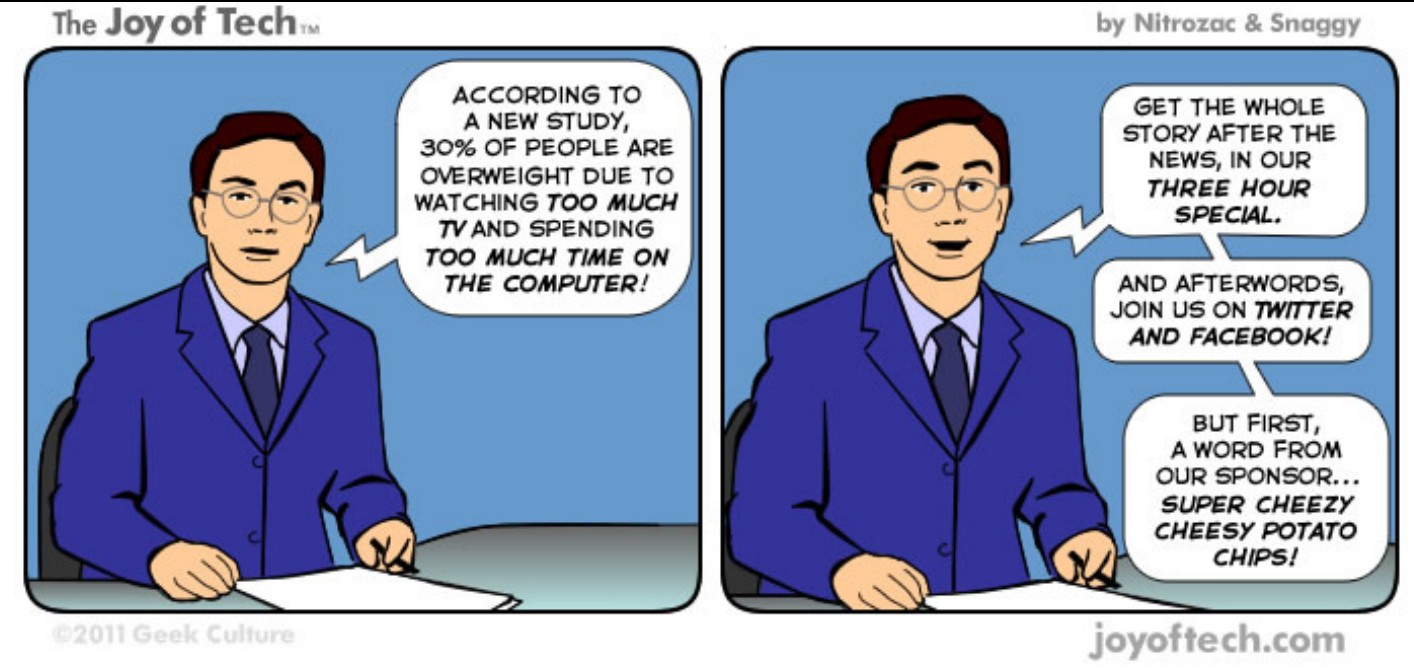
Fonte: http://www.pleated-jeans.com/2011/12/27/the-60-funniest-web-comics-of-2011/ Acesso em 25 de julho de 2014.
Marque a opção que pode substituir “due to” sem alterar o sentido do período.
Fonte: http://www.pleated-jeans.com/2011/12/27/the-60-funniest-web-comics-of-2011/ Acesso em 25 de julho de 2014.
A relação semântica entre os dois quadros é de
Fonte: http://www.pleated-jeans.com/2011/12/27/the-60-funniest-web-comics-of-2011/ Acesso em 25 de julho de 2014.
A reportagem anunciada na tirinha
Texto-base:
Texto-base:
Texto-base:
Texto-base:
Texto-base:
Texto-base:
Texto-base:
Texto-base:
Texto-base:
Texto-base:
Texto-base:
Texto-base:
Texto-base:
Texto-base:
Texto-base:
Texto-base:
Texto-base:
Texto-base:
Texto-base:
Texto-base: