← Voltar para a lista de provas Academia da Força Aérea (AFA) — Comando da Aeronáutica · Cadete — Cursos de Formação de Oficiais Aviadores, Intendentes e de Infantaria (CFOAV/CFOINT/CFOINF) 65 questões nesta prova · página 3 de 4 · 63 com gabarito Gabarito disponível Gabarito disponível Na voz ativa, o sujeito 'fields' leva o verbo no presente simples: 'include'. A frase original 'The study... is included in the fields' está no presente simples passivo. Na ativa, o presente simples com sujeito plural fica 'The fields ... include the study of friendship'. B) Present perfect altera o tempo verbal. C) Present continuous altera o tempo verbal. D) Present perfect continuous também altera o tempo. A voz passiva em presente simples exige o ativo no presente simples. Referência: Active and passive voice. Resolução comentada do VaiConcursos. Gabarito disponível Gabarito disponível Gabarito disponível No discurso indireto, o verbo recua para o passado e usa-se 'said that'. A forma indireta correta é 'The text said that good friends encouraged their friends...', com 'said that' e o verbo recuado para o passado (encourage → encouraged). A e C) Errada: 'told' exige complemento de pessoa ('told us'), e o verbo ficou no presente. B) Errada: 'said us' é incorreto, pois 'say' não leva objeto indireto sem 'to', e o verbo ficou no presente. Referência: Reported speech. Resolução comentada do VaiConcursos. Gabarito disponível Gabarito disponível 'Coping skills' são habilidades de lidar com algo. 'Coping skills' são habilidades para lidar com situações difíceis, como doenças e problemas de saúde. O sentido mais próximo é 'the ability to manage something'. A) Capacidade de desistir: ideia oposta. C) Posição de ressentir: sem relação. D) Condição de renunciar: sem relação com enfrentar problemas. Referência: Vocabulário em contexto. Resolução comentada do VaiConcursos. Gabarito disponível 'That' pode ser substituído por 'which', pronome relativo para coisas. Em 'theories that attempt to explain', 'that' se refere a 'theories' (coisa) e é sujeito da oração relativa. Por isso pode ser trocado por 'which'. A) 'When' é para tempo. B) 'How' é para modo. C) 'Whom' é para pessoas e é objeto, enquanto aqui o antecedente é coisa. Referência: Relative pronouns. Resolução comentada do VaiConcursos. Gabarito disponível Gabarito disponível Gabarito disponível Gabarito disponível Gabarito disponível Gabarito disponível Para 1 °C, uma barra de 1 m varia 13·10⁻⁶ m. Por ΔL = L₀·α·ΔT, com L₀ = 1 m, α = 13·10⁻⁶ e ΔT = 1 °C, obtém-se ΔL = 13·10⁻⁶ m. A) ΔL = 10·13·10⁻⁶·20 = 2,6·10⁻³ m = 0,26 cm, não 2,6 cm. B) β = 2α = 26·10⁻⁶ °C⁻¹. D) γ = 3α = 39·10⁻⁶ °C⁻¹, não 10⁻¹⁸. Referência: Dilatação térmica linear, superficial e volumétrica. Resolução comentada do VaiConcursos. Gabarito disponível São necessários 75 g de carvão e a potência do braseiro é de 3000 W. O calor útil é Q = 1000·1·90 = 90 000 cal. Como só 20% é aproveitado, o calor liberado é 450 000 cal, o que dá 450 000/6000 = 75 g de carvão. A potência é 450 000·4 J/600 s = 3000 W. A e C (15 g): ignoram a perda de 80%, tomando 90 000/6000. A e B (600 W): usam apenas o calor útil, 360 000 J/600 s. As alternativas B e C misturam um valor correto com um errado. Referência: Calorimetria e potência. Resolução comentada do VaiConcursos. Gabarito disponível Gabarito disponível Gabarito disponível Gabarito disponível Gabarito disponívelEPCAR — Exame de Admissão ao CFOAV/CFOINT/CFOINF 2016 — Língua Portuguesa, Matemática, Língua Inglesa, Física e Redação — Versão A
Directions: Answer questions 33 to 48 according to the text.
TEXT
THE RELATIONSHIP BETWEEN FRIENDS AND TYPES OF FRIENDSHIP
Everyone has at least one best friend, some
maybe even more. There are also those people who are
just friends and also arch-enemies. People may think
that just because they are your friends it means that they
[5] are your best friend. The thing is, even though they are
your friend, the relationship between a best friend and a
friend is different. Either way regardless of arch-
enemies, friends or best friends, there are not many
ways to compare any of these different types of friends,
[10] but you can easily contrast them from one another.
Arch-enemies often know more about each
other than two friends. In a comparison of personal
relationships, friendship is considered to be closer than
association, although a wide range of degrees of
[15] intimacy exists in friendships, arch-enemies, and
associations. Friendship and association can be thought
of as spanning across the same continuum. The study of
friendship is included in the fields of sociology, social
psychology, anthropology, philosophy, and zoology.
[20] Even animals have familiars! Various academic theories
of friendship have been proposed, among which are
social exchange theory, equity theory, relational
dialectics, and attachment styles. In Russia, one typically
bestows very few people the status of “friend”.
[25] These friendships, however, make up in
intensity what they lack in number. Friends are entitled
to call each other by their first names alone, and to use
diminutives. A customary example of polite behavior is
addressing "acquaintances" by full first name plus their
[30] patronymic. These could include relationships which
elsewhere would be qualified as real friendships, such
as workplace relationships of long standing, or neighbors
with whom one shares an occasional meal or a social
drink with.
[35] Also in the Middle East and Central Asia, male
friendships, while less restricted than in Russia, tend to
be reserved and respectable in nature. They may use
nicknames and diminutive forms of their first names. In
countries like India, it is believed in some parts that
[40] friendship is a form of respect, not born out of fear or
superiority. Friends are people who are equal in most
standards, but still respect each other regardless of their
attributes or shortcomings. Most of the countries
previously mentioned (Russia, Asia, and even the Middle
[45] East) and even our own nation are suffering a decline in
genuine friendships.
According to a study documented in the June
2006 issue of the Journal American Sociological Review,
Americans are thought to be suffering a loss in the
[50] quality and quantity of close friendships since at least
1985. The study’s results state that twenty-five percent
of Americans have no close confidants, and the average
total number of confidants per citizen has dropped from
four to two. According to the study, Americans'
[55] dependence on family as a safety net went up from fifty-
seven percent to eighty percent; Americans dependence
on a partner or spouse went up from five percent to nine
percent.
Recent studies have found a link between fewer
[60] friendships, especially in quality, and psychological and
physiological regression. In the sequence of the
emotional development of the individual, friendships
come after parental bonding and before the pair bonding
engaged in at the approach of maturity. In the
[65] intervening period between the end of early childhood
and the onset of full adulthood, friendships are often the
most important relationships in the emotional life of the
adolescent, and are often more intense than
relationships experienced later in life.
[70] Unfortunately, making friends seems to trouble
many of people. Having no friends can be emotionally
damaging for all ages, from young children to full grown
adults. A study performed by researchers from Purdue
University found that post-secondary-education
[75] friendships, college and university last longer than the
friendships before it. Children with Asperger syndrome
and autism usually have some difficulty forming
friendships. Socially crippling conditions like these are
just one way that the social world is so difficult to thrive
[80] in. This does not mean that they are not able to form
friendships, however. With time, moderation and proper
instruction, they are able to form friendships after
realizing their own strengths and weaknesses.
There is a number of theories that attempt to
[85] explain the link, including that; Good friends encourage
their friends to lead more healthy lifestyles; Good friends
encourage their friends to seek help and access
services, when needed; Good friends enhance their
friend’s coping skills in dealing with illness and other
[90] health problems; and/or Good friends actually affect
physiological pathways that are protective of health.
Regardless of what we think, we can clearly see that
there are some ways that friends, best friends and arch-
enemies are the same, but in the end they are clearly
[95] more different. Nonetheless we all have every single
type in our lives.
(Adapted from: http://www.ukessays.com/essays/philosophy/the-relationship-between-friends-and-types-of-friendship-philosophy-essay.php)

Directions: Answer questions 33 to 48 according to the text.
TEXT
THE RELATIONSHIP BETWEEN FRIENDS AND TYPES OF FRIENDSHIP
Everyone has at least one best friend, some
maybe even more. There are also those people who are
just friends and also arch-enemies. People may think
that just because they are your friends it means that they
[5] are your best friend. The thing is, even though they are
your friend, the relationship between a best friend and a
friend is different. Either way regardless of arch-
enemies, friends or best friends, there are not many
ways to compare any of these different types of friends,
[10] but you can easily contrast them from one another.
Arch-enemies often know more about each
other than two friends. In a comparison of personal
relationships, friendship is considered to be closer than
association, although a wide range of degrees of
[15] intimacy exists in friendships, arch-enemies, and
associations. Friendship and association can be thought
of as spanning across the same continuum. The study of
friendship is included in the fields of sociology, social
psychology, anthropology, philosophy, and zoology.
[20] Even animals have familiars! Various academic theories
of friendship have been proposed, among which are
social exchange theory, equity theory, relational
dialectics, and attachment styles. In Russia, one typically
bestows very few people the status of “friend”.
[25] These friendships, however, make up in
intensity what they lack in number. Friends are entitled
to call each other by their first names alone, and to use
diminutives. A customary example of polite behavior is
addressing "acquaintances" by full first name plus their
[30] patronymic. These could include relationships which
elsewhere would be qualified as real friendships, such
as workplace relationships of long standing, or neighbors
with whom one shares an occasional meal or a social
drink with.
[35] Also in the Middle East and Central Asia, male
friendships, while less restricted than in Russia, tend to
be reserved and respectable in nature. They may use
nicknames and diminutive forms of their first names. In
countries like India, it is believed in some parts that
[40] friendship is a form of respect, not born out of fear or
superiority. Friends are people who are equal in most
standards, but still respect each other regardless of their
attributes or shortcomings. Most of the countries
previously mentioned (Russia, Asia, and even the Middle
[45] East) and even our own nation are suffering a decline in
genuine friendships.
According to a study documented in the June
2006 issue of the Journal American Sociological Review,
Americans are thought to be suffering a loss in the
[50] quality and quantity of close friendships since at least
1985. The study’s results state that twenty-five percent
of Americans have no close confidants, and the average
total number of confidants per citizen has dropped from
four to two. According to the study, Americans'
[55] dependence on family as a safety net went up from fifty-
seven percent to eighty percent; Americans dependence
on a partner or spouse went up from five percent to nine
percent.
Recent studies have found a link between fewer
[60] friendships, especially in quality, and psychological and
physiological regression. In the sequence of the
emotional development of the individual, friendships
come after parental bonding and before the pair bonding
engaged in at the approach of maturity. In the
[65] intervening period between the end of early childhood
and the onset of full adulthood, friendships are often the
most important relationships in the emotional life of the
adolescent, and are often more intense than
relationships experienced later in life.
[70] Unfortunately, making friends seems to trouble
many of people. Having no friends can be emotionally
damaging for all ages, from young children to full grown
adults. A study performed by researchers from Purdue
University found that post-secondary-education
[75] friendships, college and university last longer than the
friendships before it. Children with Asperger syndrome
and autism usually have some difficulty forming
friendships. Socially crippling conditions like these are
just one way that the social world is so difficult to thrive
[80] in. This does not mean that they are not able to form
friendships, however. With time, moderation and proper
instruction, they are able to form friendships after
realizing their own strengths and weaknesses.
There is a number of theories that attempt to
[85] explain the link, including that; Good friends encourage
their friends to lead more healthy lifestyles; Good friends
encourage their friends to seek help and access
services, when needed; Good friends enhance their
friend’s coping skills in dealing with illness and other
[90] health problems; and/or Good friends actually affect
physiological pathways that are protective of health.
Regardless of what we think, we can clearly see that
there are some ways that friends, best friends and arch-
enemies are the same, but in the end they are clearly
[95] more different. Nonetheless we all have every single
type in our lives.
(Adapted from: http://www.ukessays.com/essays/philosophy/the-relationship-between-friends-and-types-of-friendship-philosophy-essay.php)
Choose the best option to complete the active form of the sentence: “The study of friendship is included in the fields of sociology, social psychology, anthropology, philosophy, and zoology” (lines 17 to 19).
The fields of sociology, social psychology, anthropology, philosophy, and zoology ______________ the study of friendship.Resolução comentada
Análise das alternativas
Directions: Answer questions 33 to 48 according to the text.
TEXT
THE RELATIONSHIP BETWEEN FRIENDS AND TYPES OF FRIENDSHIP
Everyone has at least one best friend, some
maybe even more. There are also those people who are
just friends and also arch-enemies. People may think
that just because they are your friends it means that they
[5] are your best friend. The thing is, even though they are
your friend, the relationship between a best friend and a
friend is different. Either way regardless of arch-
enemies, friends or best friends, there are not many
ways to compare any of these different types of friends,
[10] but you can easily contrast them from one another.
Arch-enemies often know more about each
other than two friends. In a comparison of personal
relationships, friendship is considered to be closer than
association, although a wide range of degrees of
[15] intimacy exists in friendships, arch-enemies, and
associations. Friendship and association can be thought
of as spanning across the same continuum. The study of
friendship is included in the fields of sociology, social
psychology, anthropology, philosophy, and zoology.
[20] Even animals have familiars! Various academic theories
of friendship have been proposed, among which are
social exchange theory, equity theory, relational
dialectics, and attachment styles. In Russia, one typically
bestows very few people the status of “friend”.
[25] These friendships, however, make up in
intensity what they lack in number. Friends are entitled
to call each other by their first names alone, and to use
diminutives. A customary example of polite behavior is
addressing "acquaintances" by full first name plus their
[30] patronymic. These could include relationships which
elsewhere would be qualified as real friendships, such
as workplace relationships of long standing, or neighbors
with whom one shares an occasional meal or a social
drink with.
[35] Also in the Middle East and Central Asia, male
friendships, while less restricted than in Russia, tend to
be reserved and respectable in nature. They may use
nicknames and diminutive forms of their first names. In
countries like India, it is believed in some parts that
[40] friendship is a form of respect, not born out of fear or
superiority. Friends are people who are equal in most
standards, but still respect each other regardless of their
attributes or shortcomings. Most of the countries
previously mentioned (Russia, Asia, and even the Middle
[45] East) and even our own nation are suffering a decline in
genuine friendships.
According to a study documented in the June
2006 issue of the Journal American Sociological Review,
Americans are thought to be suffering a loss in the
[50] quality and quantity of close friendships since at least
1985. The study’s results state that twenty-five percent
of Americans have no close confidants, and the average
total number of confidants per citizen has dropped from
four to two. According to the study, Americans'
[55] dependence on family as a safety net went up from fifty-
seven percent to eighty percent; Americans dependence
on a partner or spouse went up from five percent to nine
percent.
Recent studies have found a link between fewer
[60] friendships, especially in quality, and psychological and
physiological regression. In the sequence of the
emotional development of the individual, friendships
come after parental bonding and before the pair bonding
engaged in at the approach of maturity. In the
[65] intervening period between the end of early childhood
and the onset of full adulthood, friendships are often the
most important relationships in the emotional life of the
adolescent, and are often more intense than
relationships experienced later in life.
[70] Unfortunately, making friends seems to trouble
many of people. Having no friends can be emotionally
damaging for all ages, from young children to full grown
adults. A study performed by researchers from Purdue
University found that post-secondary-education
[75] friendships, college and university last longer than the
friendships before it. Children with Asperger syndrome
and autism usually have some difficulty forming
friendships. Socially crippling conditions like these are
just one way that the social world is so difficult to thrive
[80] in. This does not mean that they are not able to form
friendships, however. With time, moderation and proper
instruction, they are able to form friendships after
realizing their own strengths and weaknesses.
There is a number of theories that attempt to
[85] explain the link, including that; Good friends encourage
their friends to lead more healthy lifestyles; Good friends
encourage their friends to seek help and access
services, when needed; Good friends enhance their
friend’s coping skills in dealing with illness and other
[90] health problems; and/or Good friends actually affect
physiological pathways that are protective of health.
Regardless of what we think, we can clearly see that
there are some ways that friends, best friends and arch-
enemies are the same, but in the end they are clearly
[95] more different. Nonetheless we all have every single
type in our lives.
(Adapted from: http://www.ukessays.com/essays/philosophy/the-relationship-between-friends-and-types-of-friendship-philosophy-essay.php)

Directions: Answer questions 33 to 48 according to the text.
TEXT
THE RELATIONSHIP BETWEEN FRIENDS AND TYPES OF FRIENDSHIP
Everyone has at least one best friend, some
maybe even more. There are also those people who are
just friends and also arch-enemies. People may think
that just because they are your friends it means that they
[5] are your best friend. The thing is, even though they are
your friend, the relationship between a best friend and a
friend is different. Either way regardless of arch-
enemies, friends or best friends, there are not many
ways to compare any of these different types of friends,
[10] but you can easily contrast them from one another.
Arch-enemies often know more about each
other than two friends. In a comparison of personal
relationships, friendship is considered to be closer than
association, although a wide range of degrees of
[15] intimacy exists in friendships, arch-enemies, and
associations. Friendship and association can be thought
of as spanning across the same continuum. The study of
friendship is included in the fields of sociology, social
psychology, anthropology, philosophy, and zoology.
[20] Even animals have familiars! Various academic theories
of friendship have been proposed, among which are
social exchange theory, equity theory, relational
dialectics, and attachment styles. In Russia, one typically
bestows very few people the status of “friend”.
[25] These friendships, however, make up in
intensity what they lack in number. Friends are entitled
to call each other by their first names alone, and to use
diminutives. A customary example of polite behavior is
addressing "acquaintances" by full first name plus their
[30] patronymic. These could include relationships which
elsewhere would be qualified as real friendships, such
as workplace relationships of long standing, or neighbors
with whom one shares an occasional meal or a social
drink with.
[35] Also in the Middle East and Central Asia, male
friendships, while less restricted than in Russia, tend to
be reserved and respectable in nature. They may use
nicknames and diminutive forms of their first names. In
countries like India, it is believed in some parts that
[40] friendship is a form of respect, not born out of fear or
superiority. Friends are people who are equal in most
standards, but still respect each other regardless of their
attributes or shortcomings. Most of the countries
previously mentioned (Russia, Asia, and even the Middle
[45] East) and even our own nation are suffering a decline in
genuine friendships.
According to a study documented in the June
2006 issue of the Journal American Sociological Review,
Americans are thought to be suffering a loss in the
[50] quality and quantity of close friendships since at least
1985. The study’s results state that twenty-five percent
of Americans have no close confidants, and the average
total number of confidants per citizen has dropped from
four to two. According to the study, Americans'
[55] dependence on family as a safety net went up from fifty-
seven percent to eighty percent; Americans dependence
on a partner or spouse went up from five percent to nine
percent.
Recent studies have found a link between fewer
[60] friendships, especially in quality, and psychological and
physiological regression. In the sequence of the
emotional development of the individual, friendships
come after parental bonding and before the pair bonding
engaged in at the approach of maturity. In the
[65] intervening period between the end of early childhood
and the onset of full adulthood, friendships are often the
most important relationships in the emotional life of the
adolescent, and are often more intense than
relationships experienced later in life.
[70] Unfortunately, making friends seems to trouble
many of people. Having no friends can be emotionally
damaging for all ages, from young children to full grown
adults. A study performed by researchers from Purdue
University found that post-secondary-education
[75] friendships, college and university last longer than the
friendships before it. Children with Asperger syndrome
and autism usually have some difficulty forming
friendships. Socially crippling conditions like these are
just one way that the social world is so difficult to thrive
[80] in. This does not mean that they are not able to form
friendships, however. With time, moderation and proper
instruction, they are able to form friendships after
realizing their own strengths and weaknesses.
There is a number of theories that attempt to
[85] explain the link, including that; Good friends encourage
their friends to lead more healthy lifestyles; Good friends
encourage their friends to seek help and access
services, when needed; Good friends enhance their
friend’s coping skills in dealing with illness and other
[90] health problems; and/or Good friends actually affect
physiological pathways that are protective of health.
Regardless of what we think, we can clearly see that
there are some ways that friends, best friends and arch-
enemies are the same, but in the end they are clearly
[95] more different. Nonetheless we all have every single
type in our lives.
(Adapted from: http://www.ukessays.com/essays/philosophy/the-relationship-between-friends-and-types-of-friendship-philosophy-essay.php)

Directions: Answer questions 33 to 48 according to the text.
TEXT
THE RELATIONSHIP BETWEEN FRIENDS AND TYPES OF FRIENDSHIP
Everyone has at least one best friend, some
maybe even more. There are also those people who are
just friends and also arch-enemies. People may think
that just because they are your friends it means that they
[5] are your best friend. The thing is, even though they are
your friend, the relationship between a best friend and a
friend is different. Either way regardless of arch-
enemies, friends or best friends, there are not many
ways to compare any of these different types of friends,
[10] but you can easily contrast them from one another.
Arch-enemies often know more about each
other than two friends. In a comparison of personal
relationships, friendship is considered to be closer than
association, although a wide range of degrees of
[15] intimacy exists in friendships, arch-enemies, and
associations. Friendship and association can be thought
of as spanning across the same continuum. The study of
friendship is included in the fields of sociology, social
psychology, anthropology, philosophy, and zoology.
[20] Even animals have familiars! Various academic theories
of friendship have been proposed, among which are
social exchange theory, equity theory, relational
dialectics, and attachment styles. In Russia, one typically
bestows very few people the status of “friend”.
[25] These friendships, however, make up in
intensity what they lack in number. Friends are entitled
to call each other by their first names alone, and to use
diminutives. A customary example of polite behavior is
addressing "acquaintances" by full first name plus their
[30] patronymic. These could include relationships which
elsewhere would be qualified as real friendships, such
as workplace relationships of long standing, or neighbors
with whom one shares an occasional meal or a social
drink with.
[35] Also in the Middle East and Central Asia, male
friendships, while less restricted than in Russia, tend to
be reserved and respectable in nature. They may use
nicknames and diminutive forms of their first names. In
countries like India, it is believed in some parts that
[40] friendship is a form of respect, not born out of fear or
superiority. Friends are people who are equal in most
standards, but still respect each other regardless of their
attributes or shortcomings. Most of the countries
previously mentioned (Russia, Asia, and even the Middle
[45] East) and even our own nation are suffering a decline in
genuine friendships.
According to a study documented in the June
2006 issue of the Journal American Sociological Review,
Americans are thought to be suffering a loss in the
[50] quality and quantity of close friendships since at least
1985. The study’s results state that twenty-five percent
of Americans have no close confidants, and the average
total number of confidants per citizen has dropped from
four to two. According to the study, Americans'
[55] dependence on family as a safety net went up from fifty-
seven percent to eighty percent; Americans dependence
on a partner or spouse went up from five percent to nine
percent.
Recent studies have found a link between fewer
[60] friendships, especially in quality, and psychological and
physiological regression. In the sequence of the
emotional development of the individual, friendships
come after parental bonding and before the pair bonding
engaged in at the approach of maturity. In the
[65] intervening period between the end of early childhood
and the onset of full adulthood, friendships are often the
most important relationships in the emotional life of the
adolescent, and are often more intense than
relationships experienced later in life.
[70] Unfortunately, making friends seems to trouble
many of people. Having no friends can be emotionally
damaging for all ages, from young children to full grown
adults. A study performed by researchers from Purdue
University found that post-secondary-education
[75] friendships, college and university last longer than the
friendships before it. Children with Asperger syndrome
and autism usually have some difficulty forming
friendships. Socially crippling conditions like these are
just one way that the social world is so difficult to thrive
[80] in. This does not mean that they are not able to form
friendships, however. With time, moderation and proper
instruction, they are able to form friendships after
realizing their own strengths and weaknesses.
There is a number of theories that attempt to
[85] explain the link, including that; Good friends encourage
their friends to lead more healthy lifestyles; Good friends
encourage their friends to seek help and access
services, when needed; Good friends enhance their
friend’s coping skills in dealing with illness and other
[90] health problems; and/or Good friends actually affect
physiological pathways that are protective of health.
Regardless of what we think, we can clearly see that
there are some ways that friends, best friends and arch-
enemies are the same, but in the end they are clearly
[95] more different. Nonetheless we all have every single
type in our lives.
(Adapted from: http://www.ukessays.com/essays/philosophy/the-relationship-between-friends-and-types-of-friendship-philosophy-essay.php)
Choose the option that shows the sentence “good friends encourage their friends to seek help and access services” (lines 86 to 88) in the indirect speech form.Resolução comentada
Análise das alternativas
Directions: Answer questions 33 to 48 according to the text.
TEXT
THE RELATIONSHIP BETWEEN FRIENDS AND TYPES OF FRIENDSHIP
Everyone has at least one best friend, some
maybe even more. There are also those people who are
just friends and also arch-enemies. People may think
that just because they are your friends it means that they
[5] are your best friend. The thing is, even though they are
your friend, the relationship between a best friend and a
friend is different. Either way regardless of arch-
enemies, friends or best friends, there are not many
ways to compare any of these different types of friends,
[10] but you can easily contrast them from one another.
Arch-enemies often know more about each
other than two friends. In a comparison of personal
relationships, friendship is considered to be closer than
association, although a wide range of degrees of
[15] intimacy exists in friendships, arch-enemies, and
associations. Friendship and association can be thought
of as spanning across the same continuum. The study of
friendship is included in the fields of sociology, social
psychology, anthropology, philosophy, and zoology.
[20] Even animals have familiars! Various academic theories
of friendship have been proposed, among which are
social exchange theory, equity theory, relational
dialectics, and attachment styles. In Russia, one typically
bestows very few people the status of “friend”.
[25] These friendships, however, make up in
intensity what they lack in number. Friends are entitled
to call each other by their first names alone, and to use
diminutives. A customary example of polite behavior is
addressing "acquaintances" by full first name plus their
[30] patronymic. These could include relationships which
elsewhere would be qualified as real friendships, such
as workplace relationships of long standing, or neighbors
with whom one shares an occasional meal or a social
drink with.
[35] Also in the Middle East and Central Asia, male
friendships, while less restricted than in Russia, tend to
be reserved and respectable in nature. They may use
nicknames and diminutive forms of their first names. In
countries like India, it is believed in some parts that
[40] friendship is a form of respect, not born out of fear or
superiority. Friends are people who are equal in most
standards, but still respect each other regardless of their
attributes or shortcomings. Most of the countries
previously mentioned (Russia, Asia, and even the Middle
[45] East) and even our own nation are suffering a decline in
genuine friendships.
According to a study documented in the June
2006 issue of the Journal American Sociological Review,
Americans are thought to be suffering a loss in the
[50] quality and quantity of close friendships since at least
1985. The study’s results state that twenty-five percent
of Americans have no close confidants, and the average
total number of confidants per citizen has dropped from
four to two. According to the study, Americans'
[55] dependence on family as a safety net went up from fifty-
seven percent to eighty percent; Americans dependence
on a partner or spouse went up from five percent to nine
percent.
Recent studies have found a link between fewer
[60] friendships, especially in quality, and psychological and
physiological regression. In the sequence of the
emotional development of the individual, friendships
come after parental bonding and before the pair bonding
engaged in at the approach of maturity. In the
[65] intervening period between the end of early childhood
and the onset of full adulthood, friendships are often the
most important relationships in the emotional life of the
adolescent, and are often more intense than
relationships experienced later in life.
[70] Unfortunately, making friends seems to trouble
many of people. Having no friends can be emotionally
damaging for all ages, from young children to full grown
adults. A study performed by researchers from Purdue
University found that post-secondary-education
[75] friendships, college and university last longer than the
friendships before it. Children with Asperger syndrome
and autism usually have some difficulty forming
friendships. Socially crippling conditions like these are
just one way that the social world is so difficult to thrive
[80] in. This does not mean that they are not able to form
friendships, however. With time, moderation and proper
instruction, they are able to form friendships after
realizing their own strengths and weaknesses.
There is a number of theories that attempt to
[85] explain the link, including that; Good friends encourage
their friends to lead more healthy lifestyles; Good friends
encourage their friends to seek help and access
services, when needed; Good friends enhance their
friend’s coping skills in dealing with illness and other
[90] health problems; and/or Good friends actually affect
physiological pathways that are protective of health.
Regardless of what we think, we can clearly see that
there are some ways that friends, best friends and arch-
enemies are the same, but in the end they are clearly
[95] more different. Nonetheless we all have every single
type in our lives.
(Adapted from: http://www.ukessays.com/essays/philosophy/the-relationship-between-friends-and-types-of-friendship-philosophy-essay.php)

Directions: Answer questions 33 to 48 according to the text.
TEXT
THE RELATIONSHIP BETWEEN FRIENDS AND TYPES OF FRIENDSHIP
Everyone has at least one best friend, some
maybe even more. There are also those people who are
just friends and also arch-enemies. People may think
that just because they are your friends it means that they
[5] are your best friend. The thing is, even though they are
your friend, the relationship between a best friend and a
friend is different. Either way regardless of arch-
enemies, friends or best friends, there are not many
ways to compare any of these different types of friends,
[10] but you can easily contrast them from one another.
Arch-enemies often know more about each
other than two friends. In a comparison of personal
relationships, friendship is considered to be closer than
association, although a wide range of degrees of
[15] intimacy exists in friendships, arch-enemies, and
associations. Friendship and association can be thought
of as spanning across the same continuum. The study of
friendship is included in the fields of sociology, social
psychology, anthropology, philosophy, and zoology.
[20] Even animals have familiars! Various academic theories
of friendship have been proposed, among which are
social exchange theory, equity theory, relational
dialectics, and attachment styles. In Russia, one typically
bestows very few people the status of “friend”.
[25] These friendships, however, make up in
intensity what they lack in number. Friends are entitled
to call each other by their first names alone, and to use
diminutives. A customary example of polite behavior is
addressing "acquaintances" by full first name plus their
[30] patronymic. These could include relationships which
elsewhere would be qualified as real friendships, such
as workplace relationships of long standing, or neighbors
with whom one shares an occasional meal or a social
drink with.
[35] Also in the Middle East and Central Asia, male
friendships, while less restricted than in Russia, tend to
be reserved and respectable in nature. They may use
nicknames and diminutive forms of their first names. In
countries like India, it is believed in some parts that
[40] friendship is a form of respect, not born out of fear or
superiority. Friends are people who are equal in most
standards, but still respect each other regardless of their
attributes or shortcomings. Most of the countries
previously mentioned (Russia, Asia, and even the Middle
[45] East) and even our own nation are suffering a decline in
genuine friendships.
According to a study documented in the June
2006 issue of the Journal American Sociological Review,
Americans are thought to be suffering a loss in the
[50] quality and quantity of close friendships since at least
1985. The study’s results state that twenty-five percent
of Americans have no close confidants, and the average
total number of confidants per citizen has dropped from
four to two. According to the study, Americans'
[55] dependence on family as a safety net went up from fifty-
seven percent to eighty percent; Americans dependence
on a partner or spouse went up from five percent to nine
percent.
Recent studies have found a link between fewer
[60] friendships, especially in quality, and psychological and
physiological regression. In the sequence of the
emotional development of the individual, friendships
come after parental bonding and before the pair bonding
engaged in at the approach of maturity. In the
[65] intervening period between the end of early childhood
and the onset of full adulthood, friendships are often the
most important relationships in the emotional life of the
adolescent, and are often more intense than
relationships experienced later in life.
[70] Unfortunately, making friends seems to trouble
many of people. Having no friends can be emotionally
damaging for all ages, from young children to full grown
adults. A study performed by researchers from Purdue
University found that post-secondary-education
[75] friendships, college and university last longer than the
friendships before it. Children with Asperger syndrome
and autism usually have some difficulty forming
friendships. Socially crippling conditions like these are
just one way that the social world is so difficult to thrive
[80] in. This does not mean that they are not able to form
friendships, however. With time, moderation and proper
instruction, they are able to form friendships after
realizing their own strengths and weaknesses.
There is a number of theories that attempt to
[85] explain the link, including that; Good friends encourage
their friends to lead more healthy lifestyles; Good friends
encourage their friends to seek help and access
services, when needed; Good friends enhance their
friend’s coping skills in dealing with illness and other
[90] health problems; and/or Good friends actually affect
physiological pathways that are protective of health.
Regardless of what we think, we can clearly see that
there are some ways that friends, best friends and arch-
enemies are the same, but in the end they are clearly
[95] more different. Nonetheless we all have every single
type in our lives.
(Adapted from: http://www.ukessays.com/essays/philosophy/the-relationship-between-friends-and-types-of-friendship-philosophy-essay.php)
The expression “coping skills” (line 89) is closest in meaning toResolução comentada
Análise das alternativas
Directions: Answer questions 33 to 48 according to the text.
TEXT
THE RELATIONSHIP BETWEEN FRIENDS AND TYPES OF FRIENDSHIP
Everyone has at least one best friend, some
maybe even more. There are also those people who are
just friends and also arch-enemies. People may think
that just because they are your friends it means that they
[5] are your best friend. The thing is, even though they are
your friend, the relationship between a best friend and a
friend is different. Either way regardless of arch-
enemies, friends or best friends, there are not many
ways to compare any of these different types of friends,
[10] but you can easily contrast them from one another.
Arch-enemies often know more about each
other than two friends. In a comparison of personal
relationships, friendship is considered to be closer than
association, although a wide range of degrees of
[15] intimacy exists in friendships, arch-enemies, and
associations. Friendship and association can be thought
of as spanning across the same continuum. The study of
friendship is included in the fields of sociology, social
psychology, anthropology, philosophy, and zoology.
[20] Even animals have familiars! Various academic theories
of friendship have been proposed, among which are
social exchange theory, equity theory, relational
dialectics, and attachment styles. In Russia, one typically
bestows very few people the status of “friend”.
[25] These friendships, however, make up in
intensity what they lack in number. Friends are entitled
to call each other by their first names alone, and to use
diminutives. A customary example of polite behavior is
addressing "acquaintances" by full first name plus their
[30] patronymic. These could include relationships which
elsewhere would be qualified as real friendships, such
as workplace relationships of long standing, or neighbors
with whom one shares an occasional meal or a social
drink with.
[35] Also in the Middle East and Central Asia, male
friendships, while less restricted than in Russia, tend to
be reserved and respectable in nature. They may use
nicknames and diminutive forms of their first names. In
countries like India, it is believed in some parts that
[40] friendship is a form of respect, not born out of fear or
superiority. Friends are people who are equal in most
standards, but still respect each other regardless of their
attributes or shortcomings. Most of the countries
previously mentioned (Russia, Asia, and even the Middle
[45] East) and even our own nation are suffering a decline in
genuine friendships.
According to a study documented in the June
2006 issue of the Journal American Sociological Review,
Americans are thought to be suffering a loss in the
[50] quality and quantity of close friendships since at least
1985. The study’s results state that twenty-five percent
of Americans have no close confidants, and the average
total number of confidants per citizen has dropped from
four to two. According to the study, Americans'
[55] dependence on family as a safety net went up from fifty-
seven percent to eighty percent; Americans dependence
on a partner or spouse went up from five percent to nine
percent.
Recent studies have found a link between fewer
[60] friendships, especially in quality, and psychological and
physiological regression. In the sequence of the
emotional development of the individual, friendships
come after parental bonding and before the pair bonding
engaged in at the approach of maturity. In the
[65] intervening period between the end of early childhood
and the onset of full adulthood, friendships are often the
most important relationships in the emotional life of the
adolescent, and are often more intense than
relationships experienced later in life.
[70] Unfortunately, making friends seems to trouble
many of people. Having no friends can be emotionally
damaging for all ages, from young children to full grown
adults. A study performed by researchers from Purdue
University found that post-secondary-education
[75] friendships, college and university last longer than the
friendships before it. Children with Asperger syndrome
and autism usually have some difficulty forming
friendships. Socially crippling conditions like these are
just one way that the social world is so difficult to thrive
[80] in. This does not mean that they are not able to form
friendships, however. With time, moderation and proper
instruction, they are able to form friendships after
realizing their own strengths and weaknesses.
There is a number of theories that attempt to
[85] explain the link, including that; Good friends encourage
their friends to lead more healthy lifestyles; Good friends
encourage their friends to seek help and access
services, when needed; Good friends enhance their
friend’s coping skills in dealing with illness and other
[90] health problems; and/or Good friends actually affect
physiological pathways that are protective of health.
Regardless of what we think, we can clearly see that
there are some ways that friends, best friends and arch-
enemies are the same, but in the end they are clearly
[95] more different. Nonetheless we all have every single
type in our lives.
(Adapted from: http://www.ukessays.com/essays/philosophy/the-relationship-between-friends-and-types-of-friendship-philosophy-essay.php)
In the sentence “there is a number of theories that attempt to explain the link” (lines 84-85), it is possible to find an option to substitute the pronoun accordingly inResolução comentada
Análise das alternativas
Nas questões de Física, quando necessário, use
aceleração da gravidade: g = 10 m/s²
densidade da água: d = 1,0 kg/L
calor específico da água: c = 1 cal/g °C
1 cal = 4 J
constante eletrostática: k = 9,0.10⁹ N.m²/C²
constante universal dos gases perfeitos: R = 8 J/mol.K
Dois móveis, A e B, partindo juntos de uma mesma posição, porém com velocidades diferentes, que variam conforme o gráfico abaixo, irão se encontrar novamente em um determinado instante.
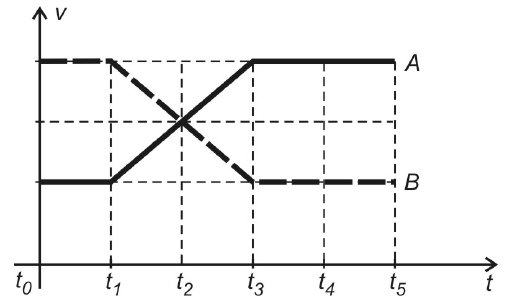
Considerando que os intervalos de tempo t₁ − t₀, t₂ − t₁, t₃ − t₂, t₄ − t₃ e t₅ − t₄ são todos iguais, os móveis A e B novamente se encontrarão no instante
Nas questões de Física, quando necessário, use
aceleração da gravidade: g = 10 m/s²
densidade da água: d = 1,0 kg/L
calor específico da água: c = 1 cal/g °C
1 cal = 4 J
constante eletrostática: k = 9,0.10⁹ N.m²/C²
constante universal dos gases perfeitos: R = 8 J/mol.K
Um bloco é lançado com velocidade vₒ no ponto P paralelamente a uma rampa, conforme a figura. Ao escorregar sobre a rampa, esse bloco para na metade dela, devido à ação do atrito.
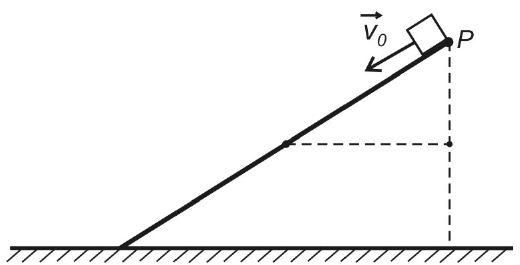
Tratando o bloco como partícula e considerando o coeficiente de atrito entre a superfície do bloco e da rampa, constante ao longo de toda descida, a velocidade de lançamento para que este bloco pudesse chegar ao final da rampa deveria ser, no mínimo,
Nas questões de Física, quando necessário, use
aceleração da gravidade: g = 10 m/s²
densidade da água: d = 1,0 kg/L
calor específico da água: c = 1 cal/g °C
1 cal = 4 J
constante eletrostática: k = 9,0.10⁹ N.m²/C²
constante universal dos gases perfeitos: R = 8 J/mol.K
Dois mecanismos que giram com velocidades angulares ω₁ e ω₂ constantes são usados para lançar horizontalmente duas partículas de massas m₁ = 1kg e m₂ = 2kg de uma altura h = 30m, como mostra a figura 1 abaixo.
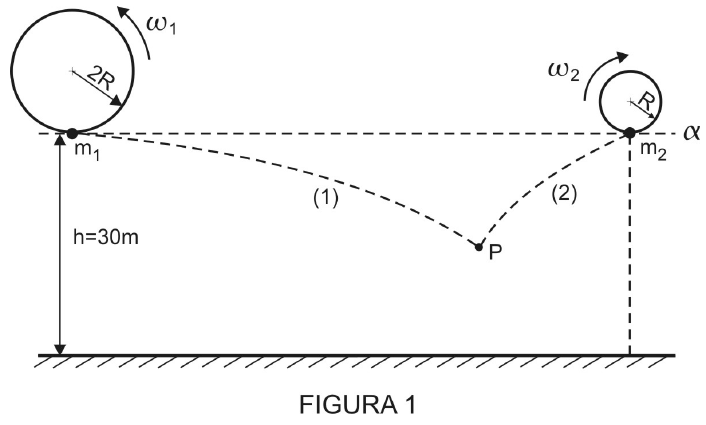
Num dado momento em que as partículas passam, simultaneamente, tangenciando o plano horizontal α, elas são desacopladas dos mecanismos de giro e, lançadas horizontalmente, seguem as trajetórias 1 e 2 (figura 1) até se encontrarem no ponto P.
Os gráficos das energias cinéticas, em joule, das partículas 1 e 2 durante os movimentos de queda, até a colisão, são apresentados na figura 2 em função de (h − y), em m, onde y é a altura vertical das partículas num tempo qualquer, medida a partir do solo perfeitamente horizontal.
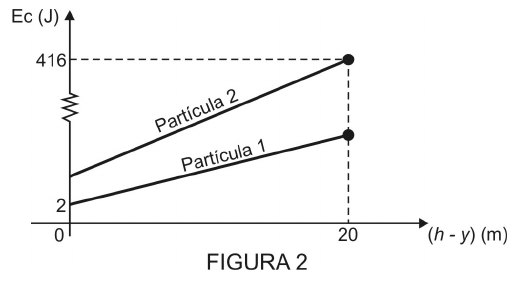
Desprezando qualquer forma de atrito, a razão ω₂/ω₁ é
Nas questões de Física, quando necessário, use
aceleração da gravidade: g = 10 m/s²
densidade da água: d = 1,0 kg/L
calor específico da água: c = 1 cal/g °C
1 cal = 4 J
constante eletrostática: k = 9,0.10⁹ N.m²/C²
constante universal dos gases perfeitos: R = 8 J/mol.K
Um balão, cheio de um certo gás, que tem volume de 2,0 m³, é mantido em repouso a uma determinada altura de uma superfície horizontal, conforme a figura abaixo.
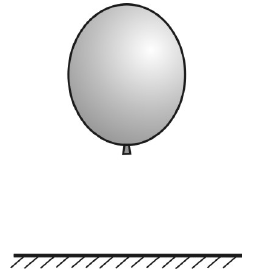
Sabendo-se que a massa total do balão (incluindo o gás) é de 1,6 kg, considerando o ar como uma camada uniforme de densidade igual a 1,3 kg/m³, pode-se afirmar que ao liberar o balão, ele
Nas questões de Física, quando necessário, use
aceleração da gravidade: g = 10 m/s²
densidade da água: d = 1,0 kg/L
calor específico da água: c = 1 cal/g °C
1 cal = 4 J
constante eletrostática: k = 9,0.10⁹ N.m²/C²
constante universal dos gases perfeitos: R = 8 J/mol.K
Considere a Terra um Planeta esférico, homogêneo, de raio R, massa M concentrada no seu centro de massa e que gira em torno do seu eixo E com velocidade angular constante ω, isolada do resto do universo.
Um corpo de prova colocado sobre a superfície da Terra, em um ponto de latitude φ, descreverá uma trajetória circular de raio r e centro sobre o eixo E da Terra, conforme a figura abaixo. Nessas condições, o corpo de prova ficará sujeito a uma força de atração gravitacional F⃗, que admite duas componentes, uma centrípeta, F⃗cp, e outra que traduz o peso aparente do corpo, P⃗.
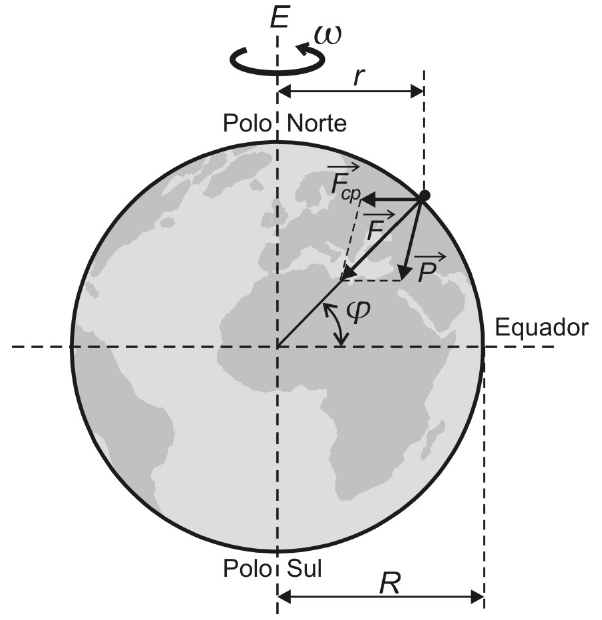
Quando φ = 0°, então o corpo de prova está sobre a linha do equador e experimenta um valor aparente da aceleração da gravidade igual a gₑ. Por outro lado, quando φ = 90°, o corpo de prova se encontra em um dos Polos, experimentando um valor aparente da aceleração da gravidade igual a gₚ.
Sendo G a constante de gravitação universal, a razão gₑ/gₚ vale
Nas questões de Física, quando necessário, use
aceleração da gravidade: g = 10 m/s²
densidade da água: d = 1,0 kg/L
calor específico da água: c = 1 cal/g °C
1 cal = 4 J
constante eletrostática: k = 9,0.10⁹ N.m²/C²
constante universal dos gases perfeitos: R = 8 J/mol.K
Consultando uma tabela da dilatação térmica dos sólidos verifica-se que o coeficiente de dilatação linear do ferro é 13 · 10⁻⁶ °C⁻¹. Portanto, pode-se concluir queResolução comentada
Análise das alternativas
Nas questões de Física, quando necessário, use
aceleração da gravidade: g = 10 m/s²
densidade da água: d = 1,0 kg/L
calor específico da água: c = 1 cal/g °C
1 cal = 4 J
constante eletrostática: k = 9,0.10⁹ N.m²/C²
constante universal dos gases perfeitos: R = 8 J/mol.K
Deseja-se aquecer 1,0 L de água que se encontra inicialmente à temperatura de 10 °C até atingir 100 °C sob pressão normal, em 10 minutos, usando a queima de carvão. Sabendo-se que o calor de combustão do carvão é 6000 cal/g e que 80% do calor liberado na sua queima é perdido para o ambiente, a massa mínima de carvão consumida no processo, em gramas, e a potência média emitida pelo braseiro, em watts, sãoResolução comentada
Análise das alternativas
Nas questões de Física, quando necessário, use
aceleração da gravidade: g = 10 m/s²
densidade da água: d = 1,0 kg/L
calor específico da água: c = 1 cal/g °C
1 cal = 4 J
constante eletrostática: k = 9,0.10⁹ N.m²/C²
constante universal dos gases perfeitos: R = 8 J/mol.K
Três pêndulos simples 1, 2 e 3 que oscilam em MHS possuem massas respectivamente iguais a m, 2m e 3m são mostrados na figura abaixo.
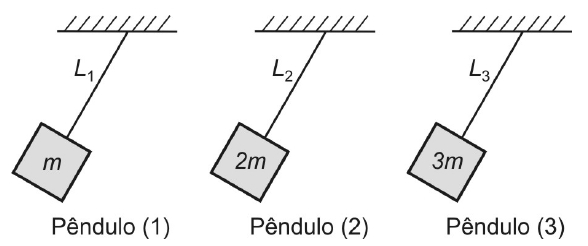
Os fios que sustentam as massas são ideais, inextensíveis e possuem comprimento respectivamente L₁, L₂ e L₃.
Para cada um dos pêndulos registrou-se a posição (x), em metro, em função do tempo (t), em segundo, e os gráficos desses registros são apresentados nas figuras 1, 2 e 3 abaixo.
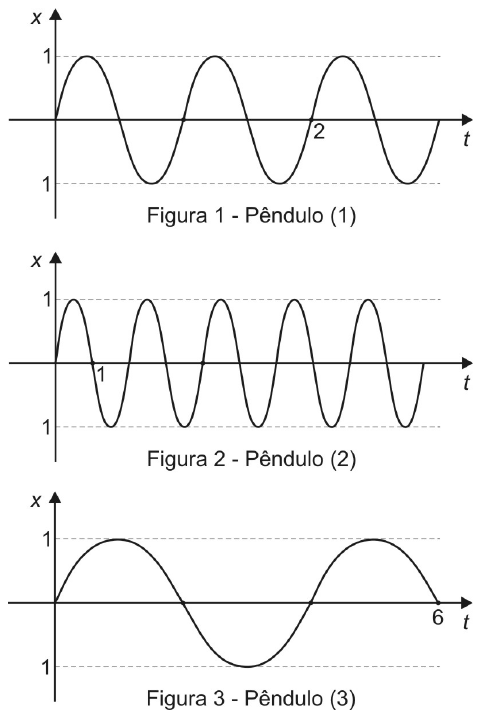
Considerando a inexistência de atritos e que a aceleração da gravidade seja g = π² m/s², é correto afirmar que
Nas questões de Física, quando necessário, use
aceleração da gravidade: g = 10 m/s²
densidade da água: d = 1,0 kg/L
calor específico da água: c = 1 cal/g °C
1 cal = 4 J
constante eletrostática: k = 9,0.10⁹ N.m²/C²
constante universal dos gases perfeitos: R = 8 J/mol.K
Uma figura de difração é obtida em um experimento de difração por fenda simples quando luz monocromática de comprimento de onda λ₁ passa por uma fenda de largura d₁. O gráfico da intensidade luminosa I em função da posição x ao longo do anteparo onde essa figura de difração é projetada, está apresentado na figura 1 abaixo.
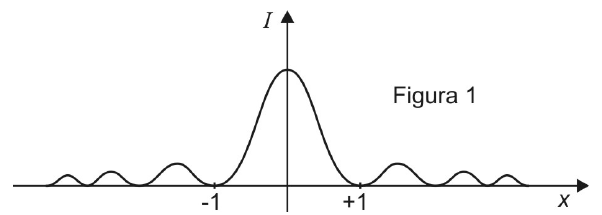
Alterando-se neste experimento apenas o comprimento de onda da luz monocromática para um valor λ₂, obtém-se o gráfico apresentado na figura 2. E alterando-se apenas o valor da largura da fenda para um valor d₂, obtém-se o gráfico da figura 3.
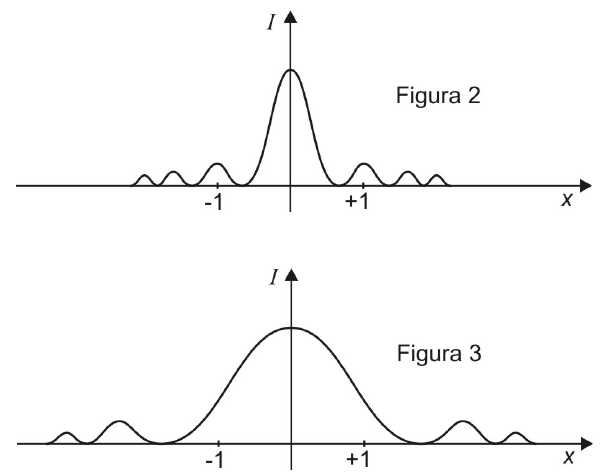
Nessas condições, é correto afirmar que
Nas questões de Física, quando necessário, use
aceleração da gravidade: g = 10 m/s²
densidade da água: d = 1,0 kg/L
calor específico da água: c = 1 cal/g °C
1 cal = 4 J
constante eletrostática: k = 9,0.10⁹ N.m²/C²
constante universal dos gases perfeitos: R = 8 J/mol.K
Considere um objeto formado por uma combinação de um quadrado de aresta a cujos vértices são centros geométricos de círculos e quadrados menores, como mostra a figura abaixo.
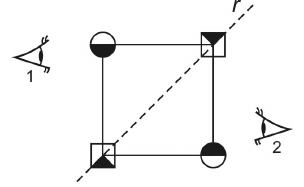
Colocando-se um espelho plano, espelhado em ambos os lados, de dimensões infinitas e de espessura desprezível ao longo da reta r, os observadores colocados nas posições 1 e 2 veriam, respectivamente, objetos completos com as seguintes formas
Nas questões de Física, quando necessário, use
aceleração da gravidade: g = 10 m/s²
densidade da água: d = 1,0 kg/L
calor específico da água: c = 1 cal/g °C
1 cal = 4 J
constante eletrostática: k = 9,0.10⁹ N.m²/C²
constante universal dos gases perfeitos: R = 8 J/mol.K
A figura abaixo mostra uma pequena esfera vazada E, com carga elétrica q = +2,0 · 10⁻⁵ C e massa 80 g, perpassada por um eixo retilíneo situado num plano horizontal e distante D = 3 m de uma carga puntiforme fixa Q = −3,0 · 10⁻⁶ C.
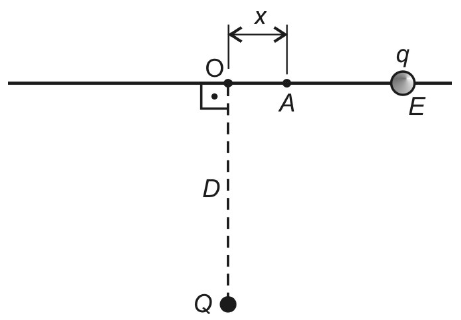
Se a esfera for abandonada, em repouso, no ponto A, a uma distância x, muito próxima da posição de equilíbrio O, tal que, x/D << 1 a esfera passará a oscilar de MHS, em torno de O, cuja pulsação é, em rad/s, igual a
Nas questões de Física, quando necessário, use
aceleração da gravidade: g = 10 m/s²
densidade da água: d = 1,0 kg/L
calor específico da água: c = 1 cal/g °C
1 cal = 4 J
constante eletrostática: k = 9,0.10⁹ N.m²/C²
constante universal dos gases perfeitos: R = 8 J/mol.K
Uma partícula de massa m e carga elétrica −q é lançada com um ângulo θ em relação ao eixo x, com velocidade igual a v⃗₀, numa região onde atuam um campo elétrico E⃗ e um campo gravitacional g⃗, ambos uniformes e constantes, conforme indicado na figura abaixo.
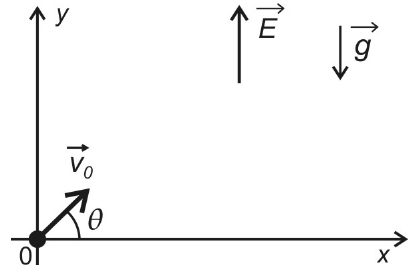
Desprezando interações de quaisquer outras naturezas com essa partícula, o gráfico que melhor representa a variação de sua energia potencial (ΔEₚ) em função da distância (d) percorrida na direção do eixo x, é
Texto-base:
Texto-base:
Texto-base:
Texto-base:
Texto-base:
Texto-base:
Texto-base:
Texto-base:
Texto-base:
Texto-base:
Texto-base:
Texto-base:
Texto-base:
Texto-base:
Texto-base:
Texto-base:
Texto-base:
Texto-base:
Texto-base:
Texto-base: