← Voltar para a lista de provas Instituto Tecnológico de Aeronáutica (ITA) · Vestibular 2016 — Inglês 20 questões nesta prova · 20 com gabarito Gabarito disponível Bolsa de valores não é mencionada no texto. O texto trata de empresas familiares, mão de obra qualificada (shortage of skilled workers) e incentivos fiscais (preferential tax treatment). Os encargos financeiros aparecem nos impostos e nas horas gastas com eles. Não há menção a bolsa de valores. A) Mencionada: controle familiar. B) Mencionada: falta de trabalhadores qualificados. C) Mencionada: tratamento tributário preferencial e isenções fiscais. D) Mencionada: regras tributárias complexas e custo de tributação. Referência: The Economist, Brazil's business Belindia (28/02/2015). Resolução comentada do VaiConcursos. Gabarito disponível A pesquisa de Van Reenen aponta que escolher parentes em vez de gestores qualificados prejudica o desempenho. O texto diz que muitas empresas familiares escolhem parentes em vez de gestores profissionais e que o desempenho sofre. A pesquisa de Van Reenen mostra que as que contratam CEOs externos não vão pior. A) Errada: o texto cita agricultura e aeroespacial como bem-sucedidas. B) Errada: "Belindia" compara a economia, com ilha de prosperidade em mar de pobreza, e não só a produtividade empresarial. D) Errada: as reuniões com políticos são criticadas como perda de tempo. E) Errada: o texto diz que o Brasil caiu de 8 para 7 empresas na Fortune. Referência: The Economist, Brazil's business Belindia (28/02/2015). Resolução comentada do VaiConcursos. Gabarito disponível Gabarito disponível Gabarito disponível A frase da linha 58-59 critica o excesso de proteção estatal. "Coddling by the state can be more a curse than a blessing" expressa diretamente o posicionamento do autor sobre o papel do governo: a proteção excessiva prejudica as empresas. A) Errada: trata de obstáculos em geral. B) Errada: compara notas de gestão, sem falar do governo. C) Errada: trata de controle familiar. D) Errada: critica o curtoprazismo das empresas, não o papel do governo. Referência: The Economist, Brazil's business Belindia (28/02/2015). Resolução comentada do VaiConcursos. Gabarito disponível Bradesco e Arezzo são os exemplos de sucesso sem apoio do Estado. O texto diz que firmas de sucesso estão em setores que o Estado não tentou ajudar, como varejo e finanças, e cita Bradesco e Arezzo como exemplos. Portanto, A. B) Errada: a Petrobras está em escândalos e a Embraer recebeu apoio governamental (ITA). C) Errada: a Embrapa é agência estatal. D) Errada: a Petrobras não é modelo de sucesso. E) Errada: a Usiminas é criticada pelo curto prazo, e a JBS é citada em outro contexto. Referência: The Economist, Brazil's business Belindia (28/02/2015). Resolução comentada do VaiConcursos. Gabarito disponível Gabarito disponível Gabarito disponível Gabarito disponível Gabarito disponível Plunkett foi o responsável pela descoberta do PTFE, resina não corrosiva. O texto diz que Plunkett inventou o Teflon por acidente e que o PTFE descoberto é não corrosivo, entre outras propriedades. Portanto, C está correta. A) Errada: ele buscava refrigerantes não tóxicos, não descobriu substâncias tóxicas. B) Errada: ele já trabalhava na DuPont antes de 1938. D) Errada: o texto não fala em acidente causado pelo armazenamento. E) Errada: o estudo foi transferido a outros químicos, e Plunkett foi promovido a outra divisão. Referência: Texto "Teflon was Invented by Accident" (todayifoundout.com). Resolução comentada do VaiConcursos. Gabarito disponível Ser refrigerante era o uso buscado para o TFE, não uma propriedade do PTFE. As propriedades citadas do PTFE são: muito escorregadio, não corrosivo, quimicamente estável e com ponto de fusão muito alto. "Refrigerante" era a finalidade pretendida para o TFE, não uma propriedade da resina. B) Citada: extremamente escorregadio. C) Citada: quimicamente estável (inerte). D) Citada: ponto de fusão muito alto, ou seja, resistência a altas temperaturas. E) Citada: non-corrosive. Referência: Texto "Teflon was Invented by Accident" (todayifoundout.com). Resolução comentada do VaiConcursos. Gabarito disponível O Teflon foi descoberto por acaso durante pesquisas sobre refrigerantes. Plunkett e Rebok trabalhavam com TFE como possível refrigerante alternativo. Ao abrir um cilindro, encontraram o gás polimerizado em PTFE, a descoberta acidental. A) Errada: o estudo foi transferido para outro departamento e não se afirma que a DuPont o ampliou desde 1938. B) Errada: a venda começou cerca de 1945, e o uso em panelas é que ocorreu nos anos 1960. C) Errada: o estudo foi transferido a um departamento existente, o Central Research Department, e não a um novo. E) Errada: o objetivo inicial era achar refrigerantes não tóxicos, não equipamentos baratos. Referência: Texto "Teflon was Invented by Accident" (todayifoundout.com). Resolução comentada do VaiConcursos. Gabarito disponível O texto não cita a indústria farmacêutica entre as aplicações do Teflon. O texto cita tecido (stain repellant in fabrics), lubrificante automotivo, ignitores de propelentes de foguete e produtos para cabelo. Não há menção a aplicações farmacêuticas. A) Errada: a indústria têxtil usa Teflon em tecidos e carpetes. B) Errada: a automobilística usa lubrificante automotivo e limpadores de para-brisa. C) Errada: a espacial usa ignitores de propelente de foguete. E) Errada: a cosmética usa Teflon em produtos para cabelo. Referência: Texto "Teflon was Invented by Accident" (todayifoundout.com). Resolução comentada do VaiConcursos. Gabarito disponível As pesquisas mostram que a confiabilidade é percebida pela expressão facial. Em todos os estudos, rostos com expressão feliz (e não os de expressão zangada) foram vistos como amigáveis e confiáveis. Portanto, a confiabilidade é avaliada pela expressão facial. A) Errada: os neurocientistas são da Universidade de Nova York, não de empresas de RH. B) Errada: os métodos variaram (fotos reais, rostos gerados por computador, rostos médios). C) Errada: o texto não diz que as pesquisas foram encomendadas por redes sociais. E) Errada: os resultados sobre afetuosidade foram coerentes, não totalmente distintos. Referência: Texto "Your Facial Bone Structure Has a Big Influence on How People See You". Resolução comentada do VaiConcursos. Gabarito disponível A percepção de força depende da estrutura óssea do rosto, não da expressão. O texto afirma que a percepção de habilidades como força física "não depende das expressões faciais, mas sim da estrutura óssea facial" (linhas 11-12). Isso corresponde à alternativa E. A) Errada: o texto não diz que fotos em redes sociais determinam competências de candidatos a emprego. B) Errada: o texto diz que fotos hoje transmitem mais do que as do tempo da Kodak. C) Errada: o texto não diz que a universidade pretende divulgar essas características. D) Errada: condição socioeconômica não é mencionada. Referência: Texto "Your Facial Bone Structure Has a Big Influence on How People See You". Resolução comentada do VaiConcursos. Gabarito disponível Só a sentença II é verdadeira: o segundo estudo acrescentou a avaliação de warmth (afetuosidade). O segundo estudo manteve os mesmos traços do primeiro e acrescentou "warmth", o que torna a II correta. A I é falsa porque o primeiro estudo usou 10 pessoas fotografadas, mas os avaliadores, subjects e experts, eram outros grupos. A III é falsa porque a razão largura/altura foi calculada no primeiro estudo. A IV é falsa porque o quarto estudo usou mais de 100 variações geradas de um único "base face". A) Errada: I e IV são falsas. C) Errada: a III é falsa. D) Errada: a IV é falsa. E) Errada: a IV é falsa e a II é verdadeira. Referência: Texto "Your Facial Bone Structure Has a Big Influence on How People See You". Resolução comentada do VaiConcursos. Gabarito disponível No terceiro estudo, rostos mais largos foram escolhidos como os de campeões de levantamento de peso. O texto diz que os participantes escolheram rostos com expressões mais felizes como consultores financeiros e rostos mais largos ("broader faces") como de campeões de power-lifting. Logo, rostos mais largos indicam pessoas fisicamente mais fortes. A) Errada: a largura do rosto não foi associada à felicidade. B) Errada: rostos mais finos não foram associados a competência. C) Errada: o comprimento do rosto não foi associado a afetuosidade. D) Errada: confiabilidade foi ligada à expressão feliz, não a rostos finos. Referência: Texto "Your Facial Bone Structure Has a Big Influence on How People See You". Resolução comentada do VaiConcursos. Gabarito disponível Gabarito disponível Em A, "more" é advérbio (verbo "convey"), não adjetivo flexionado em grau. Em "convey more... than snapshots", "more" modifica o verbo, portanto é advérbio. Nas demais frases há adjetivos com grau: "best" (superlativo de good), "happier" e "broader" (comparativos de superioridade sintéticos) e "more trustworthy" (comparativo analítico). B) Tem adjetivo: "best" é o superlativo de "good". C) Tem adjetivo: "happier" é comparativo de "happy". D) Tem adjetivo: "broader" é comparativo de "broad". E) Tem adjetivo: "more trustworthy" é comparativo de "trustworthy". Referência: Gramática da língua inglesa: grau dos adjetivos (comparativo e superlativo). Resolução comentada do VaiConcursos.ITA — Vestibular 2016 — Prova de Inglês
1 Brazil’s business Belindia – Why the country produces fewer world-class companies than it should
2
3 BRAZILIANS make up almost 3% of the planet’s population and produce about 3% of its output. Yet of the firms in
4 Fortune magazine’s 2014 “Global 500” ranking of the biggest companies by revenue only seven, or 1.4%, were from
5 Brazil, down from eight in 2013. And on Forbes’s list of the 2,000 most highly valued firms worldwide just 25, or 1.3%,
6 were Brazilian. The country’s biggest corporate “star”, Petrobras, is mired in scandals, its debt downgraded to junk status.
7 In 1974 Edmar Bacha, an economist, described its economy as “Belindia”, a Belgium-sized island of prosperity in a sea of
8 India-like poverty. Since then Brazil has done far better than India in alleviating poverty, but in business terms it still has a
9 Belindia problem: a handful of world-class enterprises in a sea of poorly run ones.
10 Brazilian businesses face a litany of obstacles: bureaucracy, complex tax rules, shoddy infrastructure and a
11 shortage of skilled workers—to say nothing of a stagnant economy. But a big reason for Brazilian firms’
12 underperformance is less well rehearsed: poor management. Since 2004 John van Reenen of the London School of
13 Economics and his colleagues have surveyed 11,300 midsized firms in 34 countries, grading them on a five-point scale
14 based on how well they monitor their operations, set targets and reward performance. Brazilian firms’ average score, at
15 2.7, is similar to that of China’s and a bit above that of India’s. But Brazil ranks below Chile (2.8) and Mexico (2.9);
16 America leads the pack with 3.3. The best Brazilian firms score as well as the best American ones, but its long tail of
17 badly run ones is fatter.
18 Part of the explanation is that medium and large firms tend to be better-organised than small ones, and not only
19 because well-run ones are likelier to grow. Brazil offers incentives aplenty to stay bitty, such as preferential tax treatment
20 for firms with a turnover of no more than 3.6m reais ($1.3m). As they expand, many firms split rather than face increased
21 scrutiny from the taxman. According to the World Bank, a midsized Brazilian firm spends 2,600 hours filing taxes each
22 year. In Mexico, it is 330 hours.
23 Ownership patterns play a part too. Many Brazilian concerns are controlled by an individual shareholder, or one or
24 two families. Two-thirds of those with sales of more than $1 billion a year are family-owned, notes Heinz-Peter Elstrodt of
25 McKinsey, a consulting firm. That is less than in Mexico (96%) or South Korea (84%) but more than in America or Europe.
26 Mr Van Reenen’s research shows that where family owners plump for outside chief executives, their firms do no worse
27 than similarly sized ones with more diverse shareholders. But all too often they pick kin over professional managers—and
28 performance suffers. This is particularly true in “low-trust” societies like Brazil, where bosses hire relatives instead of
29 better-qualified strangers to avoid being robbed or sued for falling foul of overly worker-friendly labour laws.
30 Decades of economic turmoil—which ended when hyperinflation was vanquished in 1994—meant that companies
31 were managed from crisis to crisis. This forced Brazilian firms to be nimble. But it also encouraged short-termism, which
32 management consultants and academics finger as Brazilian managers’ number-one sin. Faced with a record drought in
33 2014, and a subsequent spike in energy prices in a hydropower-dependent country, Usiminas, a steelmaker, stopped
34 smelting and started selling power it had bought on cheap long-term contracts. Energy sales made up most of its
35 operating profits that year. Such short-term stunts are hardly the path to long-term greatness.
36 Worse, crisis management all too often consists of going cap in hand to the government. Brazilian bosses continue
37 to waste hours in meetings with politicians that could be better spent improving their businesses. In January 2014, as
38 vehicle sales flagged, the automotive industry’s reflex reaction was to descend on the capital, Brasília, and demand an
39 extension of its costly tax breaks. Thanks to lifelines cast by the state, feeble firms stay afloat rather than sink and make
40 room for more agile competitors. Shielded from competition by tariffs, subsidies and local-content rules, they have little
41 reason to innovate. A locally invented gizmo which lets cars run on both petrol and biodiesel is nifty. But, asks Marcos
42 Lisboa of Insper, a business school, does that really justify six decades of public support for the motor industry?
43
44 The dead hand of government
45
46 Indeed, a glance at the “Belgian” end of Brazil’s corporate landscape suggests that successful firms cluster in
47 sectors the state has not tried desperately to help, such as retail or finance. Bradesco, a big lender, is internationally
48 praised as a pioneer of automated banking. Each month Arezzo creates 1,000 new models of women’s shoes, and picks
49 170-odd to sell in its shops.
50 Brazil’s other world-beaters are in industries like agriculture and aerospace, which are free to compete at home
51 and abroad, and in which the government sticks to its proper role. In 1990 farms were allowed to consolidate and to buy
52 foreign machines, pesticides and fertiliser. Efforts by Brazil’s trade negotiators opened up export markets. JBS, a meat
53 giant, can slaughter 100,000 head of cattle a day, selling more beef than any rival worldwide. Thanks in part to Embrapa,
54 the national agriculture-research agency, Brazilian farms have been raising productivity by about 4% a year for two
55 decades. Similarly, a supply of skilled engineers and know-how from the government’s Technological Institute of
56 Aeronautics has helped turn Embraer, privatised in 1994, into one of the world’s most successful aircraft-makers.
57 The success of businesses such as these offers a lesson for the state. The best way to make Brazil’s
58 underperforming firms more competitive would be to make them compete more. Coddling by the state can be more a
59 curse than a blessing. Ronald Reagan’s dictum that the nine most terrifying words in the English language are, “I’m from
60 the government and I’m here to help,” translates well into Flemish, Hindi and Brazilian Portuguese.
By Schumpeter. In: The Economist. Feb 28th,2015.
Marque a opção cujo assunto não é mencionado no texto.Resolução comentada
Análise das alternativas
1 Brazil’s business Belindia – Why the country produces fewer world-class companies than it should
2
3 BRAZILIANS make up almost 3% of the planet’s population and produce about 3% of its output. Yet of the firms in
4 Fortune magazine’s 2014 “Global 500” ranking of the biggest companies by revenue only seven, or 1.4%, were from
5 Brazil, down from eight in 2013. And on Forbes’s list of the 2,000 most highly valued firms worldwide just 25, or 1.3%,
6 were Brazilian. The country’s biggest corporate “star”, Petrobras, is mired in scandals, its debt downgraded to junk status.
7 In 1974 Edmar Bacha, an economist, described its economy as “Belindia”, a Belgium-sized island of prosperity in a sea of
8 India-like poverty. Since then Brazil has done far better than India in alleviating poverty, but in business terms it still has a
9 Belindia problem: a handful of world-class enterprises in a sea of poorly run ones.
10 Brazilian businesses face a litany of obstacles: bureaucracy, complex tax rules, shoddy infrastructure and a
11 shortage of skilled workers—to say nothing of a stagnant economy. But a big reason for Brazilian firms’
12 underperformance is less well rehearsed: poor management. Since 2004 John van Reenen of the London School of
13 Economics and his colleagues have surveyed 11,300 midsized firms in 34 countries, grading them on a five-point scale
14 based on how well they monitor their operations, set targets and reward performance. Brazilian firms’ average score, at
15 2.7, is similar to that of China’s and a bit above that of India’s. But Brazil ranks below Chile (2.8) and Mexico (2.9);
16 America leads the pack with 3.3. The best Brazilian firms score as well as the best American ones, but its long tail of
17 badly run ones is fatter.
18 Part of the explanation is that medium and large firms tend to be better-organised than small ones, and not only
19 because well-run ones are likelier to grow. Brazil offers incentives aplenty to stay bitty, such as preferential tax treatment
20 for firms with a turnover of no more than 3.6m reais ($1.3m). As they expand, many firms split rather than face increased
21 scrutiny from the taxman. According to the World Bank, a midsized Brazilian firm spends 2,600 hours filing taxes each
22 year. In Mexico, it is 330 hours.
23 Ownership patterns play a part too. Many Brazilian concerns are controlled by an individual shareholder, or one or
24 two families. Two-thirds of those with sales of more than $1 billion a year are family-owned, notes Heinz-Peter Elstrodt of
25 McKinsey, a consulting firm. That is less than in Mexico (96%) or South Korea (84%) but more than in America or Europe.
26 Mr Van Reenen’s research shows that where family owners plump for outside chief executives, their firms do no worse
27 than similarly sized ones with more diverse shareholders. But all too often they pick kin over professional managers—and
28 performance suffers. This is particularly true in “low-trust” societies like Brazil, where bosses hire relatives instead of
29 better-qualified strangers to avoid being robbed or sued for falling foul of overly worker-friendly labour laws.
30 Decades of economic turmoil—which ended when hyperinflation was vanquished in 1994—meant that companies
31 were managed from crisis to crisis. This forced Brazilian firms to be nimble. But it also encouraged short-termism, which
32 management consultants and academics finger as Brazilian managers’ number-one sin. Faced with a record drought in
33 2014, and a subsequent spike in energy prices in a hydropower-dependent country, Usiminas, a steelmaker, stopped
34 smelting and started selling power it had bought on cheap long-term contracts. Energy sales made up most of its
35 operating profits that year. Such short-term stunts are hardly the path to long-term greatness.
36 Worse, crisis management all too often consists of going cap in hand to the government. Brazilian bosses continue
37 to waste hours in meetings with politicians that could be better spent improving their businesses. In January 2014, as
38 vehicle sales flagged, the automotive industry’s reflex reaction was to descend on the capital, Brasília, and demand an
39 extension of its costly tax breaks. Thanks to lifelines cast by the state, feeble firms stay afloat rather than sink and make
40 room for more agile competitors. Shielded from competition by tariffs, subsidies and local-content rules, they have little
41 reason to innovate. A locally invented gizmo which lets cars run on both petrol and biodiesel is nifty. But, asks Marcos
42 Lisboa of Insper, a business school, does that really justify six decades of public support for the motor industry?
43
44 The dead hand of government
45
46 Indeed, a glance at the “Belgian” end of Brazil’s corporate landscape suggests that successful firms cluster in
47 sectors the state has not tried desperately to help, such as retail or finance. Bradesco, a big lender, is internationally
48 praised as a pioneer of automated banking. Each month Arezzo creates 1,000 new models of women’s shoes, and picks
49 170-odd to sell in its shops.
50 Brazil’s other world-beaters are in industries like agriculture and aerospace, which are free to compete at home
51 and abroad, and in which the government sticks to its proper role. In 1990 farms were allowed to consolidate and to buy
52 foreign machines, pesticides and fertiliser. Efforts by Brazil’s trade negotiators opened up export markets. JBS, a meat
53 giant, can slaughter 100,000 head of cattle a day, selling more beef than any rival worldwide. Thanks in part to Embrapa,
54 the national agriculture-research agency, Brazilian farms have been raising productivity by about 4% a year for two
55 decades. Similarly, a supply of skilled engineers and know-how from the government’s Technological Institute of
56 Aeronautics has helped turn Embraer, privatised in 1994, into one of the world’s most successful aircraft-makers.
57 The success of businesses such as these offers a lesson for the state. The best way to make Brazil’s
58 underperforming firms more competitive would be to make them compete more. Coddling by the state can be more a
59 curse than a blessing. Ronald Reagan’s dictum that the nine most terrifying words in the English language are, “I’m from
60 the government and I’m here to help,” translates well into Flemish, Hindi and Brazilian Portuguese.
By Schumpeter. In: The Economist. Feb 28th,2015.
De acordo com o texto,Resolução comentada
Análise das alternativas
1 Brazil’s business Belindia – Why the country produces fewer world-class companies than it should
2
3 BRAZILIANS make up almost 3% of the planet’s population and produce about 3% of its output. Yet of the firms in
4 Fortune magazine’s 2014 “Global 500” ranking of the biggest companies by revenue only seven, or 1.4%, were from
5 Brazil, down from eight in 2013. And on Forbes’s list of the 2,000 most highly valued firms worldwide just 25, or 1.3%,
6 were Brazilian. The country’s biggest corporate “star”, Petrobras, is mired in scandals, its debt downgraded to junk status.
7 In 1974 Edmar Bacha, an economist, described its economy as “Belindia”, a Belgium-sized island of prosperity in a sea of
8 India-like poverty. Since then Brazil has done far better than India in alleviating poverty, but in business terms it still has a
9 Belindia problem: a handful of world-class enterprises in a sea of poorly run ones.
10 Brazilian businesses face a litany of obstacles: bureaucracy, complex tax rules, shoddy infrastructure and a
11 shortage of skilled workers—to say nothing of a stagnant economy. But a big reason for Brazilian firms’
12 underperformance is less well rehearsed: poor management. Since 2004 John van Reenen of the London School of
13 Economics and his colleagues have surveyed 11,300 midsized firms in 34 countries, grading them on a five-point scale
14 based on how well they monitor their operations, set targets and reward performance. Brazilian firms’ average score, at
15 2.7, is similar to that of China’s and a bit above that of India’s. But Brazil ranks below Chile (2.8) and Mexico (2.9);
16 America leads the pack with 3.3. The best Brazilian firms score as well as the best American ones, but its long tail of
17 badly run ones is fatter.
18 Part of the explanation is that medium and large firms tend to be better-organised than small ones, and not only
19 because well-run ones are likelier to grow. Brazil offers incentives aplenty to stay bitty, such as preferential tax treatment
20 for firms with a turnover of no more than 3.6m reais ($1.3m). As they expand, many firms split rather than face increased
21 scrutiny from the taxman. According to the World Bank, a midsized Brazilian firm spends 2,600 hours filing taxes each
22 year. In Mexico, it is 330 hours.
23 Ownership patterns play a part too. Many Brazilian concerns are controlled by an individual shareholder, or one or
24 two families. Two-thirds of those with sales of more than $1 billion a year are family-owned, notes Heinz-Peter Elstrodt of
25 McKinsey, a consulting firm. That is less than in Mexico (96%) or South Korea (84%) but more than in America or Europe.
26 Mr Van Reenen’s research shows that where family owners plump for outside chief executives, their firms do no worse
27 than similarly sized ones with more diverse shareholders. But all too often they pick kin over professional managers—and
28 performance suffers. This is particularly true in “low-trust” societies like Brazil, where bosses hire relatives instead of
29 better-qualified strangers to avoid being robbed or sued for falling foul of overly worker-friendly labour laws.
30 Decades of economic turmoil—which ended when hyperinflation was vanquished in 1994—meant that companies
31 were managed from crisis to crisis. This forced Brazilian firms to be nimble. But it also encouraged short-termism, which
32 management consultants and academics finger as Brazilian managers’ number-one sin. Faced with a record drought in
33 2014, and a subsequent spike in energy prices in a hydropower-dependent country, Usiminas, a steelmaker, stopped
34 smelting and started selling power it had bought on cheap long-term contracts. Energy sales made up most of its
35 operating profits that year. Such short-term stunts are hardly the path to long-term greatness.
36 Worse, crisis management all too often consists of going cap in hand to the government. Brazilian bosses continue
37 to waste hours in meetings with politicians that could be better spent improving their businesses. In January 2014, as
38 vehicle sales flagged, the automotive industry’s reflex reaction was to descend on the capital, Brasília, and demand an
39 extension of its costly tax breaks. Thanks to lifelines cast by the state, feeble firms stay afloat rather than sink and make
40 room for more agile competitors. Shielded from competition by tariffs, subsidies and local-content rules, they have little
41 reason to innovate. A locally invented gizmo which lets cars run on both petrol and biodiesel is nifty. But, asks Marcos
42 Lisboa of Insper, a business school, does that really justify six decades of public support for the motor industry?
43
44 The dead hand of government
45
46 Indeed, a glance at the “Belgian” end of Brazil’s corporate landscape suggests that successful firms cluster in
47 sectors the state has not tried desperately to help, such as retail or finance. Bradesco, a big lender, is internationally
48 praised as a pioneer of automated banking. Each month Arezzo creates 1,000 new models of women’s shoes, and picks
49 170-odd to sell in its shops.
50 Brazil’s other world-beaters are in industries like agriculture and aerospace, which are free to compete at home
51 and abroad, and in which the government sticks to its proper role. In 1990 farms were allowed to consolidate and to buy
52 foreign machines, pesticides and fertiliser. Efforts by Brazil’s trade negotiators opened up export markets. JBS, a meat
53 giant, can slaughter 100,000 head of cattle a day, selling more beef than any rival worldwide. Thanks in part to Embrapa,
54 the national agriculture-research agency, Brazilian farms have been raising productivity by about 4% a year for two
55 decades. Similarly, a supply of skilled engineers and know-how from the government’s Technological Institute of
56 Aeronautics has helped turn Embraer, privatised in 1994, into one of the world’s most successful aircraft-makers.
57 The success of businesses such as these offers a lesson for the state. The best way to make Brazil’s
58 underperforming firms more competitive would be to make them compete more. Coddling by the state can be more a
59 curse than a blessing. Ronald Reagan’s dictum that the nine most terrifying words in the English language are, “I’m from
60 the government and I’m here to help,” translates well into Flemish, Hindi and Brazilian Portuguese.
By Schumpeter. In: The Economist. Feb 28th,2015.
Marque a opção em que a(s) vírgula(s) sublinhada(s) não demarca(m) um termo ou expressão explicativa.
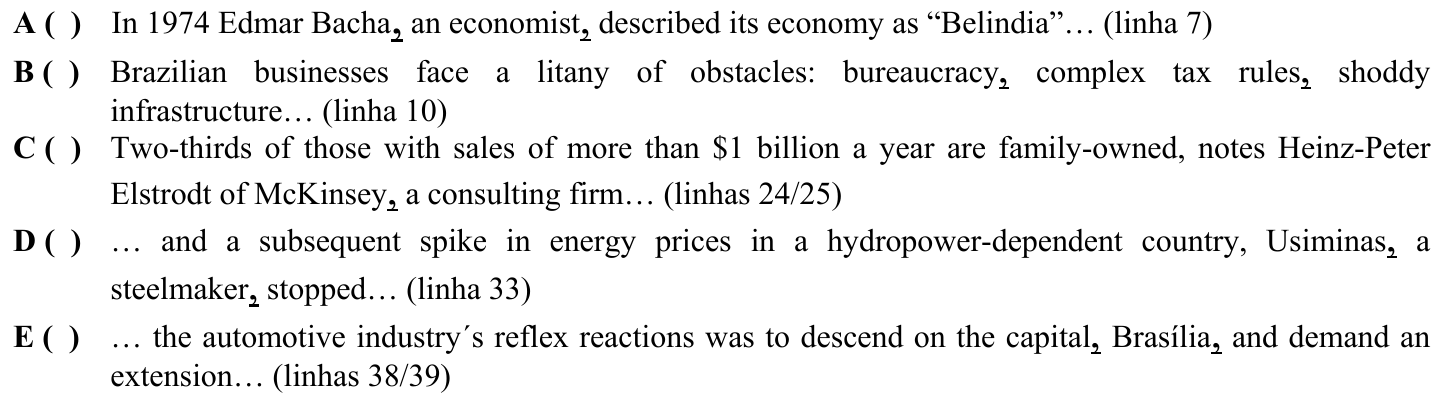
1 Brazil’s business Belindia – Why the country produces fewer world-class companies than it should
2
3 BRAZILIANS make up almost 3% of the planet’s population and produce about 3% of its output. Yet of the firms in
4 Fortune magazine’s 2014 “Global 500” ranking of the biggest companies by revenue only seven, or 1.4%, were from
5 Brazil, down from eight in 2013. And on Forbes’s list of the 2,000 most highly valued firms worldwide just 25, or 1.3%,
6 were Brazilian. The country’s biggest corporate “star”, Petrobras, is mired in scandals, its debt downgraded to junk status.
7 In 1974 Edmar Bacha, an economist, described its economy as “Belindia”, a Belgium-sized island of prosperity in a sea of
8 India-like poverty. Since then Brazil has done far better than India in alleviating poverty, but in business terms it still has a
9 Belindia problem: a handful of world-class enterprises in a sea of poorly run ones.
10 Brazilian businesses face a litany of obstacles: bureaucracy, complex tax rules, shoddy infrastructure and a
11 shortage of skilled workers—to say nothing of a stagnant economy. But a big reason for Brazilian firms’
12 underperformance is less well rehearsed: poor management. Since 2004 John van Reenen of the London School of
13 Economics and his colleagues have surveyed 11,300 midsized firms in 34 countries, grading them on a five-point scale
14 based on how well they monitor their operations, set targets and reward performance. Brazilian firms’ average score, at
15 2.7, is similar to that of China’s and a bit above that of India’s. But Brazil ranks below Chile (2.8) and Mexico (2.9);
16 America leads the pack with 3.3. The best Brazilian firms score as well as the best American ones, but its long tail of
17 badly run ones is fatter.
18 Part of the explanation is that medium and large firms tend to be better-organised than small ones, and not only
19 because well-run ones are likelier to grow. Brazil offers incentives aplenty to stay bitty, such as preferential tax treatment
20 for firms with a turnover of no more than 3.6m reais ($1.3m). As they expand, many firms split rather than face increased
21 scrutiny from the taxman. According to the World Bank, a midsized Brazilian firm spends 2,600 hours filing taxes each
22 year. In Mexico, it is 330 hours.
23 Ownership patterns play a part too. Many Brazilian concerns are controlled by an individual shareholder, or one or
24 two families. Two-thirds of those with sales of more than $1 billion a year are family-owned, notes Heinz-Peter Elstrodt of
25 McKinsey, a consulting firm. That is less than in Mexico (96%) or South Korea (84%) but more than in America or Europe.
26 Mr Van Reenen’s research shows that where family owners plump for outside chief executives, their firms do no worse
27 than similarly sized ones with more diverse shareholders. But all too often they pick kin over professional managers—and
28 performance suffers. This is particularly true in “low-trust” societies like Brazil, where bosses hire relatives instead of
29 better-qualified strangers to avoid being robbed or sued for falling foul of overly worker-friendly labour laws.
30 Decades of economic turmoil—which ended when hyperinflation was vanquished in 1994—meant that companies
31 were managed from crisis to crisis. This forced Brazilian firms to be nimble. But it also encouraged short-termism, which
32 management consultants and academics finger as Brazilian managers’ number-one sin. Faced with a record drought in
33 2014, and a subsequent spike in energy prices in a hydropower-dependent country, Usiminas, a steelmaker, stopped
34 smelting and started selling power it had bought on cheap long-term contracts. Energy sales made up most of its
35 operating profits that year. Such short-term stunts are hardly the path to long-term greatness.
36 Worse, crisis management all too often consists of going cap in hand to the government. Brazilian bosses continue
37 to waste hours in meetings with politicians that could be better spent improving their businesses. In January 2014, as
38 vehicle sales flagged, the automotive industry’s reflex reaction was to descend on the capital, Brasília, and demand an
39 extension of its costly tax breaks. Thanks to lifelines cast by the state, feeble firms stay afloat rather than sink and make
40 room for more agile competitors. Shielded from competition by tariffs, subsidies and local-content rules, they have little
41 reason to innovate. A locally invented gizmo which lets cars run on both petrol and biodiesel is nifty. But, asks Marcos
42 Lisboa of Insper, a business school, does that really justify six decades of public support for the motor industry?
43
44 The dead hand of government
45
46 Indeed, a glance at the “Belgian” end of Brazil’s corporate landscape suggests that successful firms cluster in
47 sectors the state has not tried desperately to help, such as retail or finance. Bradesco, a big lender, is internationally
48 praised as a pioneer of automated banking. Each month Arezzo creates 1,000 new models of women’s shoes, and picks
49 170-odd to sell in its shops.
50 Brazil’s other world-beaters are in industries like agriculture and aerospace, which are free to compete at home
51 and abroad, and in which the government sticks to its proper role. In 1990 farms were allowed to consolidate and to buy
52 foreign machines, pesticides and fertiliser. Efforts by Brazil’s trade negotiators opened up export markets. JBS, a meat
53 giant, can slaughter 100,000 head of cattle a day, selling more beef than any rival worldwide. Thanks in part to Embrapa,
54 the national agriculture-research agency, Brazilian farms have been raising productivity by about 4% a year for two
55 decades. Similarly, a supply of skilled engineers and know-how from the government’s Technological Institute of
56 Aeronautics has helped turn Embraer, privatised in 1994, into one of the world’s most successful aircraft-makers.
57 The success of businesses such as these offers a lesson for the state. The best way to make Brazil’s
58 underperforming firms more competitive would be to make them compete more. Coddling by the state can be more a
59 curse than a blessing. Ronald Reagan’s dictum that the nine most terrifying words in the English language are, “I’m from
60 the government and I’m here to help,” translates well into Flemish, Hindi and Brazilian Portuguese.
By Schumpeter. In: The Economist. Feb 28th,2015.
Os termos sublinhados nas orações abaixo podem ser substituídos, respectivamente, sem que haja prejuízo do sentido, por:
I. Ownership patterns play a part too (linha 23) → as well.
II. Decades of economic turmoil... (linha 30) → growth.
III. Brazilian bosses continue to waste hours in meetings with politicians…(linhas 36/37) → findings.
IV. In January 2014, as vehicle sales flagged… (linha 37/38) → dropped.

Estão corretas
1 Brazil’s business Belindia – Why the country produces fewer world-class companies than it should
2
3 BRAZILIANS make up almost 3% of the planet’s population and produce about 3% of its output. Yet of the firms in
4 Fortune magazine’s 2014 “Global 500” ranking of the biggest companies by revenue only seven, or 1.4%, were from
5 Brazil, down from eight in 2013. And on Forbes’s list of the 2,000 most highly valued firms worldwide just 25, or 1.3%,
6 were Brazilian. The country’s biggest corporate “star”, Petrobras, is mired in scandals, its debt downgraded to junk status.
7 In 1974 Edmar Bacha, an economist, described its economy as “Belindia”, a Belgium-sized island of prosperity in a sea of
8 India-like poverty. Since then Brazil has done far better than India in alleviating poverty, but in business terms it still has a
9 Belindia problem: a handful of world-class enterprises in a sea of poorly run ones.
10 Brazilian businesses face a litany of obstacles: bureaucracy, complex tax rules, shoddy infrastructure and a
11 shortage of skilled workers—to say nothing of a stagnant economy. But a big reason for Brazilian firms’
12 underperformance is less well rehearsed: poor management. Since 2004 John van Reenen of the London School of
13 Economics and his colleagues have surveyed 11,300 midsized firms in 34 countries, grading them on a five-point scale
14 based on how well they monitor their operations, set targets and reward performance. Brazilian firms’ average score, at
15 2.7, is similar to that of China’s and a bit above that of India’s. But Brazil ranks below Chile (2.8) and Mexico (2.9);
16 America leads the pack with 3.3. The best Brazilian firms score as well as the best American ones, but its long tail of
17 badly run ones is fatter.
18 Part of the explanation is that medium and large firms tend to be better-organised than small ones, and not only
19 because well-run ones are likelier to grow. Brazil offers incentives aplenty to stay bitty, such as preferential tax treatment
20 for firms with a turnover of no more than 3.6m reais ($1.3m). As they expand, many firms split rather than face increased
21 scrutiny from the taxman. According to the World Bank, a midsized Brazilian firm spends 2,600 hours filing taxes each
22 year. In Mexico, it is 330 hours.
23 Ownership patterns play a part too. Many Brazilian concerns are controlled by an individual shareholder, or one or
24 two families. Two-thirds of those with sales of more than $1 billion a year are family-owned, notes Heinz-Peter Elstrodt of
25 McKinsey, a consulting firm. That is less than in Mexico (96%) or South Korea (84%) but more than in America or Europe.
26 Mr Van Reenen’s research shows that where family owners plump for outside chief executives, their firms do no worse
27 than similarly sized ones with more diverse shareholders. But all too often they pick kin over professional managers—and
28 performance suffers. This is particularly true in “low-trust” societies like Brazil, where bosses hire relatives instead of
29 better-qualified strangers to avoid being robbed or sued for falling foul of overly worker-friendly labour laws.
30 Decades of economic turmoil—which ended when hyperinflation was vanquished in 1994—meant that companies
31 were managed from crisis to crisis. This forced Brazilian firms to be nimble. But it also encouraged short-termism, which
32 management consultants and academics finger as Brazilian managers’ number-one sin. Faced with a record drought in
33 2014, and a subsequent spike in energy prices in a hydropower-dependent country, Usiminas, a steelmaker, stopped
34 smelting and started selling power it had bought on cheap long-term contracts. Energy sales made up most of its
35 operating profits that year. Such short-term stunts are hardly the path to long-term greatness.
36 Worse, crisis management all too often consists of going cap in hand to the government. Brazilian bosses continue
37 to waste hours in meetings with politicians that could be better spent improving their businesses. In January 2014, as
38 vehicle sales flagged, the automotive industry’s reflex reaction was to descend on the capital, Brasília, and demand an
39 extension of its costly tax breaks. Thanks to lifelines cast by the state, feeble firms stay afloat rather than sink and make
40 room for more agile competitors. Shielded from competition by tariffs, subsidies and local-content rules, they have little
41 reason to innovate. A locally invented gizmo which lets cars run on both petrol and biodiesel is nifty. But, asks Marcos
42 Lisboa of Insper, a business school, does that really justify six decades of public support for the motor industry?
43
44 The dead hand of government
45
46 Indeed, a glance at the “Belgian” end of Brazil’s corporate landscape suggests that successful firms cluster in
47 sectors the state has not tried desperately to help, such as retail or finance. Bradesco, a big lender, is internationally
48 praised as a pioneer of automated banking. Each month Arezzo creates 1,000 new models of women’s shoes, and picks
49 170-odd to sell in its shops.
50 Brazil’s other world-beaters are in industries like agriculture and aerospace, which are free to compete at home
51 and abroad, and in which the government sticks to its proper role. In 1990 farms were allowed to consolidate and to buy
52 foreign machines, pesticides and fertiliser. Efforts by Brazil’s trade negotiators opened up export markets. JBS, a meat
53 giant, can slaughter 100,000 head of cattle a day, selling more beef than any rival worldwide. Thanks in part to Embrapa,
54 the national agriculture-research agency, Brazilian farms have been raising productivity by about 4% a year for two
55 decades. Similarly, a supply of skilled engineers and know-how from the government’s Technological Institute of
56 Aeronautics has helped turn Embraer, privatised in 1994, into one of the world’s most successful aircraft-makers.
57 The success of businesses such as these offers a lesson for the state. The best way to make Brazil’s
58 underperforming firms more competitive would be to make them compete more. Coddling by the state can be more a
59 curse than a blessing. Ronald Reagan’s dictum that the nine most terrifying words in the English language are, “I’m from
60 the government and I’m here to help,” translates well into Flemish, Hindi and Brazilian Portuguese.
By Schumpeter. In: The Economist. Feb 28th,2015.
Marque, dentre as frases extraídas do texto, aquela que expressa o posicionamento do autor com relação ao papel do governo na gestão de empresas brasileiras.Resolução comentada
Análise das alternativas
1 Brazil’s business Belindia – Why the country produces fewer world-class companies than it should
2
3 BRAZILIANS make up almost 3% of the planet’s population and produce about 3% of its output. Yet of the firms in
4 Fortune magazine’s 2014 “Global 500” ranking of the biggest companies by revenue only seven, or 1.4%, were from
5 Brazil, down from eight in 2013. And on Forbes’s list of the 2,000 most highly valued firms worldwide just 25, or 1.3%,
6 were Brazilian. The country’s biggest corporate “star”, Petrobras, is mired in scandals, its debt downgraded to junk status.
7 In 1974 Edmar Bacha, an economist, described its economy as “Belindia”, a Belgium-sized island of prosperity in a sea of
8 India-like poverty. Since then Brazil has done far better than India in alleviating poverty, but in business terms it still has a
9 Belindia problem: a handful of world-class enterprises in a sea of poorly run ones.
10 Brazilian businesses face a litany of obstacles: bureaucracy, complex tax rules, shoddy infrastructure and a
11 shortage of skilled workers—to say nothing of a stagnant economy. But a big reason for Brazilian firms’
12 underperformance is less well rehearsed: poor management. Since 2004 John van Reenen of the London School of
13 Economics and his colleagues have surveyed 11,300 midsized firms in 34 countries, grading them on a five-point scale
14 based on how well they monitor their operations, set targets and reward performance. Brazilian firms’ average score, at
15 2.7, is similar to that of China’s and a bit above that of India’s. But Brazil ranks below Chile (2.8) and Mexico (2.9);
16 America leads the pack with 3.3. The best Brazilian firms score as well as the best American ones, but its long tail of
17 badly run ones is fatter.
18 Part of the explanation is that medium and large firms tend to be better-organised than small ones, and not only
19 because well-run ones are likelier to grow. Brazil offers incentives aplenty to stay bitty, such as preferential tax treatment
20 for firms with a turnover of no more than 3.6m reais ($1.3m). As they expand, many firms split rather than face increased
21 scrutiny from the taxman. According to the World Bank, a midsized Brazilian firm spends 2,600 hours filing taxes each
22 year. In Mexico, it is 330 hours.
23 Ownership patterns play a part too. Many Brazilian concerns are controlled by an individual shareholder, or one or
24 two families. Two-thirds of those with sales of more than $1 billion a year are family-owned, notes Heinz-Peter Elstrodt of
25 McKinsey, a consulting firm. That is less than in Mexico (96%) or South Korea (84%) but more than in America or Europe.
26 Mr Van Reenen’s research shows that where family owners plump for outside chief executives, their firms do no worse
27 than similarly sized ones with more diverse shareholders. But all too often they pick kin over professional managers—and
28 performance suffers. This is particularly true in “low-trust” societies like Brazil, where bosses hire relatives instead of
29 better-qualified strangers to avoid being robbed or sued for falling foul of overly worker-friendly labour laws.
30 Decades of economic turmoil—which ended when hyperinflation was vanquished in 1994—meant that companies
31 were managed from crisis to crisis. This forced Brazilian firms to be nimble. But it also encouraged short-termism, which
32 management consultants and academics finger as Brazilian managers’ number-one sin. Faced with a record drought in
33 2014, and a subsequent spike in energy prices in a hydropower-dependent country, Usiminas, a steelmaker, stopped
34 smelting and started selling power it had bought on cheap long-term contracts. Energy sales made up most of its
35 operating profits that year. Such short-term stunts are hardly the path to long-term greatness.
36 Worse, crisis management all too often consists of going cap in hand to the government. Brazilian bosses continue
37 to waste hours in meetings with politicians that could be better spent improving their businesses. In January 2014, as
38 vehicle sales flagged, the automotive industry’s reflex reaction was to descend on the capital, Brasília, and demand an
39 extension of its costly tax breaks. Thanks to lifelines cast by the state, feeble firms stay afloat rather than sink and make
40 room for more agile competitors. Shielded from competition by tariffs, subsidies and local-content rules, they have little
41 reason to innovate. A locally invented gizmo which lets cars run on both petrol and biodiesel is nifty. But, asks Marcos
42 Lisboa of Insper, a business school, does that really justify six decades of public support for the motor industry?
43
44 The dead hand of government
45
46 Indeed, a glance at the “Belgian” end of Brazil’s corporate landscape suggests that successful firms cluster in
47 sectors the state has not tried desperately to help, such as retail or finance. Bradesco, a big lender, is internationally
48 praised as a pioneer of automated banking. Each month Arezzo creates 1,000 new models of women’s shoes, and picks
49 170-odd to sell in its shops.
50 Brazil’s other world-beaters are in industries like agriculture and aerospace, which are free to compete at home
51 and abroad, and in which the government sticks to its proper role. In 1990 farms were allowed to consolidate and to buy
52 foreign machines, pesticides and fertiliser. Efforts by Brazil’s trade negotiators opened up export markets. JBS, a meat
53 giant, can slaughter 100,000 head of cattle a day, selling more beef than any rival worldwide. Thanks in part to Embrapa,
54 the national agriculture-research agency, Brazilian farms have been raising productivity by about 4% a year for two
55 decades. Similarly, a supply of skilled engineers and know-how from the government’s Technological Institute of
56 Aeronautics has helped turn Embraer, privatised in 1994, into one of the world’s most successful aircraft-makers.
57 The success of businesses such as these offers a lesson for the state. The best way to make Brazil’s
58 underperforming firms more competitive would be to make them compete more. Coddling by the state can be more a
59 curse than a blessing. Ronald Reagan’s dictum that the nine most terrifying words in the English language are, “I’m from
60 the government and I’m here to help,” translates well into Flemish, Hindi and Brazilian Portuguese.
By Schumpeter. In: The Economist. Feb 28th,2015.
O texto apresenta como modelos de gestão bem sucedida e independente de auxílio do governo as empresasResolução comentada
Análise das alternativas
1 Brazil’s business Belindia – Why the country produces fewer world-class companies than it should
2
3 BRAZILIANS make up almost 3% of the planet’s population and produce about 3% of its output. Yet of the firms in
4 Fortune magazine’s 2014 “Global 500” ranking of the biggest companies by revenue only seven, or 1.4%, were from
5 Brazil, down from eight in 2013. And on Forbes’s list of the 2,000 most highly valued firms worldwide just 25, or 1.3%,
6 were Brazilian. The country’s biggest corporate “star”, Petrobras, is mired in scandals, its debt downgraded to junk status.
7 In 1974 Edmar Bacha, an economist, described its economy as “Belindia”, a Belgium-sized island of prosperity in a sea of
8 India-like poverty. Since then Brazil has done far better than India in alleviating poverty, but in business terms it still has a
9 Belindia problem: a handful of world-class enterprises in a sea of poorly run ones.
10 Brazilian businesses face a litany of obstacles: bureaucracy, complex tax rules, shoddy infrastructure and a
11 shortage of skilled workers—to say nothing of a stagnant economy. But a big reason for Brazilian firms’
12 underperformance is less well rehearsed: poor management. Since 2004 John van Reenen of the London School of
13 Economics and his colleagues have surveyed 11,300 midsized firms in 34 countries, grading them on a five-point scale
14 based on how well they monitor their operations, set targets and reward performance. Brazilian firms’ average score, at
15 2.7, is similar to that of China’s and a bit above that of India’s. But Brazil ranks below Chile (2.8) and Mexico (2.9);
16 America leads the pack with 3.3. The best Brazilian firms score as well as the best American ones, but its long tail of
17 badly run ones is fatter.
18 Part of the explanation is that medium and large firms tend to be better-organised than small ones, and not only
19 because well-run ones are likelier to grow. Brazil offers incentives aplenty to stay bitty, such as preferential tax treatment
20 for firms with a turnover of no more than 3.6m reais ($1.3m). As they expand, many firms split rather than face increased
21 scrutiny from the taxman. According to the World Bank, a midsized Brazilian firm spends 2,600 hours filing taxes each
22 year. In Mexico, it is 330 hours.
23 Ownership patterns play a part too. Many Brazilian concerns are controlled by an individual shareholder, or one or
24 two families. Two-thirds of those with sales of more than $1 billion a year are family-owned, notes Heinz-Peter Elstrodt of
25 McKinsey, a consulting firm. That is less than in Mexico (96%) or South Korea (84%) but more than in America or Europe.
26 Mr Van Reenen’s research shows that where family owners plump for outside chief executives, their firms do no worse
27 than similarly sized ones with more diverse shareholders. But all too often they pick kin over professional managers—and
28 performance suffers. This is particularly true in “low-trust” societies like Brazil, where bosses hire relatives instead of
29 better-qualified strangers to avoid being robbed or sued for falling foul of overly worker-friendly labour laws.
30 Decades of economic turmoil—which ended when hyperinflation was vanquished in 1994—meant that companies
31 were managed from crisis to crisis. This forced Brazilian firms to be nimble. But it also encouraged short-termism, which
32 management consultants and academics finger as Brazilian managers’ number-one sin. Faced with a record drought in
33 2014, and a subsequent spike in energy prices in a hydropower-dependent country, Usiminas, a steelmaker, stopped
34 smelting and started selling power it had bought on cheap long-term contracts. Energy sales made up most of its
35 operating profits that year. Such short-term stunts are hardly the path to long-term greatness.
36 Worse, crisis management all too often consists of going cap in hand to the government. Brazilian bosses continue
37 to waste hours in meetings with politicians that could be better spent improving their businesses. In January 2014, as
38 vehicle sales flagged, the automotive industry’s reflex reaction was to descend on the capital, Brasília, and demand an
39 extension of its costly tax breaks. Thanks to lifelines cast by the state, feeble firms stay afloat rather than sink and make
40 room for more agile competitors. Shielded from competition by tariffs, subsidies and local-content rules, they have little
41 reason to innovate. A locally invented gizmo which lets cars run on both petrol and biodiesel is nifty. But, asks Marcos
42 Lisboa of Insper, a business school, does that really justify six decades of public support for the motor industry?
43
44 The dead hand of government
45
46 Indeed, a glance at the “Belgian” end of Brazil’s corporate landscape suggests that successful firms cluster in
47 sectors the state has not tried desperately to help, such as retail or finance. Bradesco, a big lender, is internationally
48 praised as a pioneer of automated banking. Each month Arezzo creates 1,000 new models of women’s shoes, and picks
49 170-odd to sell in its shops.
50 Brazil’s other world-beaters are in industries like agriculture and aerospace, which are free to compete at home
51 and abroad, and in which the government sticks to its proper role. In 1990 farms were allowed to consolidate and to buy
52 foreign machines, pesticides and fertiliser. Efforts by Brazil’s trade negotiators opened up export markets. JBS, a meat
53 giant, can slaughter 100,000 head of cattle a day, selling more beef than any rival worldwide. Thanks in part to Embrapa,
54 the national agriculture-research agency, Brazilian farms have been raising productivity by about 4% a year for two
55 decades. Similarly, a supply of skilled engineers and know-how from the government’s Technological Institute of
56 Aeronautics has helped turn Embraer, privatised in 1994, into one of the world’s most successful aircraft-makers.
57 The success of businesses such as these offers a lesson for the state. The best way to make Brazil’s
58 underperforming firms more competitive would be to make them compete more. Coddling by the state can be more a
59 curse than a blessing. Ronald Reagan’s dictum that the nine most terrifying words in the English language are, “I’m from
60 the government and I’m here to help,” translates well into Flemish, Hindi and Brazilian Portuguese.
By Schumpeter. In: The Economist. Feb 28th,2015.
Considere as seguintes afirmativas:
I. Em “This forced Brazilian firms to be nimble. But it also encouraged short-termism, which management consultants...” (linhas 31/32), os pronomes sublinhados possuem o mesmo referente.
II. Em “The best Brazilian firms score as well as the best American ones...” (linha 16) e em “Brazil offers incentives aplenty to stay bitty, such as preferential tax treatment…” (linha 19) os termos sublinhados têm o mesmo sentido.
III. Em “This is particularly true in “low-trust” societies like Brazil…” (linha 28) e em “Bradesco, a big lender, is internationally praised as a pioneer…” (linhas 47/48) os termos sublinhados têm o mesmo sentido.
IV. Em “...which ended when hyperinflation was vanquished in 1994” (linha 30) e em “…the automotive industry’s reflex reaction was to descend on the capital…” (linha 38), as formas verbais sublinhadas estão na voz passiva.
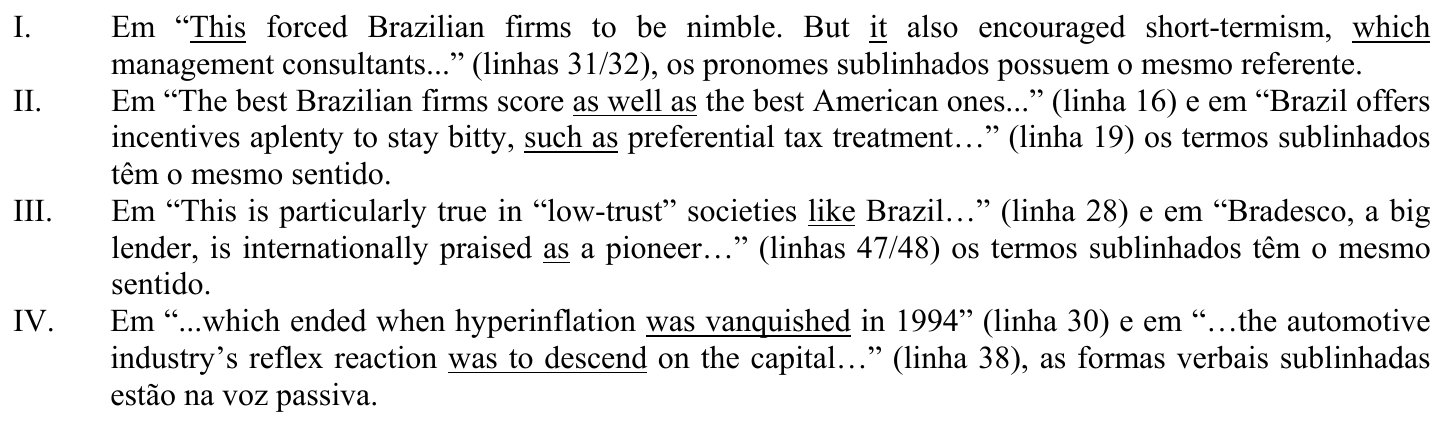
Está(ão) correta(s)
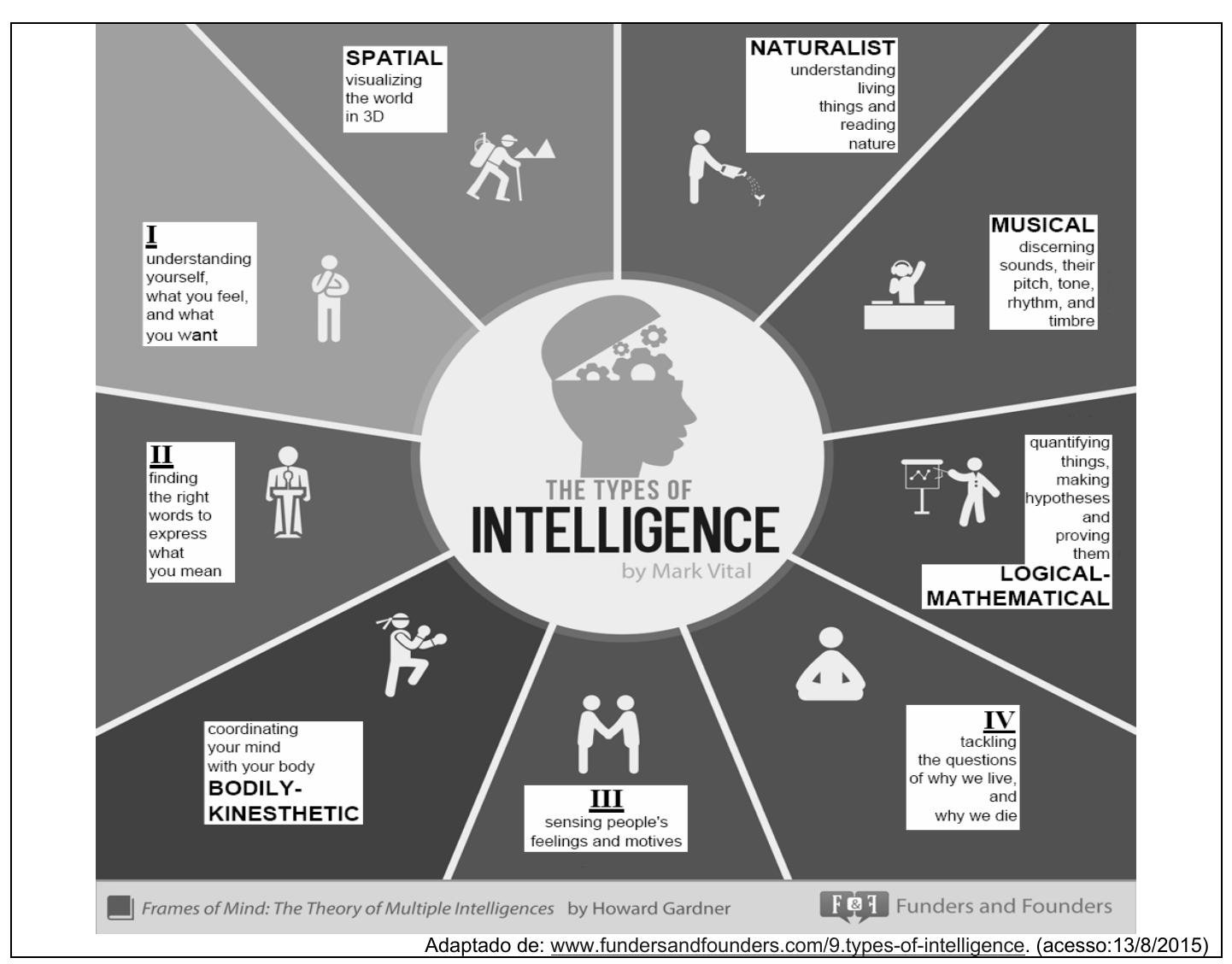
Os tipos de inteligência que se associam às definições I, II, III e IV da figura são, respectivamente:
De acordo com a descrição dos tipos de inteligência apresentados na figura,
Considere as seguintes construções léxico-gramaticais da figura:
I. O uso do -ing mostra que os tipos de inteligência são momentâneos.
II. O uso dos pronomes you, we, your, yourself possibilita identificação dos leitores com a figura.
III. Os pronomes what e why têm função interrogativa.
Está(ão) correta(s)
1 Teflon was Invented by Accident
2
3 Today I found out Teflon was invented by accident.
4 The man who accidentally invented it was Dr. Roy Plunkett. After receiving his BA, MS, and eventually PhD in
5 organic chemistry, Dr. Plunkett took a job with DuPont, in Jackson New Jersey. He was subsequently assigned to work
6 on synthesizing various new forms of refrigerant, trying to find a non-toxic alternative to refrigerants like sulfur dioxide and
7 ammonia.
8 According to DuPont, in 1938, 27 year old Dr. Plunkett and his assistant, Jack Rebok, were experimenting with
9 one such potential alternative refrigerant, tetrafluorethylene (TFE). Dr. Plunkett subsequently created around 100 pounds
10 of TFE and stored the gas in small cylinders.
11 On April 6, 1938, upon opening the valve on one of the pressurized cylinders of TFE that had previously been
12 frozen, nothing came out, even though by its weight, it seemed to still be full. Dr. Plunkett and Jack Rebok then decided
13 to investigate further by cutting the cylinder open. Once they managed to get it open, they discovered that the TFE gas
14 inside had polymerized into a waxy white powder, polytetrafluoroethylene (PTFE) resin.
15 Ever the scientist, Plunkett then proceeded to run tests on this new substance to see if it had any unique or useful
16 properties. Four of the most important properties of this substance discovered were that it was extremely slippery (one of
17 the slipperiest substances known to man), non-corrosive, chemically stable, and that it had an extremely high melting
18 point. These properties were deemed interesting enough that the study of the substance was transferred to DuPont’s
19 Central Research Department and assigned to chemists that had special experience in polymer research and
20 development, while Dr. Plunkett was then promoted and transferred to a separate division that produced tetraethyl (sic),
21 used to boost gasoline octane levels.
22 Three years later, the process and name of Teflon were patented and trademarked. Four years after that, Teflon
23 first began being sold, initially only used for various industrial and military applications due to the expense of producing
24 TFE. By the 1960s, various forms of Teflon were being used in a variety of applications, such as stain repellant in fabrics
25 and electrical wire insulation. It was also in the 1960s that Teflon began being used in its most publicly known application,
26 as a coating for non-stick pans. Today, Teflon or other brands of the same product are also used in windshield wipers;
27 carpets and furniture (as a stain repellant); light bulbs; coating on glasses; in various hair products; in semiconductor
28 manufacturing; automotive lubricant; igniters for solid-fuel rocket propellants; and in infrared decoy flares, among other
29 things.
Adaptado de www.todayIfoundout.com (acesso em 19/07/2015).
De acordo com o texto, pode-se afirmar que Dr. Roy PlunkettResolução comentada
Análise das alternativas
1 Teflon was Invented by Accident
2
3 Today I found out Teflon was invented by accident.
4 The man who accidentally invented it was Dr. Roy Plunkett. After receiving his BA, MS, and eventually PhD in
5 organic chemistry, Dr. Plunkett took a job with DuPont, in Jackson New Jersey. He was subsequently assigned to work
6 on synthesizing various new forms of refrigerant, trying to find a non-toxic alternative to refrigerants like sulfur dioxide and
7 ammonia.
8 According to DuPont, in 1938, 27 year old Dr. Plunkett and his assistant, Jack Rebok, were experimenting with
9 one such potential alternative refrigerant, tetrafluorethylene (TFE). Dr. Plunkett subsequently created around 100 pounds
10 of TFE and stored the gas in small cylinders.
11 On April 6, 1938, upon opening the valve on one of the pressurized cylinders of TFE that had previously been
12 frozen, nothing came out, even though by its weight, it seemed to still be full. Dr. Plunkett and Jack Rebok then decided
13 to investigate further by cutting the cylinder open. Once they managed to get it open, they discovered that the TFE gas
14 inside had polymerized into a waxy white powder, polytetrafluoroethylene (PTFE) resin.
15 Ever the scientist, Plunkett then proceeded to run tests on this new substance to see if it had any unique or useful
16 properties. Four of the most important properties of this substance discovered were that it was extremely slippery (one of
17 the slipperiest substances known to man), non-corrosive, chemically stable, and that it had an extremely high melting
18 point. These properties were deemed interesting enough that the study of the substance was transferred to DuPont’s
19 Central Research Department and assigned to chemists that had special experience in polymer research and
20 development, while Dr. Plunkett was then promoted and transferred to a separate division that produced tetraethyl (sic),
21 used to boost gasoline octane levels.
22 Three years later, the process and name of Teflon were patented and trademarked. Four years after that, Teflon
23 first began being sold, initially only used for various industrial and military applications due to the expense of producing
24 TFE. By the 1960s, various forms of Teflon were being used in a variety of applications, such as stain repellant in fabrics
25 and electrical wire insulation. It was also in the 1960s that Teflon began being used in its most publicly known application,
26 as a coating for non-stick pans. Today, Teflon or other brands of the same product are also used in windshield wipers;
27 carpets and furniture (as a stain repellant); light bulbs; coating on glasses; in various hair products; in semiconductor
28 manufacturing; automotive lubricant; igniters for solid-fuel rocket propellants; and in infrared decoy flares, among other
29 things.
Adaptado de www.todayIfoundout.com (acesso em 19/07/2015).
Dentre as propriedades da resina PTFE citadas no texto, não se inclui aResolução comentada
Análise das alternativas
1 Teflon was Invented by Accident
2
3 Today I found out Teflon was invented by accident.
4 The man who accidentally invented it was Dr. Roy Plunkett. After receiving his BA, MS, and eventually PhD in
5 organic chemistry, Dr. Plunkett took a job with DuPont, in Jackson New Jersey. He was subsequently assigned to work
6 on synthesizing various new forms of refrigerant, trying to find a non-toxic alternative to refrigerants like sulfur dioxide and
7 ammonia.
8 According to DuPont, in 1938, 27 year old Dr. Plunkett and his assistant, Jack Rebok, were experimenting with
9 one such potential alternative refrigerant, tetrafluorethylene (TFE). Dr. Plunkett subsequently created around 100 pounds
10 of TFE and stored the gas in small cylinders.
11 On April 6, 1938, upon opening the valve on one of the pressurized cylinders of TFE that had previously been
12 frozen, nothing came out, even though by its weight, it seemed to still be full. Dr. Plunkett and Jack Rebok then decided
13 to investigate further by cutting the cylinder open. Once they managed to get it open, they discovered that the TFE gas
14 inside had polymerized into a waxy white powder, polytetrafluoroethylene (PTFE) resin.
15 Ever the scientist, Plunkett then proceeded to run tests on this new substance to see if it had any unique or useful
16 properties. Four of the most important properties of this substance discovered were that it was extremely slippery (one of
17 the slipperiest substances known to man), non-corrosive, chemically stable, and that it had an extremely high melting
18 point. These properties were deemed interesting enough that the study of the substance was transferred to DuPont’s
19 Central Research Department and assigned to chemists that had special experience in polymer research and
20 development, while Dr. Plunkett was then promoted and transferred to a separate division that produced tetraethyl (sic),
21 used to boost gasoline octane levels.
22 Three years later, the process and name of Teflon were patented and trademarked. Four years after that, Teflon
23 first began being sold, initially only used for various industrial and military applications due to the expense of producing
24 TFE. By the 1960s, various forms of Teflon were being used in a variety of applications, such as stain repellant in fabrics
25 and electrical wire insulation. It was also in the 1960s that Teflon began being used in its most publicly known application,
26 as a coating for non-stick pans. Today, Teflon or other brands of the same product are also used in windshield wipers;
27 carpets and furniture (as a stain repellant); light bulbs; coating on glasses; in various hair products; in semiconductor
28 manufacturing; automotive lubricant; igniters for solid-fuel rocket propellants; and in infrared decoy flares, among other
29 things.
Adaptado de www.todayIfoundout.com (acesso em 19/07/2015).
De acordo com o texto,Resolução comentada
Análise das alternativas
1 Teflon was Invented by Accident
2
3 Today I found out Teflon was invented by accident.
4 The man who accidentally invented it was Dr. Roy Plunkett. After receiving his BA, MS, and eventually PhD in
5 organic chemistry, Dr. Plunkett took a job with DuPont, in Jackson New Jersey. He was subsequently assigned to work
6 on synthesizing various new forms of refrigerant, trying to find a non-toxic alternative to refrigerants like sulfur dioxide and
7 ammonia.
8 According to DuPont, in 1938, 27 year old Dr. Plunkett and his assistant, Jack Rebok, were experimenting with
9 one such potential alternative refrigerant, tetrafluorethylene (TFE). Dr. Plunkett subsequently created around 100 pounds
10 of TFE and stored the gas in small cylinders.
11 On April 6, 1938, upon opening the valve on one of the pressurized cylinders of TFE that had previously been
12 frozen, nothing came out, even though by its weight, it seemed to still be full. Dr. Plunkett and Jack Rebok then decided
13 to investigate further by cutting the cylinder open. Once they managed to get it open, they discovered that the TFE gas
14 inside had polymerized into a waxy white powder, polytetrafluoroethylene (PTFE) resin.
15 Ever the scientist, Plunkett then proceeded to run tests on this new substance to see if it had any unique or useful
16 properties. Four of the most important properties of this substance discovered were that it was extremely slippery (one of
17 the slipperiest substances known to man), non-corrosive, chemically stable, and that it had an extremely high melting
18 point. These properties were deemed interesting enough that the study of the substance was transferred to DuPont’s
19 Central Research Department and assigned to chemists that had special experience in polymer research and
20 development, while Dr. Plunkett was then promoted and transferred to a separate division that produced tetraethyl (sic),
21 used to boost gasoline octane levels.
22 Three years later, the process and name of Teflon were patented and trademarked. Four years after that, Teflon
23 first began being sold, initially only used for various industrial and military applications due to the expense of producing
24 TFE. By the 1960s, various forms of Teflon were being used in a variety of applications, such as stain repellant in fabrics
25 and electrical wire insulation. It was also in the 1960s that Teflon began being used in its most publicly known application,
26 as a coating for non-stick pans. Today, Teflon or other brands of the same product are also used in windshield wipers;
27 carpets and furniture (as a stain repellant); light bulbs; coating on glasses; in various hair products; in semiconductor
28 manufacturing; automotive lubricant; igniters for solid-fuel rocket propellants; and in infrared decoy flares, among other
29 things.
Adaptado de www.todayIfoundout.com (acesso em 19/07/2015).
De acordo com o texto, o tipo de indústria que não se beneficia com as propriedades do Teflon é a indústriaResolução comentada
Análise das alternativas
1 Your Facial Bone Structure Has a Big Influence on How People See You
2
3 (…) Selfies, headshots, mug shots — photos of oneself convey more these days than snapshots ever did back in
4 the Kodak era. Most digitally minded people continually post and update pictures of themselves at professional, social
5 media and dating sites such as LinkedIn, Facebook, Match.com and Tinder. For better or worse, viewers then tend to
6 make snap judgments about someone’s personality or character from a single shot. As such, it can be a stressful task to
7 select the photo that conveys the best impression of ourselves. For those of us seeking to appear friendly and trustworthy
8 to others, a new study underscores an old, chipper piece of advice: Put on a happy face.
9 A newly published series of experiments by cognitive neuroscientists at New York University is reinforcing the
10 relevance of facial expressions to perceptions of characteristics such as trustworthiness and friendliness. More
11 importantly, the research also revealed the unexpected finding that perceptions of abilities such as physical strength are
12 not dependent on facial expressions but rather on facial bone structure.
13 The team’s first experiment featured photographs of 10 different people presenting five different facial expressions
14 each. Study subjects rated how friendly, trustworthy or strong the person in each photo appeared. A separate group of
15 subjects scored each face on an emotional scale from “very angry” to “very happy.” And three experts not involved in
16 either of the previous two ratings to avoid confounding results calculated the facial width-to-height ratio for each face. An
17 analysis revealed that participants generally ranked people with a happy expression as friendly and trustworthy but not
18 those with angry expressions. Surprisingly, participants did not rank faces as indicative of physical strength based on
19 facial expression but graded faces that were very broad as that of a strong individual.
20 In a second survey facial expression and facial structure were manipulated in computer-generated faces.
21 Participants rated each face for the same traits as in the first survey, with the addition of a rating for warmth. Again,
22 people thought a happy expression, but not an angry one, indicated friendliness, trustworthiness — and in this case,
23 warmth. The researchers then showed two additional sets of participants the same faces, this time either with areas
24 relevant to facial expressions obscured or the width cropped. In the first variation, for faces lacking emotional cues,
25 people could no longer perceive personality traits but could still perceive strength based on width. Similarly, for those
26 faces lacking structural cues, people could no longer perceive strength but could still perceive personality traits based on
27 facial expressions.
28 In a third iteration of the survey participants had to pick four faces out of a lineup of eight faces varied for
29 expression and width that they might select either as their financial advisor or as the winner of a power-lifting competition.
30 As might be expected, participants picked faces with happier expressions as financial advisors and selected broader
31 faces as belonging to power-lifting champs.
32 In a final survey the researchers generated more than 100 variations of one individual “base face” by varying facial
33 features. Participants saw two faces at a time, and then picked one as either trustworthy or high in ability or as a good
34 financial advisor or power-lifting winner. Using these results, a computer then created an average face for each of these
35 four categories, which were shown to a separate set of participants who had to pick which face appeared either more
36 trustworthy or stronger. Most of the participants found the computer-generated averages to be good representations of
37 trustworthiness or strength — and generally saw the average “financial advisor” face as more trustworthy and the “power-
38 lifter” face as stronger. The findings from all four surveys were published in the Personality and Social Psychology Bulletin
39 on June 18.
Adaptado de www.scientific.american.com/article/your-facial-bone-strecture-has-a-big-influence-on-how-people-see-you.(acesso em 20/8/2015)
De acordo com o texto,Resolução comentada
Análise das alternativas
1 Your Facial Bone Structure Has a Big Influence on How People See You
2
3 (…) Selfies, headshots, mug shots — photos of oneself convey more these days than snapshots ever did back in
4 the Kodak era. Most digitally minded people continually post and update pictures of themselves at professional, social
5 media and dating sites such as LinkedIn, Facebook, Match.com and Tinder. For better or worse, viewers then tend to
6 make snap judgments about someone’s personality or character from a single shot. As such, it can be a stressful task to
7 select the photo that conveys the best impression of ourselves. For those of us seeking to appear friendly and trustworthy
8 to others, a new study underscores an old, chipper piece of advice: Put on a happy face.
9 A newly published series of experiments by cognitive neuroscientists at New York University is reinforcing the
10 relevance of facial expressions to perceptions of characteristics such as trustworthiness and friendliness. More
11 importantly, the research also revealed the unexpected finding that perceptions of abilities such as physical strength are
12 not dependent on facial expressions but rather on facial bone structure.
13 The team’s first experiment featured photographs of 10 different people presenting five different facial expressions
14 each. Study subjects rated how friendly, trustworthy or strong the person in each photo appeared. A separate group of
15 subjects scored each face on an emotional scale from “very angry” to “very happy.” And three experts not involved in
16 either of the previous two ratings to avoid confounding results calculated the facial width-to-height ratio for each face. An
17 analysis revealed that participants generally ranked people with a happy expression as friendly and trustworthy but not
18 those with angry expressions. Surprisingly, participants did not rank faces as indicative of physical strength based on
19 facial expression but graded faces that were very broad as that of a strong individual.
20 In a second survey facial expression and facial structure were manipulated in computer-generated faces.
21 Participants rated each face for the same traits as in the first survey, with the addition of a rating for warmth. Again,
22 people thought a happy expression, but not an angry one, indicated friendliness, trustworthiness — and in this case,
23 warmth. The researchers then showed two additional sets of participants the same faces, this time either with areas
24 relevant to facial expressions obscured or the width cropped. In the first variation, for faces lacking emotional cues,
25 people could no longer perceive personality traits but could still perceive strength based on width. Similarly, for those
26 faces lacking structural cues, people could no longer perceive strength but could still perceive personality traits based on
27 facial expressions.
28 In a third iteration of the survey participants had to pick four faces out of a lineup of eight faces varied for
29 expression and width that they might select either as their financial advisor or as the winner of a power-lifting competition.
30 As might be expected, participants picked faces with happier expressions as financial advisors and selected broader
31 faces as belonging to power-lifting champs.
32 In a final survey the researchers generated more than 100 variations of one individual “base face” by varying facial
33 features. Participants saw two faces at a time, and then picked one as either trustworthy or high in ability or as a good
34 financial advisor or power-lifting winner. Using these results, a computer then created an average face for each of these
35 four categories, which were shown to a separate set of participants who had to pick which face appeared either more
36 trustworthy or stronger. Most of the participants found the computer-generated averages to be good representations of
37 trustworthiness or strength — and generally saw the average “financial advisor” face as more trustworthy and the “power-
38 lifter” face as stronger. The findings from all four surveys were published in the Personality and Social Psychology Bulletin
39 on June 18.
Adaptado de www.scientific.american.com/article/your-facial-bone-strecture-has-a-big-influence-on-how-people-see-you.(acesso em 20/8/2015)
Considere as sentenças a seguir:
I. O primeiro estudo foi realizado com um grupo de 10 participantes e 3 avaliadores.
II. O segundo estudo ampliou o primeiro, incluindo a avaliação sobre afetuosidade.
III. O terceiro estudo calculou a força física pela razão entre altura e largura da face.
IV. O quarto estudo utilizou as mesmas imagens do primeiro estudo.
Está(ão) correta(as)Resolução comentada
Análise das alternativas
1 Your Facial Bone Structure Has a Big Influence on How People See You
2
3 (…) Selfies, headshots, mug shots — photos of oneself convey more these days than snapshots ever did back in
4 the Kodak era. Most digitally minded people continually post and update pictures of themselves at professional, social
5 media and dating sites such as LinkedIn, Facebook, Match.com and Tinder. For better or worse, viewers then tend to
6 make snap judgments about someone’s personality or character from a single shot. As such, it can be a stressful task to
7 select the photo that conveys the best impression of ourselves. For those of us seeking to appear friendly and trustworthy
8 to others, a new study underscores an old, chipper piece of advice: Put on a happy face.
9 A newly published series of experiments by cognitive neuroscientists at New York University is reinforcing the
10 relevance of facial expressions to perceptions of characteristics such as trustworthiness and friendliness. More
11 importantly, the research also revealed the unexpected finding that perceptions of abilities such as physical strength are
12 not dependent on facial expressions but rather on facial bone structure.
13 The team’s first experiment featured photographs of 10 different people presenting five different facial expressions
14 each. Study subjects rated how friendly, trustworthy or strong the person in each photo appeared. A separate group of
15 subjects scored each face on an emotional scale from “very angry” to “very happy.” And three experts not involved in
16 either of the previous two ratings to avoid confounding results calculated the facial width-to-height ratio for each face. An
17 analysis revealed that participants generally ranked people with a happy expression as friendly and trustworthy but not
18 those with angry expressions. Surprisingly, participants did not rank faces as indicative of physical strength based on
19 facial expression but graded faces that were very broad as that of a strong individual.
20 In a second survey facial expression and facial structure were manipulated in computer-generated faces.
21 Participants rated each face for the same traits as in the first survey, with the addition of a rating for warmth. Again,
22 people thought a happy expression, but not an angry one, indicated friendliness, trustworthiness — and in this case,
23 warmth. The researchers then showed two additional sets of participants the same faces, this time either with areas
24 relevant to facial expressions obscured or the width cropped. In the first variation, for faces lacking emotional cues,
25 people could no longer perceive personality traits but could still perceive strength based on width. Similarly, for those
26 faces lacking structural cues, people could no longer perceive strength but could still perceive personality traits based on
27 facial expressions.
28 In a third iteration of the survey participants had to pick four faces out of a lineup of eight faces varied for
29 expression and width that they might select either as their financial advisor or as the winner of a power-lifting competition.
30 As might be expected, participants picked faces with happier expressions as financial advisors and selected broader
31 faces as belonging to power-lifting champs.
32 In a final survey the researchers generated more than 100 variations of one individual “base face” by varying facial
33 features. Participants saw two faces at a time, and then picked one as either trustworthy or high in ability or as a good
34 financial advisor or power-lifting winner. Using these results, a computer then created an average face for each of these
35 four categories, which were shown to a separate set of participants who had to pick which face appeared either more
36 trustworthy or stronger. Most of the participants found the computer-generated averages to be good representations of
37 trustworthiness or strength — and generally saw the average “financial advisor” face as more trustworthy and the “power-
38 lifter” face as stronger. The findings from all four surveys were published in the Personality and Social Psychology Bulletin
39 on June 18.
Adaptado de www.scientific.american.com/article/your-facial-bone-strecture-has-a-big-influence-on-how-people-see-you.(acesso em 20/8/2015)
De acordo com o terceiro estudo,Resolução comentada
Análise das alternativas
1 Your Facial Bone Structure Has a Big Influence on How People See You
2
3 (…) Selfies, headshots, mug shots — photos of oneself convey more these days than snapshots ever did back in
4 the Kodak era. Most digitally minded people continually post and update pictures of themselves at professional, social
5 media and dating sites such as LinkedIn, Facebook, Match.com and Tinder. For better or worse, viewers then tend to
6 make snap judgments about someone’s personality or character from a single shot. As such, it can be a stressful task to
7 select the photo that conveys the best impression of ourselves. For those of us seeking to appear friendly and trustworthy
8 to others, a new study underscores an old, chipper piece of advice: Put on a happy face.
9 A newly published series of experiments by cognitive neuroscientists at New York University is reinforcing the
10 relevance of facial expressions to perceptions of characteristics such as trustworthiness and friendliness. More
11 importantly, the research also revealed the unexpected finding that perceptions of abilities such as physical strength are
12 not dependent on facial expressions but rather on facial bone structure.
13 The team’s first experiment featured photographs of 10 different people presenting five different facial expressions
14 each. Study subjects rated how friendly, trustworthy or strong the person in each photo appeared. A separate group of
15 subjects scored each face on an emotional scale from “very angry” to “very happy.” And three experts not involved in
16 either of the previous two ratings to avoid confounding results calculated the facial width-to-height ratio for each face. An
17 analysis revealed that participants generally ranked people with a happy expression as friendly and trustworthy but not
18 those with angry expressions. Surprisingly, participants did not rank faces as indicative of physical strength based on
19 facial expression but graded faces that were very broad as that of a strong individual.
20 In a second survey facial expression and facial structure were manipulated in computer-generated faces.
21 Participants rated each face for the same traits as in the first survey, with the addition of a rating for warmth. Again,
22 people thought a happy expression, but not an angry one, indicated friendliness, trustworthiness — and in this case,
23 warmth. The researchers then showed two additional sets of participants the same faces, this time either with areas
24 relevant to facial expressions obscured or the width cropped. In the first variation, for faces lacking emotional cues,
25 people could no longer perceive personality traits but could still perceive strength based on width. Similarly, for those
26 faces lacking structural cues, people could no longer perceive strength but could still perceive personality traits based on
27 facial expressions.
28 In a third iteration of the survey participants had to pick four faces out of a lineup of eight faces varied for
29 expression and width that they might select either as their financial advisor or as the winner of a power-lifting competition.
30 As might be expected, participants picked faces with happier expressions as financial advisors and selected broader
31 faces as belonging to power-lifting champs.
32 In a final survey the researchers generated more than 100 variations of one individual “base face” by varying facial
33 features. Participants saw two faces at a time, and then picked one as either trustworthy or high in ability or as a good
34 financial advisor or power-lifting winner. Using these results, a computer then created an average face for each of these
35 four categories, which were shown to a separate set of participants who had to pick which face appeared either more
36 trustworthy or stronger. Most of the participants found the computer-generated averages to be good representations of
37 trustworthiness or strength — and generally saw the average “financial advisor” face as more trustworthy and the “power-
38 lifter” face as stronger. The findings from all four surveys were published in the Personality and Social Psychology Bulletin
39 on June 18.
Adaptado de www.scientific.american.com/article/your-facial-bone-strecture-has-a-big-influence-on-how-people-see-you.(acesso em 20/8/2015)
Marque a opção em que o item sublinhado denota um qualificador.

1 Your Facial Bone Structure Has a Big Influence on How People See You
2
3 (…) Selfies, headshots, mug shots — photos of oneself convey more these days than snapshots ever did back in
4 the Kodak era. Most digitally minded people continually post and update pictures of themselves at professional, social
5 media and dating sites such as LinkedIn, Facebook, Match.com and Tinder. For better or worse, viewers then tend to
6 make snap judgments about someone’s personality or character from a single shot. As such, it can be a stressful task to
7 select the photo that conveys the best impression of ourselves. For those of us seeking to appear friendly and trustworthy
8 to others, a new study underscores an old, chipper piece of advice: Put on a happy face.
9 A newly published series of experiments by cognitive neuroscientists at New York University is reinforcing the
10 relevance of facial expressions to perceptions of characteristics such as trustworthiness and friendliness. More
11 importantly, the research also revealed the unexpected finding that perceptions of abilities such as physical strength are
12 not dependent on facial expressions but rather on facial bone structure.
13 The team’s first experiment featured photographs of 10 different people presenting five different facial expressions
14 each. Study subjects rated how friendly, trustworthy or strong the person in each photo appeared. A separate group of
15 subjects scored each face on an emotional scale from “very angry” to “very happy.” And three experts not involved in
16 either of the previous two ratings to avoid confounding results calculated the facial width-to-height ratio for each face. An
17 analysis revealed that participants generally ranked people with a happy expression as friendly and trustworthy but not
18 those with angry expressions. Surprisingly, participants did not rank faces as indicative of physical strength based on
19 facial expression but graded faces that were very broad as that of a strong individual.
20 In a second survey facial expression and facial structure were manipulated in computer-generated faces.
21 Participants rated each face for the same traits as in the first survey, with the addition of a rating for warmth. Again,
22 people thought a happy expression, but not an angry one, indicated friendliness, trustworthiness — and in this case,
23 warmth. The researchers then showed two additional sets of participants the same faces, this time either with areas
24 relevant to facial expressions obscured or the width cropped. In the first variation, for faces lacking emotional cues,
25 people could no longer perceive personality traits but could still perceive strength based on width. Similarly, for those
26 faces lacking structural cues, people could no longer perceive strength but could still perceive personality traits based on
27 facial expressions.
28 In a third iteration of the survey participants had to pick four faces out of a lineup of eight faces varied for
29 expression and width that they might select either as their financial advisor or as the winner of a power-lifting competition.
30 As might be expected, participants picked faces with happier expressions as financial advisors and selected broader
31 faces as belonging to power-lifting champs.
32 In a final survey the researchers generated more than 100 variations of one individual “base face” by varying facial
33 features. Participants saw two faces at a time, and then picked one as either trustworthy or high in ability or as a good
34 financial advisor or power-lifting winner. Using these results, a computer then created an average face for each of these
35 four categories, which were shown to a separate set of participants who had to pick which face appeared either more
36 trustworthy or stronger. Most of the participants found the computer-generated averages to be good representations of
37 trustworthiness or strength — and generally saw the average “financial advisor” face as more trustworthy and the “power-
38 lifter” face as stronger. The findings from all four surveys were published in the Personality and Social Psychology Bulletin
39 on June 18.
Adaptado de www.scientific.american.com/article/your-facial-bone-strecture-has-a-big-influence-on-how-people-see-you.(acesso em 20/8/2015)
Todas as frases abaixo contêm adjetivo com flexão de grau, exceto:Resolução comentada
Análise das alternativas
Texto-base:
Texto-base:
Texto-base:
Texto-base:
Texto-base:
Texto-base:
Texto-base:
Texto-base:
Texto-base:
Texto-base:
Texto-base:
Texto-base:
Texto-base:
Texto-base:
Texto-base:
Texto-base:
Texto-base:
Texto-base:
Texto-base:
Texto-base: