← Voltar para a lista de provas Instituto Tecnológico de Aeronáutica (ITA) · Vestibular 2018 — Inglês 20 questões nesta prova · 20 com gabarito Gabarito disponível Fumio morou dez anos em Nakameguro. O texto diz que ele se mudou de Nakameguro, em Tóquio, 'where I lived for a decade'. Logo, B está correta. A) Errada: ele diz que nunca foi casado. C) Errada: a nova vizinhança, Fudomae, fica em outra parte da mesma cidade. D) Errada: ele é editor em uma editora (publishing company). E) Errada: o texto não fala em dívidas, e o aluguel é mais barato. Referência: Texto-base, linhas 1-4. Resolução comentada do VaiConcursos. Gabarito disponível Ele acumulava bens por acreditar que aumentariam sua autoestima e felicidade. Nas linhas 20-21, ele diz que comprava muitas coisas acreditando que as posses aumentariam seu valor próprio e levariam a uma vida mais feliz. A) Errada: o texto não fala em vender na velhice. B) Errada: não cita carros. C) Errada: o texto diz que ele guardava coisas por incerteza do futuro, mas não por despreocupação. E) Errada: não menciona impressionar uma mulher por meio de posses. Referência: Texto-base, linhas 20-22. Resolução comentada do VaiConcursos. Gabarito disponível Antes do minimalismo, Fumio perdia tempo e não conseguia manter o foco. Nas linhas 23-24, ele diz que não conseguia focar em nada e estava sempre desperdiçando tempo. A alternativa C corresponde a isso. A) Errada: a mudança esgotou suas economias. B) Errada: o apartamento não era 'horrivelmente' bagunçado. D) Errada: ele se sentia um 'loser' com pouco dinheiro. E) Errada: o texto diz que bebia como escape e não tratava bem as mulheres, mas não que era alcoólatra nem violento. Referência: Texto-base, linhas 3-4, 24-25, 27. Resolução comentada do VaiConcursos. Gabarito disponível 'The least possible' é superlativo, e as demais são comparativos. 'The least possible' é superlativo de inferioridade. 'Cheaper', 'the more... the happier', 'more content than' e 'fewer' são formas comparativas. A) Comparativo de superioridade. C) Comparativo proporcional (the more..., the happier). D) Comparativo com 'more... than'. E) 'Fewer' é o comparativo de 'few'. Referência: Texto-base, linhas 3, 9, 13, 19, 36. Resolução comentada do VaiConcursos. Gabarito disponível Gabarito disponível Gabarito disponível Homens receberam em média 52% do valor pedido e mulheres 25%, ou seja, mais que o dobro. As mulheres receberam em média 25% do valor pedido e os homens, 52%. 52 é mais que o dobro de 25, o que torna D correta. A) Errada: as mulheres fizeram 21% das propostas. B) Errada: 53% foram recusadas, ou seja, cerca de 14 de 26, e não 16 aprovadas por causa dos estereótipos. C) Errada: 53% é a taxa de recusa, e não a fração do valor recebido. E) Errada: 52% é a média do valor recebido, e não a taxa de aprovação. Referência: Texto-base, linhas 17, 35-37. Resolução comentada do VaiConcursos. Gabarito disponível Bancos não podem assumir certos riscos, por isso o capital de risco governamental é importante. O texto diz que o capital de risco governamental é importante para suprir lacunas financeiras e apoiar inovação e crescimento, pois os VCs podem assumir riscos que os bancos não podem. A alternativa D resume essa ideia. A) Errada: as mulheres não recebem financiamento proporcional. B) Errada: a observação durou dois anos. C) Errada: o texto diz que, quando há incerteza sobre produto e mercado, o potencial do empreendedor se torna central. E) Errada: o texto diz que o papel é 'important but often hidden', não 'claro e inquestionável'. Referência: Texto-base, linhas 3-4, 7-10. Resolução comentada do VaiConcursos. Gabarito disponível O entusiasmo feminino era moderado por discussões sobre falhas emocionais. O texto diz que a experiência e o entusiasmo das mulheres eram 'tempered by discussions of their emotional shortcomings'. A alternativa A reflete essa ideia de desconfiança quanto ao controle emocional. B) Errada: o texto não associa a cautela feminina ao medo de arriscar. C) Errada: a juventude era vista como promissora só para os homens. D) Errada: agressividade e arrogância eram elogiadas nos homens. E) Errada: o texto diz que a experiência e o conhecimento das mulheres eram questionados. Referência: Texto-base, linhas 29-33. Resolução comentada do VaiConcursos. Gabarito disponível As qualidades postas em dúvida nas mulheres foram credibilidade, confiabilidade, experiência e conhecimento. As linhas 20-22 dizem que os VCs questionavam a 'credibility, trustworthiness, experience, and knowledge' das mulheres. A alternativa E traduz exatamente essas qualidades. A), B), C) e D) misturam itens que o texto atribui aos homens (assertividade, inovação, competência) ou que não aparecem entre as qualidades questionadas (liderança, determinação, competitividade). Referência: Texto-base, linhas 20-22. Resolução comentada do VaiConcursos. Gabarito disponível Gabarito disponível 'While' contrastivo pode ser trocado por 'yet'. 'While' indica contraste entre homens e mulheres. 'Yet' tem valor adversativo e mantém o sentido sem prejudicar a correção gramatical da frase. B) 'so long as' indica condição. C) 'despite' exigiria um substantivo ou gerúndio. D) 'but that' não é uma construção adequada. E) 'since' indica causa ou tempo, e não contraste. Referência: Texto-base, linhas 27-29. Resolução comentada do VaiConcursos. Gabarito disponível Gabarito disponível Gabarito disponível Gabarito disponível Due to / as well as / by / also é a sequência que preenche corretamente as lacunas. I: 'Due to advances' indica causa. II: 'as well as for mood' acrescenta mais um item à lista. III: 'by employing' mantém o paralelismo com 'pharmacologically, using...'. IV: 'also welcome' é a posição correta do advérbio. B) 'Because' exige oração, não substantivo; 'through employing' não se encaixa com o restante. C) 'beyond employing' muda o sentido. D) 'over' é inadequada em III. E) 'by way' não forma estrutura correta antes de 'employing'. Referência: Texto-base, linhas 1-12. Resolução comentada do VaiConcursos. Gabarito disponível O texto é uma chamada para publicação (call for papers). O texto convida pesquisadores a submeter trabalhos ('we welcome papers...') a um 'Research Topic' de periódico, com orientações sobre o escopo e o processo de submissão. Isso caracteriza uma chamada para publicação. A) Errada: não defende uma opinião. B) Errada: não apresenta métodos nem resultados de pesquisa. C) Errada: não resume um projeto. D) Errada: não relata uma experiência. Referência: Texto-base (Frontiers, Research Topic). Resolução comentada do VaiConcursos. Gabarito disponível Itens I e III estão corretos; o II usa 'exclusivamente', o que o texto contradiz. I está correta: o texto cita meios farmacológicos, implantes, interfaces cérebro-máquina e ablação. III está correta: o aumento pode ser considerado como tratamento de doença neurodegenerativa. II está errada, pois as abordagens também cobrem humor e emoções, e não apenas funções sensoriais, motoras e cognitivas. A) e C) Erradas por incluírem o item II. D) Errada, pois o item I também está correto. E) Errada, pois o II é falso. Referência: Texto-base, linhas 3-6. Resolução comentada do VaiConcursos. Gabarito disponível É incorreto dizer que os estudos ainda estão só na ficção científica. O texto afirma que o aumento da função cerebral 'is no longer just a theme of science fiction', ou seja, já é realidade. Por isso, dizer que os estudos estão apenas no campo da ficção é incorreto. A) Correta: os avanços nas neurociências tornaram o tema real. B) Correta: o trabalho pode ser experimental ou computacional. C) Correta: o texto acolhe cientistas de diferentes áreas. E) Correta: o texto aceita artigos sobre questões filosóficas e éticas. Referência: Texto-base, linhas 1-2, 9-12. Resolução comentada do VaiConcursos. Gabarito disponível 'it' retoma 'augmentation of brain function'. A primeira frase tem como sujeito 'Augmentation of brain function'. Na frase seguinte, 'it has become a matter of reality' retoma esse mesmo sujeito: o aumento da função cerebral se tornou realidade. A) Errada: 'advances' é plural e faz parte do adjunto introdutório. B) Errada: o tratamento é apenas um exemplo. C) Errada: 'some point in life' é um momento, não o sujeito. D) Errada: 'science fiction' é complemento de 'theme' e não é o tema do enunciado. Referência: Texto-base, linhas 1-2. Resolução comentada do VaiConcursos.ITA — Vestibular 2018 — Prova de Inglês
GOODBYE THINGS, HELLO MINIMALISM: CAN LIVING WITH LESS MAKE YOU HAPPIER?
Fumio Sasaki owns a roll-up mattress, three shirts and four pairs of socks. After deciding to scorn possessions, he began feeling happier. He explains why.
1 Let me tell you a bit about myself. I’m 35 years old, male, single, never been married. I work as an
2 editor at a publishing company. I recently moved from the Nakameguro neighbourhood in Tokyo, where I
3 lived for a decade, to a neighbourhood called Fudomae in a different part of town. The rent is cheaper, but
4 the move pretty much wiped out my savings.
5 Some of you may think that I’m a loser: an unmarried adult with not much money. The old me would
6 have been way too embarrassed to admit all this. I was filled with useless pride. But I honestly don’t care
7 about things like that any more. The reason is very simple: I’m perfectly happy just as I am. The reason? I got
8 rid of most of my material possessions.
9 Minimalism is a lifestyle in which you reduce your possessions to the least possible. Living with only
10 the bare essentials has not only provided superficial benefits such as the pleasure of a tidy room or the
11 simple ease of cleaning, it has also led to a more fundamental shift. It’s given me a chance to think about
12 what it really means to be happy.
13 We think that the more we have, the happier we will be. We never know what tomorrow might bring, so
14 we collect and save as much as we can. This means we need a lot of money, so we gradually start judging
15 people by how much money they have. You convince yourself that you need to make a lot of money so you
16 don’t miss out on success. And for you to make money, you need everyone else to spend their money. And
17 so it goes.
18 So I said goodbye to a lot of things, many of which I’d had for years. And yet now I live each day with a
19 happier spirit. I feel more content now than I ever did in the past.
20 I wasn’t always a minimalist. I used to buy a lot of things, believing that all those possessions would
21 increase my self-worth and lead to a happier life. I loved collecting a lot of useless stuff, and I couldn’t throw
22 anything away. I was a natural hoarder of knick-knacks that I thought made me an interesting person.
23 At the same time, though, I was always comparing myself with other people who had more or better
24 things, which often made me miserable. I couldn’t focus on anything, and I was always wasting time. Alcohol
25 was my escape, and I didn’t treat women fairly. I didn’t try to change; I thought this was all just part of who I
26 was, and I deserved to be unhappy.
27 My apartment wasn’t horribly messy; if my girlfriend was coming over for the weekend, I could do
28 enough tidying up to make it look presentable. On a usual day, however, there were books stacked
29 everywhere because there wasn’t enough room on my bookshelves. Most I had thumbed through once or
30 twice, thinking that I would read them when I had the time.
31 The closet was crammed with what used to be my favourite clothes, most of which I’d only worn a few
32 times. The room was filled with all the things I’d taken up as hobbies and then gotten tired of. A guitar and
33 amplifier, covered with dust. Conversational English workbooks I’d planned to study once I had more free
34 time. Even a fabulous antique camera, which of course I had never once put a roll of film in.
35 It may sound as if I’m exaggerating when I say I started to become a new person. Someone said to
36 me: “All you did is throw things away,” which is true. But by having fewer things around, I’ve started feeling
37 happier each day. I’m slowly beginning to understand what happiness is.
38 If you are anything like I used to be – miserable, constantly comparing yourself with others, or just
39 believing your life sucks – I think you should try saying goodbye to some of your things. […] Everyone wants
40 to be happy. But trying to buy happiness only makes us happy for a little while.
Fonte: adaptado de <https://www.theguardian.com/books/2017/apr/12/goodbye-things-hello-minimalism-can-living-with-less-make-you-happier>. Acesso em: 21 mai. 2017.
De acordo com o texto, FumioResolução comentada
Análise das alternativas
GOODBYE THINGS, HELLO MINIMALISM: CAN LIVING WITH LESS MAKE YOU HAPPIER?
Fumio Sasaki owns a roll-up mattress, three shirts and four pairs of socks. After deciding to scorn possessions, he began feeling happier. He explains why.
1 Let me tell you a bit about myself. I’m 35 years old, male, single, never been married. I work as an
2 editor at a publishing company. I recently moved from the Nakameguro neighbourhood in Tokyo, where I
3 lived for a decade, to a neighbourhood called Fudomae in a different part of town. The rent is cheaper, but
4 the move pretty much wiped out my savings.
5 Some of you may think that I’m a loser: an unmarried adult with not much money. The old me would
6 have been way too embarrassed to admit all this. I was filled with useless pride. But I honestly don’t care
7 about things like that any more. The reason is very simple: I’m perfectly happy just as I am. The reason? I got
8 rid of most of my material possessions.
9 Minimalism is a lifestyle in which you reduce your possessions to the least possible. Living with only
10 the bare essentials has not only provided superficial benefits such as the pleasure of a tidy room or the
11 simple ease of cleaning, it has also led to a more fundamental shift. It’s given me a chance to think about
12 what it really means to be happy.
13 We think that the more we have, the happier we will be. We never know what tomorrow might bring, so
14 we collect and save as much as we can. This means we need a lot of money, so we gradually start judging
15 people by how much money they have. You convince yourself that you need to make a lot of money so you
16 don’t miss out on success. And for you to make money, you need everyone else to spend their money. And
17 so it goes.
18 So I said goodbye to a lot of things, many of which I’d had for years. And yet now I live each day with a
19 happier spirit. I feel more content now than I ever did in the past.
20 I wasn’t always a minimalist. I used to buy a lot of things, believing that all those possessions would
21 increase my self-worth and lead to a happier life. I loved collecting a lot of useless stuff, and I couldn’t throw
22 anything away. I was a natural hoarder of knick-knacks that I thought made me an interesting person.
23 At the same time, though, I was always comparing myself with other people who had more or better
24 things, which often made me miserable. I couldn’t focus on anything, and I was always wasting time. Alcohol
25 was my escape, and I didn’t treat women fairly. I didn’t try to change; I thought this was all just part of who I
26 was, and I deserved to be unhappy.
27 My apartment wasn’t horribly messy; if my girlfriend was coming over for the weekend, I could do
28 enough tidying up to make it look presentable. On a usual day, however, there were books stacked
29 everywhere because there wasn’t enough room on my bookshelves. Most I had thumbed through once or
30 twice, thinking that I would read them when I had the time.
31 The closet was crammed with what used to be my favourite clothes, most of which I’d only worn a few
32 times. The room was filled with all the things I’d taken up as hobbies and then gotten tired of. A guitar and
33 amplifier, covered with dust. Conversational English workbooks I’d planned to study once I had more free
34 time. Even a fabulous antique camera, which of course I had never once put a roll of film in.
35 It may sound as if I’m exaggerating when I say I started to become a new person. Someone said to
36 me: “All you did is throw things away,” which is true. But by having fewer things around, I’ve started feeling
37 happier each day. I’m slowly beginning to understand what happiness is.
38 If you are anything like I used to be – miserable, constantly comparing yourself with others, or just
39 believing your life sucks – I think you should try saying goodbye to some of your things. […] Everyone wants
40 to be happy. But trying to buy happiness only makes us happy for a little while.
Fonte: adaptado de <https://www.theguardian.com/books/2017/apr/12/goodbye-things-hello-minimalism-can-living-with-less-make-you-happier>. Acesso em: 21 mai. 2017.
Antes da mudança, Fumio acumulava bens materiais porqueResolução comentada
Análise das alternativas
GOODBYE THINGS, HELLO MINIMALISM: CAN LIVING WITH LESS MAKE YOU HAPPIER?
Fumio Sasaki owns a roll-up mattress, three shirts and four pairs of socks. After deciding to scorn possessions, he began feeling happier. He explains why.
1 Let me tell you a bit about myself. I’m 35 years old, male, single, never been married. I work as an
2 editor at a publishing company. I recently moved from the Nakameguro neighbourhood in Tokyo, where I
3 lived for a decade, to a neighbourhood called Fudomae in a different part of town. The rent is cheaper, but
4 the move pretty much wiped out my savings.
5 Some of you may think that I’m a loser: an unmarried adult with not much money. The old me would
6 have been way too embarrassed to admit all this. I was filled with useless pride. But I honestly don’t care
7 about things like that any more. The reason is very simple: I’m perfectly happy just as I am. The reason? I got
8 rid of most of my material possessions.
9 Minimalism is a lifestyle in which you reduce your possessions to the least possible. Living with only
10 the bare essentials has not only provided superficial benefits such as the pleasure of a tidy room or the
11 simple ease of cleaning, it has also led to a more fundamental shift. It’s given me a chance to think about
12 what it really means to be happy.
13 We think that the more we have, the happier we will be. We never know what tomorrow might bring, so
14 we collect and save as much as we can. This means we need a lot of money, so we gradually start judging
15 people by how much money they have. You convince yourself that you need to make a lot of money so you
16 don’t miss out on success. And for you to make money, you need everyone else to spend their money. And
17 so it goes.
18 So I said goodbye to a lot of things, many of which I’d had for years. And yet now I live each day with a
19 happier spirit. I feel more content now than I ever did in the past.
20 I wasn’t always a minimalist. I used to buy a lot of things, believing that all those possessions would
21 increase my self-worth and lead to a happier life. I loved collecting a lot of useless stuff, and I couldn’t throw
22 anything away. I was a natural hoarder of knick-knacks that I thought made me an interesting person.
23 At the same time, though, I was always comparing myself with other people who had more or better
24 things, which often made me miserable. I couldn’t focus on anything, and I was always wasting time. Alcohol
25 was my escape, and I didn’t treat women fairly. I didn’t try to change; I thought this was all just part of who I
26 was, and I deserved to be unhappy.
27 My apartment wasn’t horribly messy; if my girlfriend was coming over for the weekend, I could do
28 enough tidying up to make it look presentable. On a usual day, however, there were books stacked
29 everywhere because there wasn’t enough room on my bookshelves. Most I had thumbed through once or
30 twice, thinking that I would read them when I had the time.
31 The closet was crammed with what used to be my favourite clothes, most of which I’d only worn a few
32 times. The room was filled with all the things I’d taken up as hobbies and then gotten tired of. A guitar and
33 amplifier, covered with dust. Conversational English workbooks I’d planned to study once I had more free
34 time. Even a fabulous antique camera, which of course I had never once put a roll of film in.
35 It may sound as if I’m exaggerating when I say I started to become a new person. Someone said to
36 me: “All you did is throw things away,” which is true. But by having fewer things around, I’ve started feeling
37 happier each day. I’m slowly beginning to understand what happiness is.
38 If you are anything like I used to be – miserable, constantly comparing yourself with others, or just
39 believing your life sucks – I think you should try saying goodbye to some of your things. […] Everyone wants
40 to be happy. But trying to buy happiness only makes us happy for a little while.
Fonte: adaptado de <https://www.theguardian.com/books/2017/apr/12/goodbye-things-hello-minimalism-can-living-with-less-make-you-happier>. Acesso em: 21 mai. 2017.
Sobre Fumio, é correto afirmar queResolução comentada
Análise das alternativas
GOODBYE THINGS, HELLO MINIMALISM: CAN LIVING WITH LESS MAKE YOU HAPPIER?
Fumio Sasaki owns a roll-up mattress, three shirts and four pairs of socks. After deciding to scorn possessions, he began feeling happier. He explains why.
1 Let me tell you a bit about myself. I’m 35 years old, male, single, never been married. I work as an
2 editor at a publishing company. I recently moved from the Nakameguro neighbourhood in Tokyo, where I
3 lived for a decade, to a neighbourhood called Fudomae in a different part of town. The rent is cheaper, but
4 the move pretty much wiped out my savings.
5 Some of you may think that I’m a loser: an unmarried adult with not much money. The old me would
6 have been way too embarrassed to admit all this. I was filled with useless pride. But I honestly don’t care
7 about things like that any more. The reason is very simple: I’m perfectly happy just as I am. The reason? I got
8 rid of most of my material possessions.
9 Minimalism is a lifestyle in which you reduce your possessions to the least possible. Living with only
10 the bare essentials has not only provided superficial benefits such as the pleasure of a tidy room or the
11 simple ease of cleaning, it has also led to a more fundamental shift. It’s given me a chance to think about
12 what it really means to be happy.
13 We think that the more we have, the happier we will be. We never know what tomorrow might bring, so
14 we collect and save as much as we can. This means we need a lot of money, so we gradually start judging
15 people by how much money they have. You convince yourself that you need to make a lot of money so you
16 don’t miss out on success. And for you to make money, you need everyone else to spend their money. And
17 so it goes.
18 So I said goodbye to a lot of things, many of which I’d had for years. And yet now I live each day with a
19 happier spirit. I feel more content now than I ever did in the past.
20 I wasn’t always a minimalist. I used to buy a lot of things, believing that all those possessions would
21 increase my self-worth and lead to a happier life. I loved collecting a lot of useless stuff, and I couldn’t throw
22 anything away. I was a natural hoarder of knick-knacks that I thought made me an interesting person.
23 At the same time, though, I was always comparing myself with other people who had more or better
24 things, which often made me miserable. I couldn’t focus on anything, and I was always wasting time. Alcohol
25 was my escape, and I didn’t treat women fairly. I didn’t try to change; I thought this was all just part of who I
26 was, and I deserved to be unhappy.
27 My apartment wasn’t horribly messy; if my girlfriend was coming over for the weekend, I could do
28 enough tidying up to make it look presentable. On a usual day, however, there were books stacked
29 everywhere because there wasn’t enough room on my bookshelves. Most I had thumbed through once or
30 twice, thinking that I would read them when I had the time.
31 The closet was crammed with what used to be my favourite clothes, most of which I’d only worn a few
32 times. The room was filled with all the things I’d taken up as hobbies and then gotten tired of. A guitar and
33 amplifier, covered with dust. Conversational English workbooks I’d planned to study once I had more free
34 time. Even a fabulous antique camera, which of course I had never once put a roll of film in.
35 It may sound as if I’m exaggerating when I say I started to become a new person. Someone said to
36 me: “All you did is throw things away,” which is true. But by having fewer things around, I’ve started feeling
37 happier each day. I’m slowly beginning to understand what happiness is.
38 If you are anything like I used to be – miserable, constantly comparing yourself with others, or just
39 believing your life sucks – I think you should try saying goodbye to some of your things. […] Everyone wants
40 to be happy. But trying to buy happiness only makes us happy for a little while.
Fonte: adaptado de <https://www.theguardian.com/books/2017/apr/12/goodbye-things-hello-minimalism-can-living-with-less-make-you-happier>. Acesso em: 21 mai. 2017.
Todas as frases abaixo usam a forma comparativa do adjetivo, EXCETO:Resolução comentada
Análise das alternativas
GOODBYE THINGS, HELLO MINIMALISM: CAN LIVING WITH LESS MAKE YOU HAPPIER?
Fumio Sasaki owns a roll-up mattress, three shirts and four pairs of socks. After deciding to scorn possessions, he began feeling happier. He explains why.
1 Let me tell you a bit about myself. I’m 35 years old, male, single, never been married. I work as an
2 editor at a publishing company. I recently moved from the Nakameguro neighbourhood in Tokyo, where I
3 lived for a decade, to a neighbourhood called Fudomae in a different part of town. The rent is cheaper, but
4 the move pretty much wiped out my savings.
5 Some of you may think that I’m a loser: an unmarried adult with not much money. The old me would
6 have been way too embarrassed to admit all this. I was filled with useless pride. But I honestly don’t care
7 about things like that any more. The reason is very simple: I’m perfectly happy just as I am. The reason? I got
8 rid of most of my material possessions.
9 Minimalism is a lifestyle in which you reduce your possessions to the least possible. Living with only
10 the bare essentials has not only provided superficial benefits such as the pleasure of a tidy room or the
11 simple ease of cleaning, it has also led to a more fundamental shift. It’s given me a chance to think about
12 what it really means to be happy.
13 We think that the more we have, the happier we will be. We never know what tomorrow might bring, so
14 we collect and save as much as we can. This means we need a lot of money, so we gradually start judging
15 people by how much money they have. You convince yourself that you need to make a lot of money so you
16 don’t miss out on success. And for you to make money, you need everyone else to spend their money. And
17 so it goes.
18 So I said goodbye to a lot of things, many of which I’d had for years. And yet now I live each day with a
19 happier spirit. I feel more content now than I ever did in the past.
20 I wasn’t always a minimalist. I used to buy a lot of things, believing that all those possessions would
21 increase my self-worth and lead to a happier life. I loved collecting a lot of useless stuff, and I couldn’t throw
22 anything away. I was a natural hoarder of knick-knacks that I thought made me an interesting person.
23 At the same time, though, I was always comparing myself with other people who had more or better
24 things, which often made me miserable. I couldn’t focus on anything, and I was always wasting time. Alcohol
25 was my escape, and I didn’t treat women fairly. I didn’t try to change; I thought this was all just part of who I
26 was, and I deserved to be unhappy.
27 My apartment wasn’t horribly messy; if my girlfriend was coming over for the weekend, I could do
28 enough tidying up to make it look presentable. On a usual day, however, there were books stacked
29 everywhere because there wasn’t enough room on my bookshelves. Most I had thumbed through once or
30 twice, thinking that I would read them when I had the time.
31 The closet was crammed with what used to be my favourite clothes, most of which I’d only worn a few
32 times. The room was filled with all the things I’d taken up as hobbies and then gotten tired of. A guitar and
33 amplifier, covered with dust. Conversational English workbooks I’d planned to study once I had more free
34 time. Even a fabulous antique camera, which of course I had never once put a roll of film in.
35 It may sound as if I’m exaggerating when I say I started to become a new person. Someone said to
36 me: “All you did is throw things away,” which is true. But by having fewer things around, I’ve started feeling
37 happier each day. I’m slowly beginning to understand what happiness is.
38 If you are anything like I used to be – miserable, constantly comparing yourself with others, or just
39 believing your life sucks – I think you should try saying goodbye to some of your things. […] Everyone wants
40 to be happy. But trying to buy happiness only makes us happy for a little while.
Fonte: adaptado de <https://www.theguardian.com/books/2017/apr/12/goodbye-things-hello-minimalism-can-living-with-less-make-you-happier>. Acesso em: 21 mai. 2017.
As palavras sublinhadas nos excertos da coluna I foram utilizadas tendo os referentes respectivamente indicados na coluna II.

Coluna I
I. ...it has also led to a more fundamental shift. (linha 11)
II. …which often made me miserable. (linha 24)
III. ...I would read them when I had the time. (linha 30)
IV. …which of course I had never once … (linha 34)
Coluna II
living with only the bare essentials
other people who had more or better things
my bookshelves
a fabulous antique camera
Estão corretas
GOODBYE THINGS, HELLO MINIMALISM: CAN LIVING WITH LESS MAKE YOU HAPPIER?
Fumio Sasaki owns a roll-up mattress, three shirts and four pairs of socks. After deciding to scorn possessions, he began feeling happier. He explains why.
1 Let me tell you a bit about myself. I’m 35 years old, male, single, never been married. I work as an
2 editor at a publishing company. I recently moved from the Nakameguro neighbourhood in Tokyo, where I
3 lived for a decade, to a neighbourhood called Fudomae in a different part of town. The rent is cheaper, but
4 the move pretty much wiped out my savings.
5 Some of you may think that I’m a loser: an unmarried adult with not much money. The old me would
6 have been way too embarrassed to admit all this. I was filled with useless pride. But I honestly don’t care
7 about things like that any more. The reason is very simple: I’m perfectly happy just as I am. The reason? I got
8 rid of most of my material possessions.
9 Minimalism is a lifestyle in which you reduce your possessions to the least possible. Living with only
10 the bare essentials has not only provided superficial benefits such as the pleasure of a tidy room or the
11 simple ease of cleaning, it has also led to a more fundamental shift. It’s given me a chance to think about
12 what it really means to be happy.
13 We think that the more we have, the happier we will be. We never know what tomorrow might bring, so
14 we collect and save as much as we can. This means we need a lot of money, so we gradually start judging
15 people by how much money they have. You convince yourself that you need to make a lot of money so you
16 don’t miss out on success. And for you to make money, you need everyone else to spend their money. And
17 so it goes.
18 So I said goodbye to a lot of things, many of which I’d had for years. And yet now I live each day with a
19 happier spirit. I feel more content now than I ever did in the past.
20 I wasn’t always a minimalist. I used to buy a lot of things, believing that all those possessions would
21 increase my self-worth and lead to a happier life. I loved collecting a lot of useless stuff, and I couldn’t throw
22 anything away. I was a natural hoarder of knick-knacks that I thought made me an interesting person.
23 At the same time, though, I was always comparing myself with other people who had more or better
24 things, which often made me miserable. I couldn’t focus on anything, and I was always wasting time. Alcohol
25 was my escape, and I didn’t treat women fairly. I didn’t try to change; I thought this was all just part of who I
26 was, and I deserved to be unhappy.
27 My apartment wasn’t horribly messy; if my girlfriend was coming over for the weekend, I could do
28 enough tidying up to make it look presentable. On a usual day, however, there were books stacked
29 everywhere because there wasn’t enough room on my bookshelves. Most I had thumbed through once or
30 twice, thinking that I would read them when I had the time.
31 The closet was crammed with what used to be my favourite clothes, most of which I’d only worn a few
32 times. The room was filled with all the things I’d taken up as hobbies and then gotten tired of. A guitar and
33 amplifier, covered with dust. Conversational English workbooks I’d planned to study once I had more free
34 time. Even a fabulous antique camera, which of course I had never once put a roll of film in.
35 It may sound as if I’m exaggerating when I say I started to become a new person. Someone said to
36 me: “All you did is throw things away,” which is true. But by having fewer things around, I’ve started feeling
37 happier each day. I’m slowly beginning to understand what happiness is.
38 If you are anything like I used to be – miserable, constantly comparing yourself with others, or just
39 believing your life sucks – I think you should try saying goodbye to some of your things. […] Everyone wants
40 to be happy. But trying to buy happiness only makes us happy for a little while.
Fonte: adaptado de <https://www.theguardian.com/books/2017/apr/12/goodbye-things-hello-minimalism-can-living-with-less-make-you-happier>. Acesso em: 21 mai. 2017.
Marque a opção correta de acordo com o sentido com que os verbos modais sublinhados são empregados no texto.

I. Can living with less make you happier? (título) → para indicar uma possibilidade.
II. We never know what tomorrow might bring, (linha 13) → para indicar um estado contrário à realidade.
III. It may sound as if I’m exaggerating… (linha 35) → para indicar uma probabilidade.
IV. I think you should try saying goodbye to some of your things. (linha 39) → para dar um conselho.
Estão corretas
WE RECORDED VCs CONVERSATIONS AND ANALYZED HOW DIFFERENTLY THEY TALK ABOUT FEMALE ENTREPRENEURS
1 When venture capitalists (VCs) evaluate investment proposals, the language they use to describe the
2 entrepreneurs who write them plays an important but often hidden role in shaping who is awarded funding
3 and why.[…] We were given access to government venture capital decision making meetings in Sweden and
4 were able to observe the types of language that VCs used over a two-year period. One major thing stuck out:
5 The language used to describe male and female entrepreneurs was radically different. And these differences
6 have very real consequences for those seeking funding — and for society in general.
7 […] Worldwide, government venture capital is important for bridging significant financial gaps and
8 supporting innovation and growth, as VCs can take risks where banks are not allowed to. When uncertainty is
9 high regarding assessment of product and market potential, for example, the assessment of the
10 entrepreneur’s potential becomes highly central in government VCs’ decision making.
11 In Sweden, about one-third of businesses are owned and run by women, although they are not granted
12 a corresponding proportion of government funding. In fact, women-owned businesses receive much less —
13 only 13%–18%, the rest going to male-owned companies.
14 This brings us back to our research. From 2009 to 2010 we were invited to silently observe
15 governmental VC decision-making meetings and, more important, the conversations they had about
16 entrepreneurs applying for funding. […] We observed closed-room, face-to-face discussions leading final
17 funding decisions for 125 venture applications. Of these, 99 (79%) were from male entrepreneurs and 26
18 (21%) were from female entrepreneurs. The group of government venture capitalists observed included
19 seven individuals: two women and five men. […]
20 Aside from a few exceptions, the financiers rhetorically produce stereotypical images of women as
21 having qualities opposite to those considered important to being an entrepreneur, with VCs questioning their
22 credibility, trustworthiness, experience, and knowledge.
23 Conversely, when assessing male entrepreneurs, financiers leaned on stereotypical beliefs about men
24 that reinforced their entrepreneurial potential. Male entrepreneurs were commonly described as being
25 assertive, innovative, competent, experienced, knowledgeable, and having established networks.
26 We developed male and female entrepreneur personas based on our findings […]. These personas
27 highlight a few key differences in how the entrepreneurs were perceived depending on their gender. Men
28 were characterized as having entrepreneurial potential, while the entrepreneurial potential for women was
29 diminished. Many of the young men and women were described as being young, though youth for men was
30 viewed as promising, while young women were considered inexperienced. Men were praised for being
31 viewed as aggressive or arrogant, while women’s experience and excitement were tempered by discussions
32 of their emotional shortcomings. Similarly, cautiousness was viewed very differently depending on the gender
33 of the entrepreneur.
34 Unsurprisingly, these stereotypes seem to have played a role in who got funding and who didn’t.
35 Women entrepreneurs were only awarded, on average, 25% of the applied-for amount, whereas men
36 received, on average, 52% of what they asked for. Women were also denied financing to a greater extent
37 than men, with close to 53% of women having their applications dismissed, compared with 38% of men. […]
38 Such stereotyping will inevitably influence the distribution of financing, but could also have other major
39 consequences. Because the purpose of government venture capital is to use tax money to stimulate growth
40 and value creation for society as a whole, gender bias presents the risk that the money isn’t being invested in
41 businesses that have the highest potential. This isn’t only damaging for women entrepreneurs; it’s potentially
42 damaging for society as a whole.
Fonte: Adaptado de Harvard Business Review <https://hbr.org/2017/05/we-recorded-vcs-conversations-and-analyzed-how-differently-they-talk-about-female-entrepreneurs>. Acesso em: 17 mai. 2017.
De acordo com o texto, é correto afirmar queResolução comentada
Análise das alternativas
WE RECORDED VCs CONVERSATIONS AND ANALYZED HOW DIFFERENTLY THEY TALK ABOUT FEMALE ENTREPRENEURS
1 When venture capitalists (VCs) evaluate investment proposals, the language they use to describe the
2 entrepreneurs who write them plays an important but often hidden role in shaping who is awarded funding
3 and why.[…] We were given access to government venture capital decision making meetings in Sweden and
4 were able to observe the types of language that VCs used over a two-year period. One major thing stuck out:
5 The language used to describe male and female entrepreneurs was radically different. And these differences
6 have very real consequences for those seeking funding — and for society in general.
7 […] Worldwide, government venture capital is important for bridging significant financial gaps and
8 supporting innovation and growth, as VCs can take risks where banks are not allowed to. When uncertainty is
9 high regarding assessment of product and market potential, for example, the assessment of the
10 entrepreneur’s potential becomes highly central in government VCs’ decision making.
11 In Sweden, about one-third of businesses are owned and run by women, although they are not granted
12 a corresponding proportion of government funding. In fact, women-owned businesses receive much less —
13 only 13%–18%, the rest going to male-owned companies.
14 This brings us back to our research. From 2009 to 2010 we were invited to silently observe
15 governmental VC decision-making meetings and, more important, the conversations they had about
16 entrepreneurs applying for funding. […] We observed closed-room, face-to-face discussions leading final
17 funding decisions for 125 venture applications. Of these, 99 (79%) were from male entrepreneurs and 26
18 (21%) were from female entrepreneurs. The group of government venture capitalists observed included
19 seven individuals: two women and five men. […]
20 Aside from a few exceptions, the financiers rhetorically produce stereotypical images of women as
21 having qualities opposite to those considered important to being an entrepreneur, with VCs questioning their
22 credibility, trustworthiness, experience, and knowledge.
23 Conversely, when assessing male entrepreneurs, financiers leaned on stereotypical beliefs about men
24 that reinforced their entrepreneurial potential. Male entrepreneurs were commonly described as being
25 assertive, innovative, competent, experienced, knowledgeable, and having established networks.
26 We developed male and female entrepreneur personas based on our findings […]. These personas
27 highlight a few key differences in how the entrepreneurs were perceived depending on their gender. Men
28 were characterized as having entrepreneurial potential, while the entrepreneurial potential for women was
29 diminished. Many of the young men and women were described as being young, though youth for men was
30 viewed as promising, while young women were considered inexperienced. Men were praised for being
31 viewed as aggressive or arrogant, while women’s experience and excitement were tempered by discussions
32 of their emotional shortcomings. Similarly, cautiousness was viewed very differently depending on the gender
33 of the entrepreneur.
34 Unsurprisingly, these stereotypes seem to have played a role in who got funding and who didn’t.
35 Women entrepreneurs were only awarded, on average, 25% of the applied-for amount, whereas men
36 received, on average, 52% of what they asked for. Women were also denied financing to a greater extent
37 than men, with close to 53% of women having their applications dismissed, compared with 38% of men. […]
38 Such stereotyping will inevitably influence the distribution of financing, but could also have other major
39 consequences. Because the purpose of government venture capital is to use tax money to stimulate growth
40 and value creation for society as a whole, gender bias presents the risk that the money isn’t being invested in
41 businesses that have the highest potential. This isn’t only damaging for women entrepreneurs; it’s potentially
42 damaging for society as a whole.
Fonte: Adaptado de Harvard Business Review <https://hbr.org/2017/05/we-recorded-vcs-conversations-and-analyzed-how-differently-they-talk-about-female-entrepreneurs>. Acesso em: 17 mai. 2017.
De acordo com as observações dos pesquisadores, para os investidores (VCs)Resolução comentada
Análise das alternativas
WE RECORDED VCs CONVERSATIONS AND ANALYZED HOW DIFFERENTLY THEY TALK ABOUT FEMALE ENTREPRENEURS
1 When venture capitalists (VCs) evaluate investment proposals, the language they use to describe the
2 entrepreneurs who write them plays an important but often hidden role in shaping who is awarded funding
3 and why.[…] We were given access to government venture capital decision making meetings in Sweden and
4 were able to observe the types of language that VCs used over a two-year period. One major thing stuck out:
5 The language used to describe male and female entrepreneurs was radically different. And these differences
6 have very real consequences for those seeking funding — and for society in general.
7 […] Worldwide, government venture capital is important for bridging significant financial gaps and
8 supporting innovation and growth, as VCs can take risks where banks are not allowed to. When uncertainty is
9 high regarding assessment of product and market potential, for example, the assessment of the
10 entrepreneur’s potential becomes highly central in government VCs’ decision making.
11 In Sweden, about one-third of businesses are owned and run by women, although they are not granted
12 a corresponding proportion of government funding. In fact, women-owned businesses receive much less —
13 only 13%–18%, the rest going to male-owned companies.
14 This brings us back to our research. From 2009 to 2010 we were invited to silently observe
15 governmental VC decision-making meetings and, more important, the conversations they had about
16 entrepreneurs applying for funding. […] We observed closed-room, face-to-face discussions leading final
17 funding decisions for 125 venture applications. Of these, 99 (79%) were from male entrepreneurs and 26
18 (21%) were from female entrepreneurs. The group of government venture capitalists observed included
19 seven individuals: two women and five men. […]
20 Aside from a few exceptions, the financiers rhetorically produce stereotypical images of women as
21 having qualities opposite to those considered important to being an entrepreneur, with VCs questioning their
22 credibility, trustworthiness, experience, and knowledge.
23 Conversely, when assessing male entrepreneurs, financiers leaned on stereotypical beliefs about men
24 that reinforced their entrepreneurial potential. Male entrepreneurs were commonly described as being
25 assertive, innovative, competent, experienced, knowledgeable, and having established networks.
26 We developed male and female entrepreneur personas based on our findings […]. These personas
27 highlight a few key differences in how the entrepreneurs were perceived depending on their gender. Men
28 were characterized as having entrepreneurial potential, while the entrepreneurial potential for women was
29 diminished. Many of the young men and women were described as being young, though youth for men was
30 viewed as promising, while young women were considered inexperienced. Men were praised for being
31 viewed as aggressive or arrogant, while women’s experience and excitement were tempered by discussions
32 of their emotional shortcomings. Similarly, cautiousness was viewed very differently depending on the gender
33 of the entrepreneur.
34 Unsurprisingly, these stereotypes seem to have played a role in who got funding and who didn’t.
35 Women entrepreneurs were only awarded, on average, 25% of the applied-for amount, whereas men
36 received, on average, 52% of what they asked for. Women were also denied financing to a greater extent
37 than men, with close to 53% of women having their applications dismissed, compared with 38% of men. […]
38 Such stereotyping will inevitably influence the distribution of financing, but could also have other major
39 consequences. Because the purpose of government venture capital is to use tax money to stimulate growth
40 and value creation for society as a whole, gender bias presents the risk that the money isn’t being invested in
41 businesses that have the highest potential. This isn’t only damaging for women entrepreneurs; it’s potentially
42 damaging for society as a whole.
Fonte: Adaptado de Harvard Business Review <https://hbr.org/2017/05/we-recorded-vcs-conversations-and-analyzed-how-differently-they-talk-about-female-entrepreneurs>. Acesso em: 17 mai. 2017.
Marque a opção que lista qualidades expostas no texto que foram colocadas em dúvida em relação às empreendedoras.Resolução comentada
Análise das alternativas
WE RECORDED VCs CONVERSATIONS AND ANALYZED HOW DIFFERENTLY THEY TALK ABOUT FEMALE ENTREPRENEURS
1 When venture capitalists (VCs) evaluate investment proposals, the language they use to describe the
2 entrepreneurs who write them plays an important but often hidden role in shaping who is awarded funding
3 and why.[…] We were given access to government venture capital decision making meetings in Sweden and
4 were able to observe the types of language that VCs used over a two-year period. One major thing stuck out:
5 The language used to describe male and female entrepreneurs was radically different. And these differences
6 have very real consequences for those seeking funding — and for society in general.
7 […] Worldwide, government venture capital is important for bridging significant financial gaps and
8 supporting innovation and growth, as VCs can take risks where banks are not allowed to. When uncertainty is
9 high regarding assessment of product and market potential, for example, the assessment of the
10 entrepreneur’s potential becomes highly central in government VCs’ decision making.
11 In Sweden, about one-third of businesses are owned and run by women, although they are not granted
12 a corresponding proportion of government funding. In fact, women-owned businesses receive much less —
13 only 13%–18%, the rest going to male-owned companies.
14 This brings us back to our research. From 2009 to 2010 we were invited to silently observe
15 governmental VC decision-making meetings and, more important, the conversations they had about
16 entrepreneurs applying for funding. […] We observed closed-room, face-to-face discussions leading final
17 funding decisions for 125 venture applications. Of these, 99 (79%) were from male entrepreneurs and 26
18 (21%) were from female entrepreneurs. The group of government venture capitalists observed included
19 seven individuals: two women and five men. […]
20 Aside from a few exceptions, the financiers rhetorically produce stereotypical images of women as
21 having qualities opposite to those considered important to being an entrepreneur, with VCs questioning their
22 credibility, trustworthiness, experience, and knowledge.
23 Conversely, when assessing male entrepreneurs, financiers leaned on stereotypical beliefs about men
24 that reinforced their entrepreneurial potential. Male entrepreneurs were commonly described as being
25 assertive, innovative, competent, experienced, knowledgeable, and having established networks.
26 We developed male and female entrepreneur personas based on our findings […]. These personas
27 highlight a few key differences in how the entrepreneurs were perceived depending on their gender. Men
28 were characterized as having entrepreneurial potential, while the entrepreneurial potential for women was
29 diminished. Many of the young men and women were described as being young, though youth for men was
30 viewed as promising, while young women were considered inexperienced. Men were praised for being
31 viewed as aggressive or arrogant, while women’s experience and excitement were tempered by discussions
32 of their emotional shortcomings. Similarly, cautiousness was viewed very differently depending on the gender
33 of the entrepreneur.
34 Unsurprisingly, these stereotypes seem to have played a role in who got funding and who didn’t.
35 Women entrepreneurs were only awarded, on average, 25% of the applied-for amount, whereas men
36 received, on average, 52% of what they asked for. Women were also denied financing to a greater extent
37 than men, with close to 53% of women having their applications dismissed, compared with 38% of men. […]
38 Such stereotyping will inevitably influence the distribution of financing, but could also have other major
39 consequences. Because the purpose of government venture capital is to use tax money to stimulate growth
40 and value creation for society as a whole, gender bias presents the risk that the money isn’t being invested in
41 businesses that have the highest potential. This isn’t only damaging for women entrepreneurs; it’s potentially
42 damaging for society as a whole.
Fonte: Adaptado de Harvard Business Review <https://hbr.org/2017/05/we-recorded-vcs-conversations-and-analyzed-how-differently-they-talk-about-female-entrepreneurs>. Acesso em: 17 mai. 2017.
A expressão sublinhada na primeira coluna pode ser substituída pela expressão na segunda coluna em todas as opções, EXCETO em
WE RECORDED VCs CONVERSATIONS AND ANALYZED HOW DIFFERENTLY THEY TALK ABOUT FEMALE ENTREPRENEURS
1 When venture capitalists (VCs) evaluate investment proposals, the language they use to describe the
2 entrepreneurs who write them plays an important but often hidden role in shaping who is awarded funding
3 and why.[…] We were given access to government venture capital decision making meetings in Sweden and
4 were able to observe the types of language that VCs used over a two-year period. One major thing stuck out:
5 The language used to describe male and female entrepreneurs was radically different. And these differences
6 have very real consequences for those seeking funding — and for society in general.
7 […] Worldwide, government venture capital is important for bridging significant financial gaps and
8 supporting innovation and growth, as VCs can take risks where banks are not allowed to. When uncertainty is
9 high regarding assessment of product and market potential, for example, the assessment of the
10 entrepreneur’s potential becomes highly central in government VCs’ decision making.
11 In Sweden, about one-third of businesses are owned and run by women, although they are not granted
12 a corresponding proportion of government funding. In fact, women-owned businesses receive much less —
13 only 13%–18%, the rest going to male-owned companies.
14 This brings us back to our research. From 2009 to 2010 we were invited to silently observe
15 governmental VC decision-making meetings and, more important, the conversations they had about
16 entrepreneurs applying for funding. […] We observed closed-room, face-to-face discussions leading final
17 funding decisions for 125 venture applications. Of these, 99 (79%) were from male entrepreneurs and 26
18 (21%) were from female entrepreneurs. The group of government venture capitalists observed included
19 seven individuals: two women and five men. […]
20 Aside from a few exceptions, the financiers rhetorically produce stereotypical images of women as
21 having qualities opposite to those considered important to being an entrepreneur, with VCs questioning their
22 credibility, trustworthiness, experience, and knowledge.
23 Conversely, when assessing male entrepreneurs, financiers leaned on stereotypical beliefs about men
24 that reinforced their entrepreneurial potential. Male entrepreneurs were commonly described as being
25 assertive, innovative, competent, experienced, knowledgeable, and having established networks.
26 We developed male and female entrepreneur personas based on our findings […]. These personas
27 highlight a few key differences in how the entrepreneurs were perceived depending on their gender. Men
28 were characterized as having entrepreneurial potential, while the entrepreneurial potential for women was
29 diminished. Many of the young men and women were described as being young, though youth for men was
30 viewed as promising, while young women were considered inexperienced. Men were praised for being
31 viewed as aggressive or arrogant, while women’s experience and excitement were tempered by discussions
32 of their emotional shortcomings. Similarly, cautiousness was viewed very differently depending on the gender
33 of the entrepreneur.
34 Unsurprisingly, these stereotypes seem to have played a role in who got funding and who didn’t.
35 Women entrepreneurs were only awarded, on average, 25% of the applied-for amount, whereas men
36 received, on average, 52% of what they asked for. Women were also denied financing to a greater extent
37 than men, with close to 53% of women having their applications dismissed, compared with 38% of men. […]
38 Such stereotyping will inevitably influence the distribution of financing, but could also have other major
39 consequences. Because the purpose of government venture capital is to use tax money to stimulate growth
40 and value creation for society as a whole, gender bias presents the risk that the money isn’t being invested in
41 businesses that have the highest potential. This isn’t only damaging for women entrepreneurs; it’s potentially
42 damaging for society as a whole.
Fonte: Adaptado de Harvard Business Review <https://hbr.org/2017/05/we-recorded-vcs-conversations-and-analyzed-how-differently-they-talk-about-female-entrepreneurs>. Acesso em: 17 mai. 2017.
Na sentença "Men were characterized as having entrepreneurial potential, while the entrepreneurial potential for women was diminished", indique a expressão que pode substituir while mantendo o significado e a correção gramatical.Resolução comentada
Análise das alternativas
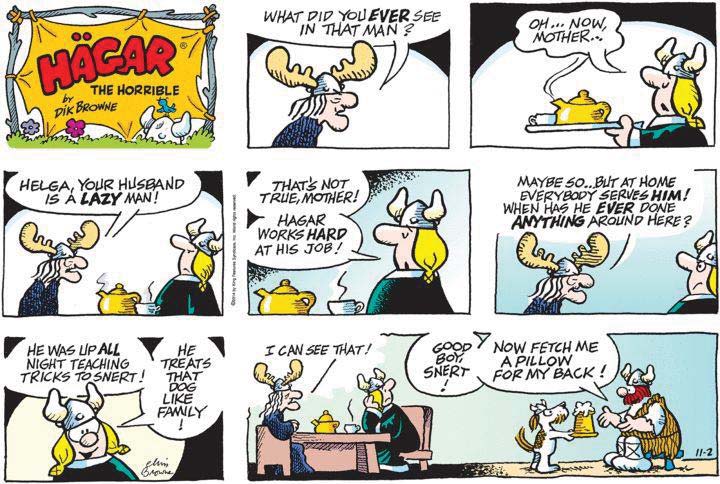
Fonte: <http://www.cartoonistgroup.com/subject/The-Snert-Comics-and-Cartoons-by-Hagar+The+Horrible.php>. Acesso em: 23 mai. 2017.
A mãe de Helga pergunta "What did you ever see in that man?" porque
Fonte: <http://www.cartoonistgroup.com/subject/The-Snert-Comics-and-Cartoons-by-Hagar+The+Horrible.php>. Acesso em: 23 mai. 2017.
O fato de Helga usar a expressão “Oh... now, mother...”, significa que ela
Fonte: <http://www.cartoonistgroup.com/subject/The-Snert-Comics-and-Cartoons-by-Hagar+The+Horrible.php>. Acesso em: 23 mai. 2017.
A ironia da mãe de Helga, ao afirmar: “I can see that!”, reside no fato de que
AUGMENTATION OF BRAIN FUNCTION: FACTS, FICTION AND CONTROVERSY
1 Augmentation of brain function is no longer just a theme of science fiction. __________(I) advances in
2 neural sciences, it has become a matter of reality that a person may consider at some point in life, for example
3 as a treatment of a neurodegenerative disease. Currently, several approaches offer enhancements for sensory,
4 motor and cognitive brain functions,__________(II) for mood and emotions. Such enhancements may be
5 achieved pharmacologically, using brain implants for recordings, stimulation and drug delivery,__________(III)
6 employing brain-machine interfaces, or even by ablation of certain brain areas.
7 In this Research Topic, we welcome papers critically evaluating the existing methods of brain
8 augmentation, introducing new approaches and probing particular parts of brain circuitry and particular
9 neuronal mechanisms as candidates for an enhancement. We welcome scientists from different fields: from
10 neuroscience of microcircuits to systems neuroscience of large-scale networks and neural engineering. The
11 work can be experimental or computational. Reviews and papers on philosophical and ethical issues are
12 __________(IV) welcome.
13 While the scope of possible relevant topics is broad, the authors are encouraged to clearly indicate how
14 their studies address the announced theme of brain augmentation.
15
16 Important Note: All contributions to this Research Topic must be within the scope of the section and
17 journal to which they are submitted, as defined in their mission statements. Frontiers reserves the right to guide
18 an out-of-scope manuscript to a more suitable section or journal at any stage of peer review.
Fonte: <http://journal.frontiersin.org/researchtopic/1563/augmentation-of-brain-function-facts-fiction-and-controversy>. Acesso em: 15 jul. 2017.
Marque a opção que preenche, correta e respectivamente, as lacunas I, II, III e IV inseridas no texto.Resolução comentada
Análise das alternativas
AUGMENTATION OF BRAIN FUNCTION: FACTS, FICTION AND CONTROVERSY
1 Augmentation of brain function is no longer just a theme of science fiction. __________(I) advances in
2 neural sciences, it has become a matter of reality that a person may consider at some point in life, for example
3 as a treatment of a neurodegenerative disease. Currently, several approaches offer enhancements for sensory,
4 motor and cognitive brain functions,__________(II) for mood and emotions. Such enhancements may be
5 achieved pharmacologically, using brain implants for recordings, stimulation and drug delivery,__________(III)
6 employing brain-machine interfaces, or even by ablation of certain brain areas.
7 In this Research Topic, we welcome papers critically evaluating the existing methods of brain
8 augmentation, introducing new approaches and probing particular parts of brain circuitry and particular
9 neuronal mechanisms as candidates for an enhancement. We welcome scientists from different fields: from
10 neuroscience of microcircuits to systems neuroscience of large-scale networks and neural engineering. The
11 work can be experimental or computational. Reviews and papers on philosophical and ethical issues are
12 __________(IV) welcome.
13 While the scope of possible relevant topics is broad, the authors are encouraged to clearly indicate how
14 their studies address the announced theme of brain augmentation.
15
16 Important Note: All contributions to this Research Topic must be within the scope of the section and
17 journal to which they are submitted, as defined in their mission statements. Frontiers reserves the right to guide
18 an out-of-scope manuscript to a more suitable section or journal at any stage of peer review.
Fonte: <http://journal.frontiersin.org/researchtopic/1563/augmentation-of-brain-function-facts-fiction-and-controversy>. Acesso em: 15 jul. 2017.
O texto é um(a):Resolução comentada
Análise das alternativas
AUGMENTATION OF BRAIN FUNCTION: FACTS, FICTION AND CONTROVERSY
1 Augmentation of brain function is no longer just a theme of science fiction. __________(I) advances in
2 neural sciences, it has become a matter of reality that a person may consider at some point in life, for example
3 as a treatment of a neurodegenerative disease. Currently, several approaches offer enhancements for sensory,
4 motor and cognitive brain functions,__________(II) for mood and emotions. Such enhancements may be
5 achieved pharmacologically, using brain implants for recordings, stimulation and drug delivery,__________(III)
6 employing brain-machine interfaces, or even by ablation of certain brain areas.
7 In this Research Topic, we welcome papers critically evaluating the existing methods of brain
8 augmentation, introducing new approaches and probing particular parts of brain circuitry and particular
9 neuronal mechanisms as candidates for an enhancement. We welcome scientists from different fields: from
10 neuroscience of microcircuits to systems neuroscience of large-scale networks and neural engineering. The
11 work can be experimental or computational. Reviews and papers on philosophical and ethical issues are
12 __________(IV) welcome.
13 While the scope of possible relevant topics is broad, the authors are encouraged to clearly indicate how
14 their studies address the announced theme of brain augmentation.
15
16 Important Note: All contributions to this Research Topic must be within the scope of the section and
17 journal to which they are submitted, as defined in their mission statements. Frontiers reserves the right to guide
18 an out-of-scope manuscript to a more suitable section or journal at any stage of peer review.
Fonte: <http://journal.frontiersin.org/researchtopic/1563/augmentation-of-brain-function-facts-fiction-and-controversy>. Acesso em: 15 jul. 2017.
Considere as seguintes afirmações:
I. A melhoria ou o aumento das funções cerebrais pode ser obtida via: estimulação farmacológica, interface cérebro-máquina, implantes cerebrais ou mesmo remoção de determinadas áreas do cérebro.
II. Atualmente, abordagens para melhoria das funções cerebrais envolvem exclusivamente funções sensoriais, cognitivas e motoras.
III. O aumento das funções cerebrais pode vir a ser usado no tratamento de doenças neurodegenerativas.
Com base no texto, estão corretasResolução comentada
Análise das alternativas
AUGMENTATION OF BRAIN FUNCTION: FACTS, FICTION AND CONTROVERSY
1 Augmentation of brain function is no longer just a theme of science fiction. __________(I) advances in
2 neural sciences, it has become a matter of reality that a person may consider at some point in life, for example
3 as a treatment of a neurodegenerative disease. Currently, several approaches offer enhancements for sensory,
4 motor and cognitive brain functions,__________(II) for mood and emotions. Such enhancements may be
5 achieved pharmacologically, using brain implants for recordings, stimulation and drug delivery,__________(III)
6 employing brain-machine interfaces, or even by ablation of certain brain areas.
7 In this Research Topic, we welcome papers critically evaluating the existing methods of brain
8 augmentation, introducing new approaches and probing particular parts of brain circuitry and particular
9 neuronal mechanisms as candidates for an enhancement. We welcome scientists from different fields: from
10 neuroscience of microcircuits to systems neuroscience of large-scale networks and neural engineering. The
11 work can be experimental or computational. Reviews and papers on philosophical and ethical issues are
12 __________(IV) welcome.
13 While the scope of possible relevant topics is broad, the authors are encouraged to clearly indicate how
14 their studies address the announced theme of brain augmentation.
15
16 Important Note: All contributions to this Research Topic must be within the scope of the section and
17 journal to which they are submitted, as defined in their mission statements. Frontiers reserves the right to guide
18 an out-of-scope manuscript to a more suitable section or journal at any stage of peer review.
Fonte: <http://journal.frontiersin.org/researchtopic/1563/augmentation-of-brain-function-facts-fiction-and-controversy>. Acesso em: 15 jul. 2017.
Com base no texto, é INCORRETO afirmar que estudos sobre a melhoria das funções cerebraisResolução comentada
Análise das alternativas
AUGMENTATION OF BRAIN FUNCTION: FACTS, FICTION AND CONTROVERSY
1 Augmentation of brain function is no longer just a theme of science fiction. __________(I) advances in
2 neural sciences, it has become a matter of reality that a person may consider at some point in life, for example
3 as a treatment of a neurodegenerative disease. Currently, several approaches offer enhancements for sensory,
4 motor and cognitive brain functions,__________(II) for mood and emotions. Such enhancements may be
5 achieved pharmacologically, using brain implants for recordings, stimulation and drug delivery,__________(III)
6 employing brain-machine interfaces, or even by ablation of certain brain areas.
7 In this Research Topic, we welcome papers critically evaluating the existing methods of brain
8 augmentation, introducing new approaches and probing particular parts of brain circuitry and particular
9 neuronal mechanisms as candidates for an enhancement. We welcome scientists from different fields: from
10 neuroscience of microcircuits to systems neuroscience of large-scale networks and neural engineering. The
11 work can be experimental or computational. Reviews and papers on philosophical and ethical issues are
12 __________(IV) welcome.
13 While the scope of possible relevant topics is broad, the authors are encouraged to clearly indicate how
14 their studies address the announced theme of brain augmentation.
15
16 Important Note: All contributions to this Research Topic must be within the scope of the section and
17 journal to which they are submitted, as defined in their mission statements. Frontiers reserves the right to guide
18 an out-of-scope manuscript to a more suitable section or journal at any stage of peer review.
Fonte: <http://journal.frontiersin.org/researchtopic/1563/augmentation-of-brain-function-facts-fiction-and-controversy>. Acesso em: 15 jul. 2017.
Marque a opção que indica a que it se refere no seguinte excerto: "...it has become a matter of reality…" (linha 2).Resolução comentada
Análise das alternativas
Texto-base:
Texto-base:
Texto-base:
Texto-base:
Texto-base:
Texto-base:
Texto-base:
Texto-base:
Texto-base:
Texto-base:
Texto-base:
Texto-base:
Texto-base:
Texto-base:
Texto-base:
Texto-base:
Texto-base:
Texto-base:
Texto-base:
Texto-base: