← Voltar para a lista de provas Comando da Aeronáutica · Exame de Admissão aos CFOAV, CFOINT e CFOINF 2019 65 questões nesta prova · página 3 de 4 · 62 com gabarito Gabarito disponível A seção 'Freedom' diz que procuramos o 'supervillainy' para nos sentir livres para agir como quisermos. O parágrafo mostra que os vilões escapam de regras e que vestir-se como eles é 'liberating'. A ideia é que buscamos essa liberdade vicária, o que corresponde a B. A) Contradiz o texto: os personagens poderosos não seguem regras. C) É um detalhe, não o resumo. D) Generaliza demais: 'Nobody can arrest Superman', que é apenas um exemplo. Referência: Texto, linhas 53 a 63. Resolução comentada do VaiConcursos. Questão anulada Gabarito disponível 'Humans have been captivated by stories...' está na voz passiva (have been + particípio). Na voz passiva o sujeito sofre a ação, e a estrutura é 'to be' + particípio passado. 'Humans have been captivated by stories' atende ao padrão, com agente 'by stories'. A) 'viewed' está na voz ativa; 'driven' é um particípio adjetival, sem auxiliar 'be'. B) 'haven't met' e 'will have' são ativas. D) 'have needed' é ativa. Referência: Passive voice: be + past participle. Resolução comentada do VaiConcursos. Gabarito disponível O parágrafo não enumera características; ele compara, afirma necessidade e descreve personagens. O parágrafo compara heróis e vilões ('better villain equals better hero'). Diz que heróis precisam de vilões ('require') e descreve os heróis e vilões. Não há enumeração de uma série de características, portanto a única opção que ele não faz é B. A) Há comparação ('as heroic as the challenge'). C) 'Great heroes require great villains' indica necessidade. D) Os personagens são descritos. Referência: Texto, linhas 80 a 84. Resolução comentada do VaiConcursos. Gabarito disponível Gabarito disponível Só as afirmações I e III estão de acordo com o texto. I está correta: segundo Maslow, quem passa privação de amor tem dificuldade em construir autoestima. III é aceitável pelo gabarito: o texto mostra fascínio e identificação com vilões, não rejeição total. II é exagerada, pois nem todos são fascinados ('everybody'). IV é falsa, porque o texto não fala de escritores 'engraçados'. V é falsa, pois não se diz que valorizamos heróis derrotados e vilões vitoriosos. A, C e D incluem II, IV ou V, que são incorretas. Referência: Texto: 'Hierarchy of needs' e 'Our Motivations...'. Resolução comentada do VaiConcursos. Gabarito disponível O texto não afirma que os super-heróis são, ao mesmo tempo, heróis e vilões. O texto trata heróis e vilões como categorias distintas ('good guys don't ache to dominate'), embora cite histórias em que heróis viram ameaças ao tentar dominar. Não há a afirmação geral de que os super-heróis são simultaneamente heróis e vilões. As demais alternativas têm base no texto. A) A curiosidade sobre o que nos confunde/desconhece é tratada em 'Exploring the unknown'. C) 'Great heroes require great villains.' D) Para Freud, o id deseja ser supervilânico. Referência: Texto: seções 'Power', 'Better villain equals better hero' e 'Wish fulfillment'. Resolução comentada do VaiConcursos. Gabarito disponível O autor conclui que os supervilões existem para revelar o quão heroicos são os heróis. O último parágrafo diz que os criadores fazem os supervilões 'first and foremost to reveal how heroic the comics' stars can be'. Isso corresponde à alternativa C. A) O texto diz que os heróis são as estrelas e os vilões é que são o elenco de apoio. B) Os motivos podem ser saudáveis ou não, e os mais doentios nascem de impulsos originalmente saudáveis. D) Os vilões são criados para destacar os heróis, não para vencê-los. Referência: Texto: 'Supervillains' Ultimate Purpose'. Resolução comentada do VaiConcursos. Gabarito disponível Gabarito disponível Gabarito disponível Gabarito disponível Gabarito disponível Gabarito disponível Questão anulada Gabarito disponível Gabarito disponível Gabarito disponível Gabarito disponível Gabarito disponívelComando da Aeronáutica — Exame de Admissão aos CFOAV, CFOINT e CFOINF 2019 — Língua Portuguesa, Matemática, Língua Inglesa, Física e Redação — Versão A
Directions: Answer questions 33 to 48 according to the text.
TEXT
WHY DO SUPERVILLAINS FASCINATE US? A
PSYCHOLOGICAL PERSPECTIVE
Why are we fascinated by supervillains? Posing
the question is much like asking why evil itself intrigues
us, but there's much more to our continued interest in
supervillains than meets the eye.
5 Not only do Lex Luthor, Dracula and the Red Skull
run unconstrained by conventional morality, they exist
outside the limits of reality itself. Their evil, even at its
most realistic, retains a touch of the unreal.
But is our fascination with fantastic fiends¹
10 healthy? From a psychological perspective, views vary
on what drives our enduring interest in superhuman bad
guys.
Shadow confrontation: Psychiatrist Carl Jung
believed we need to confront and understand our own
15 hidden nature to grow as human beings. Healthy
confrontation with our shadow selves can unearth new
strengths (e.g., Bruce Wayne creating his Dark Knight
persona to fight crime), whereas unhealthy attempts at
confrontation may involve dwelling on or unleashing the
20 worst parts of ourselves.
Wish fulfillment: Sigmund Freud viewed human
nature as inherently antisocial, biologically driven by the
undisciplined id's pleasure principle to get what we
want when we want it – born to be bad but held back by
25 society. Even if the psyche fully develops its ego
(source of self-control) and superego (conscience),
Freudians say the id still dwells² underneath, and it
wishes for many selfish things – so it would love to be
supervillainous.
30 Hierarchy of needs: Humanistic psychologist
Abraham Maslow held that people who haven't met
their most basic needs will have difficulty maturing. If
starved for food, you're unlikely to feel secure. If
starved for love and companionship, you'll have trouble
35 building self-esteem. People who dwell on their deficits
may envy and resent others who have more than they
do. Some people who are unable to overcome social
shortcomings fantasize about obtaining any means,
good or bad, to satisfy every need and greed.
40 Conditioning: Ivan Pavlov would say we can learn
to associate supervillains with other things we value –
like entertainment, strength, freedom or the heroes
themselves. Behaviorist B.F. Skinner would likely argue
that we can find it reinforcing to watch or read about
45 supervillains, but without knowing what's reinforcing
about them, that's a bit like saying it's rewarding
because it's rewarding.
Our Motivations for Seeking Out Supervillains
Throughout history, humans have been captivated
50 by stories of heroes facing off against superhuman
foes³. But what specific rewards, needs, wishes and
dark dreams do supervillains satisfy?
Freedom: Superpowered characters enjoy
freedoms the rest of us don't. Nobody can arrest
55 Superman unless he lets them (at least not without
kryptonite handcuffs). As much time as supervillains
spend locked up, they seem to escape as often as they
please, to run unconstrained by rules and regulations.
Cosplayers who dress like Wonder Woman and
60 Captain America can't do any crazy thing that crosses
their minds without seeming to mock and insult our
heroes, whereas those dressed as villains get to go
wild. Supervillainy feels liberating.
Power: Maybe you envy the power these evil
65 characters wield⁴. While that's also a reason to adore
superheroes, good guys don't ache to dominate.
Stories like Watchmen and Kingdom Come show how
heroes become menaces⁵ when they try to take over.
So when dreaming of superpowers, maybe you relate
70 to characters who dream of power as well, from the
Scarecrow (who controls individuals' fears) to Doctor
Doom (who's perpetually out to dominate the world).
Better villain than victim: Physiologically, anger
activates us and feels better than anxiety or fear. One
75 who feels victimized and cannot figure out constructive
ways to stand up, be strong or become heroic might
twist the need for self-assertion into destruction.
Alternately, a healthy person simply might focus on how
all characters assert themselves in any given story.
80 Better villain equals better hero: A hero only
appears as heroic as the challenge he or she must
overcome. Great heroes require great villains. Without
supercriminals, the world's finest heroes seem like
overpowered brutes nabbing thugs⁶ unworthy of them.
85 Through myths, legends and lore across time, we have
needed heroes who rise to the occasion, overcome
great odds⁷ and take down giants.
Facing our fears: Instead of dreading the
darkness, you might reduce that dread by shining a
90 light and seeing what's out there. Fiction can help us
feel empowered and enlightened without literally
8 9
traipsing into mob hangouts⁸ and poorly lit alleyways⁹.
Exploring the unknown: Our need to challenge
the unknown has driven the human race to cover the
95 globe. This powerful curiosity makes us wonder about
everything that baffles¹⁰ us, including the world's worst
fiends. Knowledge is power, or at least feels like it.
When gritty details repulse us, exploring evil through the
filter of fiction can help us contemplate humanity's
100 worst without turning away or dwelling almost
voyeuristically on real human tragedy. Even when the
fiction is about improbable people doing impossible
things, the story's fantastic nature reassures us that this
cannot happen – and therefore we don't have to turn
105 away.
Supervillains' Ultimate Purpose
In the end, our interest in supervillains can be
healthy or unhealthy. Even the more maladaptive
reasons for such fascination tend to arise from
110 motivations that were originally healthy and natural –
frustrated drives that went the wrong way.
Remember, though, that superheroic fiction
ultimately begins and ends with the heroes. Comic book
writers and artists create supervillains, who move in and
115 out as guest stars and supporting cast, first and
foremost to reveal how heroic the comics' stars can be.
(Adapted from https://www.wired.com/2012/07/why-do-supervillains-fascinate-us/)
Glossary:
1. fiend – an evil and cruel person
2. to dwell – remain
3. foe – an enemy
4. to wield – influence, use power
5. menace – threat
6. to nab thugs – arrest criminals
7. odds – probability
8. to traipse into mob hangouts – walk among places where gangs, criminals meet
9. poorly lit alleyways – narrow road or path with little light
10. to baffle – confuse somebody completely
Identify the option that summarizes the item “freedom” (lines 53 to 63).Resolução comentada
Análise das alternativas
Directions: Answer questions 33 to 48 according to the text.
TEXT
WHY DO SUPERVILLAINS FASCINATE US? A
PSYCHOLOGICAL PERSPECTIVE
Why are we fascinated by supervillains? Posing
the question is much like asking why evil itself intrigues
us, but there's much more to our continued interest in
supervillains than meets the eye.
5 Not only do Lex Luthor, Dracula and the Red Skull
run unconstrained by conventional morality, they exist
outside the limits of reality itself. Their evil, even at its
most realistic, retains a touch of the unreal.
But is our fascination with fantastic fiends¹
10 healthy? From a psychological perspective, views vary
on what drives our enduring interest in superhuman bad
guys.
Shadow confrontation: Psychiatrist Carl Jung
believed we need to confront and understand our own
15 hidden nature to grow as human beings. Healthy
confrontation with our shadow selves can unearth new
strengths (e.g., Bruce Wayne creating his Dark Knight
persona to fight crime), whereas unhealthy attempts at
confrontation may involve dwelling on or unleashing the
20 worst parts of ourselves.
Wish fulfillment: Sigmund Freud viewed human
nature as inherently antisocial, biologically driven by the
undisciplined id's pleasure principle to get what we
want when we want it – born to be bad but held back by
25 society. Even if the psyche fully develops its ego
(source of self-control) and superego (conscience),
Freudians say the id still dwells² underneath, and it
wishes for many selfish things – so it would love to be
supervillainous.
30 Hierarchy of needs: Humanistic psychologist
Abraham Maslow held that people who haven't met
their most basic needs will have difficulty maturing. If
starved for food, you're unlikely to feel secure. If
starved for love and companionship, you'll have trouble
35 building self-esteem. People who dwell on their deficits
may envy and resent others who have more than they
do. Some people who are unable to overcome social
shortcomings fantasize about obtaining any means,
good or bad, to satisfy every need and greed.
40 Conditioning: Ivan Pavlov would say we can learn
to associate supervillains with other things we value –
like entertainment, strength, freedom or the heroes
themselves. Behaviorist B.F. Skinner would likely argue
that we can find it reinforcing to watch or read about
45 supervillains, but without knowing what's reinforcing
about them, that's a bit like saying it's rewarding
because it's rewarding.
Our Motivations for Seeking Out Supervillains
Throughout history, humans have been captivated
50 by stories of heroes facing off against superhuman
foes³. But what specific rewards, needs, wishes and
dark dreams do supervillains satisfy?
Freedom: Superpowered characters enjoy
freedoms the rest of us don't. Nobody can arrest
55 Superman unless he lets them (at least not without
kryptonite handcuffs). As much time as supervillains
spend locked up, they seem to escape as often as they
please, to run unconstrained by rules and regulations.
Cosplayers who dress like Wonder Woman and
60 Captain America can't do any crazy thing that crosses
their minds without seeming to mock and insult our
heroes, whereas those dressed as villains get to go
wild. Supervillainy feels liberating.
Power: Maybe you envy the power these evil
65 characters wield⁴. While that's also a reason to adore
superheroes, good guys don't ache to dominate.
Stories like Watchmen and Kingdom Come show how
heroes become menaces⁵ when they try to take over.
So when dreaming of superpowers, maybe you relate
70 to characters who dream of power as well, from the
Scarecrow (who controls individuals' fears) to Doctor
Doom (who's perpetually out to dominate the world).
Better villain than victim: Physiologically, anger
activates us and feels better than anxiety or fear. One
75 who feels victimized and cannot figure out constructive
ways to stand up, be strong or become heroic might
twist the need for self-assertion into destruction.
Alternately, a healthy person simply might focus on how
all characters assert themselves in any given story.
80 Better villain equals better hero: A hero only
appears as heroic as the challenge he or she must
overcome. Great heroes require great villains. Without
supercriminals, the world's finest heroes seem like
overpowered brutes nabbing thugs⁶ unworthy of them.
85 Through myths, legends and lore across time, we have
needed heroes who rise to the occasion, overcome
great odds⁷ and take down giants.
Facing our fears: Instead of dreading the
darkness, you might reduce that dread by shining a
90 light and seeing what's out there. Fiction can help us
feel empowered and enlightened without literally
8 9
traipsing into mob hangouts⁸ and poorly lit alleyways⁹.
Exploring the unknown: Our need to challenge
the unknown has driven the human race to cover the
95 globe. This powerful curiosity makes us wonder about
everything that baffles¹⁰ us, including the world's worst
fiends. Knowledge is power, or at least feels like it.
When gritty details repulse us, exploring evil through the
filter of fiction can help us contemplate humanity's
100 worst without turning away or dwelling almost
voyeuristically on real human tragedy. Even when the
fiction is about improbable people doing impossible
things, the story's fantastic nature reassures us that this
cannot happen – and therefore we don't have to turn
105 away.
Supervillains' Ultimate Purpose
In the end, our interest in supervillains can be
healthy or unhealthy. Even the more maladaptive
reasons for such fascination tend to arise from
110 motivations that were originally healthy and natural –
frustrated drives that went the wrong way.
Remember, though, that superheroic fiction
ultimately begins and ends with the heroes. Comic book
writers and artists create supervillains, who move in and
115 out as guest stars and supporting cast, first and
foremost to reveal how heroic the comics' stars can be.
(Adapted from https://www.wired.com/2012/07/why-do-supervillains-fascinate-us/)
Glossary:
1. fiend – an evil and cruel person
2. to dwell – remain
3. foe – an enemy
4. to wield – influence, use power
5. menace – threat
6. to nab thugs – arrest criminals
7. odds – probability
8. to traipse into mob hangouts – walk among places where gangs, criminals meet
9. poorly lit alleyways – narrow road or path with little light
10. to baffle – confuse somebody completely

Directions: Answer questions 33 to 48 according to the text.
TEXT
WHY DO SUPERVILLAINS FASCINATE US? A
PSYCHOLOGICAL PERSPECTIVE
Why are we fascinated by supervillains? Posing
the question is much like asking why evil itself intrigues
us, but there's much more to our continued interest in
supervillains than meets the eye.
5 Not only do Lex Luthor, Dracula and the Red Skull
run unconstrained by conventional morality, they exist
outside the limits of reality itself. Their evil, even at its
most realistic, retains a touch of the unreal.
But is our fascination with fantastic fiends¹
10 healthy? From a psychological perspective, views vary
on what drives our enduring interest in superhuman bad
guys.
Shadow confrontation: Psychiatrist Carl Jung
believed we need to confront and understand our own
15 hidden nature to grow as human beings. Healthy
confrontation with our shadow selves can unearth new
strengths (e.g., Bruce Wayne creating his Dark Knight
persona to fight crime), whereas unhealthy attempts at
confrontation may involve dwelling on or unleashing the
20 worst parts of ourselves.
Wish fulfillment: Sigmund Freud viewed human
nature as inherently antisocial, biologically driven by the
undisciplined id's pleasure principle to get what we
want when we want it – born to be bad but held back by
25 society. Even if the psyche fully develops its ego
(source of self-control) and superego (conscience),
Freudians say the id still dwells² underneath, and it
wishes for many selfish things – so it would love to be
supervillainous.
30 Hierarchy of needs: Humanistic psychologist
Abraham Maslow held that people who haven't met
their most basic needs will have difficulty maturing. If
starved for food, you're unlikely to feel secure. If
starved for love and companionship, you'll have trouble
35 building self-esteem. People who dwell on their deficits
may envy and resent others who have more than they
do. Some people who are unable to overcome social
shortcomings fantasize about obtaining any means,
good or bad, to satisfy every need and greed.
40 Conditioning: Ivan Pavlov would say we can learn
to associate supervillains with other things we value –
like entertainment, strength, freedom or the heroes
themselves. Behaviorist B.F. Skinner would likely argue
that we can find it reinforcing to watch or read about
45 supervillains, but without knowing what's reinforcing
about them, that's a bit like saying it's rewarding
because it's rewarding.
Our Motivations for Seeking Out Supervillains
Throughout history, humans have been captivated
50 by stories of heroes facing off against superhuman
foes³. But what specific rewards, needs, wishes and
dark dreams do supervillains satisfy?
Freedom: Superpowered characters enjoy
freedoms the rest of us don't. Nobody can arrest
55 Superman unless he lets them (at least not without
kryptonite handcuffs). As much time as supervillains
spend locked up, they seem to escape as often as they
please, to run unconstrained by rules and regulations.
Cosplayers who dress like Wonder Woman and
60 Captain America can't do any crazy thing that crosses
their minds without seeming to mock and insult our
heroes, whereas those dressed as villains get to go
wild. Supervillainy feels liberating.
Power: Maybe you envy the power these evil
65 characters wield⁴. While that's also a reason to adore
superheroes, good guys don't ache to dominate.
Stories like Watchmen and Kingdom Come show how
heroes become menaces⁵ when they try to take over.
So when dreaming of superpowers, maybe you relate
70 to characters who dream of power as well, from the
Scarecrow (who controls individuals' fears) to Doctor
Doom (who's perpetually out to dominate the world).
Better villain than victim: Physiologically, anger
activates us and feels better than anxiety or fear. One
75 who feels victimized and cannot figure out constructive
ways to stand up, be strong or become heroic might
twist the need for self-assertion into destruction.
Alternately, a healthy person simply might focus on how
all characters assert themselves in any given story.
80 Better villain equals better hero: A hero only
appears as heroic as the challenge he or she must
overcome. Great heroes require great villains. Without
supercriminals, the world's finest heroes seem like
overpowered brutes nabbing thugs⁶ unworthy of them.
85 Through myths, legends and lore across time, we have
needed heroes who rise to the occasion, overcome
great odds⁷ and take down giants.
Facing our fears: Instead of dreading the
darkness, you might reduce that dread by shining a
90 light and seeing what's out there. Fiction can help us
feel empowered and enlightened without literally
8 9
traipsing into mob hangouts⁸ and poorly lit alleyways⁹.
Exploring the unknown: Our need to challenge
the unknown has driven the human race to cover the
95 globe. This powerful curiosity makes us wonder about
everything that baffles¹⁰ us, including the world's worst
fiends. Knowledge is power, or at least feels like it.
When gritty details repulse us, exploring evil through the
filter of fiction can help us contemplate humanity's
100 worst without turning away or dwelling almost
voyeuristically on real human tragedy. Even when the
fiction is about improbable people doing impossible
things, the story's fantastic nature reassures us that this
cannot happen – and therefore we don't have to turn
105 away.
Supervillains' Ultimate Purpose
In the end, our interest in supervillains can be
healthy or unhealthy. Even the more maladaptive
reasons for such fascination tend to arise from
110 motivations that were originally healthy and natural –
frustrated drives that went the wrong way.
Remember, though, that superheroic fiction
ultimately begins and ends with the heroes. Comic book
writers and artists create supervillains, who move in and
115 out as guest stars and supporting cast, first and
foremost to reveal how heroic the comics' stars can be.
(Adapted from https://www.wired.com/2012/07/why-do-supervillains-fascinate-us/)
Glossary:
1. fiend – an evil and cruel person
2. to dwell – remain
3. foe – an enemy
4. to wield – influence, use power
5. menace – threat
6. to nab thugs – arrest criminals
7. odds – probability
8. to traipse into mob hangouts – walk among places where gangs, criminals meet
9. poorly lit alleyways – narrow road or path with little light
10. to baffle – confuse somebody completely
Mark the option in which the sentence is an example of passive voice.Resolução comentada
Análise das alternativas
Directions: Answer questions 33 to 48 according to the text.
TEXT
WHY DO SUPERVILLAINS FASCINATE US? A
PSYCHOLOGICAL PERSPECTIVE
Why are we fascinated by supervillains? Posing
the question is much like asking why evil itself intrigues
us, but there's much more to our continued interest in
supervillains than meets the eye.
5 Not only do Lex Luthor, Dracula and the Red Skull
run unconstrained by conventional morality, they exist
outside the limits of reality itself. Their evil, even at its
most realistic, retains a touch of the unreal.
But is our fascination with fantastic fiends¹
10 healthy? From a psychological perspective, views vary
on what drives our enduring interest in superhuman bad
guys.
Shadow confrontation: Psychiatrist Carl Jung
believed we need to confront and understand our own
15 hidden nature to grow as human beings. Healthy
confrontation with our shadow selves can unearth new
strengths (e.g., Bruce Wayne creating his Dark Knight
persona to fight crime), whereas unhealthy attempts at
confrontation may involve dwelling on or unleashing the
20 worst parts of ourselves.
Wish fulfillment: Sigmund Freud viewed human
nature as inherently antisocial, biologically driven by the
undisciplined id's pleasure principle to get what we
want when we want it – born to be bad but held back by
25 society. Even if the psyche fully develops its ego
(source of self-control) and superego (conscience),
Freudians say the id still dwells² underneath, and it
wishes for many selfish things – so it would love to be
supervillainous.
30 Hierarchy of needs: Humanistic psychologist
Abraham Maslow held that people who haven't met
their most basic needs will have difficulty maturing. If
starved for food, you're unlikely to feel secure. If
starved for love and companionship, you'll have trouble
35 building self-esteem. People who dwell on their deficits
may envy and resent others who have more than they
do. Some people who are unable to overcome social
shortcomings fantasize about obtaining any means,
good or bad, to satisfy every need and greed.
40 Conditioning: Ivan Pavlov would say we can learn
to associate supervillains with other things we value –
like entertainment, strength, freedom or the heroes
themselves. Behaviorist B.F. Skinner would likely argue
that we can find it reinforcing to watch or read about
45 supervillains, but without knowing what's reinforcing
about them, that's a bit like saying it's rewarding
because it's rewarding.
Our Motivations for Seeking Out Supervillains
Throughout history, humans have been captivated
50 by stories of heroes facing off against superhuman
foes³. But what specific rewards, needs, wishes and
dark dreams do supervillains satisfy?
Freedom: Superpowered characters enjoy
freedoms the rest of us don't. Nobody can arrest
55 Superman unless he lets them (at least not without
kryptonite handcuffs). As much time as supervillains
spend locked up, they seem to escape as often as they
please, to run unconstrained by rules and regulations.
Cosplayers who dress like Wonder Woman and
60 Captain America can't do any crazy thing that crosses
their minds without seeming to mock and insult our
heroes, whereas those dressed as villains get to go
wild. Supervillainy feels liberating.
Power: Maybe you envy the power these evil
65 characters wield⁴. While that's also a reason to adore
superheroes, good guys don't ache to dominate.
Stories like Watchmen and Kingdom Come show how
heroes become menaces⁵ when they try to take over.
So when dreaming of superpowers, maybe you relate
70 to characters who dream of power as well, from the
Scarecrow (who controls individuals' fears) to Doctor
Doom (who's perpetually out to dominate the world).
Better villain than victim: Physiologically, anger
activates us and feels better than anxiety or fear. One
75 who feels victimized and cannot figure out constructive
ways to stand up, be strong or become heroic might
twist the need for self-assertion into destruction.
Alternately, a healthy person simply might focus on how
all characters assert themselves in any given story.
80 Better villain equals better hero: A hero only
appears as heroic as the challenge he or she must
overcome. Great heroes require great villains. Without
supercriminals, the world's finest heroes seem like
overpowered brutes nabbing thugs⁶ unworthy of them.
85 Through myths, legends and lore across time, we have
needed heroes who rise to the occasion, overcome
great odds⁷ and take down giants.
Facing our fears: Instead of dreading the
darkness, you might reduce that dread by shining a
90 light and seeing what's out there. Fiction can help us
feel empowered and enlightened without literally
8 9
traipsing into mob hangouts⁸ and poorly lit alleyways⁹.
Exploring the unknown: Our need to challenge
the unknown has driven the human race to cover the
95 globe. This powerful curiosity makes us wonder about
everything that baffles¹⁰ us, including the world's worst
fiends. Knowledge is power, or at least feels like it.
When gritty details repulse us, exploring evil through the
filter of fiction can help us contemplate humanity's
100 worst without turning away or dwelling almost
voyeuristically on real human tragedy. Even when the
fiction is about improbable people doing impossible
things, the story's fantastic nature reassures us that this
cannot happen – and therefore we don't have to turn
105 away.
Supervillains' Ultimate Purpose
In the end, our interest in supervillains can be
healthy or unhealthy. Even the more maladaptive
reasons for such fascination tend to arise from
110 motivations that were originally healthy and natural –
frustrated drives that went the wrong way.
Remember, though, that superheroic fiction
ultimately begins and ends with the heroes. Comic book
writers and artists create supervillains, who move in and
115 out as guest stars and supporting cast, first and
foremost to reveal how heroic the comics' stars can be.
(Adapted from https://www.wired.com/2012/07/why-do-supervillains-fascinate-us/)
Glossary:
1. fiend – an evil and cruel person
2. to dwell – remain
3. foe – an enemy
4. to wield – influence, use power
5. menace – threat
6. to nab thugs – arrest criminals
7. odds – probability
8. to traipse into mob hangouts – walk among places where gangs, criminals meet
9. poorly lit alleyways – narrow road or path with little light
10. to baffle – confuse somebody completely
In the paragraph “Better villain equals better hero” (lines 80 to 84), the author DOESN’TResolução comentada
Análise das alternativas
Directions: Answer questions 33 to 48 according to the text.
TEXT
WHY DO SUPERVILLAINS FASCINATE US? A
PSYCHOLOGICAL PERSPECTIVE
Why are we fascinated by supervillains? Posing
the question is much like asking why evil itself intrigues
us, but there's much more to our continued interest in
supervillains than meets the eye.
5 Not only do Lex Luthor, Dracula and the Red Skull
run unconstrained by conventional morality, they exist
outside the limits of reality itself. Their evil, even at its
most realistic, retains a touch of the unreal.
But is our fascination with fantastic fiends¹
10 healthy? From a psychological perspective, views vary
on what drives our enduring interest in superhuman bad
guys.
Shadow confrontation: Psychiatrist Carl Jung
believed we need to confront and understand our own
15 hidden nature to grow as human beings. Healthy
confrontation with our shadow selves can unearth new
strengths (e.g., Bruce Wayne creating his Dark Knight
persona to fight crime), whereas unhealthy attempts at
confrontation may involve dwelling on or unleashing the
20 worst parts of ourselves.
Wish fulfillment: Sigmund Freud viewed human
nature as inherently antisocial, biologically driven by the
undisciplined id's pleasure principle to get what we
want when we want it – born to be bad but held back by
25 society. Even if the psyche fully develops its ego
(source of self-control) and superego (conscience),
Freudians say the id still dwells² underneath, and it
wishes for many selfish things – so it would love to be
supervillainous.
30 Hierarchy of needs: Humanistic psychologist
Abraham Maslow held that people who haven't met
their most basic needs will have difficulty maturing. If
starved for food, you're unlikely to feel secure. If
starved for love and companionship, you'll have trouble
35 building self-esteem. People who dwell on their deficits
may envy and resent others who have more than they
do. Some people who are unable to overcome social
shortcomings fantasize about obtaining any means,
good or bad, to satisfy every need and greed.
40 Conditioning: Ivan Pavlov would say we can learn
to associate supervillains with other things we value –
like entertainment, strength, freedom or the heroes
themselves. Behaviorist B.F. Skinner would likely argue
that we can find it reinforcing to watch or read about
45 supervillains, but without knowing what's reinforcing
about them, that's a bit like saying it's rewarding
because it's rewarding.
Our Motivations for Seeking Out Supervillains
Throughout history, humans have been captivated
50 by stories of heroes facing off against superhuman
foes³. But what specific rewards, needs, wishes and
dark dreams do supervillains satisfy?
Freedom: Superpowered characters enjoy
freedoms the rest of us don't. Nobody can arrest
55 Superman unless he lets them (at least not without
kryptonite handcuffs). As much time as supervillains
spend locked up, they seem to escape as often as they
please, to run unconstrained by rules and regulations.
Cosplayers who dress like Wonder Woman and
60 Captain America can't do any crazy thing that crosses
their minds without seeming to mock and insult our
heroes, whereas those dressed as villains get to go
wild. Supervillainy feels liberating.
Power: Maybe you envy the power these evil
65 characters wield⁴. While that's also a reason to adore
superheroes, good guys don't ache to dominate.
Stories like Watchmen and Kingdom Come show how
heroes become menaces⁵ when they try to take over.
So when dreaming of superpowers, maybe you relate
70 to characters who dream of power as well, from the
Scarecrow (who controls individuals' fears) to Doctor
Doom (who's perpetually out to dominate the world).
Better villain than victim: Physiologically, anger
activates us and feels better than anxiety or fear. One
75 who feels victimized and cannot figure out constructive
ways to stand up, be strong or become heroic might
twist the need for self-assertion into destruction.
Alternately, a healthy person simply might focus on how
all characters assert themselves in any given story.
80 Better villain equals better hero: A hero only
appears as heroic as the challenge he or she must
overcome. Great heroes require great villains. Without
supercriminals, the world's finest heroes seem like
overpowered brutes nabbing thugs⁶ unworthy of them.
85 Through myths, legends and lore across time, we have
needed heroes who rise to the occasion, overcome
great odds⁷ and take down giants.
Facing our fears: Instead of dreading the
darkness, you might reduce that dread by shining a
90 light and seeing what's out there. Fiction can help us
feel empowered and enlightened without literally
8 9
traipsing into mob hangouts⁸ and poorly lit alleyways⁹.
Exploring the unknown: Our need to challenge
the unknown has driven the human race to cover the
95 globe. This powerful curiosity makes us wonder about
everything that baffles¹⁰ us, including the world's worst
fiends. Knowledge is power, or at least feels like it.
When gritty details repulse us, exploring evil through the
filter of fiction can help us contemplate humanity's
100 worst without turning away or dwelling almost
voyeuristically on real human tragedy. Even when the
fiction is about improbable people doing impossible
things, the story's fantastic nature reassures us that this
cannot happen – and therefore we don't have to turn
105 away.
Supervillains' Ultimate Purpose
In the end, our interest in supervillains can be
healthy or unhealthy. Even the more maladaptive
reasons for such fascination tend to arise from
110 motivations that were originally healthy and natural –
frustrated drives that went the wrong way.
Remember, though, that superheroic fiction
ultimately begins and ends with the heroes. Comic book
writers and artists create supervillains, who move in and
115 out as guest stars and supporting cast, first and
foremost to reveal how heroic the comics' stars can be.
(Adapted from https://www.wired.com/2012/07/why-do-supervillains-fascinate-us/)
Glossary:
1. fiend – an evil and cruel person
2. to dwell – remain
3. foe – an enemy
4. to wield – influence, use power
5. menace – threat
6. to nab thugs – arrest criminals
7. odds – probability
8. to traipse into mob hangouts – walk among places where gangs, criminals meet
9. poorly lit alleyways – narrow road or path with little light
10. to baffle – confuse somebody completely

Directions: Answer questions 33 to 48 according to the text.
TEXT
WHY DO SUPERVILLAINS FASCINATE US? A
PSYCHOLOGICAL PERSPECTIVE
Why are we fascinated by supervillains? Posing
the question is much like asking why evil itself intrigues
us, but there's much more to our continued interest in
supervillains than meets the eye.
5 Not only do Lex Luthor, Dracula and the Red Skull
run unconstrained by conventional morality, they exist
outside the limits of reality itself. Their evil, even at its
most realistic, retains a touch of the unreal.
But is our fascination with fantastic fiends¹
10 healthy? From a psychological perspective, views vary
on what drives our enduring interest in superhuman bad
guys.
Shadow confrontation: Psychiatrist Carl Jung
believed we need to confront and understand our own
15 hidden nature to grow as human beings. Healthy
confrontation with our shadow selves can unearth new
strengths (e.g., Bruce Wayne creating his Dark Knight
persona to fight crime), whereas unhealthy attempts at
confrontation may involve dwelling on or unleashing the
20 worst parts of ourselves.
Wish fulfillment: Sigmund Freud viewed human
nature as inherently antisocial, biologically driven by the
undisciplined id's pleasure principle to get what we
want when we want it – born to be bad but held back by
25 society. Even if the psyche fully develops its ego
(source of self-control) and superego (conscience),
Freudians say the id still dwells² underneath, and it
wishes for many selfish things – so it would love to be
supervillainous.
30 Hierarchy of needs: Humanistic psychologist
Abraham Maslow held that people who haven't met
their most basic needs will have difficulty maturing. If
starved for food, you're unlikely to feel secure. If
starved for love and companionship, you'll have trouble
35 building self-esteem. People who dwell on their deficits
may envy and resent others who have more than they
do. Some people who are unable to overcome social
shortcomings fantasize about obtaining any means,
good or bad, to satisfy every need and greed.
40 Conditioning: Ivan Pavlov would say we can learn
to associate supervillains with other things we value –
like entertainment, strength, freedom or the heroes
themselves. Behaviorist B.F. Skinner would likely argue
that we can find it reinforcing to watch or read about
45 supervillains, but without knowing what's reinforcing
about them, that's a bit like saying it's rewarding
because it's rewarding.
Our Motivations for Seeking Out Supervillains
Throughout history, humans have been captivated
50 by stories of heroes facing off against superhuman
foes³. But what specific rewards, needs, wishes and
dark dreams do supervillains satisfy?
Freedom: Superpowered characters enjoy
freedoms the rest of us don't. Nobody can arrest
55 Superman unless he lets them (at least not without
kryptonite handcuffs). As much time as supervillains
spend locked up, they seem to escape as often as they
please, to run unconstrained by rules and regulations.
Cosplayers who dress like Wonder Woman and
60 Captain America can't do any crazy thing that crosses
their minds without seeming to mock and insult our
heroes, whereas those dressed as villains get to go
wild. Supervillainy feels liberating.
Power: Maybe you envy the power these evil
65 characters wield⁴. While that's also a reason to adore
superheroes, good guys don't ache to dominate.
Stories like Watchmen and Kingdom Come show how
heroes become menaces⁵ when they try to take over.
So when dreaming of superpowers, maybe you relate
70 to characters who dream of power as well, from the
Scarecrow (who controls individuals' fears) to Doctor
Doom (who's perpetually out to dominate the world).
Better villain than victim: Physiologically, anger
activates us and feels better than anxiety or fear. One
75 who feels victimized and cannot figure out constructive
ways to stand up, be strong or become heroic might
twist the need for self-assertion into destruction.
Alternately, a healthy person simply might focus on how
all characters assert themselves in any given story.
80 Better villain equals better hero: A hero only
appears as heroic as the challenge he or she must
overcome. Great heroes require great villains. Without
supercriminals, the world's finest heroes seem like
overpowered brutes nabbing thugs⁶ unworthy of them.
85 Through myths, legends and lore across time, we have
needed heroes who rise to the occasion, overcome
great odds⁷ and take down giants.
Facing our fears: Instead of dreading the
darkness, you might reduce that dread by shining a
90 light and seeing what's out there. Fiction can help us
feel empowered and enlightened without literally
8 9
traipsing into mob hangouts⁸ and poorly lit alleyways⁹.
Exploring the unknown: Our need to challenge
the unknown has driven the human race to cover the
95 globe. This powerful curiosity makes us wonder about
everything that baffles¹⁰ us, including the world's worst
fiends. Knowledge is power, or at least feels like it.
When gritty details repulse us, exploring evil through the
filter of fiction can help us contemplate humanity's
100 worst without turning away or dwelling almost
voyeuristically on real human tragedy. Even when the
fiction is about improbable people doing impossible
things, the story's fantastic nature reassures us that this
cannot happen – and therefore we don't have to turn
105 away.
Supervillains' Ultimate Purpose
In the end, our interest in supervillains can be
healthy or unhealthy. Even the more maladaptive
reasons for such fascination tend to arise from
110 motivations that were originally healthy and natural –
frustrated drives that went the wrong way.
Remember, though, that superheroic fiction
ultimately begins and ends with the heroes. Comic book
writers and artists create supervillains, who move in and
115 out as guest stars and supporting cast, first and
foremost to reveal how heroic the comics' stars can be.
(Adapted from https://www.wired.com/2012/07/why-do-supervillains-fascinate-us/)
Glossary:
1. fiend – an evil and cruel person
2. to dwell – remain
3. foe – an enemy
4. to wield – influence, use power
5. menace – threat
6. to nab thugs – arrest criminals
7. odds – probability
8. to traipse into mob hangouts – walk among places where gangs, criminals meet
9. poorly lit alleyways – narrow road or path with little light
10. to baffle – confuse somebody completely
Read the statements below and mark the option that contains the correct ones according to the text.
I. Vulnerable people may have their self-esteem affected.
II. Everybody is infatuated with antagonists.
III. In a psychological perspective, antiheroes aren’t despised at all by the public.
IV. The author reminds us that funny writers created supervillains stories.
V. We have cherished defeated heroes and victorious antiheroes.Resolução comentada
Análise das alternativas
Directions: Answer questions 33 to 48 according to the text.
TEXT
WHY DO SUPERVILLAINS FASCINATE US? A
PSYCHOLOGICAL PERSPECTIVE
Why are we fascinated by supervillains? Posing
the question is much like asking why evil itself intrigues
us, but there's much more to our continued interest in
supervillains than meets the eye.
5 Not only do Lex Luthor, Dracula and the Red Skull
run unconstrained by conventional morality, they exist
outside the limits of reality itself. Their evil, even at its
most realistic, retains a touch of the unreal.
But is our fascination with fantastic fiends¹
10 healthy? From a psychological perspective, views vary
on what drives our enduring interest in superhuman bad
guys.
Shadow confrontation: Psychiatrist Carl Jung
believed we need to confront and understand our own
15 hidden nature to grow as human beings. Healthy
confrontation with our shadow selves can unearth new
strengths (e.g., Bruce Wayne creating his Dark Knight
persona to fight crime), whereas unhealthy attempts at
confrontation may involve dwelling on or unleashing the
20 worst parts of ourselves.
Wish fulfillment: Sigmund Freud viewed human
nature as inherently antisocial, biologically driven by the
undisciplined id's pleasure principle to get what we
want when we want it – born to be bad but held back by
25 society. Even if the psyche fully develops its ego
(source of self-control) and superego (conscience),
Freudians say the id still dwells² underneath, and it
wishes for many selfish things – so it would love to be
supervillainous.
30 Hierarchy of needs: Humanistic psychologist
Abraham Maslow held that people who haven't met
their most basic needs will have difficulty maturing. If
starved for food, you're unlikely to feel secure. If
starved for love and companionship, you'll have trouble
35 building self-esteem. People who dwell on their deficits
may envy and resent others who have more than they
do. Some people who are unable to overcome social
shortcomings fantasize about obtaining any means,
good or bad, to satisfy every need and greed.
40 Conditioning: Ivan Pavlov would say we can learn
to associate supervillains with other things we value –
like entertainment, strength, freedom or the heroes
themselves. Behaviorist B.F. Skinner would likely argue
that we can find it reinforcing to watch or read about
45 supervillains, but without knowing what's reinforcing
about them, that's a bit like saying it's rewarding
because it's rewarding.
Our Motivations for Seeking Out Supervillains
Throughout history, humans have been captivated
50 by stories of heroes facing off against superhuman
foes³. But what specific rewards, needs, wishes and
dark dreams do supervillains satisfy?
Freedom: Superpowered characters enjoy
freedoms the rest of us don't. Nobody can arrest
55 Superman unless he lets them (at least not without
kryptonite handcuffs). As much time as supervillains
spend locked up, they seem to escape as often as they
please, to run unconstrained by rules and regulations.
Cosplayers who dress like Wonder Woman and
60 Captain America can't do any crazy thing that crosses
their minds without seeming to mock and insult our
heroes, whereas those dressed as villains get to go
wild. Supervillainy feels liberating.
Power: Maybe you envy the power these evil
65 characters wield⁴. While that's also a reason to adore
superheroes, good guys don't ache to dominate.
Stories like Watchmen and Kingdom Come show how
heroes become menaces⁵ when they try to take over.
So when dreaming of superpowers, maybe you relate
70 to characters who dream of power as well, from the
Scarecrow (who controls individuals' fears) to Doctor
Doom (who's perpetually out to dominate the world).
Better villain than victim: Physiologically, anger
activates us and feels better than anxiety or fear. One
75 who feels victimized and cannot figure out constructive
ways to stand up, be strong or become heroic might
twist the need for self-assertion into destruction.
Alternately, a healthy person simply might focus on how
all characters assert themselves in any given story.
80 Better villain equals better hero: A hero only
appears as heroic as the challenge he or she must
overcome. Great heroes require great villains. Without
supercriminals, the world's finest heroes seem like
overpowered brutes nabbing thugs⁶ unworthy of them.
85 Through myths, legends and lore across time, we have
needed heroes who rise to the occasion, overcome
great odds⁷ and take down giants.
Facing our fears: Instead of dreading the
darkness, you might reduce that dread by shining a
90 light and seeing what's out there. Fiction can help us
feel empowered and enlightened without literally
8 9
traipsing into mob hangouts⁸ and poorly lit alleyways⁹.
Exploring the unknown: Our need to challenge
the unknown has driven the human race to cover the
95 globe. This powerful curiosity makes us wonder about
everything that baffles¹⁰ us, including the world's worst
fiends. Knowledge is power, or at least feels like it.
When gritty details repulse us, exploring evil through the
filter of fiction can help us contemplate humanity's
100 worst without turning away or dwelling almost
voyeuristically on real human tragedy. Even when the
fiction is about improbable people doing impossible
things, the story's fantastic nature reassures us that this
cannot happen – and therefore we don't have to turn
105 away.
Supervillains' Ultimate Purpose
In the end, our interest in supervillains can be
healthy or unhealthy. Even the more maladaptive
reasons for such fascination tend to arise from
110 motivations that were originally healthy and natural –
frustrated drives that went the wrong way.
Remember, though, that superheroic fiction
ultimately begins and ends with the heroes. Comic book
writers and artists create supervillains, who move in and
115 out as guest stars and supporting cast, first and
foremost to reveal how heroic the comics' stars can be.
(Adapted from https://www.wired.com/2012/07/why-do-supervillains-fascinate-us/)
Glossary:
1. fiend – an evil and cruel person
2. to dwell – remain
3. foe – an enemy
4. to wield – influence, use power
5. menace – threat
6. to nab thugs – arrest criminals
7. odds – probability
8. to traipse into mob hangouts – walk among places where gangs, criminals meet
9. poorly lit alleyways – narrow road or path with little light
10. to baffle – confuse somebody completely
One of the statements below LACKS the content of the text.
Mark it.Resolução comentada
Análise das alternativas
Directions: Answer questions 33 to 48 according to the text.
TEXT
WHY DO SUPERVILLAINS FASCINATE US? A
PSYCHOLOGICAL PERSPECTIVE
Why are we fascinated by supervillains? Posing
the question is much like asking why evil itself intrigues
us, but there's much more to our continued interest in
supervillains than meets the eye.
5 Not only do Lex Luthor, Dracula and the Red Skull
run unconstrained by conventional morality, they exist
outside the limits of reality itself. Their evil, even at its
most realistic, retains a touch of the unreal.
But is our fascination with fantastic fiends¹
10 healthy? From a psychological perspective, views vary
on what drives our enduring interest in superhuman bad
guys.
Shadow confrontation: Psychiatrist Carl Jung
believed we need to confront and understand our own
15 hidden nature to grow as human beings. Healthy
confrontation with our shadow selves can unearth new
strengths (e.g., Bruce Wayne creating his Dark Knight
persona to fight crime), whereas unhealthy attempts at
confrontation may involve dwelling on or unleashing the
20 worst parts of ourselves.
Wish fulfillment: Sigmund Freud viewed human
nature as inherently antisocial, biologically driven by the
undisciplined id's pleasure principle to get what we
want when we want it – born to be bad but held back by
25 society. Even if the psyche fully develops its ego
(source of self-control) and superego (conscience),
Freudians say the id still dwells² underneath, and it
wishes for many selfish things – so it would love to be
supervillainous.
30 Hierarchy of needs: Humanistic psychologist
Abraham Maslow held that people who haven't met
their most basic needs will have difficulty maturing. If
starved for food, you're unlikely to feel secure. If
starved for love and companionship, you'll have trouble
35 building self-esteem. People who dwell on their deficits
may envy and resent others who have more than they
do. Some people who are unable to overcome social
shortcomings fantasize about obtaining any means,
good or bad, to satisfy every need and greed.
40 Conditioning: Ivan Pavlov would say we can learn
to associate supervillains with other things we value –
like entertainment, strength, freedom or the heroes
themselves. Behaviorist B.F. Skinner would likely argue
that we can find it reinforcing to watch or read about
45 supervillains, but without knowing what's reinforcing
about them, that's a bit like saying it's rewarding
because it's rewarding.
Our Motivations for Seeking Out Supervillains
Throughout history, humans have been captivated
50 by stories of heroes facing off against superhuman
foes³. But what specific rewards, needs, wishes and
dark dreams do supervillains satisfy?
Freedom: Superpowered characters enjoy
freedoms the rest of us don't. Nobody can arrest
55 Superman unless he lets them (at least not without
kryptonite handcuffs). As much time as supervillains
spend locked up, they seem to escape as often as they
please, to run unconstrained by rules and regulations.
Cosplayers who dress like Wonder Woman and
60 Captain America can't do any crazy thing that crosses
their minds without seeming to mock and insult our
heroes, whereas those dressed as villains get to go
wild. Supervillainy feels liberating.
Power: Maybe you envy the power these evil
65 characters wield⁴. While that's also a reason to adore
superheroes, good guys don't ache to dominate.
Stories like Watchmen and Kingdom Come show how
heroes become menaces⁵ when they try to take over.
So when dreaming of superpowers, maybe you relate
70 to characters who dream of power as well, from the
Scarecrow (who controls individuals' fears) to Doctor
Doom (who's perpetually out to dominate the world).
Better villain than victim: Physiologically, anger
activates us and feels better than anxiety or fear. One
75 who feels victimized and cannot figure out constructive
ways to stand up, be strong or become heroic might
twist the need for self-assertion into destruction.
Alternately, a healthy person simply might focus on how
all characters assert themselves in any given story.
80 Better villain equals better hero: A hero only
appears as heroic as the challenge he or she must
overcome. Great heroes require great villains. Without
supercriminals, the world's finest heroes seem like
overpowered brutes nabbing thugs⁶ unworthy of them.
85 Through myths, legends and lore across time, we have
needed heroes who rise to the occasion, overcome
great odds⁷ and take down giants.
Facing our fears: Instead of dreading the
darkness, you might reduce that dread by shining a
90 light and seeing what's out there. Fiction can help us
feel empowered and enlightened without literally
8 9
traipsing into mob hangouts⁸ and poorly lit alleyways⁹.
Exploring the unknown: Our need to challenge
the unknown has driven the human race to cover the
95 globe. This powerful curiosity makes us wonder about
everything that baffles¹⁰ us, including the world's worst
fiends. Knowledge is power, or at least feels like it.
When gritty details repulse us, exploring evil through the
filter of fiction can help us contemplate humanity's
100 worst without turning away or dwelling almost
voyeuristically on real human tragedy. Even when the
fiction is about improbable people doing impossible
things, the story's fantastic nature reassures us that this
cannot happen – and therefore we don't have to turn
105 away.
Supervillains' Ultimate Purpose
In the end, our interest in supervillains can be
healthy or unhealthy. Even the more maladaptive
reasons for such fascination tend to arise from
110 motivations that were originally healthy and natural –
frustrated drives that went the wrong way.
Remember, though, that superheroic fiction
ultimately begins and ends with the heroes. Comic book
writers and artists create supervillains, who move in and
115 out as guest stars and supporting cast, first and
foremost to reveal how heroic the comics' stars can be.
(Adapted from https://www.wired.com/2012/07/why-do-supervillains-fascinate-us/)
Glossary:
1. fiend – an evil and cruel person
2. to dwell – remain
3. foe – an enemy
4. to wield – influence, use power
5. menace – threat
6. to nab thugs – arrest criminals
7. odds – probability
8. to traipse into mob hangouts – walk among places where gangs, criminals meet
9. poorly lit alleyways – narrow road or path with little light
10. to baffle – confuse somebody completely
The author concludes thatResolução comentada
Análise das alternativas
• Aceleração da gravidade: g = 10 m/s²;
• Calor específico da água: c = 1,0 cal/g ºC;
• sen 45° = cos 45° = √2/2.
Três partículas, A, B e C, movimentam-se, com velocidades constantes, ao longo de uma mesma direção. No instante inicial, t₀ = 0, a distância entre A e B vale x, e entre B e C vale y, conforme indica a figura a seguir.
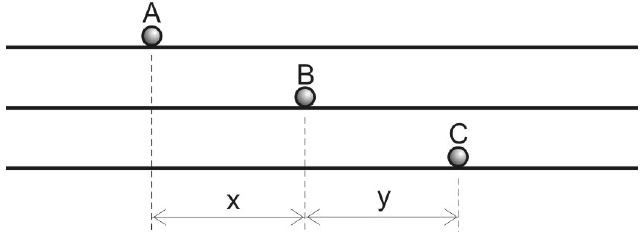
Em t = 2 s, a partícula A cruza com a partícula B. Em t = 3 s, a partícula A cruza com a partícula C. A partícula C alcançará a partícula B no instante dado pela relação
• Aceleração da gravidade: g = 10 m/s²;
• Calor específico da água: c = 1,0 cal/g ºC;
• sen 45° = cos 45° = √2/2.
Uma partícula, de massa 1 kg, descreve um movimento circular uniformemente variado, de raio 2,25 m, iniciando-o a partir do repouso no instante t₀ = 0.
Em t = 2 s, o módulo de sua velocidade vetorial (v⃗) é de 6 m/s, conforme figura abaixo.
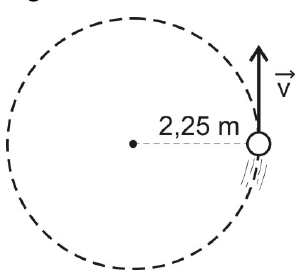
A intensidade da força resultante sobre a partícula, no instante t = 1 s, em N, vale
• Aceleração da gravidade: g = 10 m/s²;
• Calor específico da água: c = 1,0 cal/g ºC;
• sen 45° = cos 45° = √2/2.
Considere dois sistemas térmicos A e B constituídos de corpos perfeitamente esféricos, em condições normais de temperatura e pressão, conforme figura abaixo.
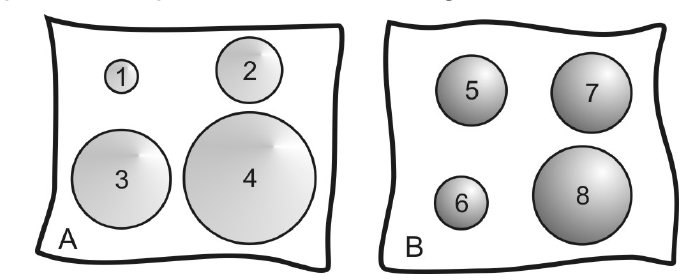
No sistema A, as esferas 1, 2, 3 e 4 são pequenas gotas esféricas de água pura com massa respectivamente iguais a 1 g, 2 g, 4 g e 8 g. O sistema B é constituído das esferas maciças e homogêneas 5, 6, 7 e 8 de mesmo material, de calor específico constante igual a 0,2 cal/g ºC e massa específica igual a 2,5 g/cm³. Os volumes dessas esferas são conhecidos e valem, respectivamente, 4, 5, 7 e 16 cm³.
Nessas condições, o número máximo de esferas do sistema A que podem ser permutadas simultaneamente com esferas do sistema B, de maneira que os sistemas A e B continuem com a mesma capacidade térmica inicial e com o mesmo número de esferas, é
• Aceleração da gravidade: g = 10 m/s²;
• Calor específico da água: c = 1,0 cal/g ºC;
• sen 45° = cos 45° = √2/2.
Uma esfera, de dimensões desprezíveis, sob ação de um campo gravitacional constante, está inicialmente equilibrada na vertical por uma mola. A mola é ideal e se encontra com uma deformação x, conforme ilustrado na figura 1.
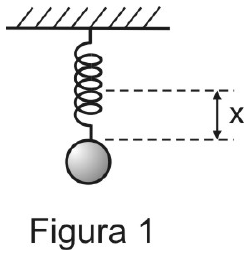
O sistema esfera-mola é posto, em seguida, a deslizar sobre uma superfície horizontal, com velocidade constante, conforme indicado na figura 2. Nessa situação, quando o ângulo de inclinação da mola é θ, em relação à horizontal, sua deformação é y.
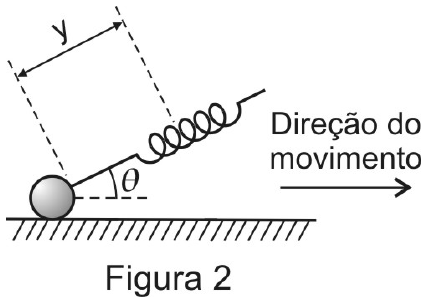
Nessas condições, o coeficiente de atrito cinético entre a esfera e a superfície horizontal vale
• Aceleração da gravidade: g = 10 m/s²;
• Calor específico da água: c = 1,0 cal/g ºC;
• sen 45° = cos 45° = √2/2.
A montagem da figura a seguir ilustra a descida de uma partícula 1 ao longo de um trilho curvilíneo. Partindo do repouso em A, a partícula chega ao ponto B, que está a uma distância vertical H abaixo do ponto A, de onde, então, é lançada obliquamente, com um ângulo de 45º com a horizontal.
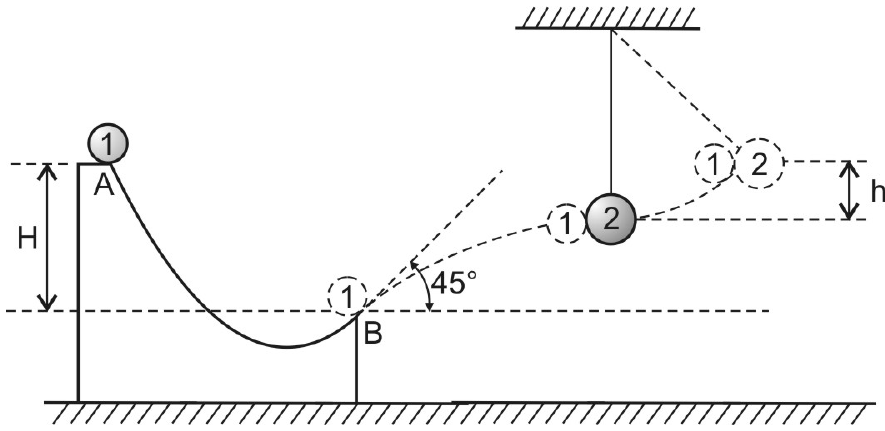
A partícula, agora, descreve uma trajetória parabólica e, ao atingir seu ponto de altura máxima, nessa trajetória, ela se acopla a uma partícula 2, sofrendo, portanto, uma colisão inelástica.
Essa segunda partícula possui o dobro de massa da primeira, está em repouso antes da colisão e está presa ao teto por um fio ideal, de comprimento maior que H, constituindo, assim, um pêndulo. Considerando que apenas na colisão atuaram forças dissipativas, e que o campo gravitacional local é constante. O sistema formado pelas partículas 1 e 2 atinge uma altura máxima h igual a
• Aceleração da gravidade: g = 10 m/s²;
• Calor específico da água: c = 1,0 cal/g ºC;
• sen 45° = cos 45° = √2/2.
Um armário, cujas dimensões estão indicadas na figura abaixo, está em repouso sobre um assoalho plano e horizontal.
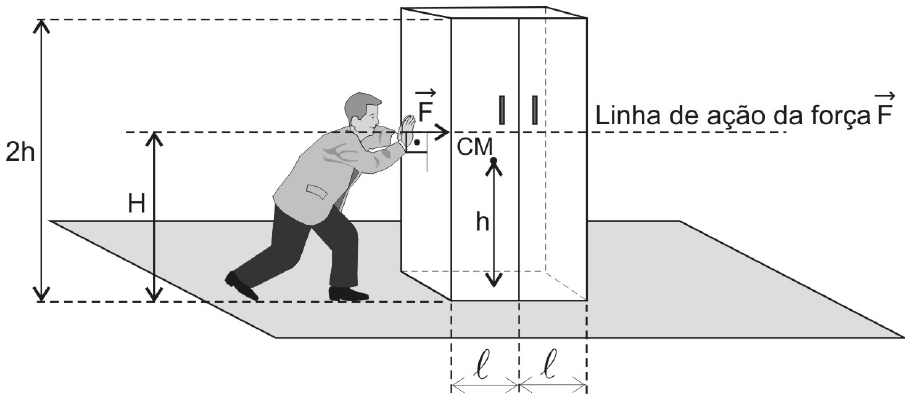
Uma pessoa aplica uma força F⃗ constante e horizontal, cuja linha de ação e o centro de massa (CM) do armário estão num mesmo plano vertical. Sendo o coeficiente de atrito estático entre o assoalho e o piso do armário igual a μ e estando o armário na iminência de escorregar, a altura máxima H na qual a pessoa poderá aplicar a força para que a base do armário continue completamente em contato com o assoalho é
• Aceleração da gravidade: g = 10 m/s²;
• Calor específico da água: c = 1,0 cal/g ºC;
• sen 45° = cos 45° = √2/2.
Um feixe de luz monocromática incide em uma interface perfeitamente plana formada por dois meios com índices de refração absolutos n₁ e n₂, com n₂ > n₁, conforme figura abaixo.
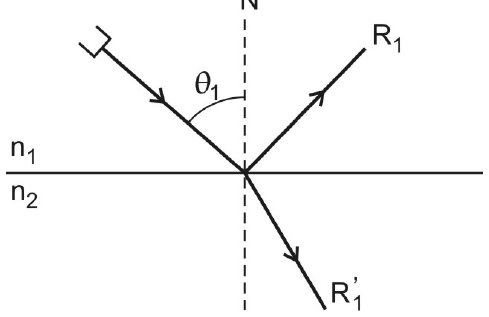
Esse feixe dá origem a dois outros feixes, o refletido R₁ e o refratado R₁’, com intensidades I₁ e I₁’, respectivamente.
O ângulo de incidência θ₁, θ₁ < π/6, medido em relação à normal N, pode ser alterado para um valor θ₂ tal que θ₁ < θ₂ < π/3, originando dois novos feixes, o refletido R₂ e o refratado R₂’, de intensidades, respectivamente I₂ e I₂’.
Considere que os meios sejam perfeitamente homogêneos, transparentes e isótropos, que não haja dissipação da energia incidente, nem absorção de luz na interface.
Nessas condições, são feitas as seguintes afirmativas sobre as intensidades dos raios refletidos e refratados.
I. I₁ > I₁’ e I₂ < I₂’
II. I₁ > I₂ e I₁’ > I₂’
III. I₁ < I₁’ e I₂ > I₂’
IV. I₁ < I₂ e I₁’ > I₂’
V. I₁ < I₁’ e I₂ < I₂’
Assim, são corretas as afirmativas
• Aceleração da gravidade: g = 10 m/s²;
• Calor específico da água: c = 1,0 cal/g ºC;
• sen 45° = cos 45° = √2/2.
Duas lentes esféricas delgadas 1 e 2, com índices de refração n₁ e n₂, respectivamente, são usadas para observar a figura plana mostrada abaixo, quando o observador, objeto e lente estão imersos em um meio homogêneo, transparente e isótropo com índice de refração n maior do que os índices n₁ e n₂.
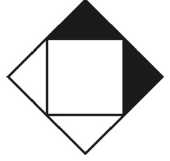
As imagens observadas são apresentadas nas figuras 1 e 2 em comparação com o objeto observado.
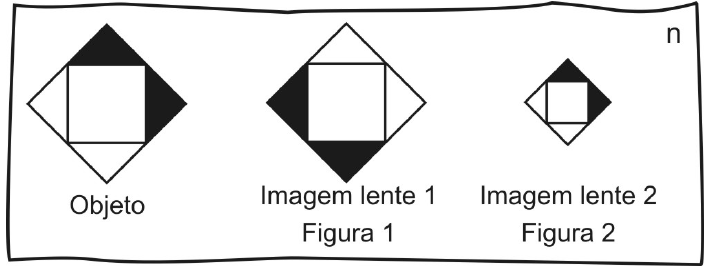
Se a mesma observação for realizada, porém com o observador, objeto e lente imersos em um outro meio com índice de refração n’ menor do que n₁ e n₂, das opções abaixo a que apresenta as imagens que poderão ser observadas, respectivamente, pelas lentes 1 e 2 serão
• Aceleração da gravidade: g = 10 m/s²;
• Calor específico da água: c = 1,0 cal/g ºC;
• sen 45° = cos 45° = √2/2.
Num instante t₀ = 0 um capacitor de 2,5 mF, totalmente descarregado, é ligado a uma fonte de 12 V por meio de uma chave Ch que é colocada na posição 1, conforme figura abaixo.
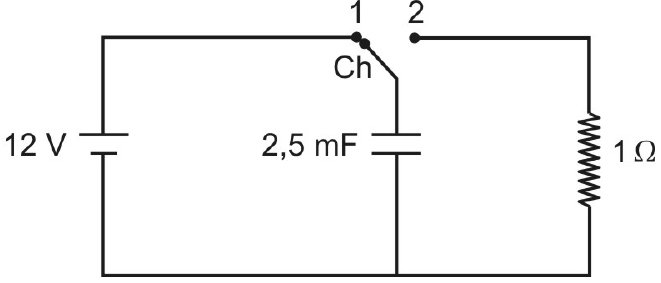
Em um determinado instante t₁, o capacitor fica completamente carregado.
Nessas condições, são feitas as seguintes afirmativas.
I. Ao colocar a chave do circuito na posição 2, o capacitor será descarregado através do resistor de 1 Ω e sua diferença de potencial decrescerá exponencialmente com o tempo, até completar o processo de descarga.
II. Com a chave do circuito na posição 1, para qualquer instante de tempo t, tal que t ≤ t₁, o capacitor sofre um processo de carga, em que a corrente no circuito vai diminuindo linearmente com o tempo e tem sua intensidade nula quando t = t₁.
III. A energia potencial armazenada no capacitor no instante de tempo t₁ vale 0,18 J.
São verdadeiras as afirmativas
• Aceleração da gravidade: g = 10 m/s²;
• Calor específico da água: c = 1,0 cal/g ºC;
• sen 45° = cos 45° = √2/2.
Um corpo de massa m = 1 kg movimenta-se no sentido horário, ao longo de uma trajetória circular de raio A, em movimento circular uniforme com velocidade angular igual a 2 rad/s, conforme a figura abaixo.
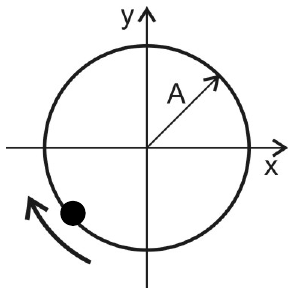
Nessas condições, os sistemas massa-mola oscilando em movimento harmônico simples, a partir de t = 0, que podem representar o movimento dessa partícula, respectivamente, nos eixos x e y, são
• Aceleração da gravidade: g = 10 m/s²;
• Calor específico da água: c = 1,0 cal/g ºC;
• sen 45° = cos 45° = √2/2.
A figura abaixo representa dois harmônicos A e B, de frequências, respectivamente, iguais a fA e fB, que podem ser estabelecidos em uma mesma corda, fixa em suas extremidades, e tracionada por uma força de módulo F.
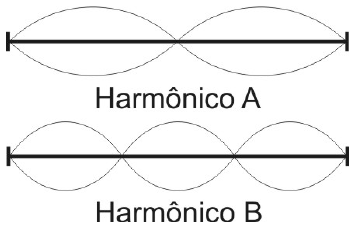
Nessas condições, a mesma razão, entre as frequências fA/fB, pode ser obtida entre as frequências das ondas estacionárias representadas nos tubos sonoros abertos e idênticos A’ e B’, indicados na opção
• Aceleração da gravidade: g = 10 m/s²;
• Calor específico da água: c = 1,0 cal/g ºC;
• sen 45° = cos 45° = √2/2.
Duas partículas eletrizadas A e B, localizadas num plano isolante e horizontal α, estão em repouso e interligadas por um fio ideal, também isolante, de comprimento ℓ igual a 3 cm, conforme ilustrado na figura abaixo.
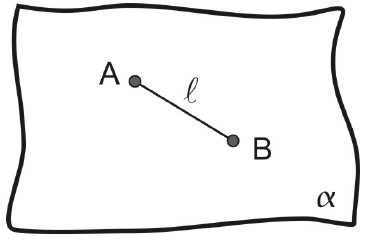
A partícula A está fixa e B pode mover-se, sem quaisquer resistências sobre o plano. Quando B, que tem massa igual a 20 g, está em repouso, verifica-se que a força tensora no fio vale 9 N. Imprime-se certa velocidade na partícula B, que passa a descrever um movimento circular uniforme em torno de A, de tal forma que a força tensora no fio altera-se para 15 N. Desprezando as ações gravitacionais, enquanto a tensão no fio permanecer igual a 15 N, pode-se afirmar que a energia do sistema, constituído das partículas A e B, será, em J, de
Texto-base:
Texto-base:
Texto-base:
Texto-base:
Texto-base:
Texto-base:
Texto-base:
Texto-base:
Nas questões de Física, quando necessário, use:
Nas questões de Física, quando necessário, use:
Nas questões de Física, quando necessário, use:
Nas questões de Física, quando necessário, use:
Nas questões de Física, quando necessário, use:
Nas questões de Física, quando necessário, use:
Nas questões de Física, quando necessário, use:
Nas questões de Física, quando necessário, use:
Nas questões de Física, quando necessário, use:
Nas questões de Física, quando necessário, use:
Nas questões de Física, quando necessário, use:
Nas questões de Física, quando necessário, use: