← Voltar para a lista de provas Instituto Tecnológico de Aeronáutica (ITA) · Vestibular 2019 — 1ª Fase (Física, Português, Inglês, Matemática e Química) 60 questões nesta prova · página 2 de 3 · 60 com gabarito Gabarito disponível Senhora é romântico por ter uma protagonista virtuosa movida pelo amor. Aurélia Camargo, apesar da vingança que arquiteta, é movida pelo amor por Seixas e se redime no fim. Idealizar uma heroína virtuosa e sentimental é característica romântica. A: não há rivalidade familiar, e sim o casamento por interesse. B: Seixas se corrompe pelo dinheiro. C: o cenário é urbano, mas a natureza não é o foco. D: o determinismo é próprio do Naturalismo. Referência: José de Alencar, Senhora Resolução comentada do VaiConcursos. Gabarito disponível A ambiguidade do adultério aparece no interesse de Sofia por Carlos Maria, que não se consuma. Em Quincas Borba, Sofia se sente atraída pelo galanteador Carlos Maria e esconde isso do marido. Fica a dúvida sobre os limites da relação, e a traição não se confirma. É o tratamento ambíguo do adultério descrito no enunciado. A e C tratam apenas do ciúme ou da reação masculina, sem a dubiedade feminina. B envolve o assédio de Rubião, que não ilustra a ambiguidade da traição desejada, mas não consumada. E contraria a situação, pois Sofia não se empenha em casar Maria Benedita com Carlos Maria. Referência: Machado de Assis, Quincas Borba Resolução comentada do VaiConcursos. Gabarito disponível Paulo Honório reconhece que as agruras da vida lhe deram uma alma agreste. Na narrativa em primeira pessoa, Paulo Honório admite que a vida dura, até enriquecer, endureceu seu caráter e o tornou áspero ('alma agreste'). Isso explica sua brutalidade com os outros, inclusive com Madalena. A: ele se relaciona com as mulheres da fazenda. B: apesar da violência, tem traços de humanidade e remorso. D: não abandona a mãe de criação. E: após a morte de Madalena, ele se questiona sobre seus atos. Referência: Graciliano Ramos, São Bernardo Resolução comentada do VaiConcursos. Gabarito disponível Choro e onda se aproximam pela água em movimento; o choro contido deixa náufragos dentro. I está correta, pois a comparação metafórica se apoia na água em movimento. II também: o choro acompanha a emoção, enquanto a onda obedece às 'ordens augustas' do céu e do mar, em movimento cíclico. IV também: o choro que 'foge sem vestígios' leva 'náufragos dentro', ou seja, deixa um peso emocional desolador. O item III é falso, porque o poema não ameniza o drama do choro: o fim sugere que a dor permanece em quem chora. A omite o IV. C inclui o III, que é falso. D traz o III e deixa de fora o I e o IV. E inclui o III. Referência: Cecília Meireles, Viagem/Vaga música Resolução comentada do VaiConcursos. Gabarito disponível Hoje se compra três vezes mais sorvete que em 1976. O texto diz 'three times more ice cream', o que corresponde à alternativa D. A: compra-se metade do leite fresco, não 50% a mais. B: são um terço a mais de cereais matinais, não 3%. C: são 39 vezes mais sobremesas lácteas, não menos. E: são três vezes mais batatas fritas (crisps), não menos. Referência: Texto: Age of obesity shaming (The Guardian, 2018), linhas 10-13 Resolução comentada do VaiConcursos. Gabarito disponível O debate sobre a foto de 1976 mostra que culpar o obeso funciona. Depois de dizer que as empresas promovem a ideia de 'personal responsibility', o autor afirma que, pelo debate suscitado pela foto, 'it works'. Isso indica que a estratégia de culpar o indivíduo tem sido eficaz. A: 2.280 kcal em 1976 excluía doces e álcool; com eles eram 2.590. B: o açúcar indireto provavelmente disparou, e o que caiu foram as compras diretas. C: o texto diz que só há dados de compra a partir de 1992, o que não é o mesmo que existir só até 1992. D: a indústria contrata cientistas para confundir a população, não para orientá-la. Referência: Texto: Age of obesity shaming (The Guardian, 2018) Resolução comentada do VaiConcursos. Gabarito disponível Mais de 90% dos legisladores creem na motivação pessoal, logo menos de 10% não creem. O texto cita artigo do Lancet segundo o qual mais de 90% dos policymakers acreditam que a motivação pessoal tem forte influência na obesidade. Portanto, menos de 10% não acreditam nisso, como diz a alternativa B. A: os legisladores ignoram as evidências, e a neurociência é usada pelos publicitários. C: eles não propõem mecanismo algum. D: atribuem a obesidade à falta de vontade; estresse e ansiedade vêm da literatura científica. E: o autor chama a explicação de improvável e imune a evidências. Referência: Texto: Age of obesity shaming (The Guardian, 2018) Resolução comentada do VaiConcursos. Gabarito disponível O autor defende que força de vontade e responsabilidade pessoal cabem a governos e legisladores. No fim do texto, o autor diz que a força de vontade 'needs to be exercised – by governments' e que a responsabilidade pessoal é necessária 'on the part of policymakers'. A alternativa D reproduz essa inversão, atribuindo respectivamente aos governantes e aos legisladores. A e B reproduzem opiniões de comentaristas que o autor critica. C inverte a relação, pois a obesidade é maior entre os mais pobres. E distorce o último parágrafo, em que o controle deve recair sobre quem explora as fraquezas, não sobre os obesos. Referência: Texto: Age of obesity shaming (The Guardian, 2018) Resolução comentada do VaiConcursos. Gabarito disponível 'As' com valor de conformidade equivale a 'In line with what'. 'As Jacques Peretti argued...' tem sentido de 'conforme/como Peretti argumentou', ou seja, conformidade com o que foi dito. 'In line with what' mantém esse sentido e a gramática. B (in contempt of = em desprezo a), C (during the time = durante o tempo), D (considering that = considerando que, causa) e E (despite the fact that = apesar de, concessão) alteram o sentido. Referência: Linking words: as = conformidade Resolução comentada do VaiConcursos. Gabarito disponível Gabarito disponível Gabarito disponível Gabarito disponível A alternativa D inverte a ideia do texto sobre empresas públicas. O autor diz que não podemos confiar que as empresas se autorregulem, pois as públicas são incentivadas a maximizar lucros e seus algoritmos otimizam metas financeiras, não sociais. A alternativa D afirma que são incentivadas a se automonitorar e que maximizam ora metas financeiras, ora sociais, o que contradiz o texto. A (linhas 8-9), B (10-14), C (15-18) e E (31-33) refletem fielmente o texto, portanto não são a incorreta. Referência: Texto: AI regulation (MarketWatch, 2018) Resolução comentada do VaiConcursos. Gabarito disponível Itens I, II e IV refletem o texto; o III distorce o trecho sobre o Facebook. I e II estão nas linhas 19-21: a regulação por software monitora melhor e os algoritmos veem padrões que humanos não captam. IV corresponde às linhas 23-25, sobre algoritmos que monitoram humanos, por exemplo para detectar hosts que recusam minorias. O item III afirma como fato que o Facebook difundiu manchetes de partidos conservadores. O texto só usa hipóteses ('if Congress wants...', 'if Facebook's editors are squashing conservative headlines'), e fala em notícias conservadoras, não em partidos. A omite o IV. C e D incluem o III, que é incorreto. E omite o I. Referência: Texto: AI regulation (MarketWatch, 2018) Resolução comentada do VaiConcursos. Gabarito disponível Gabarito disponível 'So' como propósito (so that), intensificador e conectivo de conclusão. Em I, 'so it benefits society' equivale a 'so that', indicando finalidade. Em II, 'so difficult' intensifica o adjetivo. Em III, 'So,' inicia a frase retomando e concluindo o raciocínio anterior (sobre regulação excessiva). B inverte as funções de I e II (resultado/tamanho) e trata III como substituição de oração. C, D e E atribuem funções que 'so' não tem nesses trechos (decisão, adversativa, preposição etc.). Referência: Usos de 'so' em inglês Resolução comentada do VaiConcursos. Gabarito disponível Tangente do ângulo MÂN no retângulo com AB = 2·BC é 4/35. Tome A=(0,0), B=(4,0), C=(4,2), D=(0,2), de modo que AB = 2·BC. Então M=(4,1) e N=(4,3/2). Assim tg(BÂM)=1/4 e tg(BÂN)=3/8. Logo tg(MÂN) = (3/8 − 1/4)/(1 + 3/32) = (1/8)/(35/32) = 4/35. 1/35, 2/35, 8/35 e 16/35 não saem da fórmula da tangente da diferença com esses valores. Os resultados 2/35, 8/35 e 16/35 são múltiplos incorretos de 4/35. Referência: tg(a−b) = (tg a − tg b)/(1 + tg a·tg b) Resolução comentada do VaiConcursos. Gabarito disponível Raízes em PA não negativas de x³+ax²+bx, com soma dos coeficientes 10; soma das raízes = 9. Como não há termo independente, 0 é raiz. Sendo as raízes não negativas e em PA, elas são 0, r e 2r. Por Girard, a = −3r e b = 2r². A soma dos coeficientes é 1+a+b = 10, logo 2r² − 3r − 9 = 0, o que dá r = 3 (a outra solução é negativa). A soma das raízes é 3r = 9. B, C, D e E não resultam da condição 1+a+b=10: com r=3 as raízes são 0, 3 e 6, e a soma é 9, não 8, 3, 9/2 nem 10. Referência: Relações de Girard; progressão aritmética Resolução comentada do VaiConcursos. Gabarito disponível cos θ = 1/5. A distância OP é √(1+9) = √10 e o raio é 2. Se θ é o ângulo entre as tangentes, sen(θ/2) = 2/√10. Então cos θ = 1 − 2sen²(θ/2) = 1 − 2·4/10 = 1/5. B, C, D, E) São valores que não resultam de sen(θ/2)=2/√10. Referência: Geometria analítica; tangentes à circunferência Resolução comentada do VaiConcursos. Gabarito disponível Raio da base 6 cm e altura 8 cm. O arco do setor de 216° com raio 10 é (216/360)·2π·10 = 12π, que é o comprimento da circunferência da base. Então 2πr = 12π e r = 6. A altura é h = √(10²−6²) = 8 cm. A, B, C, E) São valores de altura que não correspondem a r = 6 e g = 10. Referência: Cone; planificação da superfície lateral Resolução comentada do VaiConcursos.ITA — Vestibular 2019 — 1ª Fase — Física, Português, Inglês, Matemática e Química
Resolução comentada
Análise das alternativas
Resolução comentada
Análise das alternativas
Resolução comentada
Análise das alternativas
“Epigrama n. 04”
O choro vem perto dos olhos
para que a dor transborde e caia.
O choro vem quase chorando
como a onda que toca a praia.
Descem dos céus ordens augustas
e o mar chama a onda para o centro.
O choro foge sem vestígios,
mas levando náufragos dentro.
(MEIRELES, Cecília, Viagem/Vaga música. Rio de Janeiro: Nova Fronteira, 1982.p.43)
O texto
I. aproxima metaforicamente um fenômeno humano e um fenômeno natural a partir da identificação de, pelo menos, um traço comum a ambos: água em movimento.
II. sugere que, enquanto o movimento do choro é ligado à variação das emoções, o movimento da onda deve-se a forças naturais, responsáveis pela circularidade marítima.
III. ameniza o dramatismo do choro humano, pois, quando acomete o sujeito, ele passa naturalmente, como a onda que volta ao mar.
IV. leva-nos a perceber que o choro contido tem um impacto emocional que o torna desolador.
Estão corretas:Resolução comentada
Análise das alternativas
As questões de 25 a 29 referem-se ao texto a seguir:
1 […] A picture of Brighton beach in 1976, featured in the Guardian a few weeks ago, appeared to show an alien
2 race. Almost everyone was slim. I mentioned it on social media, then went on holiday. When I returned, I found that
3 people were still debating it. The heated discussion prompted me to read more. How have we grown so fat, so fast? To
4 my astonishment, almost every explanation proposed in the thread turned out to be untrue. […] The obvious
5 explanation, many on social media insisted, is that we’re eating more. […]
6 So here’s the first big surprise: we ate more in 1976. According to government figures, we currently consume an
7 average of 2,130 kilocalories a day, a figure that appears to include sweets and alcohol. But in 1976, we consumed
8 2,280 kcal excluding alcohol and sweets, or 2,590 kcal when they’re included. I have found no reason to disbelieve the
9 figures. […]
10 So what has happened? The light begins to dawn when you look at the nutrition figures in more detail. Yes, we
11 ate more in 1976, but differently. Today, we buy half as much fresh milk per person, but five times more yoghurt, three
12 times more ice cream and – wait for it – 39 times as many dairy desserts. We buy half as many eggs as in 1976, but a
13 third more breakfast cereals and twice the cereal snacks; half the total potatoes, but three times the crisps. While our
14 direct purchases of sugar have sharply declined, the sugar we consume in drinks and confectionery is likely to have
15 rocketed (there are purchase numbers only from 1992, at which point they were rising rapidly. Perhaps, as we
16 consumed just 9kcal a day in the form of drinks in 1976, no one thought the numbers were worth collecting.) In other
17 words, the opportunities to load our food with sugar have boomed. As some experts have long proposed, this seems to
18 be the issue.
19 The shift has not happened by accident. As Jacques Peretti argued in his film The Men Who Made Us Fat, food
20 companies have invested heavily in designing products that use sugar to bypass our natural appetite control
21 mechanisms, and in packaging and promoting these products to break down what remains of our defenses, including
22 through the use of subliminal scents. They employ an army of food scientists and psychologists to trick us into eating
23 more than we need, while their advertisers use the latest findings in neuroscience to overcome our resistance.
24 They hire biddable scientists and thinktanks to confuse us about the causes of obesity. Above all, just as the
25 tobacco companies did with smoking, they promote the idea that weight is a question of “personal responsibility”. After
26 spending billions on overriding our willpower, they blame us for failing to exercise it.
27 To judge by the debate the 1976 photograph triggered, it works. “There are no excuses. Take responsibility for
28 your own lives, people!” “No one force feeds you junk food, it’s personal choice. We’re not lemmings.” “Sometimes I think
29 having free healthcare is a mistake. It’s everyone’s right to be lazy and fat because there is a sense of entitlement about
30 getting fixed.” The thrill of disapproval chimes disastrously with industry propaganda. We delight in blaming the victims.
31 More alarmingly, according to a paper in the Lancet, more than 90% of policymakers believe that “personal
32 motivation” is “a strong or very strong influence on the rise of obesity”. Such people propose no mechanism by which the
33 61% of English people who are overweight or obese have lost their willpower. But this improbable explanation seems
34 immune to evidence.
35 Perhaps this is because obesophobia is often a fatly-disguised form of snobbery. In most rich nations, obesity
36 rates are much higher at the bottom of the socioeconomic scale. They correlate strongly with inequality, which helps to
37 explain why the UK’s incidence is greater than in most European and OECD nations. The scientific literature shows how
38 the lower spending power, stress, anxiety and depression associated with low social status makes people more
39 vulnerable to bad diets.
40 Just as jobless people are blamed for structural unemployment, and indebted people are blamed for impossible
41 housing costs, fat people are blamed for a societal problem. But yes, willpower needs to be exercised – by governments.
42 Yes, we need personal responsibility – on the part of policymakers. And yes, control needs to be exerted – over those
43 who have discovered our weaknesses and ruthlessly exploit them.
Adaptado de: <https://www.theguardian.com/commentisfree/2018/aug/15/age-of-obesity-shaming-overweight-people/>. Acesso em: ago. 2018.
De acordo com o texto, em comparação com 1976, atualmente nós compramosResolução comentada
Análise das alternativas
As questões de 25 a 29 referem-se ao texto a seguir:
1 […] A picture of Brighton beach in 1976, featured in the Guardian a few weeks ago, appeared to show an alien
2 race. Almost everyone was slim. I mentioned it on social media, then went on holiday. When I returned, I found that
3 people were still debating it. The heated discussion prompted me to read more. How have we grown so fat, so fast? To
4 my astonishment, almost every explanation proposed in the thread turned out to be untrue. […] The obvious
5 explanation, many on social media insisted, is that we’re eating more. […]
6 So here’s the first big surprise: we ate more in 1976. According to government figures, we currently consume an
7 average of 2,130 kilocalories a day, a figure that appears to include sweets and alcohol. But in 1976, we consumed
8 2,280 kcal excluding alcohol and sweets, or 2,590 kcal when they’re included. I have found no reason to disbelieve the
9 figures. […]
10 So what has happened? The light begins to dawn when you look at the nutrition figures in more detail. Yes, we
11 ate more in 1976, but differently. Today, we buy half as much fresh milk per person, but five times more yoghurt, three
12 times more ice cream and – wait for it – 39 times as many dairy desserts. We buy half as many eggs as in 1976, but a
13 third more breakfast cereals and twice the cereal snacks; half the total potatoes, but three times the crisps. While our
14 direct purchases of sugar have sharply declined, the sugar we consume in drinks and confectionery is likely to have
15 rocketed (there are purchase numbers only from 1992, at which point they were rising rapidly. Perhaps, as we
16 consumed just 9kcal a day in the form of drinks in 1976, no one thought the numbers were worth collecting.) In other
17 words, the opportunities to load our food with sugar have boomed. As some experts have long proposed, this seems to
18 be the issue.
19 The shift has not happened by accident. As Jacques Peretti argued in his film The Men Who Made Us Fat, food
20 companies have invested heavily in designing products that use sugar to bypass our natural appetite control
21 mechanisms, and in packaging and promoting these products to break down what remains of our defenses, including
22 through the use of subliminal scents. They employ an army of food scientists and psychologists to trick us into eating
23 more than we need, while their advertisers use the latest findings in neuroscience to overcome our resistance.
24 They hire biddable scientists and thinktanks to confuse us about the causes of obesity. Above all, just as the
25 tobacco companies did with smoking, they promote the idea that weight is a question of “personal responsibility”. After
26 spending billions on overriding our willpower, they blame us for failing to exercise it.
27 To judge by the debate the 1976 photograph triggered, it works. “There are no excuses. Take responsibility for
28 your own lives, people!” “No one force feeds you junk food, it’s personal choice. We’re not lemmings.” “Sometimes I think
29 having free healthcare is a mistake. It’s everyone’s right to be lazy and fat because there is a sense of entitlement about
30 getting fixed.” The thrill of disapproval chimes disastrously with industry propaganda. We delight in blaming the victims.
31 More alarmingly, according to a paper in the Lancet, more than 90% of policymakers believe that “personal
32 motivation” is “a strong or very strong influence on the rise of obesity”. Such people propose no mechanism by which the
33 61% of English people who are overweight or obese have lost their willpower. But this improbable explanation seems
34 immune to evidence.
35 Perhaps this is because obesophobia is often a fatly-disguised form of snobbery. In most rich nations, obesity
36 rates are much higher at the bottom of the socioeconomic scale. They correlate strongly with inequality, which helps to
37 explain why the UK’s incidence is greater than in most European and OECD nations. The scientific literature shows how
38 the lower spending power, stress, anxiety and depression associated with low social status makes people more
39 vulnerable to bad diets.
40 Just as jobless people are blamed for structural unemployment, and indebted people are blamed for impossible
41 housing costs, fat people are blamed for a societal problem. But yes, willpower needs to be exercised – by governments.
42 Yes, we need personal responsibility – on the part of policymakers. And yes, control needs to be exerted – over those
43 who have discovered our weaknesses and ruthlessly exploit them.
Adaptado de: <https://www.theguardian.com/commentisfree/2018/aug/15/age-of-obesity-shaming-overweight-people/>. Acesso em: ago. 2018.
De acordo com o texto, é correto afirmar queResolução comentada
Análise das alternativas
As questões de 25 a 29 referem-se ao texto a seguir:
1 […] A picture of Brighton beach in 1976, featured in the Guardian a few weeks ago, appeared to show an alien
2 race. Almost everyone was slim. I mentioned it on social media, then went on holiday. When I returned, I found that
3 people were still debating it. The heated discussion prompted me to read more. How have we grown so fat, so fast? To
4 my astonishment, almost every explanation proposed in the thread turned out to be untrue. […] The obvious
5 explanation, many on social media insisted, is that we’re eating more. […]
6 So here’s the first big surprise: we ate more in 1976. According to government figures, we currently consume an
7 average of 2,130 kilocalories a day, a figure that appears to include sweets and alcohol. But in 1976, we consumed
8 2,280 kcal excluding alcohol and sweets, or 2,590 kcal when they’re included. I have found no reason to disbelieve the
9 figures. […]
10 So what has happened? The light begins to dawn when you look at the nutrition figures in more detail. Yes, we
11 ate more in 1976, but differently. Today, we buy half as much fresh milk per person, but five times more yoghurt, three
12 times more ice cream and – wait for it – 39 times as many dairy desserts. We buy half as many eggs as in 1976, but a
13 third more breakfast cereals and twice the cereal snacks; half the total potatoes, but three times the crisps. While our
14 direct purchases of sugar have sharply declined, the sugar we consume in drinks and confectionery is likely to have
15 rocketed (there are purchase numbers only from 1992, at which point they were rising rapidly. Perhaps, as we
16 consumed just 9kcal a day in the form of drinks in 1976, no one thought the numbers were worth collecting.) In other
17 words, the opportunities to load our food with sugar have boomed. As some experts have long proposed, this seems to
18 be the issue.
19 The shift has not happened by accident. As Jacques Peretti argued in his film The Men Who Made Us Fat, food
20 companies have invested heavily in designing products that use sugar to bypass our natural appetite control
21 mechanisms, and in packaging and promoting these products to break down what remains of our defenses, including
22 through the use of subliminal scents. They employ an army of food scientists and psychologists to trick us into eating
23 more than we need, while their advertisers use the latest findings in neuroscience to overcome our resistance.
24 They hire biddable scientists and thinktanks to confuse us about the causes of obesity. Above all, just as the
25 tobacco companies did with smoking, they promote the idea that weight is a question of “personal responsibility”. After
26 spending billions on overriding our willpower, they blame us for failing to exercise it.
27 To judge by the debate the 1976 photograph triggered, it works. “There are no excuses. Take responsibility for
28 your own lives, people!” “No one force feeds you junk food, it’s personal choice. We’re not lemmings.” “Sometimes I think
29 having free healthcare is a mistake. It’s everyone’s right to be lazy and fat because there is a sense of entitlement about
30 getting fixed.” The thrill of disapproval chimes disastrously with industry propaganda. We delight in blaming the victims.
31 More alarmingly, according to a paper in the Lancet, more than 90% of policymakers believe that “personal
32 motivation” is “a strong or very strong influence on the rise of obesity”. Such people propose no mechanism by which the
33 61% of English people who are overweight or obese have lost their willpower. But this improbable explanation seems
34 immune to evidence.
35 Perhaps this is because obesophobia is often a fatly-disguised form of snobbery. In most rich nations, obesity
36 rates are much higher at the bottom of the socioeconomic scale. They correlate strongly with inequality, which helps to
37 explain why the UK’s incidence is greater than in most European and OECD nations. The scientific literature shows how
38 the lower spending power, stress, anxiety and depression associated with low social status makes people more
39 vulnerable to bad diets.
40 Just as jobless people are blamed for structural unemployment, and indebted people are blamed for impossible
41 housing costs, fat people are blamed for a societal problem. But yes, willpower needs to be exercised – by governments.
42 Yes, we need personal responsibility – on the part of policymakers. And yes, control needs to be exerted – over those
43 who have discovered our weaknesses and ruthlessly exploit them.
Adaptado de: <https://www.theguardian.com/commentisfree/2018/aug/15/age-of-obesity-shaming-overweight-people/>. Acesso em: ago. 2018.
De acordo com o texto,Resolução comentada
Análise das alternativas
As questões de 25 a 29 referem-se ao texto a seguir:
1 […] A picture of Brighton beach in 1976, featured in the Guardian a few weeks ago, appeared to show an alien
2 race. Almost everyone was slim. I mentioned it on social media, then went on holiday. When I returned, I found that
3 people were still debating it. The heated discussion prompted me to read more. How have we grown so fat, so fast? To
4 my astonishment, almost every explanation proposed in the thread turned out to be untrue. […] The obvious
5 explanation, many on social media insisted, is that we’re eating more. […]
6 So here’s the first big surprise: we ate more in 1976. According to government figures, we currently consume an
7 average of 2,130 kilocalories a day, a figure that appears to include sweets and alcohol. But in 1976, we consumed
8 2,280 kcal excluding alcohol and sweets, or 2,590 kcal when they’re included. I have found no reason to disbelieve the
9 figures. […]
10 So what has happened? The light begins to dawn when you look at the nutrition figures in more detail. Yes, we
11 ate more in 1976, but differently. Today, we buy half as much fresh milk per person, but five times more yoghurt, three
12 times more ice cream and – wait for it – 39 times as many dairy desserts. We buy half as many eggs as in 1976, but a
13 third more breakfast cereals and twice the cereal snacks; half the total potatoes, but three times the crisps. While our
14 direct purchases of sugar have sharply declined, the sugar we consume in drinks and confectionery is likely to have
15 rocketed (there are purchase numbers only from 1992, at which point they were rising rapidly. Perhaps, as we
16 consumed just 9kcal a day in the form of drinks in 1976, no one thought the numbers were worth collecting.) In other
17 words, the opportunities to load our food with sugar have boomed. As some experts have long proposed, this seems to
18 be the issue.
19 The shift has not happened by accident. As Jacques Peretti argued in his film The Men Who Made Us Fat, food
20 companies have invested heavily in designing products that use sugar to bypass our natural appetite control
21 mechanisms, and in packaging and promoting these products to break down what remains of our defenses, including
22 through the use of subliminal scents. They employ an army of food scientists and psychologists to trick us into eating
23 more than we need, while their advertisers use the latest findings in neuroscience to overcome our resistance.
24 They hire biddable scientists and thinktanks to confuse us about the causes of obesity. Above all, just as the
25 tobacco companies did with smoking, they promote the idea that weight is a question of “personal responsibility”. After
26 spending billions on overriding our willpower, they blame us for failing to exercise it.
27 To judge by the debate the 1976 photograph triggered, it works. “There are no excuses. Take responsibility for
28 your own lives, people!” “No one force feeds you junk food, it’s personal choice. We’re not lemmings.” “Sometimes I think
29 having free healthcare is a mistake. It’s everyone’s right to be lazy and fat because there is a sense of entitlement about
30 getting fixed.” The thrill of disapproval chimes disastrously with industry propaganda. We delight in blaming the victims.
31 More alarmingly, according to a paper in the Lancet, more than 90% of policymakers believe that “personal
32 motivation” is “a strong or very strong influence on the rise of obesity”. Such people propose no mechanism by which the
33 61% of English people who are overweight or obese have lost their willpower. But this improbable explanation seems
34 immune to evidence.
35 Perhaps this is because obesophobia is often a fatly-disguised form of snobbery. In most rich nations, obesity
36 rates are much higher at the bottom of the socioeconomic scale. They correlate strongly with inequality, which helps to
37 explain why the UK’s incidence is greater than in most European and OECD nations. The scientific literature shows how
38 the lower spending power, stress, anxiety and depression associated with low social status makes people more
39 vulnerable to bad diets.
40 Just as jobless people are blamed for structural unemployment, and indebted people are blamed for impossible
41 housing costs, fat people are blamed for a societal problem. But yes, willpower needs to be exercised – by governments.
42 Yes, we need personal responsibility – on the part of policymakers. And yes, control needs to be exerted – over those
43 who have discovered our weaknesses and ruthlessly exploit them.
Adaptado de: <https://www.theguardian.com/commentisfree/2018/aug/15/age-of-obesity-shaming-overweight-people/>. Acesso em: ago. 2018.
De acordo com o texto, é correto afirmar que o autor sustenta queResolução comentada
Análise das alternativas
As questões de 25 a 29 referem-se ao texto a seguir:
1 […] A picture of Brighton beach in 1976, featured in the Guardian a few weeks ago, appeared to show an alien
2 race. Almost everyone was slim. I mentioned it on social media, then went on holiday. When I returned, I found that
3 people were still debating it. The heated discussion prompted me to read more. How have we grown so fat, so fast? To
4 my astonishment, almost every explanation proposed in the thread turned out to be untrue. […] The obvious
5 explanation, many on social media insisted, is that we’re eating more. […]
6 So here’s the first big surprise: we ate more in 1976. According to government figures, we currently consume an
7 average of 2,130 kilocalories a day, a figure that appears to include sweets and alcohol. But in 1976, we consumed
8 2,280 kcal excluding alcohol and sweets, or 2,590 kcal when they’re included. I have found no reason to disbelieve the
9 figures. […]
10 So what has happened? The light begins to dawn when you look at the nutrition figures in more detail. Yes, we
11 ate more in 1976, but differently. Today, we buy half as much fresh milk per person, but five times more yoghurt, three
12 times more ice cream and – wait for it – 39 times as many dairy desserts. We buy half as many eggs as in 1976, but a
13 third more breakfast cereals and twice the cereal snacks; half the total potatoes, but three times the crisps. While our
14 direct purchases of sugar have sharply declined, the sugar we consume in drinks and confectionery is likely to have
15 rocketed (there are purchase numbers only from 1992, at which point they were rising rapidly. Perhaps, as we
16 consumed just 9kcal a day in the form of drinks in 1976, no one thought the numbers were worth collecting.) In other
17 words, the opportunities to load our food with sugar have boomed. As some experts have long proposed, this seems to
18 be the issue.
19 The shift has not happened by accident. As Jacques Peretti argued in his film The Men Who Made Us Fat, food
20 companies have invested heavily in designing products that use sugar to bypass our natural appetite control
21 mechanisms, and in packaging and promoting these products to break down what remains of our defenses, including
22 through the use of subliminal scents. They employ an army of food scientists and psychologists to trick us into eating
23 more than we need, while their advertisers use the latest findings in neuroscience to overcome our resistance.
24 They hire biddable scientists and thinktanks to confuse us about the causes of obesity. Above all, just as the
25 tobacco companies did with smoking, they promote the idea that weight is a question of “personal responsibility”. After
26 spending billions on overriding our willpower, they blame us for failing to exercise it.
27 To judge by the debate the 1976 photograph triggered, it works. “There are no excuses. Take responsibility for
28 your own lives, people!” “No one force feeds you junk food, it’s personal choice. We’re not lemmings.” “Sometimes I think
29 having free healthcare is a mistake. It’s everyone’s right to be lazy and fat because there is a sense of entitlement about
30 getting fixed.” The thrill of disapproval chimes disastrously with industry propaganda. We delight in blaming the victims.
31 More alarmingly, according to a paper in the Lancet, more than 90% of policymakers believe that “personal
32 motivation” is “a strong or very strong influence on the rise of obesity”. Such people propose no mechanism by which the
33 61% of English people who are overweight or obese have lost their willpower. But this improbable explanation seems
34 immune to evidence.
35 Perhaps this is because obesophobia is often a fatly-disguised form of snobbery. In most rich nations, obesity
36 rates are much higher at the bottom of the socioeconomic scale. They correlate strongly with inequality, which helps to
37 explain why the UK’s incidence is greater than in most European and OECD nations. The scientific literature shows how
38 the lower spending power, stress, anxiety and depression associated with low social status makes people more
39 vulnerable to bad diets.
40 Just as jobless people are blamed for structural unemployment, and indebted people are blamed for impossible
41 housing costs, fat people are blamed for a societal problem. But yes, willpower needs to be exercised – by governments.
42 Yes, we need personal responsibility – on the part of policymakers. And yes, control needs to be exerted – over those
43 who have discovered our weaknesses and ruthlessly exploit them.
Adaptado de: <https://www.theguardian.com/commentisfree/2018/aug/15/age-of-obesity-shaming-overweight-people/>. Acesso em: ago. 2018.
Assinale a alternativa que pode substituir ‘as’ na sentença “As Jacques Peretti argued in his film The Men Who Made Us Fat, food companies have invested heavily in designing products [...]” (linhas 19-20) mantendo o mesmo sentido do texto e a correção gramatical.Resolução comentada
Análise das alternativas
As questões de 30 a 32 referem-se à tirinha a seguir:
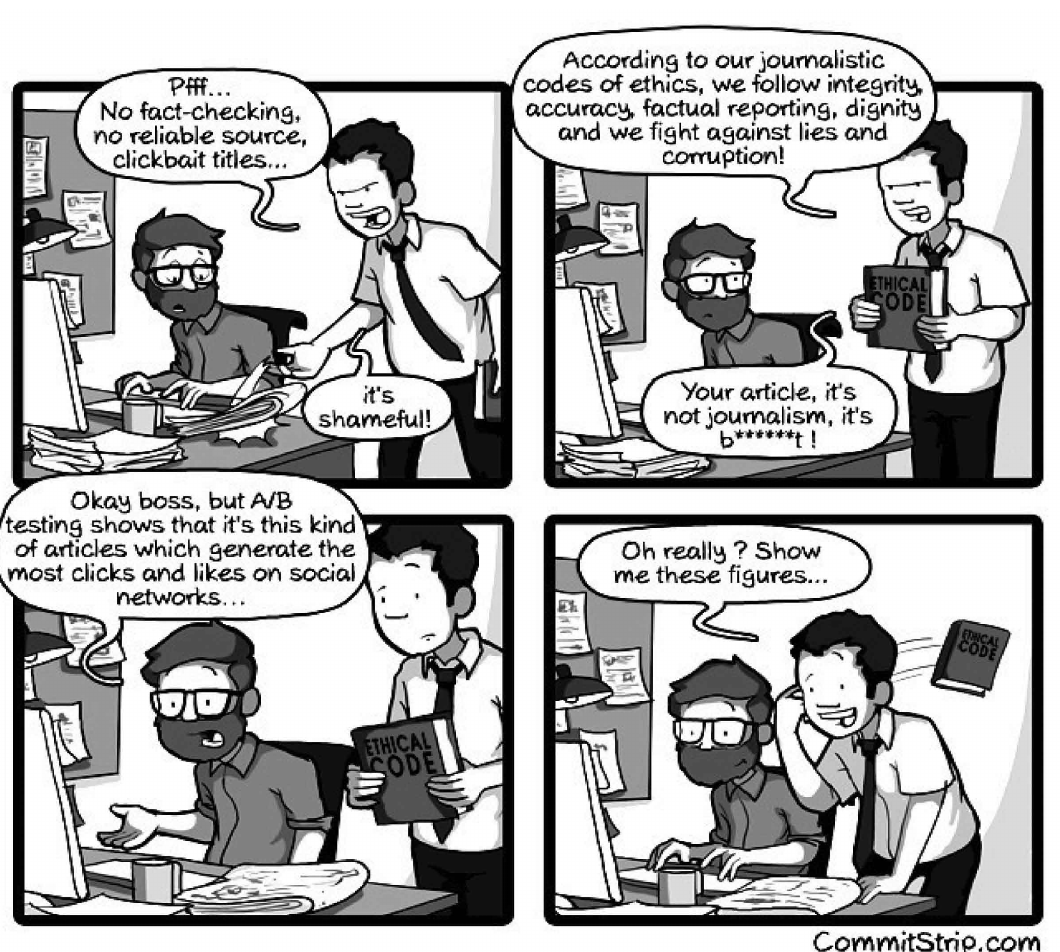
Fonte: <http://www.commitstrip.com/en/2015/10/26/journalists-today/>. Acesso em: maio 2018.
De acordo com a tirinha,
As questões de 30 a 32 referem-se à tirinha a seguir:
Fonte: <http://www.commitstrip.com/en/2015/10/26/journalists-today/>. Acesso em: maio 2018.
No último quadrinho, o chefe do jornalista
As questões de 30 a 32 referem-se à tirinha a seguir:
Fonte: <http://www.commitstrip.com/en/2015/10/26/journalists-today/>. Acesso em: maio 2018.
No contexto da tirinha, todas as palavras pertencem à mesma classe gramatical, EXCETO:
As questões de 33 a 36 referem-se ao texto a seguir:
1 Artificial Intelligence (AI) is going to play an enormous role in our lives and in the global economy. It is the key to
2 self-driving cars, the Amazon Alexa in your home, autonomous trading desks on Wall Street, innovation in medicine,
3 and cyberwar defenses.
4 Technology is rarely good nor evil — it’s all in how humans use it. AI could do an enormous amount of good and
5 solve some of the world’s hardest problems, but that same power could be turned against us. AI could be set up to inflict
6 bias based on race or beliefs, invade our privacy, learn about and exploit our personal weaknesses — and do a lot of
7 nefarious things we can’t yet foresee.
8 Which means that our policymakers must understand and help guide AI so it benefits society. [...] We don’t
9 want overreaching regulation that goes beyond keeping us safe and ends up stifling innovation. Regulators helped make
10 it so difficult to develop atomic energy, today the U.S. gets only 20% of its electricity from nuclear power. So, while we
11 need a Federal Artificial Intelligence Agency, or FAIA, I would prefer to see it created as a public-private partnership.
12 Washington should bring in AI experts from the tech industry to a federal agency designed to understand and direct AI
13 and to inform lawmakers. Perhaps the AI experts would rotate through Washington on a kind of public service tour of
14 duty.
15 Importantly, we’re at the beginning of a new era in government — one where governance is software-defined.
16 The nature of AI and algorithms means we need to develop a new kind of agency — one that includes both humans and
17 software. The software will help monitor algorithms. Existing, old-school regulations that rely on manual enforcement are
18 too cumbersome to keep up with technology and too “dumb” to monitor algorithms in a timely way.
19 Software-defined regulation can monitor software-driven industries better than regulations enforced by squads of
20 regulators. Algorithms can continuously watch emerging utilities such as Facebook, looking for details and patterns that
21 humans might never catch, but nonetheless signal abuses. If Congress wants to make sure Facebook doesn’t exploit
22 political biases, it could direct the FAIA to write an algorithm to look for the behavior.
23 It’s just as important to have algorithms that keep an eye on the role of humans inside these companies. We
24 want technology that can tell if Airbnb hosts are illegally turning down minorities or if Facebook’s human editors
25 are squashing conservative news headlines.
26 The watchdog algorithms can be like open-source software — open to examination by anyone, while the
27 companies keep private proprietary algorithms and data. If the algorithms are public, anyone can run various datasets
28 against them and analyze for “off the rails” behaviors and unexpected results.
29 Clearly, AI needs some governance. As Facebook is proving, we can’t rely on companies to monitor and regulate
30 themselves. Public companies, especially, are incentivized to make the biggest profits possible, and their algorithms will
31 optimize for financial goals, not societal goals. But as a tech investor, I don’t want to see an ill-informed Congress set up
32 regulatory schemes for social networks, search and other key services that then make our dynamic tech companies as
33 dull and bureaucratic as electric companies. [...] Technology companies and policymakers need to come together soon
34 and share ideas about AI governance and the establishment of a software-driven AI agency. [...]
35 Let’s do this before bad regulations get enacted — and before AI gets away from us and does more damage. We
36 have a chance right now to tee up AI so it does tremendous good. To unleash it in a positive direction, we need to get
37 the checks and balances in place right now.
Adaptado de <https://www.marketwatch.com/story/artificial-intelligence-is-too-powerful-to-be-left-to-facebook-amazon-and-other-tech-giants-2018-04-23>. Acesso em: jun. 2018.
Assinale a alternativa INCORRETA. No texto, o autor afirma queResolução comentada
Análise das alternativas
As questões de 33 a 36 referem-se ao texto a seguir:
1 Artificial Intelligence (AI) is going to play an enormous role in our lives and in the global economy. It is the key to
2 self-driving cars, the Amazon Alexa in your home, autonomous trading desks on Wall Street, innovation in medicine,
3 and cyberwar defenses.
4 Technology is rarely good nor evil — it’s all in how humans use it. AI could do an enormous amount of good and
5 solve some of the world’s hardest problems, but that same power could be turned against us. AI could be set up to inflict
6 bias based on race or beliefs, invade our privacy, learn about and exploit our personal weaknesses — and do a lot of
7 nefarious things we can’t yet foresee.
8 Which means that our policymakers must understand and help guide AI so it benefits society. [...] We don’t
9 want overreaching regulation that goes beyond keeping us safe and ends up stifling innovation. Regulators helped make
10 it so difficult to develop atomic energy, today the U.S. gets only 20% of its electricity from nuclear power. So, while we
11 need a Federal Artificial Intelligence Agency, or FAIA, I would prefer to see it created as a public-private partnership.
12 Washington should bring in AI experts from the tech industry to a federal agency designed to understand and direct AI
13 and to inform lawmakers. Perhaps the AI experts would rotate through Washington on a kind of public service tour of
14 duty.
15 Importantly, we’re at the beginning of a new era in government — one where governance is software-defined.
16 The nature of AI and algorithms means we need to develop a new kind of agency — one that includes both humans and
17 software. The software will help monitor algorithms. Existing, old-school regulations that rely on manual enforcement are
18 too cumbersome to keep up with technology and too “dumb” to monitor algorithms in a timely way.
19 Software-defined regulation can monitor software-driven industries better than regulations enforced by squads of
20 regulators. Algorithms can continuously watch emerging utilities such as Facebook, looking for details and patterns that
21 humans might never catch, but nonetheless signal abuses. If Congress wants to make sure Facebook doesn’t exploit
22 political biases, it could direct the FAIA to write an algorithm to look for the behavior.
23 It’s just as important to have algorithms that keep an eye on the role of humans inside these companies. We
24 want technology that can tell if Airbnb hosts are illegally turning down minorities or if Facebook’s human editors
25 are squashing conservative news headlines.
26 The watchdog algorithms can be like open-source software — open to examination by anyone, while the
27 companies keep private proprietary algorithms and data. If the algorithms are public, anyone can run various datasets
28 against them and analyze for “off the rails” behaviors and unexpected results.
29 Clearly, AI needs some governance. As Facebook is proving, we can’t rely on companies to monitor and regulate
30 themselves. Public companies, especially, are incentivized to make the biggest profits possible, and their algorithms will
31 optimize for financial goals, not societal goals. But as a tech investor, I don’t want to see an ill-informed Congress set up
32 regulatory schemes for social networks, search and other key services that then make our dynamic tech companies as
33 dull and bureaucratic as electric companies. [...] Technology companies and policymakers need to come together soon
34 and share ideas about AI governance and the establishment of a software-driven AI agency. [...]
35 Let’s do this before bad regulations get enacted — and before AI gets away from us and does more damage. We
36 have a chance right now to tee up AI so it does tremendous good. To unleash it in a positive direction, we need to get
37 the checks and balances in place right now.
Adaptado de <https://www.marketwatch.com/story/artificial-intelligence-is-too-powerful-to-be-left-to-facebook-amazon-and-other-tech-giants-2018-04-23>. Acesso em: jun. 2018.
O autor defende uma regulação definida por software, pois
I. a considera mais adequada para monitorar indústrias orientadas por software do que regulações impostas por equipes de reguladores humanos.
II. algoritmos podem procurar por detalhes e padrões que os seres humanos talvez nunca pudessem descobrir, mas que, não obstante, são indicativos de abusos.
III. precisamos de tecnologia que seja capaz de identificar comportamentos como o do Facebook que, ao explorar vieses políticos, difundiu manchetes de partidos conservadores.
IV. é importante que algoritmos monitorem o papel dos seres humanos em empresas orientadas por software para evitar que minorias sejam prejudicadas na utilização de serviços.
Estão corretas apenasResolução comentada
Análise das alternativas
As questões de 33 a 36 referem-se ao texto a seguir:
1 Artificial Intelligence (AI) is going to play an enormous role in our lives and in the global economy. It is the key to
2 self-driving cars, the Amazon Alexa in your home, autonomous trading desks on Wall Street, innovation in medicine,
3 and cyberwar defenses.
4 Technology is rarely good nor evil — it’s all in how humans use it. AI could do an enormous amount of good and
5 solve some of the world’s hardest problems, but that same power could be turned against us. AI could be set up to inflict
6 bias based on race or beliefs, invade our privacy, learn about and exploit our personal weaknesses — and do a lot of
7 nefarious things we can’t yet foresee.
8 Which means that our policymakers must understand and help guide AI so it benefits society. [...] We don’t
9 want overreaching regulation that goes beyond keeping us safe and ends up stifling innovation. Regulators helped make
10 it so difficult to develop atomic energy, today the U.S. gets only 20% of its electricity from nuclear power. So, while we
11 need a Federal Artificial Intelligence Agency, or FAIA, I would prefer to see it created as a public-private partnership.
12 Washington should bring in AI experts from the tech industry to a federal agency designed to understand and direct AI
13 and to inform lawmakers. Perhaps the AI experts would rotate through Washington on a kind of public service tour of
14 duty.
15 Importantly, we’re at the beginning of a new era in government — one where governance is software-defined.
16 The nature of AI and algorithms means we need to develop a new kind of agency — one that includes both humans and
17 software. The software will help monitor algorithms. Existing, old-school regulations that rely on manual enforcement are
18 too cumbersome to keep up with technology and too “dumb” to monitor algorithms in a timely way.
19 Software-defined regulation can monitor software-driven industries better than regulations enforced by squads of
20 regulators. Algorithms can continuously watch emerging utilities such as Facebook, looking for details and patterns that
21 humans might never catch, but nonetheless signal abuses. If Congress wants to make sure Facebook doesn’t exploit
22 political biases, it could direct the FAIA to write an algorithm to look for the behavior.
23 It’s just as important to have algorithms that keep an eye on the role of humans inside these companies. We
24 want technology that can tell if Airbnb hosts are illegally turning down minorities or if Facebook’s human editors
25 are squashing conservative news headlines.
26 The watchdog algorithms can be like open-source software — open to examination by anyone, while the
27 companies keep private proprietary algorithms and data. If the algorithms are public, anyone can run various datasets
28 against them and analyze for “off the rails” behaviors and unexpected results.
29 Clearly, AI needs some governance. As Facebook is proving, we can’t rely on companies to monitor and regulate
30 themselves. Public companies, especially, are incentivized to make the biggest profits possible, and their algorithms will
31 optimize for financial goals, not societal goals. But as a tech investor, I don’t want to see an ill-informed Congress set up
32 regulatory schemes for social networks, search and other key services that then make our dynamic tech companies as
33 dull and bureaucratic as electric companies. [...] Technology companies and policymakers need to come together soon
34 and share ideas about AI governance and the establishment of a software-driven AI agency. [...]
35 Let’s do this before bad regulations get enacted — and before AI gets away from us and does more damage. We
36 have a chance right now to tee up AI so it does tremendous good. To unleash it in a positive direction, we need to get
37 the checks and balances in place right now.
Adaptado de <https://www.marketwatch.com/story/artificial-intelligence-is-too-powerful-to-be-left-to-facebook-amazon-and-other-tech-giants-2018-04-23>. Acesso em: jun. 2018.
A palavra ou expressão sublinhada na primeira coluna pode ser substituída pela palavra ou expressão na segunda coluna em todas as opções, mantendo o mesmo sentido, EXCETO em:
As questões de 33 a 36 referem-se ao texto a seguir:
1 Artificial Intelligence (AI) is going to play an enormous role in our lives and in the global economy. It is the key to
2 self-driving cars, the Amazon Alexa in your home, autonomous trading desks on Wall Street, innovation in medicine,
3 and cyberwar defenses.
4 Technology is rarely good nor evil — it’s all in how humans use it. AI could do an enormous amount of good and
5 solve some of the world’s hardest problems, but that same power could be turned against us. AI could be set up to inflict
6 bias based on race or beliefs, invade our privacy, learn about and exploit our personal weaknesses — and do a lot of
7 nefarious things we can’t yet foresee.
8 Which means that our policymakers must understand and help guide AI so it benefits society. [...] We don’t
9 want overreaching regulation that goes beyond keeping us safe and ends up stifling innovation. Regulators helped make
10 it so difficult to develop atomic energy, today the U.S. gets only 20% of its electricity from nuclear power. So, while we
11 need a Federal Artificial Intelligence Agency, or FAIA, I would prefer to see it created as a public-private partnership.
12 Washington should bring in AI experts from the tech industry to a federal agency designed to understand and direct AI
13 and to inform lawmakers. Perhaps the AI experts would rotate through Washington on a kind of public service tour of
14 duty.
15 Importantly, we’re at the beginning of a new era in government — one where governance is software-defined.
16 The nature of AI and algorithms means we need to develop a new kind of agency — one that includes both humans and
17 software. The software will help monitor algorithms. Existing, old-school regulations that rely on manual enforcement are
18 too cumbersome to keep up with technology and too “dumb” to monitor algorithms in a timely way.
19 Software-defined regulation can monitor software-driven industries better than regulations enforced by squads of
20 regulators. Algorithms can continuously watch emerging utilities such as Facebook, looking for details and patterns that
21 humans might never catch, but nonetheless signal abuses. If Congress wants to make sure Facebook doesn’t exploit
22 political biases, it could direct the FAIA to write an algorithm to look for the behavior.
23 It’s just as important to have algorithms that keep an eye on the role of humans inside these companies. We
24 want technology that can tell if Airbnb hosts are illegally turning down minorities or if Facebook’s human editors
25 are squashing conservative news headlines.
26 The watchdog algorithms can be like open-source software — open to examination by anyone, while the
27 companies keep private proprietary algorithms and data. If the algorithms are public, anyone can run various datasets
28 against them and analyze for “off the rails” behaviors and unexpected results.
29 Clearly, AI needs some governance. As Facebook is proving, we can’t rely on companies to monitor and regulate
30 themselves. Public companies, especially, are incentivized to make the biggest profits possible, and their algorithms will
31 optimize for financial goals, not societal goals. But as a tech investor, I don’t want to see an ill-informed Congress set up
32 regulatory schemes for social networks, search and other key services that then make our dynamic tech companies as
33 dull and bureaucratic as electric companies. [...] Technology companies and policymakers need to come together soon
34 and share ideas about AI governance and the establishment of a software-driven AI agency. [...]
35 Let’s do this before bad regulations get enacted — and before AI gets away from us and does more damage. We
36 have a chance right now to tee up AI so it does tremendous good. To unleash it in a positive direction, we need to get
37 the checks and balances in place right now.
Adaptado de <https://www.marketwatch.com/story/artificial-intelligence-is-too-powerful-to-be-left-to-facebook-amazon-and-other-tech-giants-2018-04-23>. Acesso em: jun. 2018.
Observe o uso da palavra ‘so’ nas frases abaixo.
I. […] and help guide AI so it benefits society […] (linha 8)
II. Regulators helped make it so difficult to develop […] (linha 9 e 10)
III. So, while we need a Federal Artificial Intelligence Agency, or FAIA […] (linha 10 e 11)
Assinale a alternativa que explica respectivamente, o uso de ‘so’.Resolução comentada
Análise das alternativas
Notações
ℝ : conjunto dos números reais
i : unidade imaginária i² = −1
det(M) : determinante da matriz M
M⁻¹ : inversa da matriz M
Mᵀ : transposta da matriz M
AB : segmento de reta de extremidades nos pontos A e B
[a, b] = {x ∈ ℝ : a ≤ x ≤ b}
Observação: Os sistemas de coordenadas considerados são os cartesianos retangulares.
Considere um retângulo ABCD em que o comprimento do lado AB é o dobro do comprimento do lado BC. Sejam M o ponto médio de BC e N o ponto médio de CM. A tangente do ângulo MÂN é igual aResolução comentada
Análise das alternativas
Notações
ℝ : conjunto dos números reais
i : unidade imaginária i² = −1
det(M) : determinante da matriz M
M⁻¹ : inversa da matriz M
Mᵀ : transposta da matriz M
AB : segmento de reta de extremidades nos pontos A e B
[a, b] = {x ∈ ℝ : a ≤ x ≤ b}
Observação: Os sistemas de coordenadas considerados são os cartesianos retangulares.
Seja p(x) = x³ + ax² + bx um polinômio cujas raízes são não negativas e estão em progressão aritmética. Sabendo que a soma de seus coeficientes é igual a 10, podemos afirmar que a soma das raízes de p(x) é igual aResolução comentada
Análise das alternativas
Notações
ℝ : conjunto dos números reais
i : unidade imaginária i² = −1
det(M) : determinante da matriz M
M⁻¹ : inversa da matriz M
Mᵀ : transposta da matriz M
AB : segmento de reta de extremidades nos pontos A e B
[a, b] = {x ∈ ℝ : a ≤ x ≤ b}
Observação: Os sistemas de coordenadas considerados são os cartesianos retangulares.
Seja γ a circunferência de equação x² + y² = 4. Se r e s são duas retas que se interceptam no ponto P = (1, 3) e são tangentes a γ, então o cosseno do ângulo entre r e s é igual aResolução comentada
Análise das alternativas
Notações
ℝ : conjunto dos números reais
i : unidade imaginária i² = −1
det(M) : determinante da matriz M
M⁻¹ : inversa da matriz M
Mᵀ : transposta da matriz M
AB : segmento de reta de extremidades nos pontos A e B
[a, b] = {x ∈ ℝ : a ≤ x ≤ b}
Observação: Os sistemas de coordenadas considerados são os cartesianos retangulares.
A superfície lateral de um cone circular reto corresponde a um setor circular de 216°, quando planificada. Se a geratriz do cone mede 10 cm, então a medida de sua altura, em cm, é igual aResolução comentada
Análise das alternativas
Senhora, de José de Alencar, é uma obra representativa do Romantismo porque apresenta
No Realismo, o adultério subverte o ideal romântico de casamento. Machado de Assis, porém, costuma tratá-lo de modo ambíguo, valendo-se, por exemplo, do ciúme masculino ou da dubiedade feminina. Com isso, em seus romances, a traição nem sempre é comprovada, ou, mesmo que desejada pela mulher, não se consuma. Constatamos tal ambiguidade em Quincas Borba, quando
São Bernardo, de Graciliano Ramos, é obra representativa da Geração de 30. Em relação ao protagonista, podemos dizer que
Leia o poema de autoria de Cecília Meireles.
Texto-base:
Texto-base:
Texto-base:
Texto-base:
Texto-base:
Texto-base:
Texto-base:
Texto-base:
Texto-base:
Texto-base:
Texto-base:
Texto-base:
Texto-base:
Texto-base:
Texto-base:
Texto-base: