← Voltar para a lista de provas Escola Preparatória de Cadetes do Ar (EPCAR) — Comando da Aeronáutica · Exame de Admissão ao CPCAR 2020 (Curso Preparatório de Cadetes do Ar) 49 questões nesta prova · página 2 de 3 · 45 com gabarito Gabarito disponível Gabarito disponível Gabarito disponível Gabarito disponível Montar a equação do rateio, que leva a k(k+6) = 1080. Com D a despesa e k os presentes, o acréscimo por pessoa é D/k − D/(k+6) = 6D/[k(k+6)]. Como D = 180 × acréscimo, temos k(k+6) = 1080. Logo k² + 6k − 1080 = 0, e k = 30. A soma dos algarismos é 3. Apenas 3 corresponde a k = 30. Os valores 5, 7 e 9 não correspondem a nenhuma raiz positiva da equação. Referência: Equação do 2º grau. Resolução comentada do VaiConcursos. Questão anulada Gabarito disponível Equacionar o lucro líquido de P (9%) com o prejuízo de Q (12,6%). O rendimento líquido de P é 10% × 0,9 = 9%. Sendo x o valor em P, temos 0,09x = 0,126(60000 − x). Daí 0,216x = 7560 e x = 35000, ficando 25000 em Q. Assim, P recebeu mais de 32000. A) Q/P = 25000/35000 = 5/7, não 5/8. B) Q devolveu 25000 × 0,874 = 21850, menos que 23000. C) A diferença é 10000, que não é maior que 11000. D) Correta: 35000 > 32000. Referência: Porcentagem e equação do 1º grau. Resolução comentada do VaiConcursos. Gabarito disponível Somar os rendimentos por hora dos dois irmãos e calcular os dias para 250 cadeiras. Luiz faz 20 cadeiras em 12 h, ou 5/3 por hora. Guilherme faz 15 em 16 h, ou 15/16 por hora. Juntos fazem 125/48 por hora, ou 125/8 por dia (6 h). Então y = 250 ÷ (125/8) = 16 dias, que tem raiz quadrada exata (4). A) Correta: √16 = 4. B) 16 não divide 100. C) 16 não divide 150. D) 16 não é múltiplo de 12. Referência: Regra de três composta / produtividade. Resolução comentada do VaiConcursos. Gabarito disponível Gabarito disponível Questão anulada Gabarito disponível Gabarito disponível Gabarito disponível O texto afirma que a Terra não foi visitada e que não há evidência de vida extraterrestre. O texto apresenta o Paradoxo de Fermi: a alta probabilidade de haver vida, somada à falta de evidências de sua existência. O Projeto Phoenix detectou ruídos cósmicos, mas nenhum atribuível a alienígenas. Logo, ninguém provou a existência de vida extraterrestre. A) Errada: o texto diz que a Terra não foi visitada por alienígenas inteligentes ("yet?"). B) Incorreta: o enunciado do texto fala em buscar vida inteligente extraterrestre, mas a alternativa não é a que reflete a ideia central de ausência de provas. C) Errada: a pergunta "Do we have neighbours beyond Earth?" fica sem resposta ("Time will tell"). D) Correta. Referência: Interpretação de texto em inglês (compreensão geral). Resolução comentada do VaiConcursos. Gabarito disponível Gabarito disponível Gabarito disponível O texto diz que nenhum sinal detectado foi atribuído a alienígenas. O Projeto Phoenix detectou ruídos cósmicos, mas nenhum atribuível a alienígenas. Afirmar que organizações detectaram sinais de alienígenas contradiz o texto. A) De acordo: há chance de vida simples. B) De acordo: exploração exige robôs e sondas. D) De acordo: Drake criou a equação. Referência: Texto, linhas 56-57. Resolução comentada do VaiConcursos. Questão anulada Gabarito disponível 'Aren't none' constitui dupla negação incorreta. Em inglês padrão não se combina 'aren't' com 'none'. O correto seria 'There aren't any' ou 'There are none'. A) Correta: 'Nobody saw them' tem negação apenas no sujeito. B) Correta: 'some' em afirmativa. C) Correta: 'any' com negativa. Referência: Dupla negação e pronomes indefinidos. Resolução comentada do VaiConcursos. Gabarito disponível O parágrafo 2 indica que provavelmente não estamos sozinhos. O parágrafo cita milhares de planetas detectados e provável grande número de planetas habitáveis, sugerindo que podemos não estar sozinhos. A) Errada: o texto diz haver bilhões de estrelas. C) Errada: diz que civilizações podem ter desenvolvido viagem interestelar, não os cientistas. D) Errada: o Sol é apenas uma entre bilhões de estrelas. Referência: Texto, parágrafo 'Where are all the aliens?' (linhas 10-18). Resolução comentada do VaiConcursos. Gabarito disponível O texto não diz que as organizações tentam provar que alienígenas não existem. As organizações SETI usam radiotelescópios para detectar sinais de vida inteligente, ou seja, buscam, não refutam. A) Mencionada: o Paradoxo de Fermi pergunta onde estão todos. B) Mencionada: a equação de Drake foi criada para racionalizar essa questão. D) Mencionada: o Projeto Phoenix buscou sinais de vida. Referência: Texto, seções 'Where are all the aliens?' e 'The search for extraterrestrial intelligence'. Resolução comentada do VaiConcursos.EPCAR — Exame de Admissão ao CPCAR 2020 — Língua Portuguesa, Matemática, Língua Inglesa e Redação — Versão A
Dois alunos participaram da 1ª rodada do jogo: Lucas e Mateus.
Ao jogarem, esses alunos receberam as seguintes fichas:
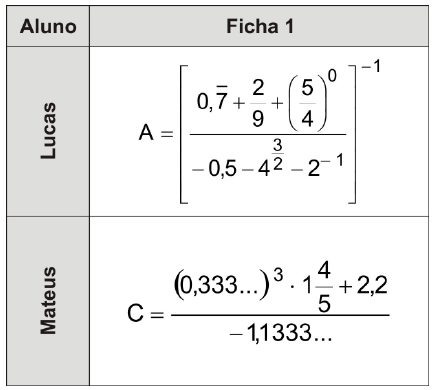
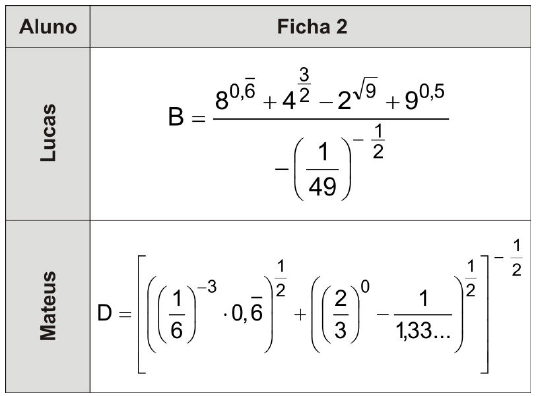
Depois de resolverem as operações, cada aluno deveria associar corretamente os resultados obtidos em cada ficha a somente um dos conjuntos abaixo.
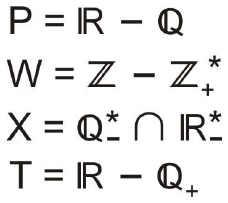
Os resultados obtidos por Lucas e Mateus foram os seguintes:
• Lucas afirmou que A ∈ T e B ∈ W
• Mateus afirmou que C ∈ X e D ∈ T
Se Lucas e Mateus acertaram as operações nas suas duas fichas, então
O personagem encontra-se no térreo e pode escolher e acionar um dos 3 elevadores ali existentes. Todos eles estão em perfeito funcionamento e são programados de modo a parar em andares diferentes, conforme esquema a seguir:
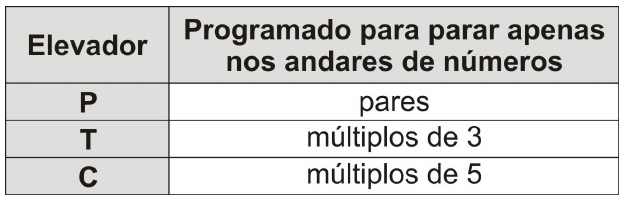
Analise cada proposição abaixo quanto a ser (V) Verdadeira ou (F) Falsa, apenas para os andares de 1 até 20
( ) Não há possibilidade de um mesmo andar receber os três elevadores P, T e C
( ) Em 6 andares desse prédio, chegam, exatamente, 2 elevadores.
( ) Se em x andares desse prédio chega apenas 1 elevador, então, x é menor que 7
Sobre as proposições, tem-se que
O VANT está a uma distância y metros de um holofote que foi instalado no helicóptero.
O feixe de luz do holofote que ultrapassa o VANT incide sobre a região plana e produz uma sombra circular de centro O e raio R
O raio R da circunferência da sombra forma um ângulo de 60º com o feixe de luz, conforme se vê na figura seguinte.
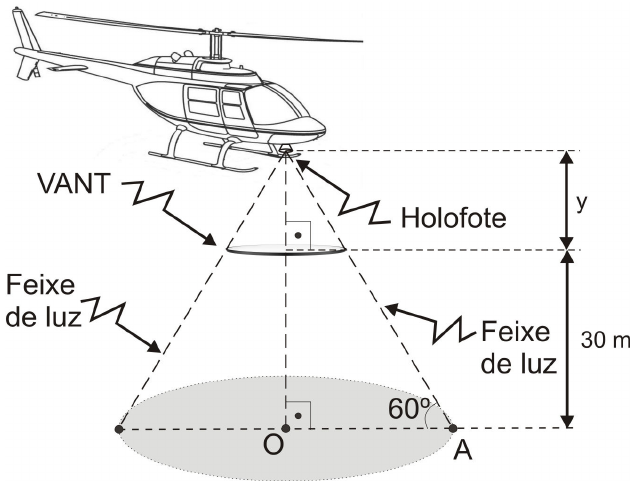
Nesse momento, uma pessoa que se encontra num ponto A da circunferência da sombra corre para o ponto O, pé da perpendicular traçada do holofote à região plana.
A distância, em metros, que essa pessoa percorre de A até O é um número entre
Na véspera do churrasco, 6 desses alunos foram convocados pelo seu Comandante para uma atividade que os impediu de comparecerem ao evento comemorativo, sendo esses 6 alunos excluídos do rateio da despesa total.
Com a ausência desses 6 alunos, foi cobrado de cada um dos demais, certo valor a mais.
Ao fazerem o rateio, os alunos perceberam que a despesa total era igual ao valor cobrado a mais de cada um dos alunos que contribuíram, multiplicado por 180
Se o número de alunos que foram ao churrasco é k, então, a soma dos algarismos de k éResolução comentada
Análise das alternativas

Sugestão: use (x² + x) = y
Analise as alternativas e marque a FALSA.
Parte desse dinheiro aplicou no investimento P e a outra parte, no investimento Q
No final de 2018, retirou o dinheiro das duas aplicações e verificou que, somando os dois valores, não obteve lucro nem prejuízo.
O investimento P rendeu 10%, mas, sobre o rendimento, foi cobrada uma taxa de 10%; já o investimento Q deu prejuízo de 12,6%
Com base nessas informações, pode-se afirmar queResolução comentada
Análise das alternativas
Luiz fabrica 20 cadeiras do modelo A em 3 dias de 4 horas de trabalho por dia. Já Guilherme fabrica 15 cadeiras do modelo A em 8 dias de 2 horas de trabalho por dia.
Uma empresa fez uma encomenda à fábrica de 250 cadeiras do modelo A
Para atender à demanda, os irmãos trabalharam juntos, no ritmo de 6 horas por dia, gastando então, y dias para concluir o trabalho e entregar a encomenda.
O número y é tal queResolução comentada
Análise das alternativas
A figura abaixo é a vista frontal dessa pista, num plano cartesiano, que é composta por:

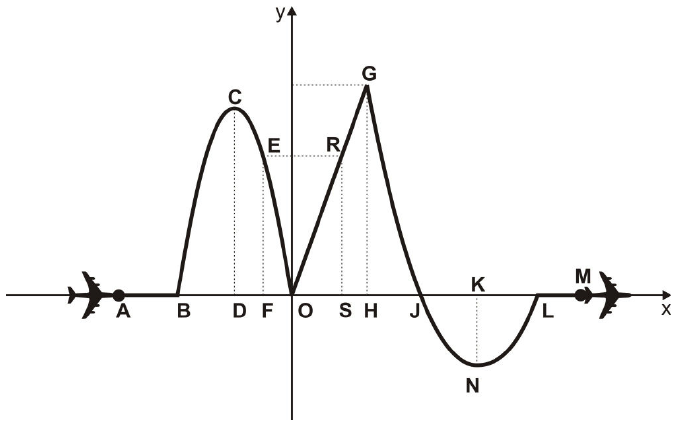
Sabe-se que:
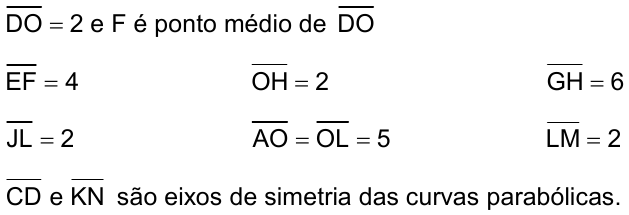
Se todas as medidas indicadas têm a mesma unidade de comprimento, então, o valor de  nessa mesma unidade de comprimento, é
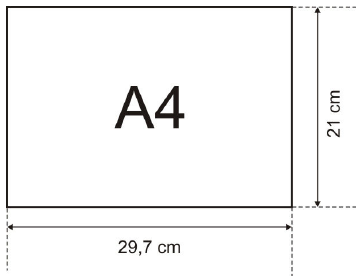
O processo de preparação de cada envelope envolve:
• dobrar a folha ao meio tanto no sentido da maior medida quanto da menor medida;
• com a folha aberta e a determinação do seu centro, tomar, a partir deste, sobre a dobra maior, 8 cm para a esquerda e 8 cm para a direita, e, sobre a dobra menor, 3 cm para cima e 3 cm para baixo, determinando um retângulo;
• sobre as menores dimensões deste retângulo, desenhar dois triângulos equiláteros;
• sobre uma das maiores dimensões do retângulo, tomar um triângulo isósceles de altura 6 cm;
• sobre a outra das maiores dimensões do retângulo, desenhar um trapézio isósceles, cuja medida do ângulo da base maior é igual a 45º e a altura é igual a 3 cm
A figura abaixo é uma planificação total de um dos envelopes.

Considere √3 = 1,7
Se o pacote de papel A4 é vendido com 500 folhas e se for confeccionado apenas um envelope com cada uma das folhas de um pacote, então, a quantidade gasta, em gramas, de papel é maior que
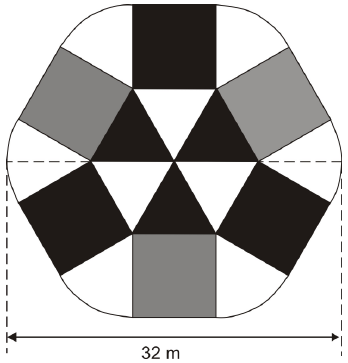
Cada quadro contém:
• um hexágono regular;
• seis quadrados, cada um com um lado coincidente com um dos lados do hexágono;
• seis setores circulares idênticos de centro nos vértices do hexágono e cuja medida do raio é igual à medida do lado do quadrado.
As figuras foram pintadas de três cores diferentes: preto, branco e cinza.
Para cada 500 cm² pintados no quadro, cobra-se 50 reais.
Cada quadro foi comprado pelo custo da pintura mais 77 reais.
Considere π = 3 e √3 = 1,7
Pode-se afirmar que Marisa pagou, por um quadro, em reais, mais de

Tabuleiro do jogo
Cada jogador, após escolher o algarismo com o qual irá preencher os quadrados menores, escreve um número por vez, em qualquer quadrado menor do tabuleiro, e passa a vez para o adversário.
Vence o primeiro que alinhar os quatro algarismos iguais.
No quadrado abaixo, estão registradas, numa partida desse jogo, as jogadas de Lucas, que escolheu o algarismo 5, e as jogadas de Mateus, que escolheu o algarismo 7
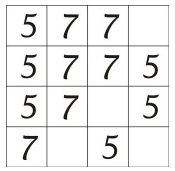
Analise cada proposição abaixo quanto a ser (V) Verdadeira ou (F) Falsa.
( ) Se o próximo jogador for Lucas, ele não terá chance de ganhar o jogo, nessa jogada.
( ) Se o próximo jogador for Mateus, então, para garantir a vitória nessa jogada, ele poderá escrever o algarismo 7 em duas posições.
( ) Se Mateus for o próximo a jogar e NÃO escrever o algarismo 7 em um quadrado que dê a vitória a ele, então, Lucas poderá ganhar a partida na jogada seguinte à de Mateus.
Sobre as proposições, tem-se que
“Existem várias versões que tentam decifrar de onde veio o jogo, mas nenhuma delas até hoje pôde ser confirmada. Acredita-se, porém, que ele tenha surgido na China, inventado por um soldado chamado Hung Ming, que teria vivido de 243 a 181 a.C. (…) O nome dominó provavelmente deriva da expressão latina domino gratias, que significa “graças a Deus”, dita pelos padres europeus enquanto jogavam. Atualmente, o dominó é jogado em quase todos os países do mundo, mas é mais popular na América Latina.”
(Disponível em: <<https://super.abril.com.br/mundo-estranho/qual-e-a-origem-do-domino/>> Acesso em 26 de fevereiro de 2019.)

Disponível em: <<https://br.depositphotos.com/64902345/stock-illustration-domino-set.html>> Acesso em 26 de fevereiro de 2019.
As 28 peças de um dominó tradicional são divididas em duas metades. Nelas aparecem representados os números 0, 1, 2, 3, 4, 5 ou 6, geralmente pintados em quantidades de pontos tal como a figura anterior.
Analise cada proposição abaixo quanto a ser (V) Verdadeira ou (F) Falsa.
( ) Dentre todas as peças do jogo, a probabilidade de se escolher uma peça em que os dois números representados são diferentes entre si é igual a 75%
( ) A probabilidade de se escolher a peça  , dentre todas as peças do jogo, é maior que 3,5%
( ) Dentre as peças que só têm representados números pares em ambas as metades, 40% são aquelas em que há um par de números iguais.
Sobre as proposições, tem-se que
Directions: Read the text below and answer questions 33 to 48 according to the text.
TEXT
The search for life beyond Earth
We have always been fascinated by the thought of
alien life elsewhere in the universe. The idea has
provided the basis for a huge wealth of science fiction
stories that have been limited only by our imaginations.
5 But can other creatures exist in the vast reaches of
space or on other planets or moons? And are there
other intelligent forms of life out there—or are we more
likely to find something much simpler?
Where are all the aliens?
10 Our Sun is just one star among billions in our
galaxy. In the last few years, scientists have detected
thousands of planets around other stars and it seems
that most stars have planetary systems. It’s therefore
likely that there will be large numbers of habitable
15 planets in the Milky Way galaxy and beyond that are
capable of supporting intelligent life. Some of these
intelligent civilisations, if they’re out there, may have
even developed interstellar travel.
Are there other intelligent forms of life out there—or
20 are we more likely to find something much simpler?
But Earth hasn’t been visited by any intelligent
aliens (yet?). This apparent high probability of life,
combined with a lack of evidence for its existence, is
called the Fermi Paradox, named for the physicist
25 Enrico Fermi who first outlined¹ the argument back in
1950. This begs the question: where is everybody?
Back in 1961, astronomer Francis Drake tried to
rationalise this question by developing an equation that
takes into account² all the factors relevant to finding
30 alien civilisations and gives an estimate of the number
of civilisations out there in the galaxy that should be
able to communicate with us. It considers factors such
as the rate³ of new star formation, how many planets
around those new and existing stars might be able to
35 support life, the number of planets supporting intelligent
life, how many of those civilisations might have
technology we can detect, whether they’re likely to
communicate with us here on Earth, and so on.
The search for extraterrestrial intelligence
40 Scientists and radio astronomers have started the
search for extraterrestrial intelligence (SETI) in a
systematic manner. Several international organisations,
including the SETI Institute and the SETI League, are
using radio telescopes to detect signals that might have
45 been produced by intelligent life.
In 1995, the SETI Institute started Project Phoenix,
which used three of the most powerful radio telescopes
in the world: the Green Bank radio telescope in West
Virginia, USA; the Arecibo telescope in Puerto Rico;
50 and the Parkes radio telescope in NSW, Australia.
During its initial phase, Project Phoenix used the
Parkes telescope to search for signals coming from 202
Sun-like stars as distant as 155 light years away. By the
end of its operations, Project Phoenix had scanned a
55 total of 800 ‘nearby’⁴ (up to 240 light years away) stars
for signs of life. The project detected some cosmic
noises, but none of that could be attributed to aliens.
These days, anyone can become involved in the
search for extraterrestrial intelligence through their
60 personal computer.
While there’s currently excitement about sending
human crews to Mars, missions beyond the Red Planet
are at this stage pretty much not feasible⁵ the distances
and travel times involved are simply too great.
65 Basically, all exploration for life beyond Earth will need
to be done using robotic space probes⁶ and landing
rovers. These instruments can provide a huge wealth of
information and are capable of exploring as far away as
Pluto, perhaps even beyond our solar system. But as
70 for life beyond the solar system, the nearest stars are
several light years away, and even communications by
electromagnetic waves (which all travel at the speed of
light) are essentially going to be a one-way message.
While we probably won’t find intelligent life too close
75 to home, there’s a chance we may still find much
simpler life forms. Do we have neighbours beyond
Earth? Time will tell—and the search continues.
(Adapted from https://www.science.org.au/curious/space-time/search-life-beyond-earth – Access on 16/02/19)
Glossary:
1. to outline – describe or give the main fact about something
2. to take into account – consider something
3. rate – expansion
4. nearby – short distance away
5. feasible – appropriate; suitable
6. space probe – spy satellite
The text states thatResolução comentada
Análise das alternativas
Directions: Read the text below and answer questions 33 to 48 according to the text.
TEXT
The search for life beyond Earth
We have always been fascinated by the thought of
alien life elsewhere in the universe. The idea has
provided the basis for a huge wealth of science fiction
stories that have been limited only by our imaginations.
5 But can other creatures exist in the vast reaches of
space or on other planets or moons? And are there
other intelligent forms of life out there—or are we more
likely to find something much simpler?
Where are all the aliens?
10 Our Sun is just one star among billions in our
galaxy. In the last few years, scientists have detected
thousands of planets around other stars and it seems
that most stars have planetary systems. It’s therefore
likely that there will be large numbers of habitable
15 planets in the Milky Way galaxy and beyond that are
capable of supporting intelligent life. Some of these
intelligent civilisations, if they’re out there, may have
even developed interstellar travel.
Are there other intelligent forms of life out there—or
20 are we more likely to find something much simpler?
But Earth hasn’t been visited by any intelligent
aliens (yet?). This apparent high probability of life,
combined with a lack of evidence for its existence, is
called the Fermi Paradox, named for the physicist
25 Enrico Fermi who first outlined¹ the argument back in
1950. This begs the question: where is everybody?
Back in 1961, astronomer Francis Drake tried to
rationalise this question by developing an equation that
takes into account² all the factors relevant to finding
30 alien civilisations and gives an estimate of the number
of civilisations out there in the galaxy that should be
able to communicate with us. It considers factors such
as the rate³ of new star formation, how many planets
around those new and existing stars might be able to
35 support life, the number of planets supporting intelligent
life, how many of those civilisations might have
technology we can detect, whether they’re likely to
communicate with us here on Earth, and so on.
The search for extraterrestrial intelligence
40 Scientists and radio astronomers have started the
search for extraterrestrial intelligence (SETI) in a
systematic manner. Several international organisations,
including the SETI Institute and the SETI League, are
using radio telescopes to detect signals that might have
45 been produced by intelligent life.
In 1995, the SETI Institute started Project Phoenix,
which used three of the most powerful radio telescopes
in the world: the Green Bank radio telescope in West
Virginia, USA; the Arecibo telescope in Puerto Rico;
50 and the Parkes radio telescope in NSW, Australia.
During its initial phase, Project Phoenix used the
Parkes telescope to search for signals coming from 202
Sun-like stars as distant as 155 light years away. By the
end of its operations, Project Phoenix had scanned a
55 total of 800 ‘nearby’⁴ (up to 240 light years away) stars
for signs of life. The project detected some cosmic
noises, but none of that could be attributed to aliens.
These days, anyone can become involved in the
search for extraterrestrial intelligence through their
60 personal computer.
While there’s currently excitement about sending
human crews to Mars, missions beyond the Red Planet
are at this stage pretty much not feasible⁵ the distances
and travel times involved are simply too great.
65 Basically, all exploration for life beyond Earth will need
to be done using robotic space probes⁶ and landing
rovers. These instruments can provide a huge wealth of
information and are capable of exploring as far away as
Pluto, perhaps even beyond our solar system. But as
70 for life beyond the solar system, the nearest stars are
several light years away, and even communications by
electromagnetic waves (which all travel at the speed of
light) are essentially going to be a one-way message.
While we probably won’t find intelligent life too close
75 to home, there’s a chance we may still find much
simpler life forms. Do we have neighbours beyond
Earth? Time will tell—and the search continues.
(Adapted from https://www.science.org.au/curious/space-time/search-life-beyond-earth – Access on 16/02/19)
Glossary:
1. to outline – describe or give the main fact about something
2. to take into account – consider something
3. rate – expansion
4. nearby – short distance away
5. feasible – appropriate; suitable
6. space probe – spy satellite
Mark the alternative in which the highlighted word is used with the same meaning as in the sentence below.

Directions: Read the text below and answer questions 33 to 48 according to the text.
TEXT
The search for life beyond Earth
We have always been fascinated by the thought of
alien life elsewhere in the universe. The idea has
provided the basis for a huge wealth of science fiction
stories that have been limited only by our imaginations.
5 But can other creatures exist in the vast reaches of
space or on other planets or moons? And are there
other intelligent forms of life out there—or are we more
likely to find something much simpler?
Where are all the aliens?
10 Our Sun is just one star among billions in our
galaxy. In the last few years, scientists have detected
thousands of planets around other stars and it seems
that most stars have planetary systems. It’s therefore
likely that there will be large numbers of habitable
15 planets in the Milky Way galaxy and beyond that are
capable of supporting intelligent life. Some of these
intelligent civilisations, if they’re out there, may have
even developed interstellar travel.
Are there other intelligent forms of life out there—or
20 are we more likely to find something much simpler?
But Earth hasn’t been visited by any intelligent
aliens (yet?). This apparent high probability of life,
combined with a lack of evidence for its existence, is
called the Fermi Paradox, named for the physicist
25 Enrico Fermi who first outlined¹ the argument back in
1950. This begs the question: where is everybody?
Back in 1961, astronomer Francis Drake tried to
rationalise this question by developing an equation that
takes into account² all the factors relevant to finding
30 alien civilisations and gives an estimate of the number
of civilisations out there in the galaxy that should be
able to communicate with us. It considers factors such
as the rate³ of new star formation, how many planets
around those new and existing stars might be able to
35 support life, the number of planets supporting intelligent
life, how many of those civilisations might have
technology we can detect, whether they’re likely to
communicate with us here on Earth, and so on.
The search for extraterrestrial intelligence
40 Scientists and radio astronomers have started the
search for extraterrestrial intelligence (SETI) in a
systematic manner. Several international organisations,
including the SETI Institute and the SETI League, are
using radio telescopes to detect signals that might have
45 been produced by intelligent life.
In 1995, the SETI Institute started Project Phoenix,
which used three of the most powerful radio telescopes
in the world: the Green Bank radio telescope in West
Virginia, USA; the Arecibo telescope in Puerto Rico;
50 and the Parkes radio telescope in NSW, Australia.
During its initial phase, Project Phoenix used the
Parkes telescope to search for signals coming from 202
Sun-like stars as distant as 155 light years away. By the
end of its operations, Project Phoenix had scanned a
55 total of 800 ‘nearby’⁴ (up to 240 light years away) stars
for signs of life. The project detected some cosmic
noises, but none of that could be attributed to aliens.
These days, anyone can become involved in the
search for extraterrestrial intelligence through their
60 personal computer.
While there’s currently excitement about sending
human crews to Mars, missions beyond the Red Planet
are at this stage pretty much not feasible⁵ the distances
and travel times involved are simply too great.
65 Basically, all exploration for life beyond Earth will need
to be done using robotic space probes⁶ and landing
rovers. These instruments can provide a huge wealth of
information and are capable of exploring as far away as
Pluto, perhaps even beyond our solar system. But as
70 for life beyond the solar system, the nearest stars are
several light years away, and even communications by
electromagnetic waves (which all travel at the speed of
light) are essentially going to be a one-way message.
While we probably won’t find intelligent life too close
75 to home, there’s a chance we may still find much
simpler life forms. Do we have neighbours beyond
Earth? Time will tell—and the search continues.
(Adapted from https://www.science.org.au/curious/space-time/search-life-beyond-earth – Access on 16/02/19)
Glossary:
1. to outline – describe or give the main fact about something
2. to take into account – consider something
3. rate – expansion
4. nearby – short distance away
5. feasible – appropriate; suitable
6. space probe – spy satellite
 (lines 3 and 4). The underlined word is a synonym for
Directions: Read the text below and answer questions 33 to 48 according to the text.
TEXT
The search for life beyond Earth
We have always been fascinated by the thought of
alien life elsewhere in the universe. The idea has
provided the basis for a huge wealth of science fiction
stories that have been limited only by our imaginations.
5 But can other creatures exist in the vast reaches of
space or on other planets or moons? And are there
other intelligent forms of life out there—or are we more
likely to find something much simpler?
Where are all the aliens?
10 Our Sun is just one star among billions in our
galaxy. In the last few years, scientists have detected
thousands of planets around other stars and it seems
that most stars have planetary systems. It’s therefore
likely that there will be large numbers of habitable
15 planets in the Milky Way galaxy and beyond that are
capable of supporting intelligent life. Some of these
intelligent civilisations, if they’re out there, may have
even developed interstellar travel.
Are there other intelligent forms of life out there—or
20 are we more likely to find something much simpler?
But Earth hasn’t been visited by any intelligent
aliens (yet?). This apparent high probability of life,
combined with a lack of evidence for its existence, is
called the Fermi Paradox, named for the physicist
25 Enrico Fermi who first outlined¹ the argument back in
1950. This begs the question: where is everybody?
Back in 1961, astronomer Francis Drake tried to
rationalise this question by developing an equation that
takes into account² all the factors relevant to finding
30 alien civilisations and gives an estimate of the number
of civilisations out there in the galaxy that should be
able to communicate with us. It considers factors such
as the rate³ of new star formation, how many planets
around those new and existing stars might be able to
35 support life, the number of planets supporting intelligent
life, how many of those civilisations might have
technology we can detect, whether they’re likely to
communicate with us here on Earth, and so on.
The search for extraterrestrial intelligence
40 Scientists and radio astronomers have started the
search for extraterrestrial intelligence (SETI) in a
systematic manner. Several international organisations,
including the SETI Institute and the SETI League, are
using radio telescopes to detect signals that might have
45 been produced by intelligent life.
In 1995, the SETI Institute started Project Phoenix,
which used three of the most powerful radio telescopes
in the world: the Green Bank radio telescope in West
Virginia, USA; the Arecibo telescope in Puerto Rico;
50 and the Parkes radio telescope in NSW, Australia.
During its initial phase, Project Phoenix used the
Parkes telescope to search for signals coming from 202
Sun-like stars as distant as 155 light years away. By the
end of its operations, Project Phoenix had scanned a
55 total of 800 ‘nearby’⁴ (up to 240 light years away) stars
for signs of life. The project detected some cosmic
noises, but none of that could be attributed to aliens.
These days, anyone can become involved in the
search for extraterrestrial intelligence through their
60 personal computer.
While there’s currently excitement about sending
human crews to Mars, missions beyond the Red Planet
are at this stage pretty much not feasible⁵ the distances
and travel times involved are simply too great.
65 Basically, all exploration for life beyond Earth will need
to be done using robotic space probes⁶ and landing
rovers. These instruments can provide a huge wealth of
information and are capable of exploring as far away as
Pluto, perhaps even beyond our solar system. But as
70 for life beyond the solar system, the nearest stars are
several light years away, and even communications by
electromagnetic waves (which all travel at the speed of
light) are essentially going to be a one-way message.
While we probably won’t find intelligent life too close
75 to home, there’s a chance we may still find much
simpler life forms. Do we have neighbours beyond
Earth? Time will tell—and the search continues.
(Adapted from https://www.science.org.au/curious/space-time/search-life-beyond-earth – Access on 16/02/19)
Glossary:
1. to outline – describe or give the main fact about something
2. to take into account – consider something
3. rate – expansion
4. nearby – short distance away
5. feasible – appropriate; suitable
6. space probe – spy satellite
Mark the statement that is in DISAGREEMENT with the text.Resolução comentada
Análise das alternativas
Directions: Read the text below and answer questions 33 to 48 according to the text.
TEXT
The search for life beyond Earth
We have always been fascinated by the thought of
alien life elsewhere in the universe. The idea has
provided the basis for a huge wealth of science fiction
stories that have been limited only by our imaginations.
5 But can other creatures exist in the vast reaches of
space or on other planets or moons? And are there
other intelligent forms of life out there—or are we more
likely to find something much simpler?
Where are all the aliens?
10 Our Sun is just one star among billions in our
galaxy. In the last few years, scientists have detected
thousands of planets around other stars and it seems
that most stars have planetary systems. It’s therefore
likely that there will be large numbers of habitable
15 planets in the Milky Way galaxy and beyond that are
capable of supporting intelligent life. Some of these
intelligent civilisations, if they’re out there, may have
even developed interstellar travel.
Are there other intelligent forms of life out there—or
20 are we more likely to find something much simpler?
But Earth hasn’t been visited by any intelligent
aliens (yet?). This apparent high probability of life,
combined with a lack of evidence for its existence, is
called the Fermi Paradox, named for the physicist
25 Enrico Fermi who first outlined¹ the argument back in
1950. This begs the question: where is everybody?
Back in 1961, astronomer Francis Drake tried to
rationalise this question by developing an equation that
takes into account² all the factors relevant to finding
30 alien civilisations and gives an estimate of the number
of civilisations out there in the galaxy that should be
able to communicate with us. It considers factors such
as the rate³ of new star formation, how many planets
around those new and existing stars might be able to
35 support life, the number of planets supporting intelligent
life, how many of those civilisations might have
technology we can detect, whether they’re likely to
communicate with us here on Earth, and so on.
The search for extraterrestrial intelligence
40 Scientists and radio astronomers have started the
search for extraterrestrial intelligence (SETI) in a
systematic manner. Several international organisations,
including the SETI Institute and the SETI League, are
using radio telescopes to detect signals that might have
45 been produced by intelligent life.
In 1995, the SETI Institute started Project Phoenix,
which used three of the most powerful radio telescopes
in the world: the Green Bank radio telescope in West
Virginia, USA; the Arecibo telescope in Puerto Rico;
50 and the Parkes radio telescope in NSW, Australia.
During its initial phase, Project Phoenix used the
Parkes telescope to search for signals coming from 202
Sun-like stars as distant as 155 light years away. By the
end of its operations, Project Phoenix had scanned a
55 total of 800 ‘nearby’⁴ (up to 240 light years away) stars
for signs of life. The project detected some cosmic
noises, but none of that could be attributed to aliens.
These days, anyone can become involved in the
search for extraterrestrial intelligence through their
60 personal computer.
While there’s currently excitement about sending
human crews to Mars, missions beyond the Red Planet
are at this stage pretty much not feasible⁵ the distances
and travel times involved are simply too great.
65 Basically, all exploration for life beyond Earth will need
to be done using robotic space probes⁶ and landing
rovers. These instruments can provide a huge wealth of
information and are capable of exploring as far away as
Pluto, perhaps even beyond our solar system. But as
70 for life beyond the solar system, the nearest stars are
several light years away, and even communications by
electromagnetic waves (which all travel at the speed of
light) are essentially going to be a one-way message.
While we probably won’t find intelligent life too close
75 to home, there’s a chance we may still find much
simpler life forms. Do we have neighbours beyond
Earth? Time will tell—and the search continues.
(Adapted from https://www.science.org.au/curious/space-time/search-life-beyond-earth – Access on 16/02/19)
Glossary:
1. to outline – describe or give the main fact about something
2. to take into account – consider something
3. rate – expansion
4. nearby – short distance away
5. feasible – appropriate; suitable
6. space probe – spy satellite
Mark the alternative that is grammatically correct.
Directions: Read the text below and answer questions 33 to 48 according to the text.
TEXT
The search for life beyond Earth
We have always been fascinated by the thought of
alien life elsewhere in the universe. The idea has
provided the basis for a huge wealth of science fiction
stories that have been limited only by our imaginations.
5 But can other creatures exist in the vast reaches of
space or on other planets or moons? And are there
other intelligent forms of life out there—or are we more
likely to find something much simpler?
Where are all the aliens?
10 Our Sun is just one star among billions in our
galaxy. In the last few years, scientists have detected
thousands of planets around other stars and it seems
that most stars have planetary systems. It’s therefore
likely that there will be large numbers of habitable
15 planets in the Milky Way galaxy and beyond that are
capable of supporting intelligent life. Some of these
intelligent civilisations, if they’re out there, may have
even developed interstellar travel.
Are there other intelligent forms of life out there—or
20 are we more likely to find something much simpler?
But Earth hasn’t been visited by any intelligent
aliens (yet?). This apparent high probability of life,
combined with a lack of evidence for its existence, is
called the Fermi Paradox, named for the physicist
25 Enrico Fermi who first outlined¹ the argument back in
1950. This begs the question: where is everybody?
Back in 1961, astronomer Francis Drake tried to
rationalise this question by developing an equation that
takes into account² all the factors relevant to finding
30 alien civilisations and gives an estimate of the number
of civilisations out there in the galaxy that should be
able to communicate with us. It considers factors such
as the rate³ of new star formation, how many planets
around those new and existing stars might be able to
35 support life, the number of planets supporting intelligent
life, how many of those civilisations might have
technology we can detect, whether they’re likely to
communicate with us here on Earth, and so on.
The search for extraterrestrial intelligence
40 Scientists and radio astronomers have started the
search for extraterrestrial intelligence (SETI) in a
systematic manner. Several international organisations,
including the SETI Institute and the SETI League, are
using radio telescopes to detect signals that might have
45 been produced by intelligent life.
In 1995, the SETI Institute started Project Phoenix,
which used three of the most powerful radio telescopes
in the world: the Green Bank radio telescope in West
Virginia, USA; the Arecibo telescope in Puerto Rico;
50 and the Parkes radio telescope in NSW, Australia.
During its initial phase, Project Phoenix used the
Parkes telescope to search for signals coming from 202
Sun-like stars as distant as 155 light years away. By the
end of its operations, Project Phoenix had scanned a
55 total of 800 ‘nearby’⁴ (up to 240 light years away) stars
for signs of life. The project detected some cosmic
noises, but none of that could be attributed to aliens.
These days, anyone can become involved in the
search for extraterrestrial intelligence through their
60 personal computer.
While there’s currently excitement about sending
human crews to Mars, missions beyond the Red Planet
are at this stage pretty much not feasible⁵ the distances
and travel times involved are simply too great.
65 Basically, all exploration for life beyond Earth will need
to be done using robotic space probes⁶ and landing
rovers. These instruments can provide a huge wealth of
information and are capable of exploring as far away as
Pluto, perhaps even beyond our solar system. But as
70 for life beyond the solar system, the nearest stars are
several light years away, and even communications by
electromagnetic waves (which all travel at the speed of
light) are essentially going to be a one-way message.
While we probably won’t find intelligent life too close
75 to home, there’s a chance we may still find much
simpler life forms. Do we have neighbours beyond
Earth? Time will tell—and the search continues.
(Adapted from https://www.science.org.au/curious/space-time/search-life-beyond-earth – Access on 16/02/19)
Glossary:
1. to outline – describe or give the main fact about something
2. to take into account – consider something
3. rate – expansion
4. nearby – short distance away
5. feasible – appropriate; suitable
6. space probe – spy satellite
Mark the alternative that is grammatically INCORRECT.
Where are all the aliens? (line 9)Resolução comentada
Análise das alternativas
Directions: Read the text below and answer questions 33 to 48 according to the text.
TEXT
The search for life beyond Earth
We have always been fascinated by the thought of
alien life elsewhere in the universe. The idea has
provided the basis for a huge wealth of science fiction
stories that have been limited only by our imaginations.
5 But can other creatures exist in the vast reaches of
space or on other planets or moons? And are there
other intelligent forms of life out there—or are we more
likely to find something much simpler?
Where are all the aliens?
10 Our Sun is just one star among billions in our
galaxy. In the last few years, scientists have detected
thousands of planets around other stars and it seems
that most stars have planetary systems. It’s therefore
likely that there will be large numbers of habitable
15 planets in the Milky Way galaxy and beyond that are
capable of supporting intelligent life. Some of these
intelligent civilisations, if they’re out there, may have
even developed interstellar travel.
Are there other intelligent forms of life out there—or
20 are we more likely to find something much simpler?
But Earth hasn’t been visited by any intelligent
aliens (yet?). This apparent high probability of life,
combined with a lack of evidence for its existence, is
called the Fermi Paradox, named for the physicist
25 Enrico Fermi who first outlined¹ the argument back in
1950. This begs the question: where is everybody?
Back in 1961, astronomer Francis Drake tried to
rationalise this question by developing an equation that
takes into account² all the factors relevant to finding
30 alien civilisations and gives an estimate of the number
of civilisations out there in the galaxy that should be
able to communicate with us. It considers factors such
as the rate³ of new star formation, how many planets
around those new and existing stars might be able to
35 support life, the number of planets supporting intelligent
life, how many of those civilisations might have
technology we can detect, whether they’re likely to
communicate with us here on Earth, and so on.
The search for extraterrestrial intelligence
40 Scientists and radio astronomers have started the
search for extraterrestrial intelligence (SETI) in a
systematic manner. Several international organisations,
including the SETI Institute and the SETI League, are
using radio telescopes to detect signals that might have
45 been produced by intelligent life.
In 1995, the SETI Institute started Project Phoenix,
which used three of the most powerful radio telescopes
in the world: the Green Bank radio telescope in West
Virginia, USA; the Arecibo telescope in Puerto Rico;
50 and the Parkes radio telescope in NSW, Australia.
During its initial phase, Project Phoenix used the
Parkes telescope to search for signals coming from 202
Sun-like stars as distant as 155 light years away. By the
end of its operations, Project Phoenix had scanned a
55 total of 800 ‘nearby’⁴ (up to 240 light years away) stars
for signs of life. The project detected some cosmic
noises, but none of that could be attributed to aliens.
These days, anyone can become involved in the
search for extraterrestrial intelligence through their
60 personal computer.
While there’s currently excitement about sending
human crews to Mars, missions beyond the Red Planet
are at this stage pretty much not feasible⁵ the distances
and travel times involved are simply too great.
65 Basically, all exploration for life beyond Earth will need
to be done using robotic space probes⁶ and landing
rovers. These instruments can provide a huge wealth of
information and are capable of exploring as far away as
Pluto, perhaps even beyond our solar system. But as
70 for life beyond the solar system, the nearest stars are
several light years away, and even communications by
electromagnetic waves (which all travel at the speed of
light) are essentially going to be a one-way message.
While we probably won’t find intelligent life too close
75 to home, there’s a chance we may still find much
simpler life forms. Do we have neighbours beyond
Earth? Time will tell—and the search continues.
(Adapted from https://www.science.org.au/curious/space-time/search-life-beyond-earth – Access on 16/02/19)
Glossary:
1. to outline – describe or give the main fact about something
2. to take into account – consider something
3. rate – expansion
4. nearby – short distance away
5. feasible – appropriate; suitable
6. space probe – spy satellite
According to paragraph 2,Resolução comentada
Análise das alternativas
Directions: Read the text below and answer questions 33 to 48 according to the text.
TEXT
The search for life beyond Earth
We have always been fascinated by the thought of
alien life elsewhere in the universe. The idea has
provided the basis for a huge wealth of science fiction
stories that have been limited only by our imaginations.
5 But can other creatures exist in the vast reaches of
space or on other planets or moons? And are there
other intelligent forms of life out there—or are we more
likely to find something much simpler?
Where are all the aliens?
10 Our Sun is just one star among billions in our
galaxy. In the last few years, scientists have detected
thousands of planets around other stars and it seems
that most stars have planetary systems. It’s therefore
likely that there will be large numbers of habitable
15 planets in the Milky Way galaxy and beyond that are
capable of supporting intelligent life. Some of these
intelligent civilisations, if they’re out there, may have
even developed interstellar travel.
Are there other intelligent forms of life out there—or
20 are we more likely to find something much simpler?
But Earth hasn’t been visited by any intelligent
aliens (yet?). This apparent high probability of life,
combined with a lack of evidence for its existence, is
called the Fermi Paradox, named for the physicist
25 Enrico Fermi who first outlined¹ the argument back in
1950. This begs the question: where is everybody?
Back in 1961, astronomer Francis Drake tried to
rationalise this question by developing an equation that
takes into account² all the factors relevant to finding
30 alien civilisations and gives an estimate of the number
of civilisations out there in the galaxy that should be
able to communicate with us. It considers factors such
as the rate³ of new star formation, how many planets
around those new and existing stars might be able to
35 support life, the number of planets supporting intelligent
life, how many of those civilisations might have
technology we can detect, whether they’re likely to
communicate with us here on Earth, and so on.
The search for extraterrestrial intelligence
40 Scientists and radio astronomers have started the
search for extraterrestrial intelligence (SETI) in a
systematic manner. Several international organisations,
including the SETI Institute and the SETI League, are
using radio telescopes to detect signals that might have
45 been produced by intelligent life.
In 1995, the SETI Institute started Project Phoenix,
which used three of the most powerful radio telescopes
in the world: the Green Bank radio telescope in West
Virginia, USA; the Arecibo telescope in Puerto Rico;
50 and the Parkes radio telescope in NSW, Australia.
During its initial phase, Project Phoenix used the
Parkes telescope to search for signals coming from 202
Sun-like stars as distant as 155 light years away. By the
end of its operations, Project Phoenix had scanned a
55 total of 800 ‘nearby’⁴ (up to 240 light years away) stars
for signs of life. The project detected some cosmic
noises, but none of that could be attributed to aliens.
These days, anyone can become involved in the
search for extraterrestrial intelligence through their
60 personal computer.
While there’s currently excitement about sending
human crews to Mars, missions beyond the Red Planet
are at this stage pretty much not feasible⁵ the distances
and travel times involved are simply too great.
65 Basically, all exploration for life beyond Earth will need
to be done using robotic space probes⁶ and landing
rovers. These instruments can provide a huge wealth of
information and are capable of exploring as far away as
Pluto, perhaps even beyond our solar system. But as
70 for life beyond the solar system, the nearest stars are
several light years away, and even communications by
electromagnetic waves (which all travel at the speed of
light) are essentially going to be a one-way message.
While we probably won’t find intelligent life too close
75 to home, there’s a chance we may still find much
simpler life forms. Do we have neighbours beyond
Earth? Time will tell—and the search continues.
(Adapted from https://www.science.org.au/curious/space-time/search-life-beyond-earth – Access on 16/02/19)
Glossary:
1. to outline – describe or give the main fact about something
2. to take into account – consider something
3. rate – expansion
4. nearby – short distance away
5. feasible – appropriate; suitable
6. space probe – spy satellite
Mark the statement that is NOT mentioned in the text.Resolução comentada
Análise das alternativas
Para dinamizar suas aulas no 8º ano a professora Luíza organizou um jogo distribuindo duas fichas contendo operações com os números reais.
Em um jogo de videogame há uma etapa em que o personagem, para se livrar do ataque de monstros, precisa subir pelo menos 1 dos 20 andares de um prédio, utilizando, necessariamente, um elevador.
À noite, um helicóptero da Força Aérea Brasileira sobrevoa uma região plana e avista um VANT (Veículo Aéreo Não Tripulado) de forma circular e altura desprezível, com raio de 3 m, estacionado paralelamente ao solo a 30 m de altura.
Para homenagear os aniversariantes do mês de junho, um grupo de alunos das turmas FOX e GOLF do esquadrão SABRE decidem fazer um churrasco comemorativo e dividir a despesa total.
Seja S ⊂ ℝ o conjunto solução, na variável x, da equação irracional dada por
Uma pessoa aplicou 60 000 reais durante o ano de 2018.
Dois irmãos, Luiz e Guilherme, têm uma pequena fábrica de móveis de madeira.
Um professor, após ter ministrado os conteúdos de função polinomial do 1º grau e função polinomial do 2º grau, elaborou, juntamente com os alunos do 9º ano, um projeto de uma pista virtual de um percurso de aviões em um jogo eletrônico.
Isabel confecciona envelopes a partir de folhas retangulares de papel A4, conhecido por ter medidas 21 cm por 29,7 cm e 75 g/m²
Para decorar uma parede no interior de sua casa, Marisa comprou quadros conforme figura abaixo.
Um jogo consiste na disputa de dois adversários que, em um tabuleiro quadrado, dividido em 16 outros quadrados menores e congruentes, conforme figura abaixo, devem conseguir alinhar VERTICALMENTE, HORIZONTALMENTE ou em DIAGONAL, quatro algarismos iguais.
Você conhece o jogo chamado Dominó?
Texto-base:
Texto-base:
Texto-base:
Texto-base:
Texto-base:
Texto-base:
Texto-base:
Texto-base: