← Voltar para a lista de provas Exército Brasileiro — Escola de Formação Complementar do Exército (EsFCEx) · Oficial do Quadro Complementar do Exército — Área: Magistério de Inglês 70 questões nesta prova · página 4 de 4 · 70 com gabarito Gabarito disponível Interação, tarefas e foco na forma conforme necessário caracterizam a abordagem comunicativa. O parágrafo descreve alunos interagindo para realizar tarefas e resolver questões reais, com atenção à forma só quando necessário, além de estratégias e aprendizagem cooperativa. Essas são marcas da abordagem comunicativa. A) Textos autênticos não são o foco do trecho. B) O trecho diz que as estruturas não são ensinadas uma a uma. D) Itens lexicais não são o foco. E) O método direto enfatiza o uso exclusivo da língua-alvo, não tarefas e cooperação. Referência: Larsen-Freeman (2000), Techniques and Principles in Language Teaching. Resolução comentada do VaiConcursos. Gabarito disponível Gabarito disponível Gabarito disponível A preposição só forma sintagma com um complemento (sintagma preposicional). Um sintagma preposicional exige preposição mais um complemento (geralmente sintagma nominal), como 'in the room'. Nos demais, o núcleo pode formar sintagma sozinho: um nome, um adjetivo, um advérbio ou um verbo. B) Um substantivo sozinho forma sintagma nominal. C) Um adjetivo sozinho forma sintagma adjetival. D) Um advérbio sozinho forma sintagma adverbial. E) Um verbo sozinho forma sintagma verbal (ex.: 'Sleep!'). Referência: Sintagmas em inglês (phrase structure). Resolução comentada do VaiConcursos. Gabarito disponível Gabarito disponível O mal-entendido decorre de diferença cultural quanto às convenções de agradecimento. O segundo parágrafo mostra que alguns estudantes de ESL agradecem em excesso ou não agradecem quando se espera, por regras culturais distintas. O aluno saiu sem agradecer, e a secretária se sentiu incomodada; trata-se de diferença cultural. B, C e E) A pergunta do aluno estava correta em sintaxe, léxico e pronúncia, e não há indício de problema linguístico. D) A resposta da secretária foi adequada e cordial; o problema não foi a escolha de palavras dela. Referência: Celce-Murcia (2001), pragmática intercultural. Resolução comentada do VaiConcursos. Gabarito disponível Gabarito disponível 'Taken aback' significa surpreso, desconcertado: bewildered. A expressão 'be taken aback' indica surpresa e perplexidade diante de algo inesperado, o que combina com a reação da secretária à saída abrupta do aluno. O sinônimo mais próximo é 'bewildered'. A) Captivated = cativada. B) Humiliated = humilhada. D) Pushed back = empurrada para trás, sentido literal, não contextual. E) Marveled = maravilhada, sentido positivo que não condiz com o desconforto. Referência: Vocabulário em contexto; phrasal expression 'taken aback'. Resolução comentada do VaiConcursos. Gabarito disponível A passiva impessoal 'It is rumored that...' não tem agente e não pode ser convertida em ativa. Em 'It is rumored that he will become the next manager' não há agente expresso nem sujeito lógico definido; a conversão para a ativa exigiria inventar um sujeito (ex.: 'People rumor...'), alterando o sentido. Nas demais há agente ou sujeito claro, e a transformação é possível. A) Possível: 'Someone is mining precious stones...'. C) Possível: 'William Wordsworth wrote the poem.' D) Possível: 'The Queen knighted him...'. E) Possível: 'Someone gave the child a dog...'. Referência: Celce-Murcia e Larsen-Freeman (1999), restrições semânticas à voz passiva. Resolução comentada do VaiConcursos. Gabarito disponível Achievement test mede o rendimento do aluno até certa etapa do curso. Testes de aproveitamento (achievement tests) verificam o que o aluno aprendeu do conteúdo trabalhado até determinado ponto do curso, como provas de fim de unidade ou semestre. A) Descreve teste referenciado à norma, comparando alunos. B) Avaliar o professor/material não é o objetivo. C) É o placement test. D) Adaptação ao método não é o foco. Referência: Harmer (2007), tipos de testes: placement, diagnostic, progress, achievement, proficiency. Resolução comentada do VaiConcursos.EsFCEx — Concurso de Admissão 2020 — Oficial do Quadro Complementar do Exército — Área: Magistério de Inglês — 014. Prova Objetiva — Versão A
Read the following extract to answer questions 61 through 65.
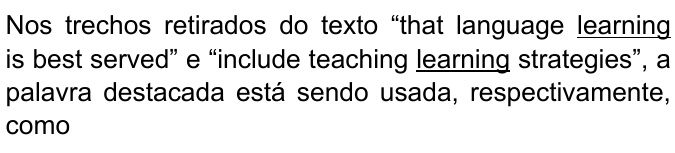
Innovation in the language teaching field in the late 1980s and 1990s has been stimulated by a special concern for the language learning process. New methods propose that language learning is best served when students are interacting – completing a task or learning content or resolving real-life issues – where linguistic structures are not taught one by one, but where attention to linguistic form is given as necessary. These views of language learning have been informed by research in second language acquisition. Also giving learning a special focus are methodological innovations of the late 1980s and 1990s. These include teaching learning strategies, using cooperative learning, and planning lessons in such a way that different intelligences are addressed.
(Larsen-Freeman, D. 2000)
O parágrafo descreve possibilidades para a sala de aula que remetem à aplicação deResolução comentada
Análise das alternativas
Read the following extract to answer questions 61 through 65.
Innovation in the language teaching field in the late 1980s and 1990s has been stimulated by a special concern for the language learning process. New methods propose that language learning is best served when students are interacting – completing a task or learning content or resolving real-life issues – where linguistic structures are not taught one by one, but where attention to linguistic form is given as necessary. These views of language learning have been informed by research in second language acquisition. Also giving learning a special focus are methodological innovations of the late 1980s and 1990s. These include teaching learning strategies, using cooperative learning, and planning lessons in such a way that different intelligences are addressed.
(Larsen-Freeman, D. 2000)
Read the following extract to answer questions 61 through 65.
Innovation in the language teaching field in the late 1980s and 1990s has been stimulated by a special concern for the language learning process. New methods propose that language learning is best served when students are interacting – completing a task or learning content or resolving real-life issues – where linguistic structures are not taught one by one, but where attention to linguistic form is given as necessary. These views of language learning have been informed by research in second language acquisition. Also giving learning a special focus are methodological innovations of the late 1980s and 1990s. These include teaching learning strategies, using cooperative learning, and planning lessons in such a way that different intelligences are addressed.
(Larsen-Freeman, D. 2000)

Read the following extract to answer questions 61 through 65.
Innovation in the language teaching field in the late 1980s and 1990s has been stimulated by a special concern for the language learning process. New methods propose that language learning is best served when students are interacting – completing a task or learning content or resolving real-life issues – where linguistic structures are not taught one by one, but where attention to linguistic form is given as necessary. These views of language learning have been informed by research in second language acquisition. Also giving learning a special focus are methodological innovations of the late 1980s and 1990s. These include teaching learning strategies, using cooperative learning, and planning lessons in such a way that different intelligences are addressed.
(Larsen-Freeman, D. 2000)
Assinale a alternativa que apresenta classe gramatical que precisa necessariamente de mais de um elemento para formar o sintagma que leva seu nome.Resolução comentada
Análise das alternativas
Read the following extract to answer questions 61 through 65.
Innovation in the language teaching field in the late 1980s and 1990s has been stimulated by a special concern for the language learning process. New methods propose that language learning is best served when students are interacting – completing a task or learning content or resolving real-life issues – where linguistic structures are not taught one by one, but where attention to linguistic form is given as necessary. These views of language learning have been informed by research in second language acquisition. Also giving learning a special focus are methodological innovations of the late 1980s and 1990s. These include teaching learning strategies, using cooperative learning, and planning lessons in such a way that different intelligences are addressed.
(Larsen-Freeman, D. 2000)

Leia os dois parágrafos a seguir para responder às questões de números 66 a 70.
An international student who majors in engineering drops by the engineering department office and asks the secretary, “Can you tell me where the English department is?” The secretary smiles and responds, “I don’t know, actually. It’s probably somewhere in the Humanities Building. Do you have a campus map?” The student turns around and leaves. The secretary is taken aback and feels slightly uncomfortable. She wonders why the student left so abruptly.
(...)
People who interact with ESL students have commented that some seem to express gratitude excessively for small considerations, even to the point of embarrassing the person they are speaking. Others seem downright rude because they do not say thank you when they are expected to.
(Celce-Murcia, M. 2001.)
A relação entre os dois parágrafos permite perceber que o mal entendido no episódio narrado no primeiro parágrafo provavelmente foi causado porResolução comentada
Análise das alternativas
Leia os dois parágrafos a seguir para responder às questões de números 66 a 70.
An international student who majors in engineering drops by the engineering department office and asks the secretary, “Can you tell me where the English department is?” The secretary smiles and responds, “I don’t know, actually. It’s probably somewhere in the Humanities Building. Do you have a campus map?” The student turns around and leaves. The secretary is taken aback and feels slightly uncomfortable. She wonders why the student left so abruptly.
(...)
People who interact with ESL students have commented that some seem to express gratitude excessively for small considerations, even to the point of embarrassing the person they are speaking. Others seem downright rude because they do not say thank you when they are expected to.
(Celce-Murcia, M. 2001.)
The expression “drop by” belongs to a category called phrasal verbs (verb + particle). Sometimes verb and particle can be separated, sometimes they cannot. Choose the alternative that displays a separable phrasal verb.
Leia os dois parágrafos a seguir para responder às questões de números 66 a 70.
An international student who majors in engineering drops by the engineering department office and asks the secretary, “Can you tell me where the English department is?” The secretary smiles and responds, “I don’t know, actually. It’s probably somewhere in the Humanities Building. Do you have a campus map?” The student turns around and leaves. The secretary is taken aback and feels slightly uncomfortable. She wonders why the student left so abruptly.
(...)
People who interact with ESL students have commented that some seem to express gratitude excessively for small considerations, even to the point of embarrassing the person they are speaking. Others seem downright rude because they do not say thank you when they are expected to.
(Celce-Murcia, M. 2001.)
In the context of the first paragraph, the expression “taken aback” means the secretary wasResolução comentada
Análise das alternativas
Leia os dois parágrafos a seguir para responder às questões de números 66 a 70.
An international student who majors in engineering drops by the engineering department office and asks the secretary, “Can you tell me where the English department is?” The secretary smiles and responds, “I don’t know, actually. It’s probably somewhere in the Humanities Building. Do you have a campus map?” The student turns around and leaves. The secretary is taken aback and feels slightly uncomfortable. She wonders why the student left so abruptly.
(...)
People who interact with ESL students have commented that some seem to express gratitude excessively for small considerations, even to the point of embarrassing the person they are speaking. Others seem downright rude because they do not say thank you when they are expected to.
(Celce-Murcia, M. 2001.)
The fragment “when they are expected to”, which ends the text, is an instance of passive voice. According to Celce-Murcia and Larsen-Freeman (1999), there are semantic constraints that make the transformation from passive to active voice inadequate. Select the alternative which represents one such situation.Resolução comentada
Análise das alternativas
Leia os dois parágrafos a seguir para responder às questões de números 66 a 70.
An international student who majors in engineering drops by the engineering department office and asks the secretary, “Can you tell me where the English department is?” The secretary smiles and responds, “I don’t know, actually. It’s probably somewhere in the Humanities Building. Do you have a campus map?” The student turns around and leaves. The secretary is taken aback and feels slightly uncomfortable. She wonders why the student left so abruptly.
(...)
People who interact with ESL students have commented that some seem to express gratitude excessively for small considerations, even to the point of embarrassing the person they are speaking. Others seem downright rude because they do not say thank you when they are expected to.
(Celce-Murcia, M. 2001.)
Harmer, J. (2007) e Celce-Murcia, M. (2001) descrevem diferentes tipos de testes, cada qual com seus objetivos. Um “achievement test”, por exemplo, será capaz de verificarResolução comentada
Análise das alternativas
Texto-base:
Texto-base:
Texto-base:
Texto-base:
Texto-base:
Texto-base:
Texto-base:
Texto-base:
Texto-base:
Texto-base: