← Voltar para a lista de provas Escola Preparatória de Cadetes do Exército (EsPCEx) — Exército Brasileiro · Concurso de Admissão à EsPCEx 56 questões nesta prova · página 3 de 3 · 55 com gabarito Gabarito disponível O líder messiânico da Primeira República é o Padre Cícero. Padre Cícero Romão Batista, de Juazeiro do Norte (CE), foi uma das lideranças religiosas populares da Primeira República, ao lado de Antônio Conselheiro e do monge José Maria. B) Diogo Antônio Feijó foi regente no período imperial. C) Padre João Ribeiro foi ligado à Revolução Pernambucana de 1817. D) Frei Caneca atuou na Confederação do Equador, em 1824. E) Raimundo Gomes, o 'Cara Preta', foi líder da Balaiada, no Império. Referência: História do Brasil: Primeira República e movimentos messiânicos. Resolução comentada do VaiConcursos. Gabarito disponível As medidas corretas do New Deal são II, III e V. O New Deal teve forte intervenção estatal: socorro aos bancos, seguridade social com seguro-desemprego e obras públicas para gerar empregos. Isso corresponde a II, III e V. I está errada: houve desvalorização do dólar, não supervalorização, para estimular exportações. IV está errada: o New Deal foi intervencionista, contrário à crença de que o mercado se autorregularia. Por isso A, B, D e E estão incorretas. Referência: História: Crise de 1929 e New Deal (Roosevelt, 1933). Resolução comentada do VaiConcursos. Gabarito disponível A descolonização africana gerou novos focos de tensão durante a Guerra Fria. A Coexistência Pacífica (a partir dos anos 1950) reduziu a tensão direta entre as superpotências, mas a descolonização da África e da Ásia abriu novos focos de disputa por influência entre EUA e URSS. A) O conflito de Kosovo ocorreu nos anos 1990, após a Guerra Fria. B) A Revolução do Veludo foi em 1989, na Tchecoslováquia, e não gerou novos focos de tensão. C) A Guerra Civil Espanhola foi de 1936 a 1939, antes do período. D) O Massacre de Katyn foi em 1940, durante a Segunda Guerra Mundial. Referência: História Contemporânea: Guerra Fria e Coexistência Pacífica. Resolução comentada do VaiConcursos. Gabarito disponível A renda per capita dos chineses continuará relativamente baixa. Apesar do enorme PIB total, a China tem população de mais de 1 bilhão de pessoas, o que dilui a riqueza. A renda per capita, portanto, continua relativamente baixa, o que é coerente com o gabarito. A) O poderio militar tende a crescer com a riqueza. B) A capacidade de investimento externo também cresce. C) A evolução científico-tecnológica é impulsionada. E) Nem toda a população altera seu estilo de vida, e a afirmação de consumo 'sem limite' é exagerada. Referência: China contemporânea: crescimento econômico e desigualdade. Resolução comentada do VaiConcursos. Gabarito disponível Gabarito disponível 'Mandatory' é sinônimo de 'compulsory'. 'Mandatory' significa obrigatório, o que corresponde a 'compulsory'. O texto diz que ela teria de fazer o teste de proficiência exigido. A) difficult é difícil. B) reasonable é razoável. D) useful é útil. E) comprehensive é abrangente. Nenhuma indica obrigatoriedade. Referência: The Guardian, parágrafo 3. Resolução comentada do VaiConcursos. Gabarito disponível Ela não atingiu a pontuação mínima na fluência oral. O trecho seguinte diz 'She got 74 when the government requires 79' e fala em 'perfect oral fluency' sem pontos suficientes. Logo, ela passou nas outras partes, mas falhou em alcançar a nota mínima na fluência oral. A) Ela ficou abaixo do exigido. B) Ela obteve resultados. C) Não há menção a falta de tempo. E) Ela passou na escrita. Referência: The Guardian, 'Computer says no', parágrafo 3. Resolução comentada do VaiConcursos. Gabarito disponível A alternativa C usa 'minefield' em sentido figurado. No texto, a mesa de jantar é um 'minefield' por parecer cheia de perigos ocultos. Em C, a retórica do sistema jurídico é um campo minado para o cidadão comum, ou seja, um terreno cheio de armadilhas, também em sentido figurado. A, B, D e E usam 'minefield' no sentido literal, de área com minas explosivas. Referência: BBC Future, parágrafo 1. Resolução comentada do VaiConcursos. Gabarito disponível O prefixo 'ill' significa 'mal' (badly). 'Ill-informed' significa mal informado. O prefixo 'ill-' indica algo feito de modo inadequado ou ruim. A) finely, C) sadly, D) highly e E) gladly não correspondem ao sentido de 'ill-', que expressa deficiência ou inadequação. Referência: BBC Future, parágrafo 2. Resolução comentada do VaiConcursos. Gabarito disponível 'Ironically' introduz uma situação que carrega contradição. O trecho diz que o exagero da mídia pode levar a medos desnecessários que levam a escolhas menos saudáveis. Isso é contraditório, pois o medo deveria proteger a saúde, e 'ironically' marca essa contradição. A) Não se trata de algo irreversível. B) Não encerra o problema. C) A situação não é falsa. E) Não traz solução, e sim um efeito contrário ao esperado. Referência: BBC Future, 'Are any foods safe to eat anymore?', parágrafo 2. Resolução comentada do VaiConcursos. Gabarito disponível 'Foster' significa promover. Nos dois contextos, 'foster' tem o sentido de promover ou estimular: barreiras que promovem o conflito e o sofrimento, e infraestrutura que promove a autossuficiência. B) Expel é expulsar. C) Minimize é reduzir. D) Finish é terminar. E) Decrease é diminuir. Nenhuma se encaixa em 'foster the attainment'. Referência: Texto 'Oxfam America', parágrafos 2 e 3. Resolução comentada do VaiConcursos. Gabarito disponível 'In which' se refere às comunidades e 'they' aos projetos. Em 'the communities in which they are based', 'which' retoma 'communities' e 'they' retoma 'projects', pois são os projetos que estão baseados nas comunidades. A, B, C e D trazem referentes que não se encaixam na estrutura sintática: Oxfam, food aid e self-sufficiency não são onde os projetos se baseiam nem o sujeito de 'are based'. Referência: Texto 'Oxfam America', parágrafo 3. Resolução comentada do VaiConcursos. Gabarito disponível A fome foi uma das consequências da Segunda Guerra Mundial na Europa. O texto diz que a Oxfam surgiu em 1942 'in response to the European famine-related issues resulting from the Second World War', o que confirma a alternativa B. A) Os projetos buscam autossuficiência, 'as opposed to merely providing relief in the form of food aid'. C) É uma organização 'privately funded'. D) Há projetos na Índia e na Califórnia. E) A organização busca soluções duradouras e acredita que a fome pode ser superada. Referência: Texto 'Oxfam America', parágrafos 1 a 3. Resolução comentada do VaiConcursos. Gabarito disponível 'Spiralled out of control' significa piorar rapidamente de modo incontrolável. No contexto, o mal-entendido causou o fracasso do projeto e prejuízos. A expressão indica que a situação foi se agravando sem que se pudesse controlá-la, o que corresponde a 'quickly got worse in an unmanageable way'. B) Nada indica melhora. C) Não houve intenção nem falta de profissionalismo deliberada. D) As coisas não saíram como todos queriam. E) Os envolvidos pensavam o oposto um do outro, sem consenso. Referência: BBC Capital, parágrafo 2. Resolução comentada do VaiConcursos. Gabarito disponível Purposefully, carefully e efficiently são advérbios. Os três terminam em -ly e modificam verbos: 'speak purposefully and carefully' e 'communicate efficiently'. Portanto, são advérbios de modo. A) Adjetivos modificariam substantivos. B) Não nomeiam seres. C) Não indicam ação. D) Não ligam termos como preposições. Referência: Gramática da língua inglesa: formação de advérbios com -ly. Resolução comentada do VaiConcursos. Gabarito disponível Estão corretas as afirmações II, III e V. II: o texto diz que Chong não revelou a palavra. III: os nativos 'might not feel the need to adapt'. V: os não nativos se comunicam com 'limited, simple language'. I é falsa (houve prejuízo, não lucro) e IV é falsa (abreviações são citadas como um problema dos nativos). A, B, C e D incluem I ou IV, que são falsas. Referência: BBC Capital, 'Native English speakers are the world's worst communicators'. Resolução comentada do VaiConcursos.EsPCEx — Concurso de Admissão 2020 — Provas de Matemática, Geografia, História e Inglês (2º dia) — Modelo D
Resolução comentada
Análise das alternativas
I – Supervalorização do dólar para tornar as importações mais competitivas.
II – Empréstimo do governo aos bancos para evitar mais falências.
III – Implantação de um sistema de seguridade social, com a criação do seguro-desemprego.
IV – Não intervenção na economia, pois o próprio mercado resolveria a crise.
V – Criação de um vasto programa de obras públicas, com o intuito de gerar novos empregos.
Assinale a alternativa que apresenta todas as medidas corretas, dentre as listadas acima.Resolução comentada
Análise das alternativas
Resolução comentada
Análise das alternativas
Resolução comentada
Análise das alternativas
Leia o texto a seguir e responda às questões 45, 46 e 47.
Computer says no: Irish vet fails oral English test needed to stay in Australia
Louise Kennedy is an Irish veterinarian with degrees in history and politics – both obtained in English. She is married to an Australian and has been working in Australia as an equine vet on a skilled worker visa for the past two years. As a native English speaker, she has excellent grammar and a broad vocabulary, but has been unable to convince a machine she can speak English well enough to stay in Australia.
But she is now scrambling for other visa options after a computer-based English test – scored by a machine – essentially handed her a fail in terms of convincing immigration officers she can fluently speak her own language.
Earlier this year, Kennedy decided she would seek permanent residency in Australia. She knew she would have to sit a mandatory English proficiency test but was shocked when she got the results. While she passed all other components of the test including writing and reading, (...). She got 74 when the government requires 79. “There’s obviously a flaw in their computer software, when a person with perfect oral fluency cannot get enough points,” she said.
The test providers have categorically denied there is anything wrong with its computer-based test or the scoring engine trained to analyse candidates’ responses. “We do not offer a pass or a fail, simply a score and the immigration department set the bar very high for people seeking permanent residency”, they say.
Kennedy, who is due to have a baby in October, says she will now have to pursue a bridging visa, while she seeks a more expensive spouse visa so she can remain with her Australian husband.
Adapted from https://www.theguardian.com/australia-news/2017/aug/08/computer-says-no-irish-vet-fails-oral-english-test-needed-to-stay-in-australia
Trecho dos parágrafos 1 a 3 como impresso na prova, com os verbos sublinhados:
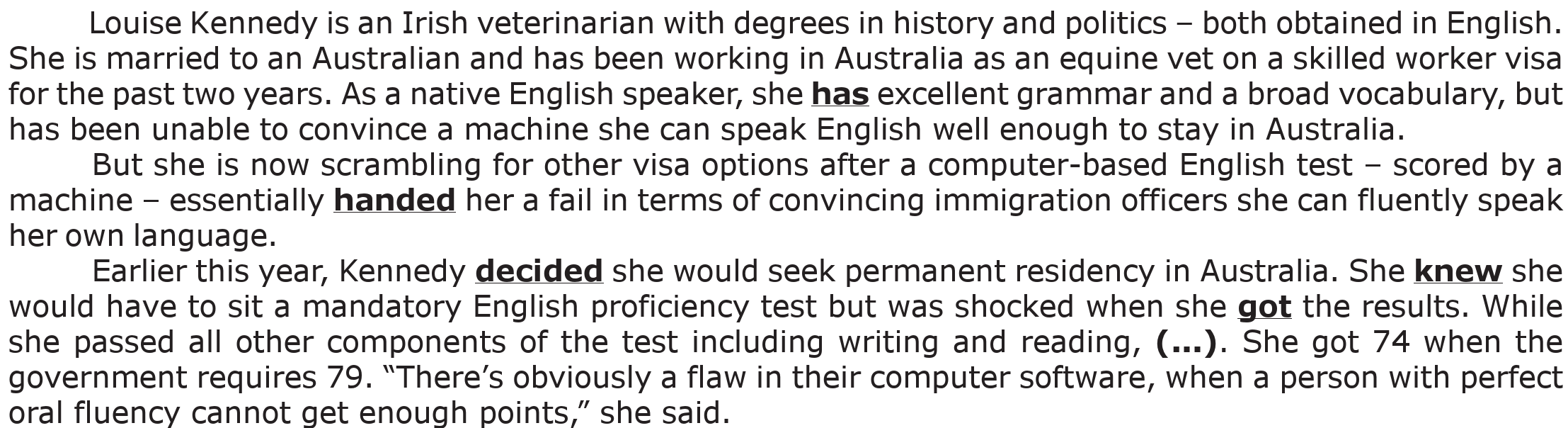
Which one from the underlined verbs in the text conveys a different verb tense?
Leia o texto a seguir e responda às questões 45, 46 e 47.
Computer says no: Irish vet fails oral English test needed to stay in Australia
Louise Kennedy is an Irish veterinarian with degrees in history and politics – both obtained in English. She is married to an Australian and has been working in Australia as an equine vet on a skilled worker visa for the past two years. As a native English speaker, she has excellent grammar and a broad vocabulary, but has been unable to convince a machine she can speak English well enough to stay in Australia.
But she is now scrambling for other visa options after a computer-based English test – scored by a machine – essentially handed her a fail in terms of convincing immigration officers she can fluently speak her own language.
Earlier this year, Kennedy decided she would seek permanent residency in Australia. She knew she would have to sit a mandatory English proficiency test but was shocked when she got the results. While she passed all other components of the test including writing and reading, (...). She got 74 when the government requires 79. “There’s obviously a flaw in their computer software, when a person with perfect oral fluency cannot get enough points,” she said.
The test providers have categorically denied there is anything wrong with its computer-based test or the scoring engine trained to analyse candidates’ responses. “We do not offer a pass or a fail, simply a score and the immigration department set the bar very high for people seeking permanent residency”, they say.
Kennedy, who is due to have a baby in October, says she will now have to pursue a bridging visa, while she seeks a more expensive spouse visa so she can remain with her Australian husband.
Adapted from https://www.theguardian.com/australia-news/2017/aug/08/computer-says-no-irish-vet-fails-oral-english-test-needed-to-stay-in-australia
Choose the alternative that has the same meaning as the word mandatory in the sentence “She knew she would have to sit a mandatory English proficiency test...” (paragraph 3).Resolução comentada
Análise das alternativas
Leia o texto a seguir e responda às questões 45, 46 e 47.
Computer says no: Irish vet fails oral English test needed to stay in Australia
Louise Kennedy is an Irish veterinarian with degrees in history and politics – both obtained in English. She is married to an Australian and has been working in Australia as an equine vet on a skilled worker visa for the past two years. As a native English speaker, she has excellent grammar and a broad vocabulary, but has been unable to convince a machine she can speak English well enough to stay in Australia.
But she is now scrambling for other visa options after a computer-based English test – scored by a machine – essentially handed her a fail in terms of convincing immigration officers she can fluently speak her own language.
Earlier this year, Kennedy decided she would seek permanent residency in Australia. She knew she would have to sit a mandatory English proficiency test but was shocked when she got the results. While she passed all other components of the test including writing and reading, (...). She got 74 when the government requires 79. “There’s obviously a flaw in their computer software, when a person with perfect oral fluency cannot get enough points,” she said.
The test providers have categorically denied there is anything wrong with its computer-based test or the scoring engine trained to analyse candidates’ responses. “We do not offer a pass or a fail, simply a score and the immigration department set the bar very high for people seeking permanent residency”, they say.
Kennedy, who is due to have a baby in October, says she will now have to pursue a bridging visa, while she seeks a more expensive spouse visa so she can remain with her Australian husband.
Adapted from https://www.theguardian.com/australia-news/2017/aug/08/computer-says-no-irish-vet-fails-oral-english-test-needed-to-stay-in-australia
According to the context, the missing part of paragraph 3 is ...
While she passed all other components of the test including writing and reading, (...).Resolução comentada
Análise das alternativas
Leia o texto a seguir e responda às questões 48, 49 e 50.
Are any foods safe to eat anymore? The fears and the facts
Food was once seen as a source of sustenance and pleasure. Today, the dinner table can instead begin to feel like a minefield. Is bacon really a risk factor of cancer? Will coffee or eggs give you a heart attack? Does wheat contribute to Alzheimer’s disease? Will dairy products clog up your arteries? Worse still, the advice changes continually. As TV-cook Nigella Lawson recently put it: “You can guarantee that what people think will be good for you this year, they won’t next year.”
This may be somewhat inevitable: evidence-based health advice should be constantly updated as new studies explore the nuances of what we eat and the effects the meals have on our bodies. But when the media (and ill-informed health gurus) exaggerate the results of a study without providing the context, it can lead to unnecessary fears that may, ironically, push you towards less healthy choices.
The good news is that “next year” you may be pleased to learn that many of your favourite foods are not the ticking time bomb you have been led to believe...
Adapted from http://www.bbc.com/future/story/20151029-are-any-foods-safe-to-eat-anymore-heres-the-truth
Choose the statement in which the word minefield has been used in a figurative way just like in paragraph 1.Resolução comentada
Análise das alternativas
Leia o texto a seguir e responda às questões 48, 49 e 50.
Are any foods safe to eat anymore? The fears and the facts
Food was once seen as a source of sustenance and pleasure. Today, the dinner table can instead begin to feel like a minefield. Is bacon really a risk factor of cancer? Will coffee or eggs give you a heart attack? Does wheat contribute to Alzheimer’s disease? Will dairy products clog up your arteries? Worse still, the advice changes continually. As TV-cook Nigella Lawson recently put it: “You can guarantee that what people think will be good for you this year, they won’t next year.”
This may be somewhat inevitable: evidence-based health advice should be constantly updated as new studies explore the nuances of what we eat and the effects the meals have on our bodies. But when the media (and ill-informed health gurus) exaggerate the results of a study without providing the context, it can lead to unnecessary fears that may, ironically, push you towards less healthy choices.
The good news is that “next year” you may be pleased to learn that many of your favourite foods are not the ticking time bomb you have been led to believe...
Adapted from http://www.bbc.com/future/story/20151029-are-any-foods-safe-to-eat-anymore-heres-the-truth
In the sentence “... ill -informed health gurus...” (paragraph 2), the prefix ill meansResolução comentada
Análise das alternativas
Leia o texto a seguir e responda às questões 48, 49 e 50.
Are any foods safe to eat anymore? The fears and the facts
Food was once seen as a source of sustenance and pleasure. Today, the dinner table can instead begin to feel like a minefield. Is bacon really a risk factor of cancer? Will coffee or eggs give you a heart attack? Does wheat contribute to Alzheimer’s disease? Will dairy products clog up your arteries? Worse still, the advice changes continually. As TV-cook Nigella Lawson recently put it: “You can guarantee that what people think will be good for you this year, they won’t next year.”
This may be somewhat inevitable: evidence-based health advice should be constantly updated as new studies explore the nuances of what we eat and the effects the meals have on our bodies. But when the media (and ill-informed health gurus) exaggerate the results of a study without providing the context, it can lead to unnecessary fears that may, ironically, push you towards less healthy choices.
The good news is that “next year” you may be pleased to learn that many of your favourite foods are not the ticking time bomb you have been led to believe...
Adapted from http://www.bbc.com/future/story/20151029-are-any-foods-safe-to-eat-anymore-heres-the-truth
In the text, the word ironically (paragraph 2) introducesResolução comentada
Análise das alternativas
Leia o texto a seguir e responda às questões 51, 52 e 53.
OXFAM AMERICA
Oxfam stands for the Oxford Committee for Famine Relief. It was started in Oxford, England in 1942 in response to the European famine-related issues resulting from the Second World War. Ten other countries worldwide, including the United States and Australia, have started chapters of Oxfam. They make up what is known as Oxfam International.
Oxfam America is dedicated to creating lasting solutions to hunger, poverty, and social injustice through long-term partnerships with poor communities around the world. As a privately funded organization, we can speak with conviction and integrity as we challenge the structural barriers that foster conflict and human suffering and limit people from gaining the skills, resources, and power to become self-sufficient.
Oxfam implements various global projects that target areas particularly affected by hunger. The projects focus on developing self-sufficiency of the communities in which they are based, as opposed to merely providing relief in the form of food aid. Oxfam’s projects operate on the communal level, and are developed by evaluating issues causing poverty and hunger in the community and subsequently the possible infrastructure that could end hunger and foster the attainment of self-sufficiency. Examples of projects in which Oxfam America has been or is involved range from a women’s literacy program in India to providing microloans and agriculture education programs for small-scale organic farmers in California.
Adapted from http://students.brown.edu/Hourglass_Cafe/Pages/about.htm
In the sentences “...barriers that foster conflict and human suffering...” (paragraph 2) and “...end hunger and foster the attainment of self-sufficiency.” (paragraph 3), the word foster meansResolução comentada
Análise das alternativas
Leia o texto a seguir e responda às questões 51, 52 e 53.
OXFAM AMERICA
Oxfam stands for the Oxford Committee for Famine Relief. It was started in Oxford, England in 1942 in response to the European famine-related issues resulting from the Second World War. Ten other countries worldwide, including the United States and Australia, have started chapters of Oxfam. They make up what is known as Oxfam International.
Oxfam America is dedicated to creating lasting solutions to hunger, poverty, and social injustice through long-term partnerships with poor communities around the world. As a privately funded organization, we can speak with conviction and integrity as we challenge the structural barriers that foster conflict and human suffering and limit people from gaining the skills, resources, and power to become self-sufficient.
Oxfam implements various global projects that target areas particularly affected by hunger. The projects focus on developing self-sufficiency of the communities in which they are based, as opposed to merely providing relief in the form of food aid. Oxfam’s projects operate on the communal level, and are developed by evaluating issues causing poverty and hunger in the community and subsequently the possible infrastructure that could end hunger and foster the attainment of self-sufficiency. Examples of projects in which Oxfam America has been or is involved range from a women’s literacy program in India to providing microloans and agriculture education programs for small-scale organic farmers in California.
Adapted from http://students.brown.edu/Hourglass_Cafe/Pages/about.htm
In the sentence “The projects focus on developing self-sufficiency of the communities in which they are based.” (paragraph 3), the words in which and they consecutively refer toResolução comentada
Análise das alternativas
Leia o texto a seguir e responda às questões 51, 52 e 53.
OXFAM AMERICA
Oxfam stands for the Oxford Committee for Famine Relief. It was started in Oxford, England in 1942 in response to the European famine-related issues resulting from the Second World War. Ten other countries worldwide, including the United States and Australia, have started chapters of Oxfam. They make up what is known as Oxfam International.
Oxfam America is dedicated to creating lasting solutions to hunger, poverty, and social injustice through long-term partnerships with poor communities around the world. As a privately funded organization, we can speak with conviction and integrity as we challenge the structural barriers that foster conflict and human suffering and limit people from gaining the skills, resources, and power to become self-sufficient.
Oxfam implements various global projects that target areas particularly affected by hunger. The projects focus on developing self-sufficiency of the communities in which they are based, as opposed to merely providing relief in the form of food aid. Oxfam’s projects operate on the communal level, and are developed by evaluating issues causing poverty and hunger in the community and subsequently the possible infrastructure that could end hunger and foster the attainment of self-sufficiency. Examples of projects in which Oxfam America has been or is involved range from a women’s literacy program in India to providing microloans and agriculture education programs for small-scale organic farmers in California.
Adapted from http://students.brown.edu/Hourglass_Cafe/Pages/about.htm
According to the text, choose the correct alternative.Resolução comentada
Análise das alternativas
Leia o texto a seguir e responda às questões 54, 55 e 56.
Native English speakers are the world’s worst communicators
It was just one word in one email, but it caused huge financial losses for a multinational company. The message, written in English, was sent by a native speaker to a colleague for whom English was a second language. Unsure of the word, the recipient found two contradictory meanings in his dictionary. He acted on the wrong one.
Months later, senior management investigated why the project had failed, costing hundreds of thousands of dollars. “It all traced back to this one word,” says Chia Suan Chong, a UK-based communications skills and intercultural trainer, who didn’t reveal the tricky word because it is highly industry-specific and possibly identifiable. “Things spiralled out of control because both parties were thinking the opposite.”
When such misunderstandings happen, it’s usually the native speakers who are to blame. Ironically, they are worse at delivering their message than people who speak English as a second or third language, according to Chong. “A lot of native speakers are happy that English has become the world’s global language. They feel they don’t have to spend time learning another language.”
The non-native speakers, it turns out, speak more purposefully and carefully, trying to communicate efficiently with limited, simple language, typical of someone speaking a second or third language. Anglophones, on the other hand, often talk too fast for others to follow, and use jokes, slang, abbreviations and references specific to their own culture, says Chong. “The native English speaker is the only one who might not feel the need to adapt to the others,” she adds.
Adapted from http://www.bbc.com/capital/story/20161028-native-english-speakers-are-the-worlds-worst-communicators
Choose the alternative that correctly substitutes SPIRALLED OUT OF CONTROL in the sentence “Things spiralled out of control because both parties were thinking the opposite.” (paragraph 2).Resolução comentada
Análise das alternativas
Leia o texto a seguir e responda às questões 54, 55 e 56.
Native English speakers are the world’s worst communicators
It was just one word in one email, but it caused huge financial losses for a multinational company. The message, written in English, was sent by a native speaker to a colleague for whom English was a second language. Unsure of the word, the recipient found two contradictory meanings in his dictionary. He acted on the wrong one.
Months later, senior management investigated why the project had failed, costing hundreds of thousands of dollars. “It all traced back to this one word,” says Chia Suan Chong, a UK-based communications skills and intercultural trainer, who didn’t reveal the tricky word because it is highly industry-specific and possibly identifiable. “Things spiralled out of control because both parties were thinking the opposite.”
When such misunderstandings happen, it’s usually the native speakers who are to blame. Ironically, they are worse at delivering their message than people who speak English as a second or third language, according to Chong. “A lot of native speakers are happy that English has become the world’s global language. They feel they don’t have to spend time learning another language.”
The non-native speakers, it turns out, speak more purposefully and carefully, trying to communicate efficiently with limited, simple language, typical of someone speaking a second or third language. Anglophones, on the other hand, often talk too fast for others to follow, and use jokes, slang, abbreviations and references specific to their own culture, says Chong. “The native English speaker is the only one who might not feel the need to adapt to the others,” she adds.
Adapted from http://www.bbc.com/capital/story/20161028-native-english-speakers-are-the-worlds-worst-communicators
About the words purposefully, carefully and efficiently (paragraph 4) , it is correct to say thatResolução comentada
Análise das alternativas
Leia o texto a seguir e responda às questões 54, 55 e 56.
Native English speakers are the world’s worst communicators
It was just one word in one email, but it caused huge financial losses for a multinational company. The message, written in English, was sent by a native speaker to a colleague for whom English was a second language. Unsure of the word, the recipient found two contradictory meanings in his dictionary. He acted on the wrong one.
Months later, senior management investigated why the project had failed, costing hundreds of thousands of dollars. “It all traced back to this one word,” says Chia Suan Chong, a UK-based communications skills and intercultural trainer, who didn’t reveal the tricky word because it is highly industry-specific and possibly identifiable. “Things spiralled out of control because both parties were thinking the opposite.”
When such misunderstandings happen, it’s usually the native speakers who are to blame. Ironically, they are worse at delivering their message than people who speak English as a second or third language, according to Chong. “A lot of native speakers are happy that English has become the world’s global language. They feel they don’t have to spend time learning another language.”
The non-native speakers, it turns out, speak more purposefully and carefully, trying to communicate efficiently with limited, simple language, typical of someone speaking a second or third language. Anglophones, on the other hand, often talk too fast for others to follow, and use jokes, slang, abbreviations and references specific to their own culture, says Chong. “The native English speaker is the only one who might not feel the need to adapt to the others,” she adds.
Adapted from http://www.bbc.com/capital/story/20161028-native-english-speakers-are-the-worlds-worst-communicators
According to the text, read the statements and choose the correct alternative.
I – The company had a profit of hundreds of thousands of dollars.
II – The tricky word that caused the problem isn’t mentioned in the text.
III – Native speakers don’t usually think they should adapt in order to make themselves understood.
IV – Using abbreviations in emails facilitates the communication.
V – Non-native speakers choose language from a limited repertoire.Resolução comentada
Análise das alternativas
Durante a Primeira República, o domínio dos “coronéis” no campo era quase absoluto. Contudo, mostrou-se insuficiente para impedir que muitos trabalhadores rurais seguissem líderes messiânicos, que acenavam com a promessa de uma sociedade justa e fraterna. Vale a pena destacar o seguinte líder religioso desse período:
O “New Deal”, de 1933, foi um plano posto em prática pelo Presidente dos Estados Unidos da América – Franklin Delano Roosevelt –, que articulava as ações do governo com os da iniciativa privada. Para tanto, foram adotadas as seguintes medidas:
Durante a Guerra Fria, de 1945 a 1991, a Coexistência Pacífica serviu como canal de entendimento entre capitalistas e socialistas, contudo não foi capaz de mitigar novos focos de tensão, tais como
Em 2007, a China já estava entre as quatro maiores economias do mundo. Para 2020, previsões colocam-na como a segunda ou a primeira. Entretanto, essa geração de riqueza não se refletirá na
Texto-base:
Texto-base:
Texto-base:
Texto-base:
Texto-base:
Texto-base:
Texto-base:
Texto-base:
Texto-base:
Texto-base:
Texto-base:
Texto-base: