← Voltar para a lista de provas Comando da Aeronáutica · Exame de Admissão aos CFOAV, CFOINT e CFOINF 2021 65 questões nesta prova · página 1 de 4 · 64 com gabarito Gabarito disponível O dano do meteorito russo foi menor que o da Sibéria. O texto diz que o dano 'was nothing compared to' o que ocorreu na Sibéria. Logo, foi bem menos grave. A) Errada: o texto descreve o dano como limitado, e não diz que seria impossível calculá-lo. C) Errada: inverte a comparação. D) Errada: não houve alerta, pois o meteorito não foi detectado. Referência: Texto, parágrafo 1 (linhas 6-9). Resolução comentada do VaiConcursos. Gabarito disponível 'Although' tem sentido concessivo, equivalente a 'despite' (com ajuste sintático). 'Although' introduz ideia de concessão/contraste. Dentre as opções, 'despite' é a que expressa essa mesma relação. A) 'However' indica contraste, mas é adversativo e usado em outra posição, não como subordinador. B) 'Therefore' indica conclusão. D) 'Once' indica tempo ou condição. Referência: Conectivos concessivos: although, though, despite, in spite of. Resolução comentada do VaiConcursos. Gabarito disponível Voz passiva no passado simples corresponde à ativa no passado simples. 'Were injured by falling glass' é passiva no simple past. Na voz ativa fica 'Falling glass injured many people', com o verbo no passado simples. A) Errada: 'have injured' é present perfect e concorda mal com o sujeito singular. B) Errada: 'has injured' é present perfect. C) Errada: 'had injured' é past perfect, tempo diferente do original. Referência: Conversão voz passiva/ativa mantendo o tempo verbal. Resolução comentada do VaiConcursos. Gabarito disponível 'Nearly one hundred years' equivale a 'approximately a century'. 'Nearly' indica quase, aproximadamente. O advérbio que mantém esse sentido é 'approximately'. A) Errada: 'actually' significa 'na verdade'. B) e D) Erradas: 'precisely' e 'exactly' indicam exatidão, contrariando 'nearly'. Referência: Vocabulário em contexto: nearly = approximately. Resolução comentada do VaiConcursos. Gabarito disponível O meteorito da Sibéria explodiu no ar e achatou cerca de 80 milhões de árvores. O objeto de Sibéria explodiu sobre uma região de florestas, derrubando cerca de 80 milhões de árvores. Assim, danificou árvores ao explodir. B) Errada: o vidro caindo refere-se a Chelyabinsk. C) Errada: a comparação com bomba nuclear é do impacto no México. D) Errada: explodiu sobre uma floresta, não sobre uma cidade grande. Referência: Texto, parágrafo 1 (linhas 8-13). Resolução comentada do VaiConcursos. Gabarito disponível A oração condicional do terceiro tipo expressa situação hipotética e irreal. 'If it had exploded... millions would have been killed' é o third conditional, que trata de algo que não aconteceu. Logo, a explosão sobre as cidades e as mortes são hipotéticas. A) Errada: as pessoas não morreram, pois a explosão não foi sobre cidades. B) Errada: o texto não fala em salvamento por especialistas. C) Errada: não há previsão de explosão futura sobre essas cidades. Referência: Third conditional (if + past perfect, would have + particípio). Resolução comentada do VaiConcursos. Gabarito disponível No mesmo dia houve outro evento de asteroide, sem relação com o meteorito. O texto fala em 'strange coincidence': outro asteroide de 50 m passou perto da Terra no mesmo dia, previsto pelos cientistas. Portanto foi um evento distinto e sem ligação. A) Errada: quem se aterrorizou foram os moradores de Chelyabinsk. B) Errada: o texto diz apenas que o asteroide voltará em 2046, não que houve alerta emitido naquele dia. C) Errada: 'coincidência' indica que os eventos não eram ligados. Referência: Texto, parágrafo 2 (linhas 14-20). Resolução comentada do VaiConcursos. Gabarito disponível Gabarito disponível O meteorito russo era pequeno demais para ser detectado antes. O texto afirma que o meteorito russo 'had been too small for anyone to spot', ou seja, ninguém o percebeu antes de explodir. A) Errada: quem voltará em 2046 é o asteroide de 50 m, não o meteorito. B) Errada: causou danos, com pessoas feridas por vidro. C) Errada: os cientistas esperavam o asteroide, não o meteorito. Referência: Texto, parágrafo 2 (linhas 17-20). Resolução comentada do VaiConcursos. Gabarito disponível Cometas e asteroides grandes podem destruir toda a vida complexa, animais e maioria das plantas. O texto diz que um cometa ou asteroide com mais de 20 km que atinja a Terra causaria a destruição completa da vida complexa, incluindo todos os animais e a maioria das plantas. Isso corresponde a acabar com a vida animal e grande parte da vegetal. A) Errada: atingiria também a maioria das plantas. C) Errada: a comparação com Hiroshima refere-se à força do impacto dos dinossauros, não a um limite de dano. D) Errada: o texto cita a morte de milhões em caso hipotético, mas a afirmação sobre especialistas se refere à destruição da vida complexa. Referência: Texto 'The end of life on Earth?', parágrafo 4 (linhas 29-33). Resolução comentada do VaiConcursos. Gabarito disponível Um asteroide relativamente pequeno ainda pode causar muito dano. O texto diz: 'As we have seen even a much smaller asteroid can cause great damage'. Exemplos são o de Tunguska, de cerca de 50 m, que derrubou milhões de árvores, e o de Chelyabinsk, que feriu muitas pessoas. A) O texto não diz que ver cedo basta; o de Chelyabinsk não foi visto e o de 50 m foi previsto, mas isso não elimina o problema. C) Contradiz o texto. D) O texto não diz que o pequeno é mais perigoso; só diz que também causa dano. Referência: Reading comprehension: main idea. Resolução comentada do VaiConcursos. Gabarito disponível A Terra esteve relativamente segura graças à sorte e ao campo gravitacional de Júpiter. O texto afirma: 'The Earth has been kept fairly safe ... by good fortune and the massive gravitational field of the planet Jupiter'. Isso corresponde a sorte e à força protetora de outro planeta. B) O texto não menciona a NASA. C) A posição em relação ao Sol não é citada como motivo (só a órbita de Júpiter é mencionada). D) 'Foreseeable future' é um tempo futuro, não uma causa. Referência: Reading comprehension: detail. Resolução comentada do VaiConcursos. Gabarito disponível 'Which' (linha 40) refere-se a 'comets and asteroids'. A frase é 'sweeps up and scatters away most of the dangerous comets and asteroids which might cross Earth's orbit'. O pronome relativo 'which' retoma 'comets and asteroids', que 'might cross Earth's orbit'. A) O Sol não cruza a órbita da Terra. C) O guardião cósmico (Júpiter) é quem varre os corpos perigosos. D) A Terra é a órbita citada, não o referente de 'which'. Referência: Reference: relative pronouns. Resolução comentada do VaiConcursos. Gabarito disponível Gabarito disponível Os cientistas acreditam que não há perigo previsível no momento. O texto diz que cientistas monitoram os riscos e 'as far as they know, there is no danger in the foreseeable future'. Isso equivale a dizer que não estamos em perigo por ora. B) O texto não cita a NASA. C) Não afirma que um meteorito atingirá a Terra cedo ou tarde. D) Os cientistas estão monitorando, então é possível monitorar. Referência: Reading comprehension: inference. Resolução comentada do VaiConcursos. Gabarito disponível Segundo o texto, meteoroide e meteorito são o mesmo objeto, mudando só o nome ao atingir a Terra. O texto define 'Meteoroid – part of an asteroid or comet' e 'Meteorite – what a meteoroid is called when it hits Earth'. Trata-se do mesmo objeto, com nome diferente conforme esteja no espaço ou tenha atingido a Terra. B) O texto diz 'probably', não 'certainly'. C) Asteroides não têm cauda, cometas têm; não são iguais. D) O meteorito de Chelyabinsk feriu pessoas. Referência: Reading comprehension: definitions. Resolução comentada do VaiConcursos. Gabarito disponível O deslocamento total em 4t é t(3v + v₀)/2, e a velocidade média é (3v + v₀)/8. De 0 a t, a velocidade vai de v₀ a v, e o deslocamento é (v₀ + v)t/2. De t a 2t, a velocidade é constante: v·t. De 2t a 4t, a velocidade varia linearmente de v a −v, com média zero e deslocamento nulo. Soma: t(v₀ + 3v)/2. Dividindo por 4t: (3v + v₀)/8. A, C e D) Não correspondem à média ponderada pelo tempo calculada pelas áreas do gráfico v×t; apresentam dimensões ou coeficientes incorretos. Referência: Cinemática: velocidade média e gráfico v×t. Resolução comentada do VaiConcursos. Gabarito disponível Gabarito disponível Gabarito disponívelComando da Aeronáutica — Exames de Admissão aos CFOAV, CFOINT e CFOINF 2021 — Língua Inglesa, Física, Língua Portuguesa, Matemática e Redação — Versão A
TEXT
The end of life on Earth?
It weighted about 10,000 tons, entered the
atmosphere at a speed of 64,000 km/h and exploded
over a city with a blast of 500 kilotons. But on 15
February 2013, we were lucky. The metereorite that
5 showered pieces of rock over Chelyabinsk, Russia, was
relatively small, at only about 17 metres wide. Although
many people were injured by falling glass, the damage
was nothing compared to what had happened in Siberia
nearly one hundred years ago, when a relatively small
10 object (approximately 50 metres in diameter) exploded in
mid-air over a forest region, flattening about 80 million
trees. If it had exploded over a city such as Moscow or
London, millions of people would have been killed.
By a strange coincidence, the same day that the
15 meteorite terrified the people of Chelyabinsk, another
50m-wide asteroid passed relatively close to Earth.
Scientists were expecting that visit and know that the
asteroid will return to fly close by us in 2046, but the
Russian meteorite earlier in the day had been too small
20 for anyone to spot.
Most scientists agree that comets and asteroids
pose the biggest natural threat to human existence. It
was probably a large asteroid or comet colliding with
Earth which wiped out the dinosaurs about 65 million
25 years ago. An enormous object, 10 to 16 km in diameter,
struck the Yucatan region in Mexico with the force of 100
megatons. That is the equivalent of one Hiroshima bomb
for every person alive on Earth today.
Many scientists, including the late Stephen
30 Hawking, say that any comet or asteroid greater than
20km in diameter that hits Earth will result in the
complete destruction of complex life, including all
animals and most plants. As we have seen even a much
smaller asteroid can cause great damage.
35 The Earth has been kept fairly safe for the last 65
million years by good fortune and the massive
gravitational field of the planet Jupiter. Our cosmic
guardian, with its stable circular orbit far from the sun,
sweeps up and scatters away most of the dangerous
40 comets and asteroids which might cross Earth’s orbit.
After the Chelyabinsk meteorite, scientists are now
monitoring potential hazards even more carefully but, as
far as they know, there is no danger in the foreseeable
future.
45 Types of space rocks
• Comet – a ball of rock and ice that sends out a
tail of gas and dust behind it. Bright comets only appear
in our visible night sky about once every ten years.
• Asteroid – a rock a few feet to several kms in
50 diameter. Unlike comets, asteroids have no tail. Most
are to small to cause any damage and burn up in the
atmosphere.
• Meteoroid – part of an asteroid or comet.
• Meteorite – what a meteoroid is called when it
55 hits Earth.
Taken from: http://learningenglishteens.britishcouncil.org - Access on 29/06/2020
The damage caused by the Russian meteoriteResolução comentada
Análise das alternativas
TEXT
The end of life on Earth?
It weighted about 10,000 tons, entered the
atmosphere at a speed of 64,000 km/h and exploded
over a city with a blast of 500 kilotons. But on 15
February 2013, we were lucky. The metereorite that
5 showered pieces of rock over Chelyabinsk, Russia, was
relatively small, at only about 17 metres wide. Although
many people were injured by falling glass, the damage
was nothing compared to what had happened in Siberia
nearly one hundred years ago, when a relatively small
10 object (approximately 50 metres in diameter) exploded in
mid-air over a forest region, flattening about 80 million
trees. If it had exploded over a city such as Moscow or
London, millions of people would have been killed.
By a strange coincidence, the same day that the
15 meteorite terrified the people of Chelyabinsk, another
50m-wide asteroid passed relatively close to Earth.
Scientists were expecting that visit and know that the
asteroid will return to fly close by us in 2046, but the
Russian meteorite earlier in the day had been too small
20 for anyone to spot.
Most scientists agree that comets and asteroids
pose the biggest natural threat to human existence. It
was probably a large asteroid or comet colliding with
Earth which wiped out the dinosaurs about 65 million
25 years ago. An enormous object, 10 to 16 km in diameter,
struck the Yucatan region in Mexico with the force of 100
megatons. That is the equivalent of one Hiroshima bomb
for every person alive on Earth today.
Many scientists, including the late Stephen
30 Hawking, say that any comet or asteroid greater than
20km in diameter that hits Earth will result in the
complete destruction of complex life, including all
animals and most plants. As we have seen even a much
smaller asteroid can cause great damage.
35 The Earth has been kept fairly safe for the last 65
million years by good fortune and the massive
gravitational field of the planet Jupiter. Our cosmic
guardian, with its stable circular orbit far from the sun,
sweeps up and scatters away most of the dangerous
40 comets and asteroids which might cross Earth’s orbit.
After the Chelyabinsk meteorite, scientists are now
monitoring potential hazards even more carefully but, as
far as they know, there is no danger in the foreseeable
future.
45 Types of space rocks
• Comet – a ball of rock and ice that sends out a
tail of gas and dust behind it. Bright comets only appear
in our visible night sky about once every ten years.
• Asteroid – a rock a few feet to several kms in
50 diameter. Unlike comets, asteroids have no tail. Most
are to small to cause any damage and burn up in the
atmosphere.
• Meteoroid – part of an asteroid or comet.
• Meteorite – what a meteoroid is called when it
55 hits Earth.
Taken from: http://learningenglishteens.britishcouncil.org - Access on 29/06/2020
Without changing the meaning, the word “although” (line 6) could be substituted for:Resolução comentada
Análise das alternativas
TEXT
The end of life on Earth?
It weighted about 10,000 tons, entered the
atmosphere at a speed of 64,000 km/h and exploded
over a city with a blast of 500 kilotons. But on 15
February 2013, we were lucky. The metereorite that
5 showered pieces of rock over Chelyabinsk, Russia, was
relatively small, at only about 17 metres wide. Although
many people were injured by falling glass, the damage
was nothing compared to what had happened in Siberia
nearly one hundred years ago, when a relatively small
10 object (approximately 50 metres in diameter) exploded in
mid-air over a forest region, flattening about 80 million
trees. If it had exploded over a city such as Moscow or
London, millions of people would have been killed.
By a strange coincidence, the same day that the
15 meteorite terrified the people of Chelyabinsk, another
50m-wide asteroid passed relatively close to Earth.
Scientists were expecting that visit and know that the
asteroid will return to fly close by us in 2046, but the
Russian meteorite earlier in the day had been too small
20 for anyone to spot.
Most scientists agree that comets and asteroids
pose the biggest natural threat to human existence. It
was probably a large asteroid or comet colliding with
Earth which wiped out the dinosaurs about 65 million
25 years ago. An enormous object, 10 to 16 km in diameter,
struck the Yucatan region in Mexico with the force of 100
megatons. That is the equivalent of one Hiroshima bomb
for every person alive on Earth today.
Many scientists, including the late Stephen
30 Hawking, say that any comet or asteroid greater than
20km in diameter that hits Earth will result in the
complete destruction of complex life, including all
animals and most plants. As we have seen even a much
smaller asteroid can cause great damage.
35 The Earth has been kept fairly safe for the last 65
million years by good fortune and the massive
gravitational field of the planet Jupiter. Our cosmic
guardian, with its stable circular orbit far from the sun,
sweeps up and scatters away most of the dangerous
40 comets and asteroids which might cross Earth’s orbit.
After the Chelyabinsk meteorite, scientists are now
monitoring potential hazards even more carefully but, as
far as they know, there is no danger in the foreseeable
future.
45 Types of space rocks
• Comet – a ball of rock and ice that sends out a
tail of gas and dust behind it. Bright comets only appear
in our visible night sky about once every ten years.
• Asteroid – a rock a few feet to several kms in
50 diameter. Unlike comets, asteroids have no tail. Most
are to small to cause any damage and burn up in the
atmosphere.
• Meteoroid – part of an asteroid or comet.
• Meteorite – what a meteoroid is called when it
55 hits Earth.
Taken from: http://learningenglishteens.britishcouncil.org - Access on 29/06/2020
The statement “many people were injured by falling glass” (line 7) stands for
Falling glass _______ many people.Resolução comentada
Análise das alternativas
TEXT
The end of life on Earth?
It weighted about 10,000 tons, entered the
atmosphere at a speed of 64,000 km/h and exploded
over a city with a blast of 500 kilotons. But on 15
February 2013, we were lucky. The metereorite that
5 showered pieces of rock over Chelyabinsk, Russia, was
relatively small, at only about 17 metres wide. Although
many people were injured by falling glass, the damage
was nothing compared to what had happened in Siberia
nearly one hundred years ago, when a relatively small
10 object (approximately 50 metres in diameter) exploded in
mid-air over a forest region, flattening about 80 million
trees. If it had exploded over a city such as Moscow or
London, millions of people would have been killed.
By a strange coincidence, the same day that the
15 meteorite terrified the people of Chelyabinsk, another
50m-wide asteroid passed relatively close to Earth.
Scientists were expecting that visit and know that the
asteroid will return to fly close by us in 2046, but the
Russian meteorite earlier in the day had been too small
20 for anyone to spot.
Most scientists agree that comets and asteroids
pose the biggest natural threat to human existence. It
was probably a large asteroid or comet colliding with
Earth which wiped out the dinosaurs about 65 million
25 years ago. An enormous object, 10 to 16 km in diameter,
struck the Yucatan region in Mexico with the force of 100
megatons. That is the equivalent of one Hiroshima bomb
for every person alive on Earth today.
Many scientists, including the late Stephen
30 Hawking, say that any comet or asteroid greater than
20km in diameter that hits Earth will result in the
complete destruction of complex life, including all
animals and most plants. As we have seen even a much
smaller asteroid can cause great damage.
35 The Earth has been kept fairly safe for the last 65
million years by good fortune and the massive
gravitational field of the planet Jupiter. Our cosmic
guardian, with its stable circular orbit far from the sun,
sweeps up and scatters away most of the dangerous
40 comets and asteroids which might cross Earth’s orbit.
After the Chelyabinsk meteorite, scientists are now
monitoring potential hazards even more carefully but, as
far as they know, there is no danger in the foreseeable
future.
45 Types of space rocks
• Comet – a ball of rock and ice that sends out a
tail of gas and dust behind it. Bright comets only appear
in our visible night sky about once every ten years.
• Asteroid – a rock a few feet to several kms in
50 diameter. Unlike comets, asteroids have no tail. Most
are to small to cause any damage and burn up in the
atmosphere.
• Meteoroid – part of an asteroid or comet.
• Meteorite – what a meteoroid is called when it
55 hits Earth.
Taken from: http://learningenglishteens.britishcouncil.org - Access on 29/06/2020
The passage “the damage was nothing compared to what had happened in Siberia nearly one hundred years ago” (lines 7 to 9) states that the incident occurred _______ a century ago.Resolução comentada
Análise das alternativas
TEXT
The end of life on Earth?
It weighted about 10,000 tons, entered the
atmosphere at a speed of 64,000 km/h and exploded
over a city with a blast of 500 kilotons. But on 15
February 2013, we were lucky. The metereorite that
5 showered pieces of rock over Chelyabinsk, Russia, was
relatively small, at only about 17 metres wide. Although
many people were injured by falling glass, the damage
was nothing compared to what had happened in Siberia
nearly one hundred years ago, when a relatively small
10 object (approximately 50 metres in diameter) exploded in
mid-air over a forest region, flattening about 80 million
trees. If it had exploded over a city such as Moscow or
London, millions of people would have been killed.
By a strange coincidence, the same day that the
15 meteorite terrified the people of Chelyabinsk, another
50m-wide asteroid passed relatively close to Earth.
Scientists were expecting that visit and know that the
asteroid will return to fly close by us in 2046, but the
Russian meteorite earlier in the day had been too small
20 for anyone to spot.
Most scientists agree that comets and asteroids
pose the biggest natural threat to human existence. It
was probably a large asteroid or comet colliding with
Earth which wiped out the dinosaurs about 65 million
25 years ago. An enormous object, 10 to 16 km in diameter,
struck the Yucatan region in Mexico with the force of 100
megatons. That is the equivalent of one Hiroshima bomb
for every person alive on Earth today.
Many scientists, including the late Stephen
30 Hawking, say that any comet or asteroid greater than
20km in diameter that hits Earth will result in the
complete destruction of complex life, including all
animals and most plants. As we have seen even a much
smaller asteroid can cause great damage.
35 The Earth has been kept fairly safe for the last 65
million years by good fortune and the massive
gravitational field of the planet Jupiter. Our cosmic
guardian, with its stable circular orbit far from the sun,
sweeps up and scatters away most of the dangerous
40 comets and asteroids which might cross Earth’s orbit.
After the Chelyabinsk meteorite, scientists are now
monitoring potential hazards even more carefully but, as
far as they know, there is no danger in the foreseeable
future.
45 Types of space rocks
• Comet – a ball of rock and ice that sends out a
tail of gas and dust behind it. Bright comets only appear
in our visible night sky about once every ten years.
• Asteroid – a rock a few feet to several kms in
50 diameter. Unlike comets, asteroids have no tail. Most
are to small to cause any damage and burn up in the
atmosphere.
• Meteoroid – part of an asteroid or comet.
• Meteorite – what a meteoroid is called when it
55 hits Earth.
Taken from: http://learningenglishteens.britishcouncil.org - Access on 29/06/2020
The Siberian meteoriteResolução comentada
Análise das alternativas
TEXT
The end of life on Earth?
It weighted about 10,000 tons, entered the
atmosphere at a speed of 64,000 km/h and exploded
over a city with a blast of 500 kilotons. But on 15
February 2013, we were lucky. The metereorite that
5 showered pieces of rock over Chelyabinsk, Russia, was
relatively small, at only about 17 metres wide. Although
many people were injured by falling glass, the damage
was nothing compared to what had happened in Siberia
nearly one hundred years ago, when a relatively small
10 object (approximately 50 metres in diameter) exploded in
mid-air over a forest region, flattening about 80 million
trees. If it had exploded over a city such as Moscow or
London, millions of people would have been killed.
By a strange coincidence, the same day that the
15 meteorite terrified the people of Chelyabinsk, another
50m-wide asteroid passed relatively close to Earth.
Scientists were expecting that visit and know that the
asteroid will return to fly close by us in 2046, but the
Russian meteorite earlier in the day had been too small
20 for anyone to spot.
Most scientists agree that comets and asteroids
pose the biggest natural threat to human existence. It
was probably a large asteroid or comet colliding with
Earth which wiped out the dinosaurs about 65 million
25 years ago. An enormous object, 10 to 16 km in diameter,
struck the Yucatan region in Mexico with the force of 100
megatons. That is the equivalent of one Hiroshima bomb
for every person alive on Earth today.
Many scientists, including the late Stephen
30 Hawking, say that any comet or asteroid greater than
20km in diameter that hits Earth will result in the
complete destruction of complex life, including all
animals and most plants. As we have seen even a much
smaller asteroid can cause great damage.
35 The Earth has been kept fairly safe for the last 65
million years by good fortune and the massive
gravitational field of the planet Jupiter. Our cosmic
guardian, with its stable circular orbit far from the sun,
sweeps up and scatters away most of the dangerous
40 comets and asteroids which might cross Earth’s orbit.
After the Chelyabinsk meteorite, scientists are now
monitoring potential hazards even more carefully but, as
far as they know, there is no danger in the foreseeable
future.
45 Types of space rocks
• Comet – a ball of rock and ice that sends out a
tail of gas and dust behind it. Bright comets only appear
in our visible night sky about once every ten years.
• Asteroid – a rock a few feet to several kms in
50 diameter. Unlike comets, asteroids have no tail. Most
are to small to cause any damage and burn up in the
atmosphere.
• Meteoroid – part of an asteroid or comet.
• Meteorite – what a meteoroid is called when it
55 hits Earth.
Taken from: http://learningenglishteens.britishcouncil.org - Access on 29/06/2020
“If it had exploded over a city such as Moscow or London, millions of people would have been killed” (lines 12 and 13). We can conclude from the information in this passage thatResolução comentada
Análise das alternativas
TEXT
The end of life on Earth?
It weighted about 10,000 tons, entered the
atmosphere at a speed of 64,000 km/h and exploded
over a city with a blast of 500 kilotons. But on 15
February 2013, we were lucky. The metereorite that
5 showered pieces of rock over Chelyabinsk, Russia, was
relatively small, at only about 17 metres wide. Although
many people were injured by falling glass, the damage
was nothing compared to what had happened in Siberia
nearly one hundred years ago, when a relatively small
10 object (approximately 50 metres in diameter) exploded in
mid-air over a forest region, flattening about 80 million
trees. If it had exploded over a city such as Moscow or
London, millions of people would have been killed.
By a strange coincidence, the same day that the
15 meteorite terrified the people of Chelyabinsk, another
50m-wide asteroid passed relatively close to Earth.
Scientists were expecting that visit and know that the
asteroid will return to fly close by us in 2046, but the
Russian meteorite earlier in the day had been too small
20 for anyone to spot.
Most scientists agree that comets and asteroids
pose the biggest natural threat to human existence. It
was probably a large asteroid or comet colliding with
Earth which wiped out the dinosaurs about 65 million
25 years ago. An enormous object, 10 to 16 km in diameter,
struck the Yucatan region in Mexico with the force of 100
megatons. That is the equivalent of one Hiroshima bomb
for every person alive on Earth today.
Many scientists, including the late Stephen
30 Hawking, say that any comet or asteroid greater than
20km in diameter that hits Earth will result in the
complete destruction of complex life, including all
animals and most plants. As we have seen even a much
smaller asteroid can cause great damage.
35 The Earth has been kept fairly safe for the last 65
million years by good fortune and the massive
gravitational field of the planet Jupiter. Our cosmic
guardian, with its stable circular orbit far from the sun,
sweeps up and scatters away most of the dangerous
40 comets and asteroids which might cross Earth’s orbit.
After the Chelyabinsk meteorite, scientists are now
monitoring potential hazards even more carefully but, as
far as they know, there is no danger in the foreseeable
future.
45 Types of space rocks
• Comet – a ball of rock and ice that sends out a
tail of gas and dust behind it. Bright comets only appear
in our visible night sky about once every ten years.
• Asteroid – a rock a few feet to several kms in
50 diameter. Unlike comets, asteroids have no tail. Most
are to small to cause any damage and burn up in the
atmosphere.
• Meteoroid – part of an asteroid or comet.
• Meteorite – what a meteoroid is called when it
55 hits Earth.
Taken from: http://learningenglishteens.britishcouncil.org - Access on 29/06/2020
On the same day as the meteorite exploded over Chelyabinsk,Resolução comentada
Análise das alternativas
TEXT
The end of life on Earth?
It weighted about 10,000 tons, entered the
atmosphere at a speed of 64,000 km/h and exploded
over a city with a blast of 500 kilotons. But on 15
February 2013, we were lucky. The metereorite that
5 showered pieces of rock over Chelyabinsk, Russia, was
relatively small, at only about 17 metres wide. Although
many people were injured by falling glass, the damage
was nothing compared to what had happened in Siberia
nearly one hundred years ago, when a relatively small
10 object (approximately 50 metres in diameter) exploded in
mid-air over a forest region, flattening about 80 million
trees. If it had exploded over a city such as Moscow or
London, millions of people would have been killed.
By a strange coincidence, the same day that the
15 meteorite terrified the people of Chelyabinsk, another
50m-wide asteroid passed relatively close to Earth.
Scientists were expecting that visit and know that the
asteroid will return to fly close by us in 2046, but the
Russian meteorite earlier in the day had been too small
20 for anyone to spot.
Most scientists agree that comets and asteroids
pose the biggest natural threat to human existence. It
was probably a large asteroid or comet colliding with
Earth which wiped out the dinosaurs about 65 million
25 years ago. An enormous object, 10 to 16 km in diameter,
struck the Yucatan region in Mexico with the force of 100
megatons. That is the equivalent of one Hiroshima bomb
for every person alive on Earth today.
Many scientists, including the late Stephen
30 Hawking, say that any comet or asteroid greater than
20km in diameter that hits Earth will result in the
complete destruction of complex life, including all
animals and most plants. As we have seen even a much
smaller asteroid can cause great damage.
35 The Earth has been kept fairly safe for the last 65
million years by good fortune and the massive
gravitational field of the planet Jupiter. Our cosmic
guardian, with its stable circular orbit far from the sun,
sweeps up and scatters away most of the dangerous
40 comets and asteroids which might cross Earth’s orbit.
After the Chelyabinsk meteorite, scientists are now
monitoring potential hazards even more carefully but, as
far as they know, there is no danger in the foreseeable
future.
45 Types of space rocks
• Comet – a ball of rock and ice that sends out a
tail of gas and dust behind it. Bright comets only appear
in our visible night sky about once every ten years.
• Asteroid – a rock a few feet to several kms in
50 diameter. Unlike comets, asteroids have no tail. Most
are to small to cause any damage and burn up in the
atmosphere.
• Meteoroid – part of an asteroid or comet.
• Meteorite – what a meteoroid is called when it
55 hits Earth.
Taken from: http://learningenglishteens.britishcouncil.org - Access on 29/06/2020

TEXT
The end of life on Earth?
It weighted about 10,000 tons, entered the
atmosphere at a speed of 64,000 km/h and exploded
over a city with a blast of 500 kilotons. But on 15
February 2013, we were lucky. The metereorite that
5 showered pieces of rock over Chelyabinsk, Russia, was
relatively small, at only about 17 metres wide. Although
many people were injured by falling glass, the damage
was nothing compared to what had happened in Siberia
nearly one hundred years ago, when a relatively small
10 object (approximately 50 metres in diameter) exploded in
mid-air over a forest region, flattening about 80 million
trees. If it had exploded over a city such as Moscow or
London, millions of people would have been killed.
By a strange coincidence, the same day that the
15 meteorite terrified the people of Chelyabinsk, another
50m-wide asteroid passed relatively close to Earth.
Scientists were expecting that visit and know that the
asteroid will return to fly close by us in 2046, but the
Russian meteorite earlier in the day had been too small
20 for anyone to spot.
Most scientists agree that comets and asteroids
pose the biggest natural threat to human existence. It
was probably a large asteroid or comet colliding with
Earth which wiped out the dinosaurs about 65 million
25 years ago. An enormous object, 10 to 16 km in diameter,
struck the Yucatan region in Mexico with the force of 100
megatons. That is the equivalent of one Hiroshima bomb
for every person alive on Earth today.
Many scientists, including the late Stephen
30 Hawking, say that any comet or asteroid greater than
20km in diameter that hits Earth will result in the
complete destruction of complex life, including all
animals and most plants. As we have seen even a much
smaller asteroid can cause great damage.
35 The Earth has been kept fairly safe for the last 65
million years by good fortune and the massive
gravitational field of the planet Jupiter. Our cosmic
guardian, with its stable circular orbit far from the sun,
sweeps up and scatters away most of the dangerous
40 comets and asteroids which might cross Earth’s orbit.
After the Chelyabinsk meteorite, scientists are now
monitoring potential hazards even more carefully but, as
far as they know, there is no danger in the foreseeable
future.
45 Types of space rocks
• Comet – a ball of rock and ice that sends out a
tail of gas and dust behind it. Bright comets only appear
in our visible night sky about once every ten years.
• Asteroid – a rock a few feet to several kms in
50 diameter. Unlike comets, asteroids have no tail. Most
are to small to cause any damage and burn up in the
atmosphere.
• Meteoroid – part of an asteroid or comet.
• Meteorite – what a meteoroid is called when it
55 hits Earth.
Taken from: http://learningenglishteens.britishcouncil.org - Access on 29/06/2020
The Russian meteoriteResolução comentada
Análise das alternativas
TEXT
The end of life on Earth?
It weighted about 10,000 tons, entered the
atmosphere at a speed of 64,000 km/h and exploded
over a city with a blast of 500 kilotons. But on 15
February 2013, we were lucky. The metereorite that
5 showered pieces of rock over Chelyabinsk, Russia, was
relatively small, at only about 17 metres wide. Although
many people were injured by falling glass, the damage
was nothing compared to what had happened in Siberia
nearly one hundred years ago, when a relatively small
10 object (approximately 50 metres in diameter) exploded in
mid-air over a forest region, flattening about 80 million
trees. If it had exploded over a city such as Moscow or
London, millions of people would have been killed.
By a strange coincidence, the same day that the
15 meteorite terrified the people of Chelyabinsk, another
50m-wide asteroid passed relatively close to Earth.
Scientists were expecting that visit and know that the
asteroid will return to fly close by us in 2046, but the
Russian meteorite earlier in the day had been too small
20 for anyone to spot.
Most scientists agree that comets and asteroids
pose the biggest natural threat to human existence. It
was probably a large asteroid or comet colliding with
Earth which wiped out the dinosaurs about 65 million
25 years ago. An enormous object, 10 to 16 km in diameter,
struck the Yucatan region in Mexico with the force of 100
megatons. That is the equivalent of one Hiroshima bomb
for every person alive on Earth today.
Many scientists, including the late Stephen
30 Hawking, say that any comet or asteroid greater than
20km in diameter that hits Earth will result in the
complete destruction of complex life, including all
animals and most plants. As we have seen even a much
smaller asteroid can cause great damage.
35 The Earth has been kept fairly safe for the last 65
million years by good fortune and the massive
gravitational field of the planet Jupiter. Our cosmic
guardian, with its stable circular orbit far from the sun,
sweeps up and scatters away most of the dangerous
40 comets and asteroids which might cross Earth’s orbit.
After the Chelyabinsk meteorite, scientists are now
monitoring potential hazards even more carefully but, as
far as they know, there is no danger in the foreseeable
future.
45 Types of space rocks
• Comet – a ball of rock and ice that sends out a
tail of gas and dust behind it. Bright comets only appear
in our visible night sky about once every ten years.
• Asteroid – a rock a few feet to several kms in
50 diameter. Unlike comets, asteroids have no tail. Most
are to small to cause any damage and burn up in the
atmosphere.
• Meteoroid – part of an asteroid or comet.
• Meteorite – what a meteoroid is called when it
55 hits Earth.
Taken from: http://learningenglishteens.britishcouncil.org - Access on 29/06/2020
Experts maintain that comets and asteroids couldResolução comentada
Análise das alternativas
TEXT
The end of life on Earth?
It weighted about 10,000 tons, entered the
atmosphere at a speed of 64,000 km/h and exploded
over a city with a blast of 500 kilotons. But on 15
February 2013, we were lucky. The metereorite that
5 showered pieces of rock over Chelyabinsk, Russia, was
relatively small, at only about 17 metres wide. Although
many people were injured by falling glass, the damage
was nothing compared to what had happened in Siberia
nearly one hundred years ago, when a relatively small
10 object (approximately 50 metres in diameter) exploded in
mid-air over a forest region, flattening about 80 million
trees. If it had exploded over a city such as Moscow or
London, millions of people would have been killed.
By a strange coincidence, the same day that the
15 meteorite terrified the people of Chelyabinsk, another
50m-wide asteroid passed relatively close to Earth.
Scientists were expecting that visit and know that the
asteroid will return to fly close by us in 2046, but the
Russian meteorite earlier in the day had been too small
20 for anyone to spot.
Most scientists agree that comets and asteroids
pose the biggest natural threat to human existence. It
was probably a large asteroid or comet colliding with
Earth which wiped out the dinosaurs about 65 million
25 years ago. An enormous object, 10 to 16 km in diameter,
struck the Yucatan region in Mexico with the force of 100
megatons. That is the equivalent of one Hiroshima bomb
for every person alive on Earth today.
Many scientists, including the late Stephen
30 Hawking, say that any comet or asteroid greater than
20km in diameter that hits Earth will result in the
complete destruction of complex life, including all
animals and most plants. As we have seen even a much
smaller asteroid can cause great damage.
35 The Earth has been kept fairly safe for the last 65
million years by good fortune and the massive
gravitational field of the planet Jupiter. Our cosmic
guardian, with its stable circular orbit far from the sun,
sweeps up and scatters away most of the dangerous
40 comets and asteroids which might cross Earth’s orbit.
After the Chelyabinsk meteorite, scientists are now
monitoring potential hazards even more carefully but, as
far as they know, there is no danger in the foreseeable
future.
45 Types of space rocks
• Comet – a ball of rock and ice that sends out a
tail of gas and dust behind it. Bright comets only appear
in our visible night sky about once every ten years.
• Asteroid – a rock a few feet to several kms in
50 diameter. Unlike comets, asteroids have no tail. Most
are to small to cause any damage and burn up in the
atmosphere.
• Meteoroid – part of an asteroid or comet.
• Meteorite – what a meteoroid is called when it
55 hits Earth.
Taken from: http://learningenglishteens.britishcouncil.org - Access on 29/06/2020
A relatively small asteroidResolução comentada
Análise das alternativas
TEXT
The end of life on Earth?
It weighted about 10,000 tons, entered the
atmosphere at a speed of 64,000 km/h and exploded
over a city with a blast of 500 kilotons. But on 15
February 2013, we were lucky. The metereorite that
5 showered pieces of rock over Chelyabinsk, Russia, was
relatively small, at only about 17 metres wide. Although
many people were injured by falling glass, the damage
was nothing compared to what had happened in Siberia
nearly one hundred years ago, when a relatively small
10 object (approximately 50 metres in diameter) exploded in
mid-air over a forest region, flattening about 80 million
trees. If it had exploded over a city such as Moscow or
London, millions of people would have been killed.
By a strange coincidence, the same day that the
15 meteorite terrified the people of Chelyabinsk, another
50m-wide asteroid passed relatively close to Earth.
Scientists were expecting that visit and know that the
asteroid will return to fly close by us in 2046, but the
Russian meteorite earlier in the day had been too small
20 for anyone to spot.
Most scientists agree that comets and asteroids
pose the biggest natural threat to human existence. It
was probably a large asteroid or comet colliding with
Earth which wiped out the dinosaurs about 65 million
25 years ago. An enormous object, 10 to 16 km in diameter,
struck the Yucatan region in Mexico with the force of 100
megatons. That is the equivalent of one Hiroshima bomb
for every person alive on Earth today.
Many scientists, including the late Stephen
30 Hawking, say that any comet or asteroid greater than
20km in diameter that hits Earth will result in the
complete destruction of complex life, including all
animals and most plants. As we have seen even a much
smaller asteroid can cause great damage.
35 The Earth has been kept fairly safe for the last 65
million years by good fortune and the massive
gravitational field of the planet Jupiter. Our cosmic
guardian, with its stable circular orbit far from the sun,
sweeps up and scatters away most of the dangerous
40 comets and asteroids which might cross Earth’s orbit.
After the Chelyabinsk meteorite, scientists are now
monitoring potential hazards even more carefully but, as
far as they know, there is no danger in the foreseeable
future.
45 Types of space rocks
• Comet – a ball of rock and ice that sends out a
tail of gas and dust behind it. Bright comets only appear
in our visible night sky about once every ten years.
• Asteroid – a rock a few feet to several kms in
50 diameter. Unlike comets, asteroids have no tail. Most
are to small to cause any damage and burn up in the
atmosphere.
• Meteoroid – part of an asteroid or comet.
• Meteorite – what a meteoroid is called when it
55 hits Earth.
Taken from: http://learningenglishteens.britishcouncil.org - Access on 29/06/2020
Earth has been relatively safe thanks toResolução comentada
Análise das alternativas
TEXT
The end of life on Earth?
It weighted about 10,000 tons, entered the
atmosphere at a speed of 64,000 km/h and exploded
over a city with a blast of 500 kilotons. But on 15
February 2013, we were lucky. The metereorite that
5 showered pieces of rock over Chelyabinsk, Russia, was
relatively small, at only about 17 metres wide. Although
many people were injured by falling glass, the damage
was nothing compared to what had happened in Siberia
nearly one hundred years ago, when a relatively small
10 object (approximately 50 metres in diameter) exploded in
mid-air over a forest region, flattening about 80 million
trees. If it had exploded over a city such as Moscow or
London, millions of people would have been killed.
By a strange coincidence, the same day that the
15 meteorite terrified the people of Chelyabinsk, another
50m-wide asteroid passed relatively close to Earth.
Scientists were expecting that visit and know that the
asteroid will return to fly close by us in 2046, but the
Russian meteorite earlier in the day had been too small
20 for anyone to spot.
Most scientists agree that comets and asteroids
pose the biggest natural threat to human existence. It
was probably a large asteroid or comet colliding with
Earth which wiped out the dinosaurs about 65 million
25 years ago. An enormous object, 10 to 16 km in diameter,
struck the Yucatan region in Mexico with the force of 100
megatons. That is the equivalent of one Hiroshima bomb
for every person alive on Earth today.
Many scientists, including the late Stephen
30 Hawking, say that any comet or asteroid greater than
20km in diameter that hits Earth will result in the
complete destruction of complex life, including all
animals and most plants. As we have seen even a much
smaller asteroid can cause great damage.
35 The Earth has been kept fairly safe for the last 65
million years by good fortune and the massive
gravitational field of the planet Jupiter. Our cosmic
guardian, with its stable circular orbit far from the sun,
sweeps up and scatters away most of the dangerous
40 comets and asteroids which might cross Earth’s orbit.
After the Chelyabinsk meteorite, scientists are now
monitoring potential hazards even more carefully but, as
far as they know, there is no danger in the foreseeable
future.
45 Types of space rocks
• Comet – a ball of rock and ice that sends out a
tail of gas and dust behind it. Bright comets only appear
in our visible night sky about once every ten years.
• Asteroid – a rock a few feet to several kms in
50 diameter. Unlike comets, asteroids have no tail. Most
are to small to cause any damage and burn up in the
atmosphere.
• Meteoroid – part of an asteroid or comet.
• Meteorite – what a meteoroid is called when it
55 hits Earth.
Taken from: http://learningenglishteens.britishcouncil.org - Access on 29/06/2020
“Which” (line 40) refers toResolução comentada
Análise das alternativas
TEXT
The end of life on Earth?
It weighted about 10,000 tons, entered the
atmosphere at a speed of 64,000 km/h and exploded
over a city with a blast of 500 kilotons. But on 15
February 2013, we were lucky. The metereorite that
5 showered pieces of rock over Chelyabinsk, Russia, was
relatively small, at only about 17 metres wide. Although
many people were injured by falling glass, the damage
was nothing compared to what had happened in Siberia
nearly one hundred years ago, when a relatively small
10 object (approximately 50 metres in diameter) exploded in
mid-air over a forest region, flattening about 80 million
trees. If it had exploded over a city such as Moscow or
London, millions of people would have been killed.
By a strange coincidence, the same day that the
15 meteorite terrified the people of Chelyabinsk, another
50m-wide asteroid passed relatively close to Earth.
Scientists were expecting that visit and know that the
asteroid will return to fly close by us in 2046, but the
Russian meteorite earlier in the day had been too small
20 for anyone to spot.
Most scientists agree that comets and asteroids
pose the biggest natural threat to human existence. It
was probably a large asteroid or comet colliding with
Earth which wiped out the dinosaurs about 65 million
25 years ago. An enormous object, 10 to 16 km in diameter,
struck the Yucatan region in Mexico with the force of 100
megatons. That is the equivalent of one Hiroshima bomb
for every person alive on Earth today.
Many scientists, including the late Stephen
30 Hawking, say that any comet or asteroid greater than
20km in diameter that hits Earth will result in the
complete destruction of complex life, including all
animals and most plants. As we have seen even a much
smaller asteroid can cause great damage.
35 The Earth has been kept fairly safe for the last 65
million years by good fortune and the massive
gravitational field of the planet Jupiter. Our cosmic
guardian, with its stable circular orbit far from the sun,
sweeps up and scatters away most of the dangerous
40 comets and asteroids which might cross Earth’s orbit.
After the Chelyabinsk meteorite, scientists are now
monitoring potential hazards even more carefully but, as
far as they know, there is no danger in the foreseeable
future.
45 Types of space rocks
• Comet – a ball of rock and ice that sends out a
tail of gas and dust behind it. Bright comets only appear
in our visible night sky about once every ten years.
• Asteroid – a rock a few feet to several kms in
50 diameter. Unlike comets, asteroids have no tail. Most
are to small to cause any damage and burn up in the
atmosphere.
• Meteoroid – part of an asteroid or comet.
• Meteorite – what a meteoroid is called when it
55 hits Earth.
Taken from: http://learningenglishteens.britishcouncil.org - Access on 29/06/2020

TEXT
The end of life on Earth?
It weighted about 10,000 tons, entered the
atmosphere at a speed of 64,000 km/h and exploded
over a city with a blast of 500 kilotons. But on 15
February 2013, we were lucky. The metereorite that
5 showered pieces of rock over Chelyabinsk, Russia, was
relatively small, at only about 17 metres wide. Although
many people were injured by falling glass, the damage
was nothing compared to what had happened in Siberia
nearly one hundred years ago, when a relatively small
10 object (approximately 50 metres in diameter) exploded in
mid-air over a forest region, flattening about 80 million
trees. If it had exploded over a city such as Moscow or
London, millions of people would have been killed.
By a strange coincidence, the same day that the
15 meteorite terrified the people of Chelyabinsk, another
50m-wide asteroid passed relatively close to Earth.
Scientists were expecting that visit and know that the
asteroid will return to fly close by us in 2046, but the
Russian meteorite earlier in the day had been too small
20 for anyone to spot.
Most scientists agree that comets and asteroids
pose the biggest natural threat to human existence. It
was probably a large asteroid or comet colliding with
Earth which wiped out the dinosaurs about 65 million
25 years ago. An enormous object, 10 to 16 km in diameter,
struck the Yucatan region in Mexico with the force of 100
megatons. That is the equivalent of one Hiroshima bomb
for every person alive on Earth today.
Many scientists, including the late Stephen
30 Hawking, say that any comet or asteroid greater than
20km in diameter that hits Earth will result in the
complete destruction of complex life, including all
animals and most plants. As we have seen even a much
smaller asteroid can cause great damage.
35 The Earth has been kept fairly safe for the last 65
million years by good fortune and the massive
gravitational field of the planet Jupiter. Our cosmic
guardian, with its stable circular orbit far from the sun,
sweeps up and scatters away most of the dangerous
40 comets and asteroids which might cross Earth’s orbit.
After the Chelyabinsk meteorite, scientists are now
monitoring potential hazards even more carefully but, as
far as they know, there is no danger in the foreseeable
future.
45 Types of space rocks
• Comet – a ball of rock and ice that sends out a
tail of gas and dust behind it. Bright comets only appear
in our visible night sky about once every ten years.
• Asteroid – a rock a few feet to several kms in
50 diameter. Unlike comets, asteroids have no tail. Most
are to small to cause any damage and burn up in the
atmosphere.
• Meteoroid – part of an asteroid or comet.
• Meteorite – what a meteoroid is called when it
55 hits Earth.
Taken from: http://learningenglishteens.britishcouncil.org - Access on 29/06/2020
Scientists support the idea thatResolução comentada
Análise das alternativas
TEXT
The end of life on Earth?
It weighted about 10,000 tons, entered the
atmosphere at a speed of 64,000 km/h and exploded
over a city with a blast of 500 kilotons. But on 15
February 2013, we were lucky. The metereorite that
5 showered pieces of rock over Chelyabinsk, Russia, was
relatively small, at only about 17 metres wide. Although
many people were injured by falling glass, the damage
was nothing compared to what had happened in Siberia
nearly one hundred years ago, when a relatively small
10 object (approximately 50 metres in diameter) exploded in
mid-air over a forest region, flattening about 80 million
trees. If it had exploded over a city such as Moscow or
London, millions of people would have been killed.
By a strange coincidence, the same day that the
15 meteorite terrified the people of Chelyabinsk, another
50m-wide asteroid passed relatively close to Earth.
Scientists were expecting that visit and know that the
asteroid will return to fly close by us in 2046, but the
Russian meteorite earlier in the day had been too small
20 for anyone to spot.
Most scientists agree that comets and asteroids
pose the biggest natural threat to human existence. It
was probably a large asteroid or comet colliding with
Earth which wiped out the dinosaurs about 65 million
25 years ago. An enormous object, 10 to 16 km in diameter,
struck the Yucatan region in Mexico with the force of 100
megatons. That is the equivalent of one Hiroshima bomb
for every person alive on Earth today.
Many scientists, including the late Stephen
30 Hawking, say that any comet or asteroid greater than
20km in diameter that hits Earth will result in the
complete destruction of complex life, including all
animals and most plants. As we have seen even a much
smaller asteroid can cause great damage.
35 The Earth has been kept fairly safe for the last 65
million years by good fortune and the massive
gravitational field of the planet Jupiter. Our cosmic
guardian, with its stable circular orbit far from the sun,
sweeps up and scatters away most of the dangerous
40 comets and asteroids which might cross Earth’s orbit.
After the Chelyabinsk meteorite, scientists are now
monitoring potential hazards even more carefully but, as
far as they know, there is no danger in the foreseeable
future.
45 Types of space rocks
• Comet – a ball of rock and ice that sends out a
tail of gas and dust behind it. Bright comets only appear
in our visible night sky about once every ten years.
• Asteroid – a rock a few feet to several kms in
50 diameter. Unlike comets, asteroids have no tail. Most
are to small to cause any damage and burn up in the
atmosphere.
• Meteoroid – part of an asteroid or comet.
• Meteorite – what a meteoroid is called when it
55 hits Earth.
Taken from: http://learningenglishteens.britishcouncil.org - Access on 29/06/2020
According to the textResolução comentada
Análise das alternativas
Nas questões de Física, quando necessário, use:
• massa atômica do hidrogênio: m_H = 1,67·10⁻²⁷ kg
• massa atômica do hélio: m_He = 6,65·10⁻²⁷ kg
• velocidade da luz no vácuo: c = 3·10⁸ m/s
• constante de Planck: h = 6·10⁻³⁴ J·s
• 1 eV = 1,6·10⁻¹⁹ J
• constante eletrostática do vácuo: k₀ = 9,0·10⁹ N·m²/C²
• aceleração da gravidade: g = 10 m/s²
• cos 30º = sen 60º = √3/2
• cos 60º = sen 30º = 1/2
• cos 45º = sen 45º = √2/2
A partir do instante t₀ = 0, uma partícula com velocidade inicial v₀ é uniformemente acelerada.
No instante t, a aceleração cessa e a partícula passa a se movimentar com velocidade constante v. Do instante 2t ao instante 4t, uma nova aceleração constante atua sobre a partícula, de tal forma que, ao final desse intervalo, sua velocidade vale -v.
Nessas condições, a velocidade média da partícula, no intervalo de 0 a 4t, é igual aResolução comentada
Análise das alternativas
Nas questões de Física, quando necessário, use:
• massa atômica do hidrogênio: m_H = 1,67·10⁻²⁷ kg
• massa atômica do hélio: m_He = 6,65·10⁻²⁷ kg
• velocidade da luz no vácuo: c = 3·10⁸ m/s
• constante de Planck: h = 6·10⁻³⁴ J·s
• 1 eV = 1,6·10⁻¹⁹ J
• constante eletrostática do vácuo: k₀ = 9,0·10⁹ N·m²/C²
• aceleração da gravidade: g = 10 m/s²
• cos 30º = sen 60º = √3/2
• cos 60º = sen 30º = 1/2
• cos 45º = sen 45º = √2/2
Numa partida de vôlei, certo atleta dá um mergulho na quadra, a uma distância x = 2,5 m da rede, defendendo um ataque adversário, conforme figura a seguir.
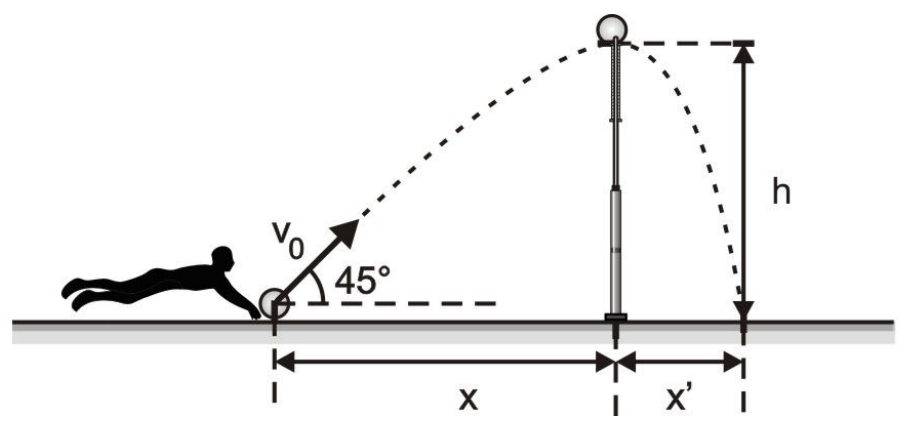
Após essa defesa, considere que a bola é lançada de uma altura desprezível em relação ao chão, de forma que sua velocidade faz um ângulo de 45º com a direção horizontal. Ao longo de sua trajetória, essa bola toca a fita da rede caindo, posteriormente, do outro lado da quadra. Imediatamente antes e imediatamente após tocar a fita, a velocidade da bola tem direção horizontal. A distância x', onde a bola cai na quadra, é igual à metade da altura h da fita.
Despreze a resistência do ar e considere a bola uma partícula de massa 200 g, cujo movimento se dá no plano da figura. O módulo do impulso, aplicado pela fita sobre a bola, em N·s, vale
Nas questões de Física, quando necessário, use:
• massa atômica do hidrogênio: m_H = 1,67·10⁻²⁷ kg
• massa atômica do hélio: m_He = 6,65·10⁻²⁷ kg
• velocidade da luz no vácuo: c = 3·10⁸ m/s
• constante de Planck: h = 6·10⁻³⁴ J·s
• 1 eV = 1,6·10⁻¹⁹ J
• constante eletrostática do vácuo: k₀ = 9,0·10⁹ N·m²/C²
• aceleração da gravidade: g = 10 m/s²
• cos 30º = sen 60º = √3/2
• cos 60º = sen 30º = 1/2
• cos 45º = sen 45º = √2/2
Uma partícula de massa M é lançada obliquamente com sua velocidade inicial v⃗₀ fazendo um ângulo de 30º com a direção horizontal, conforme indica figura a seguir.
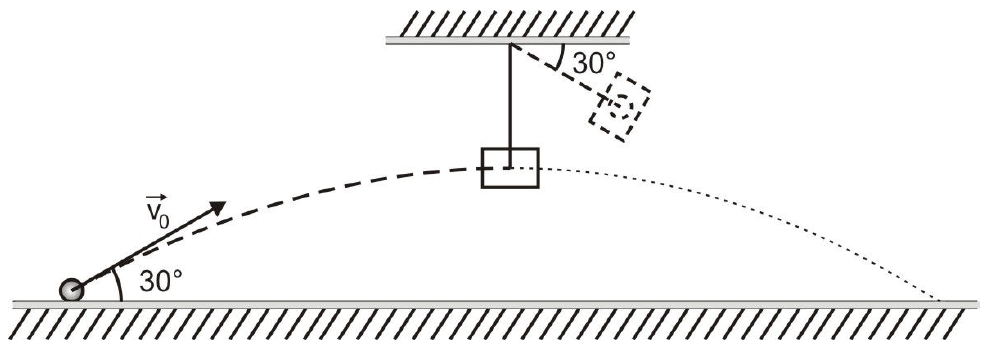
Ao atingir a altura máxima de sua trajetória parabólica, essa partícula colide inelasticamente com um bloco de massa 5M. Esse bloco, de dimensões desprezíveis, está preso ao teto por um fio ideal, de comprimento 1,2 m, formando um pêndulo balístico. Inicialmente o fio do pêndulo está na vertical. Após a colisão, o pêndulo atinge uma altura máxima, na qual o fio tem uma inclinação de 30º em relação à direção horizontal.
Desprezando a resistência do ar, o módulo da velocidade inicial da partícula, v₀, em m/s, é igual a
Nas questões de Física, quando necessário, use:
• massa atômica do hidrogênio: m_H = 1,67·10⁻²⁷ kg
• massa atômica do hélio: m_He = 6,65·10⁻²⁷ kg
• velocidade da luz no vácuo: c = 3·10⁸ m/s
• constante de Planck: h = 6·10⁻³⁴ J·s
• 1 eV = 1,6·10⁻¹⁹ J
• constante eletrostática do vácuo: k₀ = 9,0·10⁹ N·m²/C²
• aceleração da gravidade: g = 10 m/s²
• cos 30º = sen 60º = √3/2
• cos 60º = sen 30º = 1/2
• cos 45º = sen 45º = √2/2
O sistema ilustrado na figura abaixo é composto de três blocos, A, B e C, de dimensões desprezíveis e de mesma massa, duas roldanas e dois fios, todos ideais.
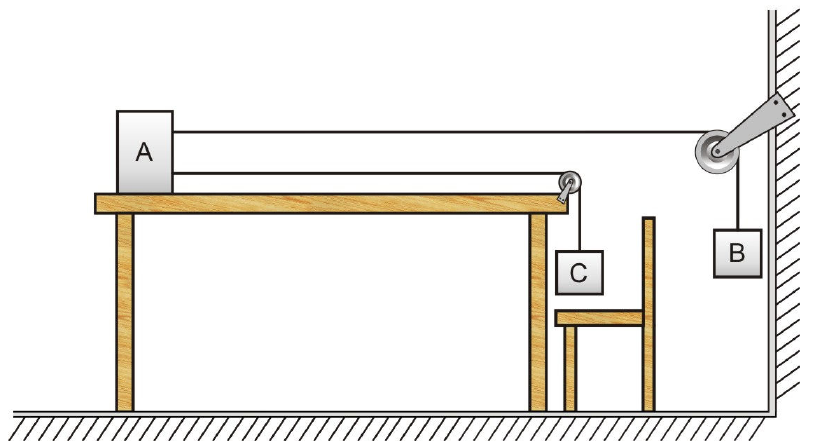
Quando o sistema é abandonado, a partir da configuração indicada na figura, o bloco A passa, então, a deslizar sobre o plano horizontal da mesa, enquanto os blocos B e C descem na vertical e a tração estabelecida no fio que liga os blocos A e B vale T_B.
Em determinado instante, o bloco C se apoia sobre uma cadeira, enquanto B continua descendo e puxando A, agora através de uma tração T'_B.
Desprezando quaisquer resistências durante o movimento dos blocos, pode-se afirmar que a razão T'_B/T_B vale
Texto-base:
Texto-base:
Texto-base:
Texto-base:
Texto-base:
Texto-base:
Texto-base:
Texto-base:
Texto-base:
Texto-base:
Texto-base:
Texto-base:
Texto-base:
Texto-base:
Texto-base:
Texto-base:
Texto-base:
Texto-base:
Texto-base:
Texto-base: