← Voltar para a lista de provas Exército Brasileiro — Escola de Formação Complementar do Exército (EsFCEx) · Oficial do Quadro Complementar do Exército 60 questões nesta prova · página 3 de 3 · 60 com gabarito Gabarito disponível 'Context' termina em grupo consonantal (-xt), o que leva à inserção de vogal final. Em 'context' /ˈkɒntekst/, a palavra termina em grupo consonantal (-kst). Como o português evita esse tipo de final, o falante tende a acrescentar um /i/ epentético (algo como 'contexti'). Isso é reforçado pela grafia, que lembra 'contexto'. A) 'number' termina em vogal reduzida /ə/ e em consoante simples, não em grupo. B) 'activity' já termina em vogal. C) 'forgiven' termina em /n/ simples. E) 'instruction' termina em /ʃn/, com som nasal final, e não nesse tipo de grupo consonantal. Referência: Fonologia contrastiva português-inglês (interferência da L1). Resolução comentada do VaiConcursos. Gabarito disponível Abordagem baseada em tarefas: a língua aprendida é a necessária para participar das tarefas. O texto diz que não há programa linguístico pré-determinado e que os alunos aprendem, a partir das tarefas, a língua de que precisam para participar delas. Logo, os itens linguísticos são tratados conforme contribuem para a participação nas tarefas comunicativas. A) O texto fala de tarefas autênticas do mundo real, não de qualquer contexto ou gênero. C) O texto não menciona ensino e avaliação juntos. D) Não há menção à prioridade da oralidade. E) O texto não diz que se evita qualquer referência a regras; diz apenas que não há programa linguístico pré-determinado. Referência: Tomlinson (ed.), Material Development in Language Teaching, 1998/2011. Resolução comentada do VaiConcursos. Gabarito disponível Tarefa autêntica em TBLT: escolher e defender um vídeo para um projeto de turma. A tarefa de TBLT tem objetivo comunicativo real, foco no significado e resultado não linguístico. Escolher e defender o vídeo preferido para um projeto da turma envolve usar a língua para decidir e argumentar, sem foco prévio em uma estrutura. A) Reproduz modelos de diálogo, prática controlada. B) Foca em explicar o uso de tempos verbais, objetivo linguístico. D) Introduz traços linguísticos, abordagem centrada na forma. E) Repetição e imitação são do método audiolingual. Referência: TOMLINSON, B. (ed.). Materials Development in Language Teaching (1998/2011) Resolução comentada do VaiConcursos. Gabarito disponível Avaliação em abordagens comunicativas/TBT. Em abordagens comunicativas, a avaliação propõe situações-problema (tarefas) cuja resolução mobiliza aprendizagens anteriores da língua, avaliando o uso da língua em contexto. A) 'Apenas' em dinâmicas em pares ou grupos é exagero. C) Evitar qualquer forma de prova não é princípio. D) Coibir a língua materna não é princípio. E) Desconsiderar erros é exagero, pois o erro é considerado de forma pedagógica. Referência: Willis & Willis; Nunan – Task-based language teaching Resolução comentada do VaiConcursos. Gabarito disponível Bilinguismo e multilinguismo e o papel do inglês globalizante. Os estudos sobre bilinguismo e multilinguismo tratam do papel do inglês e de sua expansão global (especialmente em ESL), bem como do impacto sobre as línguas locais. A) Reduz o campo a políticas contra o letramento desigual. B) Associar a 'nativismo' e insularidade é o oposto do campo. C) Não se restringem à interface entre o inglês e variedades locais. D) A proficiência nativa é justamente a visão criticada no texto. Referência: WRIGHT, BOUN, GARCÍA (eds.). Handbook of bilingual and multilingual education (2017) Resolução comentada do VaiConcursos. Gabarito disponível Gabarito disponível Professores com expectativas deficitárias controlam rigidamente o input. Expectativas deficitárias e irrealistas, como proficiência nativa e produção sem erros, levam o professor a controlar rigidamente o conteúdo linguístico para evitar estruturas desviantes. A) Desconsiderar certo e errado é perspectiva oposta à deficitária. C) Material personalizado não decorre da visão deficitária. D) Evitar correção por entender o erro como parte do aprendizado é perspectiva social. E) Trabalhar variedades diversas também contraria o ideal de falante nativo. Referência: WRIGHT, BOUN, GARCÍA (eds.). Handbook of bilingual and multilingual education (2017) Resolução comentada do VaiConcursos. Gabarito disponível Núcleo do objeto direto na frase. Em 'move away from unrealistic deficit-oriented expectations for students...', o objeto da preposição 'from' é o sintagma nominal cujo núcleo é 'expectations'. Os adjetivos 'unrealistic' e 'deficit-oriented' o modificam, e 'for students' é complemento. A) 'Unrealistic' é modificador. B) 'Deficit-oriented' é modificador. C) É o sintagma todo, não seu núcleo. E) 'Students' é núcleo do sintagma preposicional 'for students'. Referência: Gramática da língua inglesa – noun phrases Resolução comentada do VaiConcursos. Gabarito disponível Vantagem do ensino por gêneros: linguagem como se expressa na vida social. Os gêneros textuais permitem ao aluno vivenciar a linguagem em uso real, na vida social. Por isso a abordagem é relevante para o ensino de língua inglesa. A) Gêneros não têm critérios linguísticos rígidos. B) Gêneros são relativamente estáveis, e estrutura aprendida não garante compreensão correta. C) Gêneros incluem manifestações orais e escritas. E) É verdadeira, mas não explica a relevância da abordagem em termos de ensino como D. Referência: Bakhtin; Marcuschi – gêneros do discurso Resolução comentada do VaiConcursos. Gabarito disponível Escrita baseada em gêneros: representar o contexto de produção. Na abordagem por gêneros, o aluno parte do contexto: quem é o leitor, qual o objetivo e qual a esfera de circulação. Criar essa representação do contexto orienta as escolhas de linguagem do texto. A) Fixar o tipo textual é visão tipológica, não de gênero. B) Predição e inferência são estratégias de leitura. D) Selecionar estruturas e léxico por tema é abordagem gramatical. E) Distinguir tipologia e gênero é conhecimento teórico, não orientação de produção. Referência: Bakhtin; Marcuschi; Swales – ensino por gêneros Resolução comentada do VaiConcursos. Gabarito disponível Gêneros textuais adequados à sala de aula. Propaganda e manuais de instrução são gêneros textuais, com função social, suporte e estrutura reconhecíveis. Por isso são propícios ao trabalho em sala. As demais alternativas misturam gêneros com tipos textuais ou estilos. A) Twitter é plataforma e chats são ambiente, não gêneros em sentido estrito. B) Textos argumentativos são tipo textual. C) Narrativas orais e escritas são tipo textual. D) Estilo jornalístico é estilo, não gênero. Referência: Marcuschi; Bakhtin – gêneros do discurso Resolução comentada do VaiConcursos. Gabarito disponível Relação entre diferenças de estilo discursivo e ensino de língua. Os exemplos de estilos discursivos mostram que cultura e língua estão interligadas. Assim, o ensino da língua se beneficia de uma abordagem que considere padrões linguísticos interculturais. A) O texto não fala de choque cultural como consequência inevitável. C) Multilinguismo e multiletramentos não são mencionados. D) O texto não restringe o aprendizado do inglês à cultura britânica. E) Não há comparação de dificuldade de compreensão entre países. Referência: BROWN, H. D. Principles of language learning and teaching, 5th ed. Resolução comentada do VaiConcursos. Gabarito disponível Voz passiva impessoal com verbo de relato (reporting verb). 'Is said to be' é passiva impessoal formada com verbo de relato + infinitivo. Em 'has been reported to be very fearful', ocorre a mesma estrutura: o sujeito gramatical é um terceiro e o relato é impessoal. B) 'Are being classified' é passiva comum, sem verbo de relato + infinitivo. C) 'Could have been pronounced' é passiva modal comum. D) 'Have been banned... by the new governor' é passiva com agente. E) 'Have their perceptions increased' é estrutura causativa (have + objeto + particípio). Referência: Gramática da língua inglesa – impersonal passive Resolução comentada do VaiConcursos. Gabarito disponível Aprendizagem por descoberta pressupõe exploração, risco e erro. A proposta é voltada a professores que creem que os alunos aprendem explorando, correndo riscos e eventualmente errando no processo de descobrir. É o que decorre de aprender por descoberta, com orientação do professor. A) O texto não propõe abolir totalmente as aulas expositivas ('altogether' é exagero). C) Ensinar itens lexicogramaticais não é o foco, e sim como são aprendidos. D) Não se defende métodos modernos como ideais. E) O professor guia ('under our guidance'), então não assume papel secundário. Referência: HARMER, J. The practice of English language teaching, 4th ed. Resolução comentada do VaiConcursos. Gabarito disponível Os exemplos ilustram aprendizagem por descoberta e autonomia do aluno. Nos exemplos, o professor expõe os alunos aos dados (exemplos, concordância, transcrições) e os deixa descobrir por conta própria o uso. Isso mostra preocupação com a autonomia de aprendizagem dos alunos. A) Não visa a precisão de gramática e vocabulário, e sim a descoberta. B) Não se trata de levantar necessidades dos alunos. C) A tecnologia aparece só em um dos exemplos. D) Não se trata de novidades metodológicas, e sim de aprendizagem por descoberta. Referência: HARMER, J. The practice of English language teaching, 4th ed. Resolução comentada do VaiConcursos. Gabarito disponível Gabarito disponível Ensino de inglês como língua franca prioriza inteligibilidade. Na perspectiva do inglês como língua franca, o objetivo é a comunicação eficaz entre falantes de diferentes línguas maternas. Por isso o ensino privilegia a inteligibilidade, e não a imitação do falante nativo. A) Não se restringe à oralidade. B) A insistência em correção normativa contraria a ideia de língua franca, e a gramática não é universal. C) Escolher uma variedade qualquer não é critério pedagógico. E) Restringir à variedade local limita a exposição à diversidade que o inglês como língua franca exige. Referência: HARMER, J. The practice of English language teaching (2007); Jenkins (ELF) Resolução comentada do VaiConcursos. Gabarito disponível Estratégia compensatória de Oxford: inferir significados. As estratégias compensatórias ajudam o aprendiz a suprir conhecimento que falta. Ao ler um texto autêntico, inferir significados (por contexto, por exemplo) é a estratégia típica desse grupo. A) Identificar o gênero é estratégia de apoio à compreensão, não compensa falta de conhecimento. B) Scanning é técnica de leitura. C) A leitura crítica é uma estratégia cognitiva ou avaliativa. E) Previewing é estratégia de organização ou planejamento prévio da leitura. Referência: OXFORD (1990); Oxford & Ehrman (1995) Resolução comentada do VaiConcursos. Gabarito disponível Gabarito disponível Multiletramentos: valorização das culturas do aluno e ampliação do repertório. Pela perspectiva de Rojo, o trabalho com multiletramentos parte das culturas e textos de referência dos alunos, valorizando-os, e os leva a outros letramentos que ampliem seu repertório. Isso responde à multiplicidade cultural e semiótica citada no texto. A) Não se trata de abandonar as produções letradas tradicionais. B) Restringir-se às manifestações urbanas do século XXI contraria a ideia de multiplicidade. C) Oferecer apenas o que difere do cotidiano do aluno ignora o ponto de partida do aluno. E) A diferença em relação a letramentos está na multiplicidade cultural e semiótica, não na introdução de variedades orais. Referência: ROJO, R.; MOURA, E. Multiletramentos na escola (2012) Resolução comentada do VaiConcursos.EsFCEx — Concurso de Admissão 2021 — Oficial do Quadro Complementar do Exército — Área: Magistério Inglês — 010. Prova Objetiva — Versão A
Resolução comentada
Análise das alternativas
Leia o texto para responder às questões de números 42 e 43.
Task-based approaches refer to materials or courses which are designed around a series of authentic tasks which give the learners experience of using the language in ways in which it is used in the ‘real world’ outside the classroom. They usually have no pre-determined language syllabus and the aim is for learners to learn from the tasks the language that they need for successful participation in them.
(TOMLINSON, B. (ed). Material Development in Language Teaching. Cambridge: CUP. 1998/2011. p. xvi Adaptado)
From the excerpt it is correct to state that task-based language teaching coursesResolução comentada
Análise das alternativas
Leia o texto para responder às questões de números 42 e 43.
Task-based approaches refer to materials or courses which are designed around a series of authentic tasks which give the learners experience of using the language in ways in which it is used in the ‘real world’ outside the classroom. They usually have no pre-determined language syllabus and the aim is for learners to learn from the tasks the language that they need for successful participation in them.
(TOMLINSON, B. (ed). Material Development in Language Teaching. Cambridge: CUP. 1998/2011. p. xvi Adaptado)
Mark the alternative which exemplifies a learning task following principles in the frame of task-based language teaching.Resolução comentada
Análise das alternativas
Resolução comentada
Análise das alternativas
Leia o texto para responder às questões de números 45 a 48.
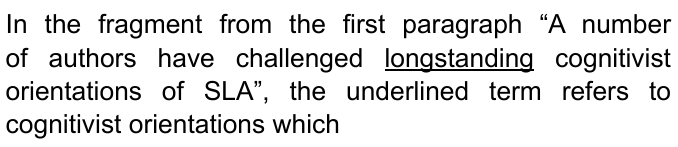
Bilingual and multilingual education, along with other language education fields, has been strongly influenced by theories from the field of second language acquisition (SLA). A number of authors have challenged longstanding cognitivist orientations of SLA that focus on language as an individual process with the goal of linear progress in acquiring a grammatical system and language proficiency equivalent to that of a “native speaker.”
Two important shifts that have resulted from the “social turn” in SLA research: changing perspectives on language, and changing theoretical positions in SLA. These socially oriented shifts move away from unrealistic deficit-oriented expectations for students such as “native-like proficiency,” error-free production, or becoming balanced bilinguals (i.e., two fully proficient monolinguals in one). Instead, the authors argue for a sociocultural view of SLA as a process “leading to repertoires or linguistic resources termed multi-competence or plurilingualism.” This in turn has the “potential of informing and enriching the design of classroom environments where students would be able to experience multiple ways of using both their home language and English for a variety of academic purposes in both their written and oral forms.”
(WRIGHT, W. E.; BOUN, S.; GARCÍA, O.(eds) The Handbook of bilingual and multilingual education. Oxford: WileyBlackwell. 2017. p. 4. Adaptado)
Multilingualism and bilingualismResolução comentada
Análise das alternativas
Leia o texto para responder às questões de números 45 a 48.
Bilingual and multilingual education, along with other language education fields, has been strongly influenced by theories from the field of second language acquisition (SLA). A number of authors have challenged longstanding cognitivist orientations of SLA that focus on language as an individual process with the goal of linear progress in acquiring a grammatical system and language proficiency equivalent to that of a “native speaker.”
Two important shifts that have resulted from the “social turn” in SLA research: changing perspectives on language, and changing theoretical positions in SLA. These socially oriented shifts move away from unrealistic deficit-oriented expectations for students such as “native-like proficiency,” error-free production, or becoming balanced bilinguals (i.e., two fully proficient monolinguals in one). Instead, the authors argue for a sociocultural view of SLA as a process “leading to repertoires or linguistic resources termed multi-competence or plurilingualism.” This in turn has the “potential of informing and enriching the design of classroom environments where students would be able to experience multiple ways of using both their home language and English for a variety of academic purposes in both their written and oral forms.”
(WRIGHT, W. E.; BOUN, S.; GARCÍA, O.(eds) The Handbook of bilingual and multilingual education. Oxford: WileyBlackwell. 2017. p. 4. Adaptado)
Leia o texto para responder às questões de números 45 a 48.
Bilingual and multilingual education, along with other language education fields, has been strongly influenced by theories from the field of second language acquisition (SLA). A number of authors have challenged longstanding cognitivist orientations of SLA that focus on language as an individual process with the goal of linear progress in acquiring a grammatical system and language proficiency equivalent to that of a “native speaker.”
Two important shifts that have resulted from the “social turn” in SLA research: changing perspectives on language, and changing theoretical positions in SLA. These socially oriented shifts move away from unrealistic deficit-oriented expectations for students such as “native-like proficiency,” error-free production, or becoming balanced bilinguals (i.e., two fully proficient monolinguals in one). Instead, the authors argue for a sociocultural view of SLA as a process “leading to repertoires or linguistic resources termed multi-competence or plurilingualism.” This in turn has the “potential of informing and enriching the design of classroom environments where students would be able to experience multiple ways of using both their home language and English for a variety of academic purposes in both their written and oral forms.”
(WRIGHT, W. E.; BOUN, S.; GARCÍA, O.(eds) The Handbook of bilingual and multilingual education. Oxford: WileyBlackwell. 2017. p. 4. Adaptado)
Teachers with “unrealistic deficit-oriented expectations” towards their students will tend toResolução comentada
Análise das alternativas
Leia o texto para responder às questões de números 45 a 48.
Bilingual and multilingual education, along with other language education fields, has been strongly influenced by theories from the field of second language acquisition (SLA). A number of authors have challenged longstanding cognitivist orientations of SLA that focus on language as an individual process with the goal of linear progress in acquiring a grammatical system and language proficiency equivalent to that of a “native speaker.”
Two important shifts that have resulted from the “social turn” in SLA research: changing perspectives on language, and changing theoretical positions in SLA. These socially oriented shifts move away from unrealistic deficit-oriented expectations for students such as “native-like proficiency,” error-free production, or becoming balanced bilinguals (i.e., two fully proficient monolinguals in one). Instead, the authors argue for a sociocultural view of SLA as a process “leading to repertoires or linguistic resources termed multi-competence or plurilingualism.” This in turn has the “potential of informing and enriching the design of classroom environments where students would be able to experience multiple ways of using both their home language and English for a variety of academic purposes in both their written and oral forms.”
(WRIGHT, W. E.; BOUN, S.; GARCÍA, O.(eds) The Handbook of bilingual and multilingual education. Oxford: WileyBlackwell. 2017. p. 4. Adaptado)
É o núcleo do objeto na frase do segundo parágrafo “These socially oriented shifts move away from unrealistic deficit-oriented expectations for students such as “native-like proficiency,” error-free production, or becoming balanced bilinguals”:Resolução comentada
Análise das alternativas
Resolução comentada
Análise das alternativas
Resolução comentada
Análise das alternativas
Resolução comentada
Análise das alternativas
Leia o texto para responder às questões de números 52 e 53.
Culture is really an integral part of the interaction between language and thought. Cultural patterns of cognition and customs are sometimes explicitly coded in language. Conversational discourse styles, for example, may be a factor of culture. Consider the “directness” of discourse of some cultures: in the United States, for example, casual conversation is said to be less frank and more concerned about face-saving than conversation in Greece, and therefore a Greek conversation may be more confrontational than a conversation in the United States, In Japanese, the relationsltip of one’s interlocutor is almost always expressed explicitly, either verbally and/or non-verbally. Perhaps those forms shape one’s perception of others in relation to self.
(Douglas Brown. Principles of language learning and teaching. 5th ed. Longman, 2000. P. 211. Adaptado)
The examples in the text about conversational discourse styles mean thatResolução comentada
Análise das alternativas
Leia o texto para responder às questões de números 52 e 53.
Culture is really an integral part of the interaction between language and thought. Cultural patterns of cognition and customs are sometimes explicitly coded in language. Conversational discourse styles, for example, may be a factor of culture. Consider the “directness” of discourse of some cultures: in the United States, for example, casual conversation is said to be less frank and more concerned about face-saving than conversation in Greece, and therefore a Greek conversation may be more confrontational than a conversation in the United States, In Japanese, the relationsltip of one’s interlocutor is almost always expressed explicitly, either verbally and/or non-verbally. Perhaps those forms shape one’s perception of others in relation to self.
(Douglas Brown. Principles of language learning and teaching. 5th ed. Longman, 2000. P. 211. Adaptado)
Note the use of the passive in “Casual conversation is said to be less frank than conversation in Greece”. Another correct use of an impersonal passive is found in alternativeResolução comentada
Análise das alternativas
Leia o texto para responder às questões de números 54 e 55.
One school of thought which is widely accepted by many language teachers is that the development of our conceptual understanding and cognitive skills is a main objective of all education. Such conceptual understanding is arrived at not through ‘blind learning’, but through a process of discovery which leads to genuine understanding (Lewis 1986: 165). The things we learn for ourselves are absorbed more effectively than things we are taught.
The practical implications of this view are quite clear: instead of explicitly teaching the present perfect tense, for instance, we will expose students to examples of it and then allow them, under our guidance, to work out for themselves how it is used. Instead of telling students which words collocate with crime, we can get them to look at a computer concordance of the word and discover the collocations on their own. Instead of telling them about spoken grammar we can get them to look at transcripts and come to their own conclusions about how it differs from written grammar. What we are doing, effectively, is to provoke ‘noticing for the learner’.
(HARMER, Jeremy. The practice of English language teaching. 4th ed. Longman, 2007. pp. 72-73. Adaptado)
A proposal such as the one pictured in the excerpt is directed to teachers who believe thatResolução comentada
Análise das alternativas
Leia o texto para responder às questões de números 54 e 55.
One school of thought which is widely accepted by many language teachers is that the development of our conceptual understanding and cognitive skills is a main objective of all education. Such conceptual understanding is arrived at not through ‘blind learning’, but through a process of discovery which leads to genuine understanding (Lewis 1986: 165). The things we learn for ourselves are absorbed more effectively than things we are taught.
The practical implications of this view are quite clear: instead of explicitly teaching the present perfect tense, for instance, we will expose students to examples of it and then allow them, under our guidance, to work out for themselves how it is used. Instead of telling students which words collocate with crime, we can get them to look at a computer concordance of the word and discover the collocations on their own. Instead of telling them about spoken grammar we can get them to look at transcripts and come to their own conclusions about how it differs from written grammar. What we are doing, effectively, is to provoke ‘noticing for the learner’.
(HARMER, Jeremy. The practice of English language teaching. 4th ed. Longman, 2007. pp. 72-73. Adaptado)
The examples provided in the second paragraph illustrate a teacher very much concerned withResolução comentada
Análise das alternativas
Leia o texto para responder à questão.
Although English is not the language with the largest number of native or ‘first’ language speakers, it has become a lingua franca. A lingua franca can be defined as a language widely adopted for communication between two speakers whose native languages are different from each other’s and where one or both speakers are using it as a ‘second’ language.
(HARMER, Jeremy. The practice of English language teaching. 4th ed. Longman, 2007. p.1. Adaptado)
No que concerne ao ensino da língua Inglesa, crescem os desafios para priorizar seu status como lingua franca, especialmente quando questões de política educacional linguística estão envolvidas. Assim, o ensino de inglês como língua franca ou língua internacional implicaResolução comentada
Análise das alternativas
Leia o texto para responder às questões de números 58 e 59.
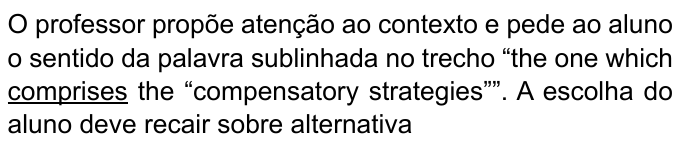
L2 learning strategies are specific behaviors or thought processes that students use to enhance their own L2 learning. One of the six major groups of L2 learning strategies identified by Oxford (1990) is the one which comprises the “compensatory strategies”, that is, strategies that help the learner make up for missing knowledge. Each instance of L2 use is an opportunity for more L2 learning. Oxford and Ehrman (1995) demonstrated that compensatory strategies are significantly related to L2 proficiency in their study of native-English-speaking learners of foreign languages.
(Oxford, Rebecca: Language Learning Styles and Strategies, In IN: Marianne Celce-Murcia. Teaching English as a second or foreign language. Boston, Massachusstes: Heinle&Heinle. 3rd edition. 2002. pp. 362;364. Adaptado
An activity aimed at developing the learners’ ability to read an authentic English text may require from the students the use of the following compensatory strategy:Resolução comentada
Análise das alternativas
Leia o texto para responder às questões de números 58 e 59.
L2 learning strategies are specific behaviors or thought processes that students use to enhance their own L2 learning. One of the six major groups of L2 learning strategies identified by Oxford (1990) is the one which comprises the “compensatory strategies”, that is, strategies that help the learner make up for missing knowledge. Each instance of L2 use is an opportunity for more L2 learning. Oxford and Ehrman (1995) demonstrated that compensatory strategies are significantly related to L2 proficiency in their study of native-English-speaking learners of foreign languages.
(Oxford, Rebecca: Language Learning Styles and Strategies, In IN: Marianne Celce-Murcia. Teaching English as a second or foreign language. Boston, Massachusstes: Heinle&Heinle. 3rd edition. 2002. pp. 362;364. Adaptado
Leia o texto para responder à questão.
Diferentemente do conceito de letramentos (múltiplos), que não faz senão apontar para a multiplicidade e variedade das práticas letradas, valorizadas ou não nas sociedades em geral, o conceito de multiletramentos aponta para dois tipos específicos e importantes de multiplicidade presentes em nossas sociedades, principalmente urbanas, na contemporaneidade: a multiplicidade cultural das populações e a multiplicidade semiótica de constituição dos textos por meio dos quais ela se informa e se comunica.
(ROJO, R.; MOURA, E. (orgs). Multiletramentos na escola. São Paulo: Parábola. 2012. p.13. Adaptado)
O trabalho com multiletramentos na escolaResolução comentada
Análise das alternativas
Indique a palavra em língua inglesa à qual o falante brasileiro, por influência da soletração e do fato de que palavras em português não tendem a terminar em grupos consonantais, poderá erroneamente adicionar uma vogal final:
Texto-base:
Texto-base:
Avaliações em cursos que seguem abordagens comunicativas para o ensino da Língua Inglesa, dentre as quais TBT (task-based teaching), buscam:
Texto-base:
Texto-base:
Texto-base:
Texto-base:
O tema gêneros textuais tem ocupado uma posição especial na discussão sobre ensino-aprendizagem de línguas, tanto materna quanto estrangeira. Nesse sentido, a abordagem de ensino de Língua Inglesa por meio de gêneros textuais tem se mostrado relevante, uma vez que
Uma proposta de ensino da habilidade da escrita baseada em gêneros deverá orientar o aluno a
São exemplos de gêneros textuais propícios ao trabalho em sala de aula:
Texto-base:
Texto-base:
Texto-base:
Texto-base:
Collocation is the way in which words co-occur – combinations which, through custom and practice, have come to be seen as normal and acceptable. An acceptable collocation in the English language is being correctly used in alternative
Texto-base:
Texto-base:
Texto-base:
Texto-base: