← Voltar para a lista de provas Comando da Aeronáutica · Exame de Admissão aos CFOAV, CFOINT e CFOINF 2022 65 questões nesta prova · página 1 de 4 · 63 com gabarito Gabarito disponível O título mais adequado é 'Should You Do What Everyone Else Is Doing?'. O texto discute por que as pessoas seguem a multidão e quando isso é bom ou ruim. Ele orienta o leitor a avaliar se deve ou não fazer o que todos fazem, e o título C resume isso. A) Errada: o texto não trata de trabalho nem apresenta uma lista de cinco dicas. B) Errada: o texto não defende que decidir seja simples. D) Errada: não há menção a máquinas ou recomendações automatizadas. Referência: Interpretação de texto: ideia central e título. Resolução comentada do VaiConcursos. Gabarito disponível Sujeito singular + 'for a long time' pede Present Perfect passivo singular: 'has been studied'. O sujeito 'The phenomenon of looking to others and following the crowd' é tratado como um só fenômeno (singular). A expressão 'for a long time' pede Present Perfect, e a ideia é passiva ('by social science'), logo 'has been studied'. A) Errada: 'have' exigiria sujeito plural. C) Errada: 'has studied' está na voz ativa, mas o agente 'by social science' exige a passiva. D) Errada: o presente simples passivo não combina com 'for a long time'. Referência: Present Perfect passive; concordância sujeito-verbo. Resolução comentada do VaiConcursos. Gabarito disponível Experimentos antigos mostraram que indivíduos cercados por outros podem ser levados a dar resposta errada. No experimento de Asch (1955), os participantes, cercados por pessoas que davam a resposta errada, muitas vezes se conformaram e erraram também. Isso corresponde à alternativa A. B) Errada: Sherif mostrou que, na incerteza, as pessoas são influenciadas pela opinião dos outros, não por crenças pessoais. C) Errada: o Efeito Autocinético é uma ilusão de movimento, não uma melhora de percepção. D) Errada: os experimentos mostraram a influência levando ao erro, não a decisões corretas. Referência: Texto, parágrafos 3 e 4 (Sherif, 1937; Asch, 1955). Resolução comentada do VaiConcursos. Gabarito disponível As pesquisas recentes indicam que as pessoas mudam crenças ou comportamento para se encaixar no grupo. O texto diz que, segundo pesquisas mais recentes, as influências sociais podem alterar percepções e memórias, e que os 'herding brains' nos fazem sentir bem ao seguir a multidão. Isso corresponde a mudar crenças ou comportamento para se encaixar no grupo. A) Errada: o texto não trata de controle sobre as escolhas e preferências. B) Errada: o seguimento da multidão ocorre mesmo quando se vê que os outros erram. D) Errada: o texto diz que as pessoas não escolhem conscientemente o erro apenas para se conformar; a influência altera o que elas veem como correto. Referência: Texto, parágrafo 4 (Edelson et al., 2011; Shamay-Tsoory et al., 2019). Resolução comentada do VaiConcursos. Gabarito disponível 'Even' em 'even when they can clearly see' é usado como ênfase ou surpresa. No trecho, 'even when' introduz uma situação inesperada: as pessoas seguem a multidão mesmo quando veem claramente que os outros estão errados. O advérbio 'even' tem função enfática, de surpresa ou contraste. B) Errada: 'even' não equivale a 'just' (apenas). C) Errada: a palavra não expressa ideia negativa em si. D) Errada: 'exactly' seria outro sentido, não se aplica aqui. Referência: Advérbios de ênfase em inglês (even); interpretação de texto. Resolução comentada do VaiConcursos. Gabarito disponível Estão corretas I e II; III contradiz o texto. I: o texto recomenda processos de pensamento mais deliberados em vez da reação inicial. II: sob emergência, como a saída mais próxima, seguir os outros pode ser válido. III está errada: o texto diz que ser levado pelos outros costuma ser um processo emocional e impensado, não racional. Por isso B, C e D, que incluem III, estão incorretas. Referência: Reading comprehension: verdadeiro ou falso. Resolução comentada do VaiConcursos. Gabarito disponível A ideia recorrente é que seguir a multidão tem prós e contras. O texto mostra que seguir o grupo pode ser mera pressão que cega ("peer pressure") e que também pode levar a decisões melhores e comportamentos pró-sociais. Daí a ideia de prós e contras. A) O texto diz que talvez sejamos programados assim, sem resposta definitiva. B) Conformar-se não reduz o impacto social. C) O texto não afirma que ir por conta própria leva a más decisões. Referência: Reading comprehension: ideia central. Resolução comentada do VaiConcursos. Gabarito disponível O parágrafo 9 trata de decisões individuais versus sociais, ou seja, do equilíbrio entre o bem próprio e o dos outros. O parágrafo 9 ("Some choices ... are more individual, while others are more social") pede que se avalie se a escolha é individual ou envolve outros. Isso corresponde a equilibrar o que é melhor para si e para os outros. A) Generaliza que seguir os outros afasta do caminho certo, o que o texto não diz. B) Recompensas imediatas não são tema do parágrafo. C) O parágrafo não afirma que decisões individuais beneficiam o grupo. Referência: Reading comprehension: ideia do parágrafo. Resolução comentada do VaiConcursos. Gabarito disponível "Therefore" (portanto) equivale a "thus". Ambos introduzem uma consequência ou conclusão: "portanto" e "assim". A) Nevertheless e B) however indicam contraste. D) Furthermore indica adição. Referência: Conectivos: relações de sentido. Resolução comentada do VaiConcursos. Gabarito disponível Fatos objetivos e dados não levam as pessoas a seguir a multidão; eles ajudam a decidir com independência. O texto diz que seguimos os outros quando há incerteza, ambiguidade e falta de informação. Mais dados objetivos reduzem esse efeito, por isso D é a exceção. A) Situações ambíguas aumentam a influência do grupo (Sherif). B) A pressão do grupo faz com que as pessoas se conformem (Asch). C) A influência social pode alterar percepção e memória. Referência: Reading comprehension: EXCEPT. Resolução comentada do VaiConcursos. Gabarito disponível "Unless" (a menos que) introduz uma condição. "Unless you are in an emergency situation..." expressa condição negativa: a menos que haja emergência, convém pensar com calma. Por isso a B é a correta. A) "From a perceptual standpoint" indica ponto de vista. C) "Rather than" indica preferência ou contraste. D) "Furthermore" indica adição. Referência: Conectivos e orações condicionais. Resolução comentada do VaiConcursos. Gabarito disponível A alternativa D traz uma pergunta indireta, pois a pergunta "why..." está embutida em "Could you explain...". Pergunta indireta é aquela inserida em outra frase, com ordem de afirmação (sujeito + verbo). Em "Could you explain why we are so compelled...", a oração "why we are..." mantém a ordem direta e vem embutida em "Could you explain". A) É uma afirmação, sem pergunta. B) É uma pergunta direta (inversão sujeito/verbo). C) É uma afirmação com oração relativa ("who"), que não é pergunta. Referência: Indirect questions. Resolução comentada do VaiConcursos. Gabarito disponível "Get along" significa ter relacionamento harmonioso e amigável. Em "helps people get along", o phrasal verb indica que as pessoas se relacionam bem, em harmonia. A) Look to é recorrer a ou olhar para. C) Look beyond é ir além ou desconsiderar. D) Figure out é descobrir ou entender. Referência: Phrasal verbs. Resolução comentada do VaiConcursos. Gabarito disponível Down-side significa aspecto negativo, sinônimo de disadvantage. "Down-sides to choices" são as desvantagens ou pontos negativos de uma escolha. O sinônimo mais próximo é "disadvantage". A) Disruption é interrupção ou perturbação. B) Discomfort é desconforto. D) Dislocation é deslocamento. Nenhuma delas significa "aspecto negativo" de uma escolha. Referência: Vocabulário em contexto. Resolução comentada do VaiConcursos. Gabarito disponível O último parágrafo recomenda buscar opiniões diferentes e conhecer os pontos negativos das escolhas, ou seja, abrir-se ao que não queremos ver. O parágrafo diz que se pode aprender com quem faz escolhas contrárias às nossas e ver "down-sides" que não notaríamos. Sugere também procurar pessoas com opiniões diferentes. Isso equivale a manter-se aberto a fatos e possibilidades de que não gostamos. B) Autoconhecimento não é discutido. C) Aceitar algo como "verdade" automaticamente aparece em outro trecho, não no último parágrafo. D) O texto não diz que é impossível reunir todos os fatos. Referência: Reading comprehension: ideia do último parágrafo. Resolução comentada do VaiConcursos. Gabarito disponível O texto é informativo e de caráter orientador. O texto apresenta pesquisas de psicologia social e, ao final, dá dicas práticas para decidir se vale seguir a multidão. Isso o torna informativo e de apoio ao leitor (supportive). A) Não é pessoal nem informal: o tom é expositivo e baseado em estudos. C) Não há ironia nem tom de lembrança pessoal. D) Não é lírico nem sublime: a linguagem é objetiva e científica. Referência: Tipologia e propósito textual (reading comprehension). Resolução comentada do VaiConcursos. Gabarito disponível Gabarito disponível Gabarito disponível Gabarito disponívelComando da Aeronáutica — Exames de Admissão aos CFOAV, CFOINT e CFOINF 2022 — Língua Inglesa, Física, Língua Portuguesa, Matemática e Redação — Versão A
Directions: Answer questions 01 to 16 according to the text.
TEXT
When making a decision, it is a common impulse
to look and see what others are doing. Nevertheless, it is
often unclear whether the path that everyone else may
be following is good for us as well. After all, sometimes
5 following the crowd has merit - at other times, it is simply
peer pressure blinding us.
The phenomenon of looking to others and
following the crowd _______ by social science for a long
time. Nevertheless, those findings do not always make
10 their way to individual decision-makers. Therefore, let’s
review why people conform to the crowd – and under
what conditions it is a god idea to go your own way
instead.
To start, individuals tend to look to the opinions of
15 others, especially when they are unsure and lack
information from other sources. This dynamic was
supported by classic research from Sherif (1937), who
explored how a person’s perception of a very ambiguous
stimuli can be influenced by the opinion of others. Sherif
20 (1937) asked participants to watch a small light in a dark
and featureless room and evaluate how much that light
moved around. In actuality, however, the light never
moved at all – but the way our perception works in that
situation gives the possible illusion of movement (called
25 the Autokinetic Effect). In this uncertain and ambiguous
perceptual situation, Sherif (1937) found that individuals
were quite susceptible to the influence of the opinions of
others when trying to decide how much light was
“moving”.
30 Unfortunately, this phenomenon also extends to
individuals following the crowd, even when they can
clearly see that others are wrong. This was first
evaluated by Asch (1955), who asked participants to
pick a line from a few choices of varying lengths that
35 matched up with another example line given to them.
From a perceptual standpoint, the task was easy – as
the correct choice of which lines were actually similar to
one another was clear. Nevertheless, when participants
were surrounded by other individuals giving the wrong
40 answer, they often conformed and made the wrong
choice as well. Thus, even when the correct choice is
clear, and what others are doing is wrong, that peer
pressure can still cause us to doubt ourselves and follow
the crowd.
45 Why is it that we are so compelled to follow the
crowd, even when it is objectively clear that they are
wrong? According to more recent research, we may
simply be wired that way. Specifically, these social
influences can actually change our perceptions and
50 memories (Edelson, Sharot, Dolan, & Dudai, 2011).
Therefore, rather than knowingly making the wrong
choice just to conform to peer pressure, the influence of
others may actually change what we see as the correct
choice in the moment and remember as the right thing
55 after the fact. Beyond that, we might just have “herding
brains” with built-in components that monitor our social
alignments and make us feel good when we follow the
crowd too (Shamay-Tsoory, Saporta, Marton-Alper, &
Gvirts, 2019).
60 Fortunately, this effect has good points as well. In
many cases, group decision-making can help individuals
look beyond their own private perspectives and make
more rational decisions (Fahr & Irlenbusch, 2011).
Furthermore, pro-social and altruistic behaviors can be
65 influenced and shared through such conformity as well
(Nook, Ong, Morelli, Mitchell, & Zaki, 2016). Therefore,
sometimes following the crowd helps people get along
and make better decisions too.
Given the above, when making a decision, it is
70 important to consider whether following others is a good
idea – or is leading you astray instead. Some simple
steps can help you figure it out.
Getting swept away by what everyone else is
doing is often an emotional and thoughtless process. We
75 are conforming simply because we have not given
sufficient attention and effort toward considering any
other options. Therefore, unless you are in an
emergency situation and need to immediately follow
everyone else toward the nearest exit, it might be a good
80 idea to switch to more deliberate thinking processes,
rather than just going with your initial reaction.
Some choices and decision-making situations
are more individual, while others are more social.
Therefore, it is important to consider the specific
85 situation. Is this an individual choice, or does it involve
others? If you have sufficient information to make a clear
choice on your own, and you do not need group
approval, then you might want to make up your own
mind. If you are personally unsure, or you need the
90 support of others to make something happen, then
taking the opinion of others into consideration might be a
good idea instead.
It is generally a good idea to evaluate your
choices and decisions from multiple perspectives. The
95 same is true for following the opinion of others too.
Although it might not feel that way at times, especially in
the modern day of media coverage and social
networking, everyone is not doing it – whatever “it” is
that you are considering. Given that, before you follow
100 the advice or choices of any particular group of people, it
might be a good idea to look at what other groups of
people are doing or choosing too. In addition, we can
learn a lot from people making choices contrary to
ourselves or our preferred group, particularly about
105 potential down-sides to choices we might not be seeing.
Therefore, if you do need to look to others to help
provide information regarding a particular choice or
decision, then it might help to seek out people with a few
different opinions, weigh your options among them, and
110 figure out what will work best for you.
(Adapted from https://www.psychologytoday.com. Access on March 25th, 2021)
Mark the option that makes an appropriate title for the text.Resolução comentada
Análise das alternativas
Directions: Answer questions 01 to 16 according to the text.
TEXT
When making a decision, it is a common impulse
to look and see what others are doing. Nevertheless, it is
often unclear whether the path that everyone else may
be following is good for us as well. After all, sometimes
5 following the crowd has merit - at other times, it is simply
peer pressure blinding us.
The phenomenon of looking to others and
following the crowd _______ by social science for a long
time. Nevertheless, those findings do not always make
10 their way to individual decision-makers. Therefore, let’s
review why people conform to the crowd – and under
what conditions it is a god idea to go your own way
instead.
To start, individuals tend to look to the opinions of
15 others, especially when they are unsure and lack
information from other sources. This dynamic was
supported by classic research from Sherif (1937), who
explored how a person’s perception of a very ambiguous
stimuli can be influenced by the opinion of others. Sherif
20 (1937) asked participants to watch a small light in a dark
and featureless room and evaluate how much that light
moved around. In actuality, however, the light never
moved at all – but the way our perception works in that
situation gives the possible illusion of movement (called
25 the Autokinetic Effect). In this uncertain and ambiguous
perceptual situation, Sherif (1937) found that individuals
were quite susceptible to the influence of the opinions of
others when trying to decide how much light was
“moving”.
30 Unfortunately, this phenomenon also extends to
individuals following the crowd, even when they can
clearly see that others are wrong. This was first
evaluated by Asch (1955), who asked participants to
pick a line from a few choices of varying lengths that
35 matched up with another example line given to them.
From a perceptual standpoint, the task was easy – as
the correct choice of which lines were actually similar to
one another was clear. Nevertheless, when participants
were surrounded by other individuals giving the wrong
40 answer, they often conformed and made the wrong
choice as well. Thus, even when the correct choice is
clear, and what others are doing is wrong, that peer
pressure can still cause us to doubt ourselves and follow
the crowd.
45 Why is it that we are so compelled to follow the
crowd, even when it is objectively clear that they are
wrong? According to more recent research, we may
simply be wired that way. Specifically, these social
influences can actually change our perceptions and
50 memories (Edelson, Sharot, Dolan, & Dudai, 2011).
Therefore, rather than knowingly making the wrong
choice just to conform to peer pressure, the influence of
others may actually change what we see as the correct
choice in the moment and remember as the right thing
55 after the fact. Beyond that, we might just have “herding
brains” with built-in components that monitor our social
alignments and make us feel good when we follow the
crowd too (Shamay-Tsoory, Saporta, Marton-Alper, &
Gvirts, 2019).
60 Fortunately, this effect has good points as well. In
many cases, group decision-making can help individuals
look beyond their own private perspectives and make
more rational decisions (Fahr & Irlenbusch, 2011).
Furthermore, pro-social and altruistic behaviors can be
65 influenced and shared through such conformity as well
(Nook, Ong, Morelli, Mitchell, & Zaki, 2016). Therefore,
sometimes following the crowd helps people get along
and make better decisions too.
Given the above, when making a decision, it is
70 important to consider whether following others is a good
idea – or is leading you astray instead. Some simple
steps can help you figure it out.
Getting swept away by what everyone else is
doing is often an emotional and thoughtless process. We
75 are conforming simply because we have not given
sufficient attention and effort toward considering any
other options. Therefore, unless you are in an
emergency situation and need to immediately follow
everyone else toward the nearest exit, it might be a good
80 idea to switch to more deliberate thinking processes,
rather than just going with your initial reaction.
Some choices and decision-making situations
are more individual, while others are more social.
Therefore, it is important to consider the specific
85 situation. Is this an individual choice, or does it involve
others? If you have sufficient information to make a clear
choice on your own, and you do not need group
approval, then you might want to make up your own
mind. If you are personally unsure, or you need the
90 support of others to make something happen, then
taking the opinion of others into consideration might be a
good idea instead.
It is generally a good idea to evaluate your
choices and decisions from multiple perspectives. The
95 same is true for following the opinion of others too.
Although it might not feel that way at times, especially in
the modern day of media coverage and social
networking, everyone is not doing it – whatever “it” is
that you are considering. Given that, before you follow
100 the advice or choices of any particular group of people, it
might be a good idea to look at what other groups of
people are doing or choosing too. In addition, we can
learn a lot from people making choices contrary to
ourselves or our preferred group, particularly about
105 potential down-sides to choices we might not be seeing.
Therefore, if you do need to look to others to help
provide information regarding a particular choice or
decision, then it might help to seek out people with a few
different opinions, weigh your options among them, and
110 figure out what will work best for you.
(Adapted from https://www.psychologytoday.com. Access on March 25th, 2021)
In paragraph 2, the option that fits the gap appropriately in standard language isResolução comentada
Análise das alternativas
Directions: Answer questions 01 to 16 according to the text.
TEXT
When making a decision, it is a common impulse
to look and see what others are doing. Nevertheless, it is
often unclear whether the path that everyone else may
be following is good for us as well. After all, sometimes
5 following the crowd has merit - at other times, it is simply
peer pressure blinding us.
The phenomenon of looking to others and
following the crowd _______ by social science for a long
time. Nevertheless, those findings do not always make
10 their way to individual decision-makers. Therefore, let’s
review why people conform to the crowd – and under
what conditions it is a god idea to go your own way
instead.
To start, individuals tend to look to the opinions of
15 others, especially when they are unsure and lack
information from other sources. This dynamic was
supported by classic research from Sherif (1937), who
explored how a person’s perception of a very ambiguous
stimuli can be influenced by the opinion of others. Sherif
20 (1937) asked participants to watch a small light in a dark
and featureless room and evaluate how much that light
moved around. In actuality, however, the light never
moved at all – but the way our perception works in that
situation gives the possible illusion of movement (called
25 the Autokinetic Effect). In this uncertain and ambiguous
perceptual situation, Sherif (1937) found that individuals
were quite susceptible to the influence of the opinions of
others when trying to decide how much light was
“moving”.
30 Unfortunately, this phenomenon also extends to
individuals following the crowd, even when they can
clearly see that others are wrong. This was first
evaluated by Asch (1955), who asked participants to
pick a line from a few choices of varying lengths that
35 matched up with another example line given to them.
From a perceptual standpoint, the task was easy – as
the correct choice of which lines were actually similar to
one another was clear. Nevertheless, when participants
were surrounded by other individuals giving the wrong
40 answer, they often conformed and made the wrong
choice as well. Thus, even when the correct choice is
clear, and what others are doing is wrong, that peer
pressure can still cause us to doubt ourselves and follow
the crowd.
45 Why is it that we are so compelled to follow the
crowd, even when it is objectively clear that they are
wrong? According to more recent research, we may
simply be wired that way. Specifically, these social
influences can actually change our perceptions and
50 memories (Edelson, Sharot, Dolan, & Dudai, 2011).
Therefore, rather than knowingly making the wrong
choice just to conform to peer pressure, the influence of
others may actually change what we see as the correct
choice in the moment and remember as the right thing
55 after the fact. Beyond that, we might just have “herding
brains” with built-in components that monitor our social
alignments and make us feel good when we follow the
crowd too (Shamay-Tsoory, Saporta, Marton-Alper, &
Gvirts, 2019).
60 Fortunately, this effect has good points as well. In
many cases, group decision-making can help individuals
look beyond their own private perspectives and make
more rational decisions (Fahr & Irlenbusch, 2011).
Furthermore, pro-social and altruistic behaviors can be
65 influenced and shared through such conformity as well
(Nook, Ong, Morelli, Mitchell, & Zaki, 2016). Therefore,
sometimes following the crowd helps people get along
and make better decisions too.
Given the above, when making a decision, it is
70 important to consider whether following others is a good
idea – or is leading you astray instead. Some simple
steps can help you figure it out.
Getting swept away by what everyone else is
doing is often an emotional and thoughtless process. We
75 are conforming simply because we have not given
sufficient attention and effort toward considering any
other options. Therefore, unless you are in an
emergency situation and need to immediately follow
everyone else toward the nearest exit, it might be a good
80 idea to switch to more deliberate thinking processes,
rather than just going with your initial reaction.
Some choices and decision-making situations
are more individual, while others are more social.
Therefore, it is important to consider the specific
85 situation. Is this an individual choice, or does it involve
others? If you have sufficient information to make a clear
choice on your own, and you do not need group
approval, then you might want to make up your own
mind. If you are personally unsure, or you need the
90 support of others to make something happen, then
taking the opinion of others into consideration might be a
good idea instead.
It is generally a good idea to evaluate your
choices and decisions from multiple perspectives. The
95 same is true for following the opinion of others too.
Although it might not feel that way at times, especially in
the modern day of media coverage and social
networking, everyone is not doing it – whatever “it” is
that you are considering. Given that, before you follow
100 the advice or choices of any particular group of people, it
might be a good idea to look at what other groups of
people are doing or choosing too. In addition, we can
learn a lot from people making choices contrary to
ourselves or our preferred group, particularly about
105 potential down-sides to choices we might not be seeing.
Therefore, if you do need to look to others to help
provide information regarding a particular choice or
decision, then it might help to seek out people with a few
different opinions, weigh your options among them, and
110 figure out what will work best for you.
(Adapted from https://www.psychologytoday.com. Access on March 25th, 2021)
Earlier experiments showed thatResolução comentada
Análise das alternativas
Directions: Answer questions 01 to 16 according to the text.
TEXT
When making a decision, it is a common impulse
to look and see what others are doing. Nevertheless, it is
often unclear whether the path that everyone else may
be following is good for us as well. After all, sometimes
5 following the crowd has merit - at other times, it is simply
peer pressure blinding us.
The phenomenon of looking to others and
following the crowd _______ by social science for a long
time. Nevertheless, those findings do not always make
10 their way to individual decision-makers. Therefore, let’s
review why people conform to the crowd – and under
what conditions it is a god idea to go your own way
instead.
To start, individuals tend to look to the opinions of
15 others, especially when they are unsure and lack
information from other sources. This dynamic was
supported by classic research from Sherif (1937), who
explored how a person’s perception of a very ambiguous
stimuli can be influenced by the opinion of others. Sherif
20 (1937) asked participants to watch a small light in a dark
and featureless room and evaluate how much that light
moved around. In actuality, however, the light never
moved at all – but the way our perception works in that
situation gives the possible illusion of movement (called
25 the Autokinetic Effect). In this uncertain and ambiguous
perceptual situation, Sherif (1937) found that individuals
were quite susceptible to the influence of the opinions of
others when trying to decide how much light was
“moving”.
30 Unfortunately, this phenomenon also extends to
individuals following the crowd, even when they can
clearly see that others are wrong. This was first
evaluated by Asch (1955), who asked participants to
pick a line from a few choices of varying lengths that
35 matched up with another example line given to them.
From a perceptual standpoint, the task was easy – as
the correct choice of which lines were actually similar to
one another was clear. Nevertheless, when participants
were surrounded by other individuals giving the wrong
40 answer, they often conformed and made the wrong
choice as well. Thus, even when the correct choice is
clear, and what others are doing is wrong, that peer
pressure can still cause us to doubt ourselves and follow
the crowd.
45 Why is it that we are so compelled to follow the
crowd, even when it is objectively clear that they are
wrong? According to more recent research, we may
simply be wired that way. Specifically, these social
influences can actually change our perceptions and
50 memories (Edelson, Sharot, Dolan, & Dudai, 2011).
Therefore, rather than knowingly making the wrong
choice just to conform to peer pressure, the influence of
others may actually change what we see as the correct
choice in the moment and remember as the right thing
55 after the fact. Beyond that, we might just have “herding
brains” with built-in components that monitor our social
alignments and make us feel good when we follow the
crowd too (Shamay-Tsoory, Saporta, Marton-Alper, &
Gvirts, 2019).
60 Fortunately, this effect has good points as well. In
many cases, group decision-making can help individuals
look beyond their own private perspectives and make
more rational decisions (Fahr & Irlenbusch, 2011).
Furthermore, pro-social and altruistic behaviors can be
65 influenced and shared through such conformity as well
(Nook, Ong, Morelli, Mitchell, & Zaki, 2016). Therefore,
sometimes following the crowd helps people get along
and make better decisions too.
Given the above, when making a decision, it is
70 important to consider whether following others is a good
idea – or is leading you astray instead. Some simple
steps can help you figure it out.
Getting swept away by what everyone else is
doing is often an emotional and thoughtless process. We
75 are conforming simply because we have not given
sufficient attention and effort toward considering any
other options. Therefore, unless you are in an
emergency situation and need to immediately follow
everyone else toward the nearest exit, it might be a good
80 idea to switch to more deliberate thinking processes,
rather than just going with your initial reaction.
Some choices and decision-making situations
are more individual, while others are more social.
Therefore, it is important to consider the specific
85 situation. Is this an individual choice, or does it involve
others? If you have sufficient information to make a clear
choice on your own, and you do not need group
approval, then you might want to make up your own
mind. If you are personally unsure, or you need the
90 support of others to make something happen, then
taking the opinion of others into consideration might be a
good idea instead.
It is generally a good idea to evaluate your
choices and decisions from multiple perspectives. The
95 same is true for following the opinion of others too.
Although it might not feel that way at times, especially in
the modern day of media coverage and social
networking, everyone is not doing it – whatever “it” is
that you are considering. Given that, before you follow
100 the advice or choices of any particular group of people, it
might be a good idea to look at what other groups of
people are doing or choosing too. In addition, we can
learn a lot from people making choices contrary to
ourselves or our preferred group, particularly about
105 potential down-sides to choices we might not be seeing.
Therefore, if you do need to look to others to help
provide information regarding a particular choice or
decision, then it might help to seek out people with a few
different opinions, weigh your options among them, and
110 figure out what will work best for you.
(Adapted from https://www.psychologytoday.com. Access on March 25th, 2021)
According to more recent research,Resolução comentada
Análise das alternativas
Directions: Answer questions 01 to 16 according to the text.
TEXT
When making a decision, it is a common impulse
to look and see what others are doing. Nevertheless, it is
often unclear whether the path that everyone else may
be following is good for us as well. After all, sometimes
5 following the crowd has merit - at other times, it is simply
peer pressure blinding us.
The phenomenon of looking to others and
following the crowd _______ by social science for a long
time. Nevertheless, those findings do not always make
10 their way to individual decision-makers. Therefore, let’s
review why people conform to the crowd – and under
what conditions it is a god idea to go your own way
instead.
To start, individuals tend to look to the opinions of
15 others, especially when they are unsure and lack
information from other sources. This dynamic was
supported by classic research from Sherif (1937), who
explored how a person’s perception of a very ambiguous
stimuli can be influenced by the opinion of others. Sherif
20 (1937) asked participants to watch a small light in a dark
and featureless room and evaluate how much that light
moved around. In actuality, however, the light never
moved at all – but the way our perception works in that
situation gives the possible illusion of movement (called
25 the Autokinetic Effect). In this uncertain and ambiguous
perceptual situation, Sherif (1937) found that individuals
were quite susceptible to the influence of the opinions of
others when trying to decide how much light was
“moving”.
30 Unfortunately, this phenomenon also extends to
individuals following the crowd, even when they can
clearly see that others are wrong. This was first
evaluated by Asch (1955), who asked participants to
pick a line from a few choices of varying lengths that
35 matched up with another example line given to them.
From a perceptual standpoint, the task was easy – as
the correct choice of which lines were actually similar to
one another was clear. Nevertheless, when participants
were surrounded by other individuals giving the wrong
40 answer, they often conformed and made the wrong
choice as well. Thus, even when the correct choice is
clear, and what others are doing is wrong, that peer
pressure can still cause us to doubt ourselves and follow
the crowd.
45 Why is it that we are so compelled to follow the
crowd, even when it is objectively clear that they are
wrong? According to more recent research, we may
simply be wired that way. Specifically, these social
influences can actually change our perceptions and
50 memories (Edelson, Sharot, Dolan, & Dudai, 2011).
Therefore, rather than knowingly making the wrong
choice just to conform to peer pressure, the influence of
others may actually change what we see as the correct
choice in the moment and remember as the right thing
55 after the fact. Beyond that, we might just have “herding
brains” with built-in components that monitor our social
alignments and make us feel good when we follow the
crowd too (Shamay-Tsoory, Saporta, Marton-Alper, &
Gvirts, 2019).
60 Fortunately, this effect has good points as well. In
many cases, group decision-making can help individuals
look beyond their own private perspectives and make
more rational decisions (Fahr & Irlenbusch, 2011).
Furthermore, pro-social and altruistic behaviors can be
65 influenced and shared through such conformity as well
(Nook, Ong, Morelli, Mitchell, & Zaki, 2016). Therefore,
sometimes following the crowd helps people get along
and make better decisions too.
Given the above, when making a decision, it is
70 important to consider whether following others is a good
idea – or is leading you astray instead. Some simple
steps can help you figure it out.
Getting swept away by what everyone else is
doing is often an emotional and thoughtless process. We
75 are conforming simply because we have not given
sufficient attention and effort toward considering any
other options. Therefore, unless you are in an
emergency situation and need to immediately follow
everyone else toward the nearest exit, it might be a good
80 idea to switch to more deliberate thinking processes,
rather than just going with your initial reaction.
Some choices and decision-making situations
are more individual, while others are more social.
Therefore, it is important to consider the specific
85 situation. Is this an individual choice, or does it involve
others? If you have sufficient information to make a clear
choice on your own, and you do not need group
approval, then you might want to make up your own
mind. If you are personally unsure, or you need the
90 support of others to make something happen, then
taking the opinion of others into consideration might be a
good idea instead.
It is generally a good idea to evaluate your
choices and decisions from multiple perspectives. The
95 same is true for following the opinion of others too.
Although it might not feel that way at times, especially in
the modern day of media coverage and social
networking, everyone is not doing it – whatever “it” is
that you are considering. Given that, before you follow
100 the advice or choices of any particular group of people, it
might be a good idea to look at what other groups of
people are doing or choosing too. In addition, we can
learn a lot from people making choices contrary to
ourselves or our preferred group, particularly about
105 potential down-sides to choices we might not be seeing.
Therefore, if you do need to look to others to help
provide information regarding a particular choice or
decision, then it might help to seek out people with a few
different opinions, weigh your options among them, and
110 figure out what will work best for you.
(Adapted from https://www.psychologytoday.com. Access on March 25th, 2021)
In the text, the word even (line 31)Resolução comentada
Análise das alternativas
Directions: Answer questions 01 to 16 according to the text.
TEXT
When making a decision, it is a common impulse
to look and see what others are doing. Nevertheless, it is
often unclear whether the path that everyone else may
be following is good for us as well. After all, sometimes
5 following the crowd has merit - at other times, it is simply
peer pressure blinding us.
The phenomenon of looking to others and
following the crowd _______ by social science for a long
time. Nevertheless, those findings do not always make
10 their way to individual decision-makers. Therefore, let’s
review why people conform to the crowd – and under
what conditions it is a god idea to go your own way
instead.
To start, individuals tend to look to the opinions of
15 others, especially when they are unsure and lack
information from other sources. This dynamic was
supported by classic research from Sherif (1937), who
explored how a person’s perception of a very ambiguous
stimuli can be influenced by the opinion of others. Sherif
20 (1937) asked participants to watch a small light in a dark
and featureless room and evaluate how much that light
moved around. In actuality, however, the light never
moved at all – but the way our perception works in that
situation gives the possible illusion of movement (called
25 the Autokinetic Effect). In this uncertain and ambiguous
perceptual situation, Sherif (1937) found that individuals
were quite susceptible to the influence of the opinions of
others when trying to decide how much light was
“moving”.
30 Unfortunately, this phenomenon also extends to
individuals following the crowd, even when they can
clearly see that others are wrong. This was first
evaluated by Asch (1955), who asked participants to
pick a line from a few choices of varying lengths that
35 matched up with another example line given to them.
From a perceptual standpoint, the task was easy – as
the correct choice of which lines were actually similar to
one another was clear. Nevertheless, when participants
were surrounded by other individuals giving the wrong
40 answer, they often conformed and made the wrong
choice as well. Thus, even when the correct choice is
clear, and what others are doing is wrong, that peer
pressure can still cause us to doubt ourselves and follow
the crowd.
45 Why is it that we are so compelled to follow the
crowd, even when it is objectively clear that they are
wrong? According to more recent research, we may
simply be wired that way. Specifically, these social
influences can actually change our perceptions and
50 memories (Edelson, Sharot, Dolan, & Dudai, 2011).
Therefore, rather than knowingly making the wrong
choice just to conform to peer pressure, the influence of
others may actually change what we see as the correct
choice in the moment and remember as the right thing
55 after the fact. Beyond that, we might just have “herding
brains” with built-in components that monitor our social
alignments and make us feel good when we follow the
crowd too (Shamay-Tsoory, Saporta, Marton-Alper, &
Gvirts, 2019).
60 Fortunately, this effect has good points as well. In
many cases, group decision-making can help individuals
look beyond their own private perspectives and make
more rational decisions (Fahr & Irlenbusch, 2011).
Furthermore, pro-social and altruistic behaviors can be
65 influenced and shared through such conformity as well
(Nook, Ong, Morelli, Mitchell, & Zaki, 2016). Therefore,
sometimes following the crowd helps people get along
and make better decisions too.
Given the above, when making a decision, it is
70 important to consider whether following others is a good
idea – or is leading you astray instead. Some simple
steps can help you figure it out.
Getting swept away by what everyone else is
doing is often an emotional and thoughtless process. We
75 are conforming simply because we have not given
sufficient attention and effort toward considering any
other options. Therefore, unless you are in an
emergency situation and need to immediately follow
everyone else toward the nearest exit, it might be a good
80 idea to switch to more deliberate thinking processes,
rather than just going with your initial reaction.
Some choices and decision-making situations
are more individual, while others are more social.
Therefore, it is important to consider the specific
85 situation. Is this an individual choice, or does it involve
others? If you have sufficient information to make a clear
choice on your own, and you do not need group
approval, then you might want to make up your own
mind. If you are personally unsure, or you need the
90 support of others to make something happen, then
taking the opinion of others into consideration might be a
good idea instead.
It is generally a good idea to evaluate your
choices and decisions from multiple perspectives. The
95 same is true for following the opinion of others too.
Although it might not feel that way at times, especially in
the modern day of media coverage and social
networking, everyone is not doing it – whatever “it” is
that you are considering. Given that, before you follow
100 the advice or choices of any particular group of people, it
might be a good idea to look at what other groups of
people are doing or choosing too. In addition, we can
learn a lot from people making choices contrary to
ourselves or our preferred group, particularly about
105 potential down-sides to choices we might not be seeing.
Therefore, if you do need to look to others to help
provide information regarding a particular choice or
decision, then it might help to seek out people with a few
different opinions, weigh your options among them, and
110 figure out what will work best for you.
(Adapted from https://www.psychologytoday.com. Access on March 25th, 2021)
Read the statements below.
I. We ought to consider things more slowly and intentionally to make better decisions.
II. When under pressure it might be valid to follow the crowd.
III. Being driven by what other people are doing is a rational process.
Mark the alternative that is correct according to the text.Resolução comentada
Análise das alternativas
Directions: Answer questions 01 to 16 according to the text.
TEXT
When making a decision, it is a common impulse
to look and see what others are doing. Nevertheless, it is
often unclear whether the path that everyone else may
be following is good for us as well. After all, sometimes
5 following the crowd has merit - at other times, it is simply
peer pressure blinding us.
The phenomenon of looking to others and
following the crowd _______ by social science for a long
time. Nevertheless, those findings do not always make
10 their way to individual decision-makers. Therefore, let’s
review why people conform to the crowd – and under
what conditions it is a god idea to go your own way
instead.
To start, individuals tend to look to the opinions of
15 others, especially when they are unsure and lack
information from other sources. This dynamic was
supported by classic research from Sherif (1937), who
explored how a person’s perception of a very ambiguous
stimuli can be influenced by the opinion of others. Sherif
20 (1937) asked participants to watch a small light in a dark
and featureless room and evaluate how much that light
moved around. In actuality, however, the light never
moved at all – but the way our perception works in that
situation gives the possible illusion of movement (called
25 the Autokinetic Effect). In this uncertain and ambiguous
perceptual situation, Sherif (1937) found that individuals
were quite susceptible to the influence of the opinions of
others when trying to decide how much light was
“moving”.
30 Unfortunately, this phenomenon also extends to
individuals following the crowd, even when they can
clearly see that others are wrong. This was first
evaluated by Asch (1955), who asked participants to
pick a line from a few choices of varying lengths that
35 matched up with another example line given to them.
From a perceptual standpoint, the task was easy – as
the correct choice of which lines were actually similar to
one another was clear. Nevertheless, when participants
were surrounded by other individuals giving the wrong
40 answer, they often conformed and made the wrong
choice as well. Thus, even when the correct choice is
clear, and what others are doing is wrong, that peer
pressure can still cause us to doubt ourselves and follow
the crowd.
45 Why is it that we are so compelled to follow the
crowd, even when it is objectively clear that they are
wrong? According to more recent research, we may
simply be wired that way. Specifically, these social
influences can actually change our perceptions and
50 memories (Edelson, Sharot, Dolan, & Dudai, 2011).
Therefore, rather than knowingly making the wrong
choice just to conform to peer pressure, the influence of
others may actually change what we see as the correct
choice in the moment and remember as the right thing
55 after the fact. Beyond that, we might just have “herding
brains” with built-in components that monitor our social
alignments and make us feel good when we follow the
crowd too (Shamay-Tsoory, Saporta, Marton-Alper, &
Gvirts, 2019).
60 Fortunately, this effect has good points as well. In
many cases, group decision-making can help individuals
look beyond their own private perspectives and make
more rational decisions (Fahr & Irlenbusch, 2011).
Furthermore, pro-social and altruistic behaviors can be
65 influenced and shared through such conformity as well
(Nook, Ong, Morelli, Mitchell, & Zaki, 2016). Therefore,
sometimes following the crowd helps people get along
and make better decisions too.
Given the above, when making a decision, it is
70 important to consider whether following others is a good
idea – or is leading you astray instead. Some simple
steps can help you figure it out.
Getting swept away by what everyone else is
doing is often an emotional and thoughtless process. We
75 are conforming simply because we have not given
sufficient attention and effort toward considering any
other options. Therefore, unless you are in an
emergency situation and need to immediately follow
everyone else toward the nearest exit, it might be a good
80 idea to switch to more deliberate thinking processes,
rather than just going with your initial reaction.
Some choices and decision-making situations
are more individual, while others are more social.
Therefore, it is important to consider the specific
85 situation. Is this an individual choice, or does it involve
others? If you have sufficient information to make a clear
choice on your own, and you do not need group
approval, then you might want to make up your own
mind. If you are personally unsure, or you need the
90 support of others to make something happen, then
taking the opinion of others into consideration might be a
good idea instead.
It is generally a good idea to evaluate your
choices and decisions from multiple perspectives. The
95 same is true for following the opinion of others too.
Although it might not feel that way at times, especially in
the modern day of media coverage and social
networking, everyone is not doing it – whatever “it” is
that you are considering. Given that, before you follow
100 the advice or choices of any particular group of people, it
might be a good idea to look at what other groups of
people are doing or choosing too. In addition, we can
learn a lot from people making choices contrary to
ourselves or our preferred group, particularly about
105 potential down-sides to choices we might not be seeing.
Therefore, if you do need to look to others to help
provide information regarding a particular choice or
decision, then it might help to seek out people with a few
different opinions, weigh your options among them, and
110 figure out what will work best for you.
(Adapted from https://www.psychologytoday.com. Access on March 25th, 2021)
A recurring idea in the text is thatResolução comentada
Análise das alternativas
Directions: Answer questions 01 to 16 according to the text.
TEXT
When making a decision, it is a common impulse
to look and see what others are doing. Nevertheless, it is
often unclear whether the path that everyone else may
be following is good for us as well. After all, sometimes
5 following the crowd has merit - at other times, it is simply
peer pressure blinding us.
The phenomenon of looking to others and
following the crowd _______ by social science for a long
time. Nevertheless, those findings do not always make
10 their way to individual decision-makers. Therefore, let’s
review why people conform to the crowd – and under
what conditions it is a god idea to go your own way
instead.
To start, individuals tend to look to the opinions of
15 others, especially when they are unsure and lack
information from other sources. This dynamic was
supported by classic research from Sherif (1937), who
explored how a person’s perception of a very ambiguous
stimuli can be influenced by the opinion of others. Sherif
20 (1937) asked participants to watch a small light in a dark
and featureless room and evaluate how much that light
moved around. In actuality, however, the light never
moved at all – but the way our perception works in that
situation gives the possible illusion of movement (called
25 the Autokinetic Effect). In this uncertain and ambiguous
perceptual situation, Sherif (1937) found that individuals
were quite susceptible to the influence of the opinions of
others when trying to decide how much light was
“moving”.
30 Unfortunately, this phenomenon also extends to
individuals following the crowd, even when they can
clearly see that others are wrong. This was first
evaluated by Asch (1955), who asked participants to
pick a line from a few choices of varying lengths that
35 matched up with another example line given to them.
From a perceptual standpoint, the task was easy – as
the correct choice of which lines were actually similar to
one another was clear. Nevertheless, when participants
were surrounded by other individuals giving the wrong
40 answer, they often conformed and made the wrong
choice as well. Thus, even when the correct choice is
clear, and what others are doing is wrong, that peer
pressure can still cause us to doubt ourselves and follow
the crowd.
45 Why is it that we are so compelled to follow the
crowd, even when it is objectively clear that they are
wrong? According to more recent research, we may
simply be wired that way. Specifically, these social
influences can actually change our perceptions and
50 memories (Edelson, Sharot, Dolan, & Dudai, 2011).
Therefore, rather than knowingly making the wrong
choice just to conform to peer pressure, the influence of
others may actually change what we see as the correct
choice in the moment and remember as the right thing
55 after the fact. Beyond that, we might just have “herding
brains” with built-in components that monitor our social
alignments and make us feel good when we follow the
crowd too (Shamay-Tsoory, Saporta, Marton-Alper, &
Gvirts, 2019).
60 Fortunately, this effect has good points as well. In
many cases, group decision-making can help individuals
look beyond their own private perspectives and make
more rational decisions (Fahr & Irlenbusch, 2011).
Furthermore, pro-social and altruistic behaviors can be
65 influenced and shared through such conformity as well
(Nook, Ong, Morelli, Mitchell, & Zaki, 2016). Therefore,
sometimes following the crowd helps people get along
and make better decisions too.
Given the above, when making a decision, it is
70 important to consider whether following others is a good
idea – or is leading you astray instead. Some simple
steps can help you figure it out.
Getting swept away by what everyone else is
doing is often an emotional and thoughtless process. We
75 are conforming simply because we have not given
sufficient attention and effort toward considering any
other options. Therefore, unless you are in an
emergency situation and need to immediately follow
everyone else toward the nearest exit, it might be a good
80 idea to switch to more deliberate thinking processes,
rather than just going with your initial reaction.
Some choices and decision-making situations
are more individual, while others are more social.
Therefore, it is important to consider the specific
85 situation. Is this an individual choice, or does it involve
others? If you have sufficient information to make a clear
choice on your own, and you do not need group
approval, then you might want to make up your own
mind. If you are personally unsure, or you need the
90 support of others to make something happen, then
taking the opinion of others into consideration might be a
good idea instead.
It is generally a good idea to evaluate your
choices and decisions from multiple perspectives. The
95 same is true for following the opinion of others too.
Although it might not feel that way at times, especially in
the modern day of media coverage and social
networking, everyone is not doing it – whatever “it” is
that you are considering. Given that, before you follow
100 the advice or choices of any particular group of people, it
might be a good idea to look at what other groups of
people are doing or choosing too. In addition, we can
learn a lot from people making choices contrary to
ourselves or our preferred group, particularly about
105 potential down-sides to choices we might not be seeing.
Therefore, if you do need to look to others to help
provide information regarding a particular choice or
decision, then it might help to seek out people with a few
different opinions, weigh your options among them, and
110 figure out what will work best for you.
(Adapted from https://www.psychologytoday.com. Access on March 25th, 2021)
The statement that is more closely related to the idea found in paragraph 9 is:Resolução comentada
Análise das alternativas
Directions: Answer questions 01 to 16 according to the text.
TEXT
When making a decision, it is a common impulse
to look and see what others are doing. Nevertheless, it is
often unclear whether the path that everyone else may
be following is good for us as well. After all, sometimes
5 following the crowd has merit - at other times, it is simply
peer pressure blinding us.
The phenomenon of looking to others and
following the crowd _______ by social science for a long
time. Nevertheless, those findings do not always make
10 their way to individual decision-makers. Therefore, let’s
review why people conform to the crowd – and under
what conditions it is a god idea to go your own way
instead.
To start, individuals tend to look to the opinions of
15 others, especially when they are unsure and lack
information from other sources. This dynamic was
supported by classic research from Sherif (1937), who
explored how a person’s perception of a very ambiguous
stimuli can be influenced by the opinion of others. Sherif
20 (1937) asked participants to watch a small light in a dark
and featureless room and evaluate how much that light
moved around. In actuality, however, the light never
moved at all – but the way our perception works in that
situation gives the possible illusion of movement (called
25 the Autokinetic Effect). In this uncertain and ambiguous
perceptual situation, Sherif (1937) found that individuals
were quite susceptible to the influence of the opinions of
others when trying to decide how much light was
“moving”.
30 Unfortunately, this phenomenon also extends to
individuals following the crowd, even when they can
clearly see that others are wrong. This was first
evaluated by Asch (1955), who asked participants to
pick a line from a few choices of varying lengths that
35 matched up with another example line given to them.
From a perceptual standpoint, the task was easy – as
the correct choice of which lines were actually similar to
one another was clear. Nevertheless, when participants
were surrounded by other individuals giving the wrong
40 answer, they often conformed and made the wrong
choice as well. Thus, even when the correct choice is
clear, and what others are doing is wrong, that peer
pressure can still cause us to doubt ourselves and follow
the crowd.
45 Why is it that we are so compelled to follow the
crowd, even when it is objectively clear that they are
wrong? According to more recent research, we may
simply be wired that way. Specifically, these social
influences can actually change our perceptions and
50 memories (Edelson, Sharot, Dolan, & Dudai, 2011).
Therefore, rather than knowingly making the wrong
choice just to conform to peer pressure, the influence of
others may actually change what we see as the correct
choice in the moment and remember as the right thing
55 after the fact. Beyond that, we might just have “herding
brains” with built-in components that monitor our social
alignments and make us feel good when we follow the
crowd too (Shamay-Tsoory, Saporta, Marton-Alper, &
Gvirts, 2019).
60 Fortunately, this effect has good points as well. In
many cases, group decision-making can help individuals
look beyond their own private perspectives and make
more rational decisions (Fahr & Irlenbusch, 2011).
Furthermore, pro-social and altruistic behaviors can be
65 influenced and shared through such conformity as well
(Nook, Ong, Morelli, Mitchell, & Zaki, 2016). Therefore,
sometimes following the crowd helps people get along
and make better decisions too.
Given the above, when making a decision, it is
70 important to consider whether following others is a good
idea – or is leading you astray instead. Some simple
steps can help you figure it out.
Getting swept away by what everyone else is
doing is often an emotional and thoughtless process. We
75 are conforming simply because we have not given
sufficient attention and effort toward considering any
other options. Therefore, unless you are in an
emergency situation and need to immediately follow
everyone else toward the nearest exit, it might be a good
80 idea to switch to more deliberate thinking processes,
rather than just going with your initial reaction.
Some choices and decision-making situations
are more individual, while others are more social.
Therefore, it is important to consider the specific
85 situation. Is this an individual choice, or does it involve
others? If you have sufficient information to make a clear
choice on your own, and you do not need group
approval, then you might want to make up your own
mind. If you are personally unsure, or you need the
90 support of others to make something happen, then
taking the opinion of others into consideration might be a
good idea instead.
It is generally a good idea to evaluate your
choices and decisions from multiple perspectives. The
95 same is true for following the opinion of others too.
Although it might not feel that way at times, especially in
the modern day of media coverage and social
networking, everyone is not doing it – whatever “it” is
that you are considering. Given that, before you follow
100 the advice or choices of any particular group of people, it
might be a good idea to look at what other groups of
people are doing or choosing too. In addition, we can
learn a lot from people making choices contrary to
ourselves or our preferred group, particularly about
105 potential down-sides to choices we might not be seeing.
Therefore, if you do need to look to others to help
provide information regarding a particular choice or
decision, then it might help to seek out people with a few
different opinions, weigh your options among them, and
110 figure out what will work best for you.
(Adapted from https://www.psychologytoday.com. Access on March 25th, 2021)
Therefore (line 51) is closest in meaning toResolução comentada
Análise das alternativas
Directions: Answer questions 01 to 16 according to the text.
TEXT
When making a decision, it is a common impulse
to look and see what others are doing. Nevertheless, it is
often unclear whether the path that everyone else may
be following is good for us as well. After all, sometimes
5 following the crowd has merit - at other times, it is simply
peer pressure blinding us.
The phenomenon of looking to others and
following the crowd _______ by social science for a long
time. Nevertheless, those findings do not always make
10 their way to individual decision-makers. Therefore, let’s
review why people conform to the crowd – and under
what conditions it is a god idea to go your own way
instead.
To start, individuals tend to look to the opinions of
15 others, especially when they are unsure and lack
information from other sources. This dynamic was
supported by classic research from Sherif (1937), who
explored how a person’s perception of a very ambiguous
stimuli can be influenced by the opinion of others. Sherif
20 (1937) asked participants to watch a small light in a dark
and featureless room and evaluate how much that light
moved around. In actuality, however, the light never
moved at all – but the way our perception works in that
situation gives the possible illusion of movement (called
25 the Autokinetic Effect). In this uncertain and ambiguous
perceptual situation, Sherif (1937) found that individuals
were quite susceptible to the influence of the opinions of
others when trying to decide how much light was
“moving”.
30 Unfortunately, this phenomenon also extends to
individuals following the crowd, even when they can
clearly see that others are wrong. This was first
evaluated by Asch (1955), who asked participants to
pick a line from a few choices of varying lengths that
35 matched up with another example line given to them.
From a perceptual standpoint, the task was easy – as
the correct choice of which lines were actually similar to
one another was clear. Nevertheless, when participants
were surrounded by other individuals giving the wrong
40 answer, they often conformed and made the wrong
choice as well. Thus, even when the correct choice is
clear, and what others are doing is wrong, that peer
pressure can still cause us to doubt ourselves and follow
the crowd.
45 Why is it that we are so compelled to follow the
crowd, even when it is objectively clear that they are
wrong? According to more recent research, we may
simply be wired that way. Specifically, these social
influences can actually change our perceptions and
50 memories (Edelson, Sharot, Dolan, & Dudai, 2011).
Therefore, rather than knowingly making the wrong
choice just to conform to peer pressure, the influence of
others may actually change what we see as the correct
choice in the moment and remember as the right thing
55 after the fact. Beyond that, we might just have “herding
brains” with built-in components that monitor our social
alignments and make us feel good when we follow the
crowd too (Shamay-Tsoory, Saporta, Marton-Alper, &
Gvirts, 2019).
60 Fortunately, this effect has good points as well. In
many cases, group decision-making can help individuals
look beyond their own private perspectives and make
more rational decisions (Fahr & Irlenbusch, 2011).
Furthermore, pro-social and altruistic behaviors can be
65 influenced and shared through such conformity as well
(Nook, Ong, Morelli, Mitchell, & Zaki, 2016). Therefore,
sometimes following the crowd helps people get along
and make better decisions too.
Given the above, when making a decision, it is
70 important to consider whether following others is a good
idea – or is leading you astray instead. Some simple
steps can help you figure it out.
Getting swept away by what everyone else is
doing is often an emotional and thoughtless process. We
75 are conforming simply because we have not given
sufficient attention and effort toward considering any
other options. Therefore, unless you are in an
emergency situation and need to immediately follow
everyone else toward the nearest exit, it might be a good
80 idea to switch to more deliberate thinking processes,
rather than just going with your initial reaction.
Some choices and decision-making situations
are more individual, while others are more social.
Therefore, it is important to consider the specific
85 situation. Is this an individual choice, or does it involve
others? If you have sufficient information to make a clear
choice on your own, and you do not need group
approval, then you might want to make up your own
mind. If you are personally unsure, or you need the
90 support of others to make something happen, then
taking the opinion of others into consideration might be a
good idea instead.
It is generally a good idea to evaluate your
choices and decisions from multiple perspectives. The
95 same is true for following the opinion of others too.
Although it might not feel that way at times, especially in
the modern day of media coverage and social
networking, everyone is not doing it – whatever “it” is
that you are considering. Given that, before you follow
100 the advice or choices of any particular group of people, it
might be a good idea to look at what other groups of
people are doing or choosing too. In addition, we can
learn a lot from people making choices contrary to
ourselves or our preferred group, particularly about
105 potential down-sides to choices we might not be seeing.
Therefore, if you do need to look to others to help
provide information regarding a particular choice or
decision, then it might help to seek out people with a few
different opinions, weigh your options among them, and
110 figure out what will work best for you.
(Adapted from https://www.psychologytoday.com. Access on March 25th, 2021)
The following factors can influence people into following the crowd, EXCEPT,Resolução comentada
Análise das alternativas
Directions: Answer questions 01 to 16 according to the text.
TEXT
When making a decision, it is a common impulse
to look and see what others are doing. Nevertheless, it is
often unclear whether the path that everyone else may
be following is good for us as well. After all, sometimes
5 following the crowd has merit - at other times, it is simply
peer pressure blinding us.
The phenomenon of looking to others and
following the crowd _______ by social science for a long
time. Nevertheless, those findings do not always make
10 their way to individual decision-makers. Therefore, let’s
review why people conform to the crowd – and under
what conditions it is a god idea to go your own way
instead.
To start, individuals tend to look to the opinions of
15 others, especially when they are unsure and lack
information from other sources. This dynamic was
supported by classic research from Sherif (1937), who
explored how a person’s perception of a very ambiguous
stimuli can be influenced by the opinion of others. Sherif
20 (1937) asked participants to watch a small light in a dark
and featureless room and evaluate how much that light
moved around. In actuality, however, the light never
moved at all – but the way our perception works in that
situation gives the possible illusion of movement (called
25 the Autokinetic Effect). In this uncertain and ambiguous
perceptual situation, Sherif (1937) found that individuals
were quite susceptible to the influence of the opinions of
others when trying to decide how much light was
“moving”.
30 Unfortunately, this phenomenon also extends to
individuals following the crowd, even when they can
clearly see that others are wrong. This was first
evaluated by Asch (1955), who asked participants to
pick a line from a few choices of varying lengths that
35 matched up with another example line given to them.
From a perceptual standpoint, the task was easy – as
the correct choice of which lines were actually similar to
one another was clear. Nevertheless, when participants
were surrounded by other individuals giving the wrong
40 answer, they often conformed and made the wrong
choice as well. Thus, even when the correct choice is
clear, and what others are doing is wrong, that peer
pressure can still cause us to doubt ourselves and follow
the crowd.
45 Why is it that we are so compelled to follow the
crowd, even when it is objectively clear that they are
wrong? According to more recent research, we may
simply be wired that way. Specifically, these social
influences can actually change our perceptions and
50 memories (Edelson, Sharot, Dolan, & Dudai, 2011).
Therefore, rather than knowingly making the wrong
choice just to conform to peer pressure, the influence of
others may actually change what we see as the correct
choice in the moment and remember as the right thing
55 after the fact. Beyond that, we might just have “herding
brains” with built-in components that monitor our social
alignments and make us feel good when we follow the
crowd too (Shamay-Tsoory, Saporta, Marton-Alper, &
Gvirts, 2019).
60 Fortunately, this effect has good points as well. In
many cases, group decision-making can help individuals
look beyond their own private perspectives and make
more rational decisions (Fahr & Irlenbusch, 2011).
Furthermore, pro-social and altruistic behaviors can be
65 influenced and shared through such conformity as well
(Nook, Ong, Morelli, Mitchell, & Zaki, 2016). Therefore,
sometimes following the crowd helps people get along
and make better decisions too.
Given the above, when making a decision, it is
70 important to consider whether following others is a good
idea – or is leading you astray instead. Some simple
steps can help you figure it out.
Getting swept away by what everyone else is
doing is often an emotional and thoughtless process. We
75 are conforming simply because we have not given
sufficient attention and effort toward considering any
other options. Therefore, unless you are in an
emergency situation and need to immediately follow
everyone else toward the nearest exit, it might be a good
80 idea to switch to more deliberate thinking processes,
rather than just going with your initial reaction.
Some choices and decision-making situations
are more individual, while others are more social.
Therefore, it is important to consider the specific
85 situation. Is this an individual choice, or does it involve
others? If you have sufficient information to make a clear
choice on your own, and you do not need group
approval, then you might want to make up your own
mind. If you are personally unsure, or you need the
90 support of others to make something happen, then
taking the opinion of others into consideration might be a
good idea instead.
It is generally a good idea to evaluate your
choices and decisions from multiple perspectives. The
95 same is true for following the opinion of others too.
Although it might not feel that way at times, especially in
the modern day of media coverage and social
networking, everyone is not doing it – whatever “it” is
that you are considering. Given that, before you follow
100 the advice or choices of any particular group of people, it
might be a good idea to look at what other groups of
people are doing or choosing too. In addition, we can
learn a lot from people making choices contrary to
ourselves or our preferred group, particularly about
105 potential down-sides to choices we might not be seeing.
Therefore, if you do need to look to others to help
provide information regarding a particular choice or
decision, then it might help to seek out people with a few
different opinions, weigh your options among them, and
110 figure out what will work best for you.
(Adapted from https://www.psychologytoday.com. Access on March 25th, 2021)
Mark the option in which the passage expresses a condition.Resolução comentada
Análise das alternativas
Directions: Answer questions 01 to 16 according to the text.
TEXT
When making a decision, it is a common impulse
to look and see what others are doing. Nevertheless, it is
often unclear whether the path that everyone else may
be following is good for us as well. After all, sometimes
5 following the crowd has merit - at other times, it is simply
peer pressure blinding us.
The phenomenon of looking to others and
following the crowd _______ by social science for a long
time. Nevertheless, those findings do not always make
10 their way to individual decision-makers. Therefore, let’s
review why people conform to the crowd – and under
what conditions it is a god idea to go your own way
instead.
To start, individuals tend to look to the opinions of
15 others, especially when they are unsure and lack
information from other sources. This dynamic was
supported by classic research from Sherif (1937), who
explored how a person’s perception of a very ambiguous
stimuli can be influenced by the opinion of others. Sherif
20 (1937) asked participants to watch a small light in a dark
and featureless room and evaluate how much that light
moved around. In actuality, however, the light never
moved at all – but the way our perception works in that
situation gives the possible illusion of movement (called
25 the Autokinetic Effect). In this uncertain and ambiguous
perceptual situation, Sherif (1937) found that individuals
were quite susceptible to the influence of the opinions of
others when trying to decide how much light was
“moving”.
30 Unfortunately, this phenomenon also extends to
individuals following the crowd, even when they can
clearly see that others are wrong. This was first
evaluated by Asch (1955), who asked participants to
pick a line from a few choices of varying lengths that
35 matched up with another example line given to them.
From a perceptual standpoint, the task was easy – as
the correct choice of which lines were actually similar to
one another was clear. Nevertheless, when participants
were surrounded by other individuals giving the wrong
40 answer, they often conformed and made the wrong
choice as well. Thus, even when the correct choice is
clear, and what others are doing is wrong, that peer
pressure can still cause us to doubt ourselves and follow
the crowd.
45 Why is it that we are so compelled to follow the
crowd, even when it is objectively clear that they are
wrong? According to more recent research, we may
simply be wired that way. Specifically, these social
influences can actually change our perceptions and
50 memories (Edelson, Sharot, Dolan, & Dudai, 2011).
Therefore, rather than knowingly making the wrong
choice just to conform to peer pressure, the influence of
others may actually change what we see as the correct
choice in the moment and remember as the right thing
55 after the fact. Beyond that, we might just have “herding
brains” with built-in components that monitor our social
alignments and make us feel good when we follow the
crowd too (Shamay-Tsoory, Saporta, Marton-Alper, &
Gvirts, 2019).
60 Fortunately, this effect has good points as well. In
many cases, group decision-making can help individuals
look beyond their own private perspectives and make
more rational decisions (Fahr & Irlenbusch, 2011).
Furthermore, pro-social and altruistic behaviors can be
65 influenced and shared through such conformity as well
(Nook, Ong, Morelli, Mitchell, & Zaki, 2016). Therefore,
sometimes following the crowd helps people get along
and make better decisions too.
Given the above, when making a decision, it is
70 important to consider whether following others is a good
idea – or is leading you astray instead. Some simple
steps can help you figure it out.
Getting swept away by what everyone else is
doing is often an emotional and thoughtless process. We
75 are conforming simply because we have not given
sufficient attention and effort toward considering any
other options. Therefore, unless you are in an
emergency situation and need to immediately follow
everyone else toward the nearest exit, it might be a good
80 idea to switch to more deliberate thinking processes,
rather than just going with your initial reaction.
Some choices and decision-making situations
are more individual, while others are more social.
Therefore, it is important to consider the specific
85 situation. Is this an individual choice, or does it involve
others? If you have sufficient information to make a clear
choice on your own, and you do not need group
approval, then you might want to make up your own
mind. If you are personally unsure, or you need the
90 support of others to make something happen, then
taking the opinion of others into consideration might be a
good idea instead.
It is generally a good idea to evaluate your
choices and decisions from multiple perspectives. The
95 same is true for following the opinion of others too.
Although it might not feel that way at times, especially in
the modern day of media coverage and social
networking, everyone is not doing it – whatever “it” is
that you are considering. Given that, before you follow
100 the advice or choices of any particular group of people, it
might be a good idea to look at what other groups of
people are doing or choosing too. In addition, we can
learn a lot from people making choices contrary to
ourselves or our preferred group, particularly about
105 potential down-sides to choices we might not be seeing.
Therefore, if you do need to look to others to help
provide information regarding a particular choice or
decision, then it might help to seek out people with a few
different opinions, weigh your options among them, and
110 figure out what will work best for you.
(Adapted from https://www.psychologytoday.com. Access on March 25th, 2021)
An indirect question can be seen in:Resolução comentada
Análise das alternativas
Directions: Answer questions 01 to 16 according to the text.
TEXT
When making a decision, it is a common impulse
to look and see what others are doing. Nevertheless, it is
often unclear whether the path that everyone else may
be following is good for us as well. After all, sometimes
5 following the crowd has merit - at other times, it is simply
peer pressure blinding us.
The phenomenon of looking to others and
following the crowd _______ by social science for a long
time. Nevertheless, those findings do not always make
10 their way to individual decision-makers. Therefore, let’s
review why people conform to the crowd – and under
what conditions it is a god idea to go your own way
instead.
To start, individuals tend to look to the opinions of
15 others, especially when they are unsure and lack
information from other sources. This dynamic was
supported by classic research from Sherif (1937), who
explored how a person’s perception of a very ambiguous
stimuli can be influenced by the opinion of others. Sherif
20 (1937) asked participants to watch a small light in a dark
and featureless room and evaluate how much that light
moved around. In actuality, however, the light never
moved at all – but the way our perception works in that
situation gives the possible illusion of movement (called
25 the Autokinetic Effect). In this uncertain and ambiguous
perceptual situation, Sherif (1937) found that individuals
were quite susceptible to the influence of the opinions of
others when trying to decide how much light was
“moving”.
30 Unfortunately, this phenomenon also extends to
individuals following the crowd, even when they can
clearly see that others are wrong. This was first
evaluated by Asch (1955), who asked participants to
pick a line from a few choices of varying lengths that
35 matched up with another example line given to them.
From a perceptual standpoint, the task was easy – as
the correct choice of which lines were actually similar to
one another was clear. Nevertheless, when participants
were surrounded by other individuals giving the wrong
40 answer, they often conformed and made the wrong
choice as well. Thus, even when the correct choice is
clear, and what others are doing is wrong, that peer
pressure can still cause us to doubt ourselves and follow
the crowd.
45 Why is it that we are so compelled to follow the
crowd, even when it is objectively clear that they are
wrong? According to more recent research, we may
simply be wired that way. Specifically, these social
influences can actually change our perceptions and
50 memories (Edelson, Sharot, Dolan, & Dudai, 2011).
Therefore, rather than knowingly making the wrong
choice just to conform to peer pressure, the influence of
others may actually change what we see as the correct
choice in the moment and remember as the right thing
55 after the fact. Beyond that, we might just have “herding
brains” with built-in components that monitor our social
alignments and make us feel good when we follow the
crowd too (Shamay-Tsoory, Saporta, Marton-Alper, &
Gvirts, 2019).
60 Fortunately, this effect has good points as well. In
many cases, group decision-making can help individuals
look beyond their own private perspectives and make
more rational decisions (Fahr & Irlenbusch, 2011).
Furthermore, pro-social and altruistic behaviors can be
65 influenced and shared through such conformity as well
(Nook, Ong, Morelli, Mitchell, & Zaki, 2016). Therefore,
sometimes following the crowd helps people get along
and make better decisions too.
Given the above, when making a decision, it is
70 important to consider whether following others is a good
idea – or is leading you astray instead. Some simple
steps can help you figure it out.
Getting swept away by what everyone else is
doing is often an emotional and thoughtless process. We
75 are conforming simply because we have not given
sufficient attention and effort toward considering any
other options. Therefore, unless you are in an
emergency situation and need to immediately follow
everyone else toward the nearest exit, it might be a good
80 idea to switch to more deliberate thinking processes,
rather than just going with your initial reaction.
Some choices and decision-making situations
are more individual, while others are more social.
Therefore, it is important to consider the specific
85 situation. Is this an individual choice, or does it involve
others? If you have sufficient information to make a clear
choice on your own, and you do not need group
approval, then you might want to make up your own
mind. If you are personally unsure, or you need the
90 support of others to make something happen, then
taking the opinion of others into consideration might be a
good idea instead.
It is generally a good idea to evaluate your
choices and decisions from multiple perspectives. The
95 same is true for following the opinion of others too.
Although it might not feel that way at times, especially in
the modern day of media coverage and social
networking, everyone is not doing it – whatever “it” is
that you are considering. Given that, before you follow
100 the advice or choices of any particular group of people, it
might be a good idea to look at what other groups of
people are doing or choosing too. In addition, we can
learn a lot from people making choices contrary to
ourselves or our preferred group, particularly about
105 potential down-sides to choices we might not be seeing.
Therefore, if you do need to look to others to help
provide information regarding a particular choice or
decision, then it might help to seek out people with a few
different opinions, weigh your options among them, and
110 figure out what will work best for you.
(Adapted from https://www.psychologytoday.com. Access on March 25th, 2021)
In the text, the phrasal verb that means have a harmonious and friendly relationship isResolução comentada
Análise das alternativas
Directions: Answer questions 01 to 16 according to the text.
TEXT
When making a decision, it is a common impulse
to look and see what others are doing. Nevertheless, it is
often unclear whether the path that everyone else may
be following is good for us as well. After all, sometimes
5 following the crowd has merit - at other times, it is simply
peer pressure blinding us.
The phenomenon of looking to others and
following the crowd _______ by social science for a long
time. Nevertheless, those findings do not always make
10 their way to individual decision-makers. Therefore, let’s
review why people conform to the crowd – and under
what conditions it is a god idea to go your own way
instead.
To start, individuals tend to look to the opinions of
15 others, especially when they are unsure and lack
information from other sources. This dynamic was
supported by classic research from Sherif (1937), who
explored how a person’s perception of a very ambiguous
stimuli can be influenced by the opinion of others. Sherif
20 (1937) asked participants to watch a small light in a dark
and featureless room and evaluate how much that light
moved around. In actuality, however, the light never
moved at all – but the way our perception works in that
situation gives the possible illusion of movement (called
25 the Autokinetic Effect). In this uncertain and ambiguous
perceptual situation, Sherif (1937) found that individuals
were quite susceptible to the influence of the opinions of
others when trying to decide how much light was
“moving”.
30 Unfortunately, this phenomenon also extends to
individuals following the crowd, even when they can
clearly see that others are wrong. This was first
evaluated by Asch (1955), who asked participants to
pick a line from a few choices of varying lengths that
35 matched up with another example line given to them.
From a perceptual standpoint, the task was easy – as
the correct choice of which lines were actually similar to
one another was clear. Nevertheless, when participants
were surrounded by other individuals giving the wrong
40 answer, they often conformed and made the wrong
choice as well. Thus, even when the correct choice is
clear, and what others are doing is wrong, that peer
pressure can still cause us to doubt ourselves and follow
the crowd.
45 Why is it that we are so compelled to follow the
crowd, even when it is objectively clear that they are
wrong? According to more recent research, we may
simply be wired that way. Specifically, these social
influences can actually change our perceptions and
50 memories (Edelson, Sharot, Dolan, & Dudai, 2011).
Therefore, rather than knowingly making the wrong
choice just to conform to peer pressure, the influence of
others may actually change what we see as the correct
choice in the moment and remember as the right thing
55 after the fact. Beyond that, we might just have “herding
brains” with built-in components that monitor our social
alignments and make us feel good when we follow the
crowd too (Shamay-Tsoory, Saporta, Marton-Alper, &
Gvirts, 2019).
60 Fortunately, this effect has good points as well. In
many cases, group decision-making can help individuals
look beyond their own private perspectives and make
more rational decisions (Fahr & Irlenbusch, 2011).
Furthermore, pro-social and altruistic behaviors can be
65 influenced and shared through such conformity as well
(Nook, Ong, Morelli, Mitchell, & Zaki, 2016). Therefore,
sometimes following the crowd helps people get along
and make better decisions too.
Given the above, when making a decision, it is
70 important to consider whether following others is a good
idea – or is leading you astray instead. Some simple
steps can help you figure it out.
Getting swept away by what everyone else is
doing is often an emotional and thoughtless process. We
75 are conforming simply because we have not given
sufficient attention and effort toward considering any
other options. Therefore, unless you are in an
emergency situation and need to immediately follow
everyone else toward the nearest exit, it might be a good
80 idea to switch to more deliberate thinking processes,
rather than just going with your initial reaction.
Some choices and decision-making situations
are more individual, while others are more social.
Therefore, it is important to consider the specific
85 situation. Is this an individual choice, or does it involve
others? If you have sufficient information to make a clear
choice on your own, and you do not need group
approval, then you might want to make up your own
mind. If you are personally unsure, or you need the
90 support of others to make something happen, then
taking the opinion of others into consideration might be a
good idea instead.
It is generally a good idea to evaluate your
choices and decisions from multiple perspectives. The
95 same is true for following the opinion of others too.
Although it might not feel that way at times, especially in
the modern day of media coverage and social
networking, everyone is not doing it – whatever “it” is
that you are considering. Given that, before you follow
100 the advice or choices of any particular group of people, it
might be a good idea to look at what other groups of
people are doing or choosing too. In addition, we can
learn a lot from people making choices contrary to
ourselves or our preferred group, particularly about
105 potential down-sides to choices we might not be seeing.
Therefore, if you do need to look to others to help
provide information regarding a particular choice or
decision, then it might help to seek out people with a few
different opinions, weigh your options among them, and
110 figure out what will work best for you.
(Adapted from https://www.psychologytoday.com. Access on March 25th, 2021)
Mark the alternative that shows a synonym for down-side (line 105).Resolução comentada
Análise das alternativas
Directions: Answer questions 01 to 16 according to the text.
TEXT
When making a decision, it is a common impulse
to look and see what others are doing. Nevertheless, it is
often unclear whether the path that everyone else may
be following is good for us as well. After all, sometimes
5 following the crowd has merit - at other times, it is simply
peer pressure blinding us.
The phenomenon of looking to others and
following the crowd _______ by social science for a long
time. Nevertheless, those findings do not always make
10 their way to individual decision-makers. Therefore, let’s
review why people conform to the crowd – and under
what conditions it is a god idea to go your own way
instead.
To start, individuals tend to look to the opinions of
15 others, especially when they are unsure and lack
information from other sources. This dynamic was
supported by classic research from Sherif (1937), who
explored how a person’s perception of a very ambiguous
stimuli can be influenced by the opinion of others. Sherif
20 (1937) asked participants to watch a small light in a dark
and featureless room and evaluate how much that light
moved around. In actuality, however, the light never
moved at all – but the way our perception works in that
situation gives the possible illusion of movement (called
25 the Autokinetic Effect). In this uncertain and ambiguous
perceptual situation, Sherif (1937) found that individuals
were quite susceptible to the influence of the opinions of
others when trying to decide how much light was
“moving”.
30 Unfortunately, this phenomenon also extends to
individuals following the crowd, even when they can
clearly see that others are wrong. This was first
evaluated by Asch (1955), who asked participants to
pick a line from a few choices of varying lengths that
35 matched up with another example line given to them.
From a perceptual standpoint, the task was easy – as
the correct choice of which lines were actually similar to
one another was clear. Nevertheless, when participants
were surrounded by other individuals giving the wrong
40 answer, they often conformed and made the wrong
choice as well. Thus, even when the correct choice is
clear, and what others are doing is wrong, that peer
pressure can still cause us to doubt ourselves and follow
the crowd.
45 Why is it that we are so compelled to follow the
crowd, even when it is objectively clear that they are
wrong? According to more recent research, we may
simply be wired that way. Specifically, these social
influences can actually change our perceptions and
50 memories (Edelson, Sharot, Dolan, & Dudai, 2011).
Therefore, rather than knowingly making the wrong
choice just to conform to peer pressure, the influence of
others may actually change what we see as the correct
choice in the moment and remember as the right thing
55 after the fact. Beyond that, we might just have “herding
brains” with built-in components that monitor our social
alignments and make us feel good when we follow the
crowd too (Shamay-Tsoory, Saporta, Marton-Alper, &
Gvirts, 2019).
60 Fortunately, this effect has good points as well. In
many cases, group decision-making can help individuals
look beyond their own private perspectives and make
more rational decisions (Fahr & Irlenbusch, 2011).
Furthermore, pro-social and altruistic behaviors can be
65 influenced and shared through such conformity as well
(Nook, Ong, Morelli, Mitchell, & Zaki, 2016). Therefore,
sometimes following the crowd helps people get along
and make better decisions too.
Given the above, when making a decision, it is
70 important to consider whether following others is a good
idea – or is leading you astray instead. Some simple
steps can help you figure it out.
Getting swept away by what everyone else is
doing is often an emotional and thoughtless process. We
75 are conforming simply because we have not given
sufficient attention and effort toward considering any
other options. Therefore, unless you are in an
emergency situation and need to immediately follow
everyone else toward the nearest exit, it might be a good
80 idea to switch to more deliberate thinking processes,
rather than just going with your initial reaction.
Some choices and decision-making situations
are more individual, while others are more social.
Therefore, it is important to consider the specific
85 situation. Is this an individual choice, or does it involve
others? If you have sufficient information to make a clear
choice on your own, and you do not need group
approval, then you might want to make up your own
mind. If you are personally unsure, or you need the
90 support of others to make something happen, then
taking the opinion of others into consideration might be a
good idea instead.
It is generally a good idea to evaluate your
choices and decisions from multiple perspectives. The
95 same is true for following the opinion of others too.
Although it might not feel that way at times, especially in
the modern day of media coverage and social
networking, everyone is not doing it – whatever “it” is
that you are considering. Given that, before you follow
100 the advice or choices of any particular group of people, it
might be a good idea to look at what other groups of
people are doing or choosing too. In addition, we can
learn a lot from people making choices contrary to
ourselves or our preferred group, particularly about
105 potential down-sides to choices we might not be seeing.
Therefore, if you do need to look to others to help
provide information regarding a particular choice or
decision, then it might help to seek out people with a few
different opinions, weigh your options among them, and
110 figure out what will work best for you.
(Adapted from https://www.psychologytoday.com. Access on March 25th, 2021)
Based on the last paragraph, it’s safe to say thatResolução comentada
Análise das alternativas
Directions: Answer questions 01 to 16 according to the text.
TEXT
When making a decision, it is a common impulse
to look and see what others are doing. Nevertheless, it is
often unclear whether the path that everyone else may
be following is good for us as well. After all, sometimes
5 following the crowd has merit - at other times, it is simply
peer pressure blinding us.
The phenomenon of looking to others and
following the crowd _______ by social science for a long
time. Nevertheless, those findings do not always make
10 their way to individual decision-makers. Therefore, let’s
review why people conform to the crowd – and under
what conditions it is a god idea to go your own way
instead.
To start, individuals tend to look to the opinions of
15 others, especially when they are unsure and lack
information from other sources. This dynamic was
supported by classic research from Sherif (1937), who
explored how a person’s perception of a very ambiguous
stimuli can be influenced by the opinion of others. Sherif
20 (1937) asked participants to watch a small light in a dark
and featureless room and evaluate how much that light
moved around. In actuality, however, the light never
moved at all – but the way our perception works in that
situation gives the possible illusion of movement (called
25 the Autokinetic Effect). In this uncertain and ambiguous
perceptual situation, Sherif (1937) found that individuals
were quite susceptible to the influence of the opinions of
others when trying to decide how much light was
“moving”.
30 Unfortunately, this phenomenon also extends to
individuals following the crowd, even when they can
clearly see that others are wrong. This was first
evaluated by Asch (1955), who asked participants to
pick a line from a few choices of varying lengths that
35 matched up with another example line given to them.
From a perceptual standpoint, the task was easy – as
the correct choice of which lines were actually similar to
one another was clear. Nevertheless, when participants
were surrounded by other individuals giving the wrong
40 answer, they often conformed and made the wrong
choice as well. Thus, even when the correct choice is
clear, and what others are doing is wrong, that peer
pressure can still cause us to doubt ourselves and follow
the crowd.
45 Why is it that we are so compelled to follow the
crowd, even when it is objectively clear that they are
wrong? According to more recent research, we may
simply be wired that way. Specifically, these social
influences can actually change our perceptions and
50 memories (Edelson, Sharot, Dolan, & Dudai, 2011).
Therefore, rather than knowingly making the wrong
choice just to conform to peer pressure, the influence of
others may actually change what we see as the correct
choice in the moment and remember as the right thing
55 after the fact. Beyond that, we might just have “herding
brains” with built-in components that monitor our social
alignments and make us feel good when we follow the
crowd too (Shamay-Tsoory, Saporta, Marton-Alper, &
Gvirts, 2019).
60 Fortunately, this effect has good points as well. In
many cases, group decision-making can help individuals
look beyond their own private perspectives and make
more rational decisions (Fahr & Irlenbusch, 2011).
Furthermore, pro-social and altruistic behaviors can be
65 influenced and shared through such conformity as well
(Nook, Ong, Morelli, Mitchell, & Zaki, 2016). Therefore,
sometimes following the crowd helps people get along
and make better decisions too.
Given the above, when making a decision, it is
70 important to consider whether following others is a good
idea – or is leading you astray instead. Some simple
steps can help you figure it out.
Getting swept away by what everyone else is
doing is often an emotional and thoughtless process. We
75 are conforming simply because we have not given
sufficient attention and effort toward considering any
other options. Therefore, unless you are in an
emergency situation and need to immediately follow
everyone else toward the nearest exit, it might be a good
80 idea to switch to more deliberate thinking processes,
rather than just going with your initial reaction.
Some choices and decision-making situations
are more individual, while others are more social.
Therefore, it is important to consider the specific
85 situation. Is this an individual choice, or does it involve
others? If you have sufficient information to make a clear
choice on your own, and you do not need group
approval, then you might want to make up your own
mind. If you are personally unsure, or you need the
90 support of others to make something happen, then
taking the opinion of others into consideration might be a
good idea instead.
It is generally a good idea to evaluate your
choices and decisions from multiple perspectives. The
95 same is true for following the opinion of others too.
Although it might not feel that way at times, especially in
the modern day of media coverage and social
networking, everyone is not doing it – whatever “it” is
that you are considering. Given that, before you follow
100 the advice or choices of any particular group of people, it
might be a good idea to look at what other groups of
people are doing or choosing too. In addition, we can
learn a lot from people making choices contrary to
ourselves or our preferred group, particularly about
105 potential down-sides to choices we might not be seeing.
Therefore, if you do need to look to others to help
provide information regarding a particular choice or
decision, then it might help to seek out people with a few
different opinions, weigh your options among them, and
110 figure out what will work best for you.
(Adapted from https://www.psychologytoday.com. Access on March 25th, 2021)
It’s correct to affirm that the text isResolução comentada
Análise das alternativas
Nas questões de Física, quando necessário, utilize:
• aceleração da gravidade: g = 10 m/s²
• cos 30º = sen 60º = √3/2
• cos 60º = sen 30º = 1/2
• condutividade térmica do vidro: K = 0,8 W/(m·K)
• 1 atm = 1,0·10⁵ N/m²
• constante universal dos gases: R = 8,0 J/(mol·K)
• 1 L = 1 dm³
• 1 cal = 4 J
• calor específico da água: c = 1 cal/(g·ºC)
• velocidade da luz no vácuo: c = 3 x 10⁸ m/s
• constante de Planck: h = 6,6 x 10⁻³⁴ J·s
• carga elementar (e) = 1,6 x 10⁻¹⁹ C
• 1 Å = 10⁻¹⁰ m
Na Figura 1, a seguir, tem-se uma vista de cima de um movimento circular uniforme descrito por duas partículas, A e B, que percorrem trajetórias semicirculares, de raios R_A e R_B, respectivamente, sobre uma mesa, mantendo-se sempre alinhadas com centro C.
Ao chegarem à borda da mesa, conforme ilustra a Figura 2, as partículas são lançadas horizontalmente e descrevem trajetórias parabólicas, livres de quaisquer forças de resistência, até chegarem ao piso, que é plano e horizontal. Ao longo dessa queda, as partículas A e B percorrem distâncias horizontais, X_A e X_B, respectivamente.
Considerando R_B = 4R_A, a razão X_B/X_A será igual a
Nas questões de Física, quando necessário, utilize:
• aceleração da gravidade: g = 10 m/s²
• cos 30º = sen 60º = √3/2
• cos 60º = sen 30º = 1/2
• condutividade térmica do vidro: K = 0,8 W/(m·K)
• 1 atm = 1,0·10⁵ N/m²
• constante universal dos gases: R = 8,0 J/(mol·K)
• 1 L = 1 dm³
• 1 cal = 4 J
• calor específico da água: c = 1 cal/(g·ºC)
• velocidade da luz no vácuo: c = 3 x 10⁸ m/s
• constante de Planck: h = 6,6 x 10⁻³⁴ J·s
• carga elementar (e) = 1,6 x 10⁻¹⁹ C
• 1 Å = 10⁻¹⁰ m
Foram apresentados a um aluno de física, os seguintes gráficos representativos de movimentos retilíneos.
Ao analisar os gráficos o aluno percebeu que podem representar um mesmo movimento, os gráficos
Nas questões de Física, quando necessário, utilize:
• aceleração da gravidade: g = 10 m/s²
• cos 30º = sen 60º = √3/2
• cos 60º = sen 30º = 1/2
• condutividade térmica do vidro: K = 0,8 W/(m·K)
• 1 atm = 1,0·10⁵ N/m²
• constante universal dos gases: R = 8,0 J/(mol·K)
• 1 L = 1 dm³
• 1 cal = 4 J
• calor específico da água: c = 1 cal/(g·ºC)
• velocidade da luz no vácuo: c = 3 x 10⁸ m/s
• constante de Planck: h = 6,6 x 10⁻³⁴ J·s
• carga elementar (e) = 1,6 x 10⁻¹⁹ C
• 1 Å = 10⁻¹⁰ m
Um candidato ao Curso de Formação de Oficiais Aviadores, após ser aprovado em todas as etapas anteriores, deverá realizar um Teste de Avaliação do Condicionamento Físico (TACF). Uma das provas do TACF consiste em correr 2.000 m dentro de um intervalo de tempo máximo. Para realizá-la, tal candidato dará 5 voltas completas, numa pista constituída de dois trechos retilíneos, de comprimento L, e de dois trechos semicirculares, de raio R, mantendo-se sempre sobre a linha pontilhada, conforme ilustra a figura a seguir.
Em sua primeira volta, o candidato percorre os trechos semicirculares com velocidade constante v e os trechos retilíneos com velocidade constante (3/2)v. Além disso, sua velocidade escalar média, nessa primeira volta, foi igual a (6/5)v.
Nessas condições, o trecho retilíneo L dessa pista tem comprimento, em m, igual a
Nas questões de Física, quando necessário, utilize:
• aceleração da gravidade: g = 10 m/s²
• cos 30º = sen 60º = √3/2
• cos 60º = sen 30º = 1/2
• condutividade térmica do vidro: K = 0,8 W/(m·K)
• 1 atm = 1,0·10⁵ N/m²
• constante universal dos gases: R = 8,0 J/(mol·K)
• 1 L = 1 dm³
• 1 cal = 4 J
• calor específico da água: c = 1 cal/(g·ºC)
• velocidade da luz no vácuo: c = 3 x 10⁸ m/s
• constante de Planck: h = 6,6 x 10⁻³⁴ J·s
• carga elementar (e) = 1,6 x 10⁻¹⁹ C
• 1 Å = 10⁻¹⁰ m
Dois blocos, A e B, de dimensões desprezíveis são abandonados, partindo do repouso, do topo de um plano inclinado de 30º em relação à horizontal; percorrendo, depois de um mesmo intervalo de tempo, as distâncias indicadas conforme ilustra a figura seguinte.
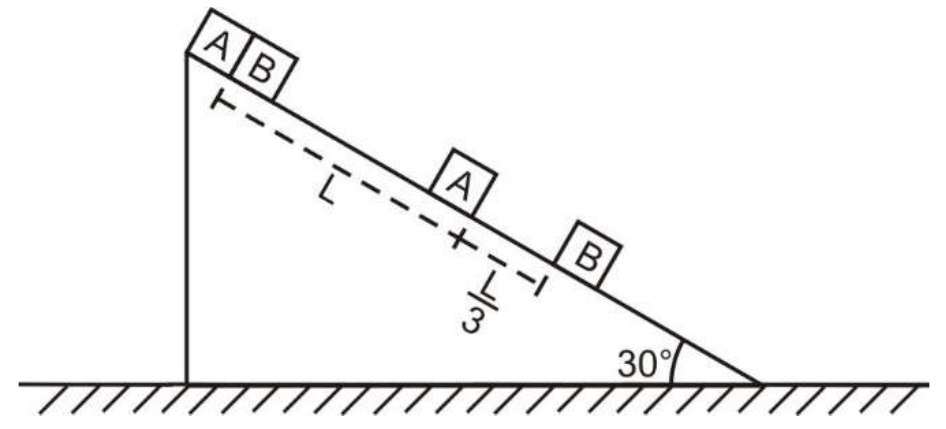
Sejam μ_A e μ_B, os coeficientes de atrito cinético entre a superfície do plano inclinado e os blocos A e B, respectivamente. Considerando μ_A = 2μ_B, então μ_B vale
Texto-base:
Texto-base:
Texto-base:
Texto-base:
Texto-base:
Texto-base:
Texto-base:
Texto-base:
Texto-base:
Texto-base:
Texto-base:
Texto-base:
Texto-base:
Texto-base:
Texto-base:
Texto-base:
Texto-base:
Texto-base:
Texto-base:
Texto-base: