← Voltar para a lista de provas Exército Brasileiro — Escola de Saúde e Formação Complementar do Exército (ESFCEx) · Oficial do Quadro Complementar do Exército 60 questões nesta prova · página 3 de 3 · 60 com gabarito Gabarito disponível O multilinguismo vai além da perspectiva dos World Englishes. O texto afirma que o 'principled polycentrism' não é o policentrismo de World Englishes, com suas normas fixas e estabelecidas de variedades regionais, mas um conceito mais fluido. Logo, o multilinguismo não se restringe a regras fixas de variedades regionais. A) O texto não diz que ele não propõe ensinar normas por saber que variam. B) Multilinguismo é entendido de forma fluida, e não como domínio de línguas separadas. C) 'Desconsidera' as normas é exagero. E) O texto critica o objetivo de falante nativo, mas não diz que não se espera proficiência. Referência: Pennycook (2017), The Cultural Politics of English as an International Language. Resolução comentada do VaiConcursos. Gabarito disponível Na prática brasileira: expor a variedades do inglês e aprender a negociar significados. O autor critica normas fixas e propõe falantes 'resourceful', capazes de negociar e acomodar, em vez de dominar uma única variedade. Logo, expor os alunos a diferentes variedades e ensiná-los a negociar sentidos traduz essa visão. A) O texto não trata de os alunos decidirem sozinhos a variedade. B) Ensinar norma padrão versus não padrão e diferenciá-las retoma a ideia de normas fixas. C) O foco não é a proficiência docente. E) Multilinguismo aqui não é só incluir outras línguas no currículo. Referência: Pennycook (2017), polycentrism and resourceful speakers. Resolução comentada do VaiConcursos. Gabarito disponível Gabarito disponível -ed pronunciado como sílaba extra após /t/ ou /d/. Em 'misguided', o verbo termina em /d/, e o -ed forma sílaba extra: /ˈmɪsˌɡaɪdɪd/. Nas demais, o -ed é só /d/ ou /t/ (confused, principled) ou o texto traz 'established' (/ɪˈstæblɪʃt/) e 'fixed' (/fɪkst/). B) 'confused' termina em /d/ depois de /z/: /kənˈfjuːzd/. C) 'principled' /ˈprɪnsəpəld/, sem sílaba extra. D) 'established' termina em /t/ depois de /ʃ/: /ɪˈstæblɪʃt/. E) 'fixed' termina em /t/ depois de /s/: /fɪkst/. Referência: Fonologia do inglês: pronúncia do sufixo -ed (/t/, /d/, /ɪd/). Resolução comentada do VaiConcursos. Gabarito disponível Validade de conteúdo: excluir do teste o que não foi trabalhado em aula. Pelo texto, a validade de conteúdo exige que a prova tenha quantidade representativa do que foi estudado. Logo, o professor deve excluir do instrumento o conteúdo (habilidades ou itens) não tratado em aula. A) Variedade de itens não é pré-condição da validade. B) Satisfazer a percepção dos alunos (validade aparente) não é o critério descrito. D) Considerar dificuldades potenciais não decorre do critério. E) Aplicar testes diferentes relaciona-se à confiabilidade (reliability), e não à validade. Referência: Hughes (1989); Fidalgo (2007). Resolução comentada do VaiConcursos. Gabarito disponível Teste válido avalia o que foi estudado, na habilidade que se quer medir. A validade (de construto e de conteúdo) exige que o teste meça a habilidade pretendida e com conteúdo trabalhado antes. Produzir texto em inglês a partir de gêneros discutidos em aulas dedicadas à escrita atende às duas. A) Cobra palavras 'novas' em produção oral, mas mistura o que foi aprendido em textos de gêneros variados, sem alinhar à habilidade medida. B) Mede compreensão oral por meio da construção de diálogos, que é produção, e não a habilidade declarada. C) Questões complexas para provocar erros contrariam a representatividade do conteúdo estudado. D) Avalia compreensão por meio de palavras desconhecidas, ou seja, a abordagem pode não refletir o conteúdo estudado. Referência: Hughes (1989), validade de construto e de conteúdo; Fidalgo (2007). Resolução comentada do VaiConcursos. Gabarito disponível Bons aprendizes aceitam a incerteza e usam vários procedimentos. Estratégias são 'ataques' específicos a problemas, variam no indivíduo e são procedimentos que facilitam a tarefa. Por isso é razoável dizer que bons aprendizes toleram a incerteza linguística e adotam várias estratégias para atingir seus objetivos. A) O texto não liga bons aprendizes a ir melhor em atividades de solução de problemas. B) Estratégias de aprendizagem e de comunicação não são vistas como sequenciais. C) Evitar erros básicos não é afirmado. E) Escolher só temas conhecidos contraria o uso de estratégias para resolver problemas. Referência: Brown (2006), Principles of Language Learning and Teaching; Chamot (2005). Resolução comentada do VaiConcursos. Gabarito disponível Gabarito disponível A abordagem humanista implica maior protagonismo do aluno. O texto diz que os aprendizes devem fazer escolhas sobre o que e como aprendem e assumir a responsabilidade de avaliar o próprio progresso. Isso corresponde a maior agência do aluno. A) Vai contra a ideia de autonomia dos alunos. C) A atualização docente não é mencionada. D) O texto não fala em reduzir o trabalho do professor, que deve diferenciar e empatizar. E) 'Condições ideais' ignora que o texto fala em condições ótimas para a aprendizagem autêntica, não que o ensino seja ideal em si. Referência: Williams & Burden (1999). Resolução comentada do VaiConcursos. Gabarito disponível A abordagem humanista combina com a sala de aula comunicativa. O texto enfatiza escolhas do aprendiz, empatia, necessidades individuais, interação em grupo e aprendizagem autêntica. Esses princípios são coerentes com a sala de aula comunicativa, centrada no aluno. A) O audiolingualismo é centrado no professor e em repetição. B) A abordagem valoriza também o grupo ('individualised and group learning'), não só métodos individuais. C) Abordagens nocional-funcionais não são mencionadas e focam a sequência de funções. D) O texto trata do contexto da sala de aula, e não de situações não institucionalizadas. Referência: Williams & Burden (1999), Psychology for Language Teachers. Resolução comentada do VaiConcursos. Gabarito disponível Gabarito disponível Gabarito disponível 'Rather than' significa 'em oposição a / em vez de'. Na frase, o aprendiz avalia seu progresso 'rather than' buscar avaliação de fonte externa; as duas ideias se contrapõem. Por isso 'rather than' equivale a 'as opposed to'. A) 'Together with' indica adição. B) 'As well as' também indica adição. D) 'Regardless of' significa 'independentemente de'. E) 'Apart from' significa 'além de / exceto', não a oposição pretendida. Referência: Vocabulário em contexto (conectivos de contraste). Resolução comentada do VaiConcursos. Gabarito disponível Cursos centrados na língua graduam a gramática do simples ao complexo. O texto afirma que esses métodos praticam estruturas linguísticas pré-selecionadas em exercícios focados na forma, vendo a aprendizagem como processo linear e aditivo. Isso corresponde à graduação cuidadosa da gramática do simples ao complexo. A) Material autêntico não é traço indicado no texto para esse método. C) O texto não diz que a escrita vem antes da oralidade. D) A preocupação com a construção de sentido é do método centrado na aprendizagem. E) O foco está em estruturas linguísticas, e não primariamente em vocabulário. Referência: Kumaravadivelu (2003), Beyond Methods. Resolução comentada do VaiConcursos. Gabarito disponível Introdução gradual e cumulativa de conteúdo: 'one brick at a time'. Nos métodos centrados na língua e no aprendiz, o desenvolvimento é linear e aditivo, com estruturas pré-selecionadas e sequenciadas. Isso equivale a construir passo a passo, 'one brick at a time'. A) 'Haste makes waste' trata de pressa, ideia ausente do texto. B) 'The more, the better' fala de quantidade, e não de sequência. C) 'Practice makes perfect' refere-se à prática, não à introdução gradual de conteúdo. D) 'A thing begun is half done' trata de começar, não de acumular. Referência: Kumaravadivelu (2003): processo linear e aditivo. Resolução comentada do VaiConcursos. Gabarito disponível Método centrado na aprendizagem usa tarefas de solução de problemas e interação aberta. O texto diz que esses métodos propõem interação significativa aberta, atividades comunicativas ou tarefas de solução de problemas. Buscar, em inglês, a solução de um problema da vida escolar dos alunos é uma tarefa desse tipo, com foco no sentido. A) Praticar diálogos tende a ser prática de estruturas e funções pré-selecionadas (centrado no aprendiz ou na língua). B) Atividade com músicas não é, por si só, tarefa de interação aberta. C) Analisar o conteúdo linguístico é foco na forma, característico do método centrado na língua. E) Traduzir poema envolve foco na forma, sem interação significativa aberta. Referência: Kumaravadivelu (2003), Beyond Methods. Resolução comentada do VaiConcursos. Gabarito disponível Gabarito disponível Gêneros desconhecidos podem entrar no currículo se forem relevantes e bem caracterizados. Pelo texto, os gêneros são definidos por características sociocomunicativas identificáveis e são entidades da vida. Por isso podem e devem ser incluídos no currículo, inclusive os desconhecidos, desde que relevantes para a faixa etária e identificados por suas características. A) 'Todo e qualquer' gênero é exagero, pois é preciso haver critério de relevância. B) A 'vagueza' é conceitual, não é motivo para evitar gêneros. D) Ter sido foco de ensino não garante ausência de dificuldade. E) O texto não prioriza tipos em estágios iniciais; os tipos são construção teórica e os gêneros são os que circulam na vida. Referência: Marcuschi (2002); ensino de língua por gêneros. Resolução comentada do VaiConcursos. Gabarito disponível A carta do leitor é um gênero jornalístico também presente no material escolar. O texto distingue tipos textuais (poucos) de gêneros (inúmeros). A carta do leitor circula em jornais e é gênero, mas também é trabalhada na escola. Por isso D é a única que a classifica como gênero e como jornalística e escolar. A) e B) tratam a carta como 'tipo' descritivo ou narrativo, quando ela é um gênero (de base argumentativa). C) Não se pode dizer que seja um gênero escolar criado para ensinar argumentação; ela é jornalística. E) 'Dissertativo' é tipo textual, e não gênero, e a carta não é restrita à escola. Referência: Marcuschi (2002), tipos textuais e gêneros textuais, conforme o texto. Resolução comentada do VaiConcursos. Gabarito disponível Gêneros acadêmicos: relatório de pesquisa e seminário. Gêneros acadêmicos são os que circulam na esfera acadêmica: relatório de pesquisa e seminário são exemplos típicos. As demais alternativas misturam tipos textuais, gêneros jornalísticos ou categorias genéricas. B) Artigos de opinião são jornalísticos. C) 'Textos escritos' e 'apresentações de diálogo' são categorias amplas, não gêneros. D) O editorial é jornalístico. E) Instrução e argumentação são tipos textuais, e não gêneros. Referência: Marcuschi (2002), conforme o texto: tipos textuais versus gêneros textuais. Resolução comentada do VaiConcursos.EsFCEx — Concurso de Admissão 2022 — Curso de Formação de Oficiais do Quadro Complementar — Área: Magistério em Inglês — 013. Prova Objetiva — Versão A
Leia o texto para responder às questões de números 41 a 44.
Multilingualism needs to be understood not so much in terms of separate monolingualisms (adding English to one or more other languages) but rather in much more fluid terms. We can start to think of ELT classrooms in terms of principled polycentrism (Pennycook, 2014). This is not the polycentrism of a World Englishes focus, with its established or fixed norms of regional varieties of English, but a more fluid concept, based on the idea that students are developing complex repertoires of multilingual and multimodal resources. This enables us to think in terms of ELT as developing resourceful speakers who are able to use available language resources and to shift between styles, discourses, registers and genres. This brings the recent sociolinguistic emphasis on repertoires and resources into conversation with a focus on the need to learn how to negotiate and accommodate, rather than to be proficient in one variety of English. So an emerging goal of ELT may be less towards proficient native-speaker-like speakers (which has always been a confused and misguided goal), and to think instead in terms of resourceful speakers (Pennycook, 2012) who can draw on multiple linguistic and semiotic resources.
(Pennycook, A. The Cultural Politics of English as an International Language. London and New York: Routledge. 2017. Adaptado)
The reading of the excerpt leads us to understand that multilingualismResolução comentada
Análise das alternativas
Leia o texto para responder às questões de números 41 a 44.
Multilingualism needs to be understood not so much in terms of separate monolingualisms (adding English to one or more other languages) but rather in much more fluid terms. We can start to think of ELT classrooms in terms of principled polycentrism (Pennycook, 2014). This is not the polycentrism of a World Englishes focus, with its established or fixed norms of regional varieties of English, but a more fluid concept, based on the idea that students are developing complex repertoires of multilingual and multimodal resources. This enables us to think in terms of ELT as developing resourceful speakers who are able to use available language resources and to shift between styles, discourses, registers and genres. This brings the recent sociolinguistic emphasis on repertoires and resources into conversation with a focus on the need to learn how to negotiate and accommodate, rather than to be proficient in one variety of English. So an emerging goal of ELT may be less towards proficient native-speaker-like speakers (which has always been a confused and misguided goal), and to think instead in terms of resourceful speakers (Pennycook, 2012) who can draw on multiple linguistic and semiotic resources.
(Pennycook, A. The Cultural Politics of English as an International Language. London and New York: Routledge. 2017. Adaptado)
In the Brazilian educational context, the view by the author can be translated intoResolução comentada
Análise das alternativas
Leia o texto para responder às questões de números 41 a 44.
Multilingualism needs to be understood not so much in terms of separate monolingualisms (adding English to one or more other languages) but rather in much more fluid terms. We can start to think of ELT classrooms in terms of principled polycentrism (Pennycook, 2014). This is not the polycentrism of a World Englishes focus, with its established or fixed norms of regional varieties of English, but a more fluid concept, based on the idea that students are developing complex repertoires of multilingual and multimodal resources. This enables us to think in terms of ELT as developing resourceful speakers who are able to use available language resources and to shift between styles, discourses, registers and genres. This brings the recent sociolinguistic emphasis on repertoires and resources into conversation with a focus on the need to learn how to negotiate and accommodate, rather than to be proficient in one variety of English. So an emerging goal of ELT may be less towards proficient native-speaker-like speakers (which has always been a confused and misguided goal), and to think instead in terms of resourceful speakers (Pennycook, 2012) who can draw on multiple linguistic and semiotic resources.
(Pennycook, A. The Cultural Politics of English as an International Language. London and New York: Routledge. 2017. Adaptado)

Leia o texto para responder às questões de números 41 a 44.
Multilingualism needs to be understood not so much in terms of separate monolingualisms (adding English to one or more other languages) but rather in much more fluid terms. We can start to think of ELT classrooms in terms of principled polycentrism (Pennycook, 2014). This is not the polycentrism of a World Englishes focus, with its established or fixed norms of regional varieties of English, but a more fluid concept, based on the idea that students are developing complex repertoires of multilingual and multimodal resources. This enables us to think in terms of ELT as developing resourceful speakers who are able to use available language resources and to shift between styles, discourses, registers and genres. This brings the recent sociolinguistic emphasis on repertoires and resources into conversation with a focus on the need to learn how to negotiate and accommodate, rather than to be proficient in one variety of English. So an emerging goal of ELT may be less towards proficient native-speaker-like speakers (which has always been a confused and misguided goal), and to think instead in terms of resourceful speakers (Pennycook, 2012) who can draw on multiple linguistic and semiotic resources.
(Pennycook, A. The Cultural Politics of English as an International Language. London and New York: Routledge. 2017. Adaptado)
Os brasileiros aprendizes de Língua Inglesa tendem a perceber o -ed final em verbos como tendo o mesmo som quando, na verdade, a desinência pode assumir diversos sons, conforme o contexto sonoro. Das palavras a seguir, retiradas do texto de Pennycook, assinale a única em que o -ed final é pronunciado em uma sílaba extra.Resolução comentada
Análise das alternativas
Leia o texto para responder às questões de números 45 e 46.
O termo validade, para referir-se à avaliação de aprendizagem, pode ser definido como o grau pelo qual as notas de um teste nos permitem tirar conclusões em relação ao objetivo do mesmo. Há diversos tipos de validade, dentro os quais destacamos:
validade de construto – é uma espécie de validade conceitual. Uma avaliação tem validade de construto se pudermos demonstrar que ela mede, exatamente, o construto que deve medir (Hughes, 1989:26). No caso de inglês, poderíamos pensar em habilidades, por exemplo. Dessa forma, uma prova teria validade de construto se medisse a habilidade que deseja medir.
validade de conteúdo – têm as provas cujo conteúdo apresenta uma quantidade representativa daquilo que tenha sido estudado anteriormente.
FIDALGO, S.S. Livros Didáticos e Avaliação de Aprendizagem: Uma Revisão teórico-Prática. IN: Maria Cristina Damianovic (org). Material Didático: Elaboração e Avaliação. Taubaté: Cabral -Editora e Livraria Universitária. 2007. p. 287-318. Adaptado)
Concerned with the criterion validity in the design of tests, when preparing an evaluation to your students you wouldResolução comentada
Análise das alternativas
Leia o texto para responder às questões de números 45 e 46.
O termo validade, para referir-se à avaliação de aprendizagem, pode ser definido como o grau pelo qual as notas de um teste nos permitem tirar conclusões em relação ao objetivo do mesmo. Há diversos tipos de validade, dentro os quais destacamos:
validade de construto – é uma espécie de validade conceitual. Uma avaliação tem validade de construto se pudermos demonstrar que ela mede, exatamente, o construto que deve medir (Hughes, 1989:26). No caso de inglês, poderíamos pensar em habilidades, por exemplo. Dessa forma, uma prova teria validade de construto se medisse a habilidade que deseja medir.
validade de conteúdo – têm as provas cujo conteúdo apresenta uma quantidade representativa daquilo que tenha sido estudado anteriormente.
FIDALGO, S.S. Livros Didáticos e Avaliação de Aprendizagem: Uma Revisão teórico-Prática. IN: Maria Cristina Damianovic (org). Material Didático: Elaboração e Avaliação. Taubaté: Cabral -Editora e Livraria Universitária. 2007. p. 287-318. Adaptado)
Um teste que obedecesse ao critério “validade” proporia avaliarResolução comentada
Análise das alternativas
Leia o texto para responder às questões de números 47 e 48.
If styles are general characteristics that differentiate one individual from another, then strategies are those specific “attacks” that we make on a given problem, and that vary considerably within each individual. They are the moment-by-moment techniques that we employ to solve “problems” posed by second language input and output. Chamot (2005, p. 112) defines strategies quite broadly as “procedures that facilitate a learning task.”
Second language acquisition has distinguished between two types of strategy: learning strategies and communication strategies. The former relate to input — to processing, storage, and retrieval, that is, to taking in messages from others. The latter pertain to output, how we productively express meaning, how we deliver messages to others.
(Brown, H.D. Principles of Language Learning and Teaching. 5th ed. White Plains, NY: Addison Wesley Longman, 2006. Adaptado)
Taking into account the view on strategies as presented in the excerpt, it is suitable to state that good language learners tend toResolução comentada
Análise das alternativas
Leia o texto para responder às questões de números 47 e 48.
If styles are general characteristics that differentiate one individual from another, then strategies are those specific “attacks” that we make on a given problem, and that vary considerably within each individual. They are the moment-by-moment techniques that we employ to solve “problems” posed by second language input and output. Chamot (2005, p. 112) defines strategies quite broadly as “procedures that facilitate a learning task.”
Second language acquisition has distinguished between two types of strategy: learning strategies and communication strategies. The former relate to input — to processing, storage, and retrieval, that is, to taking in messages from others. The latter pertain to output, how we productively express meaning, how we deliver messages to others.
(Brown, H.D. Principles of Language Learning and Teaching. 5th ed. White Plains, NY: Addison Wesley Longman, 2006. Adaptado)

Leia o texto para responder às questões de números 49 a 53.
Implications of the humanistic approach
Hamachek (1977) provides some useful examples of the kind of educational implications that follow from taking a humanistic approach. First, every learning experience should be seen within the context of helping learners to develop a sense of personal identity. This is in keeping with the view that one important task for the teacher is differentiation, i.e. identifying and seeking to meet the individual learner’s needs within the context of the classroom group. Second, learners should be encouraged to make choices for themselves in what and how they learn. This again is in sharp contrast to the view that the curriculum content for every learner of a similar age should be set in ‘tablets of stone’. Third, it is important for teachers to empathise with their learners by seeking to understand the ways in which they make sense of the world, rather than always seeking to impose their own viewpoints. Fourth, it is important to provide optimum conditions for individualised and group learning of an authentic nature to take place.Thus, from a humanistic perspective, a learning experience of personal consequence occurs when the learner assumes the responsibility of evaluating the degree to which he or she is personally moving toward knowledge rather than looking to an external source for such evaluation.
(Williams, M.; Burden, R.L. Psychology for Language Teachers: A Social Constructivist Approach. Cambridge:CUP, 1999. Adaptado)
According to the excerpt, the humanistic approach to language learning impliesResolução comentada
Análise das alternativas
Leia o texto para responder às questões de números 49 a 53.
Implications of the humanistic approach
Hamachek (1977) provides some useful examples of the kind of educational implications that follow from taking a humanistic approach. First, every learning experience should be seen within the context of helping learners to develop a sense of personal identity. This is in keeping with the view that one important task for the teacher is differentiation, i.e. identifying and seeking to meet the individual learner’s needs within the context of the classroom group. Second, learners should be encouraged to make choices for themselves in what and how they learn. This again is in sharp contrast to the view that the curriculum content for every learner of a similar age should be set in ‘tablets of stone’. Third, it is important for teachers to empathise with their learners by seeking to understand the ways in which they make sense of the world, rather than always seeking to impose their own viewpoints. Fourth, it is important to provide optimum conditions for individualised and group learning of an authentic nature to take place.Thus, from a humanistic perspective, a learning experience of personal consequence occurs when the learner assumes the responsibility of evaluating the degree to which he or she is personally moving toward knowledge rather than looking to an external source for such evaluation.
(Williams, M.; Burden, R.L. Psychology for Language Teachers: A Social Constructivist Approach. Cambridge:CUP, 1999. Adaptado)
From the exposition by Williams and Burden, it can be understood that the humanistic approach to language learning links well withResolução comentada
Análise das alternativas
Leia o texto para responder às questões de números 49 a 53.
Implications of the humanistic approach
Hamachek (1977) provides some useful examples of the kind of educational implications that follow from taking a humanistic approach. First, every learning experience should be seen within the context of helping learners to develop a sense of personal identity. This is in keeping with the view that one important task for the teacher is differentiation, i.e. identifying and seeking to meet the individual learner’s needs within the context of the classroom group. Second, learners should be encouraged to make choices for themselves in what and how they learn. This again is in sharp contrast to the view that the curriculum content for every learner of a similar age should be set in ‘tablets of stone’. Third, it is important for teachers to empathise with their learners by seeking to understand the ways in which they make sense of the world, rather than always seeking to impose their own viewpoints. Fourth, it is important to provide optimum conditions for individualised and group learning of an authentic nature to take place.Thus, from a humanistic perspective, a learning experience of personal consequence occurs when the learner assumes the responsibility of evaluating the degree to which he or she is personally moving toward knowledge rather than looking to an external source for such evaluation.
(Williams, M.; Burden, R.L. Psychology for Language Teachers: A Social Constructivist Approach. Cambridge:CUP, 1999. Adaptado)

Leia o texto para responder às questões de números 49 a 53.
Implications of the humanistic approach
Hamachek (1977) provides some useful examples of the kind of educational implications that follow from taking a humanistic approach. First, every learning experience should be seen within the context of helping learners to develop a sense of personal identity. This is in keeping with the view that one important task for the teacher is differentiation, i.e. identifying and seeking to meet the individual learner’s needs within the context of the classroom group. Second, learners should be encouraged to make choices for themselves in what and how they learn. This again is in sharp contrast to the view that the curriculum content for every learner of a similar age should be set in ‘tablets of stone’. Third, it is important for teachers to empathise with their learners by seeking to understand the ways in which they make sense of the world, rather than always seeking to impose their own viewpoints. Fourth, it is important to provide optimum conditions for individualised and group learning of an authentic nature to take place.Thus, from a humanistic perspective, a learning experience of personal consequence occurs when the learner assumes the responsibility of evaluating the degree to which he or she is personally moving toward knowledge rather than looking to an external source for such evaluation.
(Williams, M.; Burden, R.L. Psychology for Language Teachers: A Social Constructivist Approach. Cambridge:CUP, 1999. Adaptado)
There are in the text several instances of verb+noun phrase collocations, such as “make choices” and “take place”. Another correct verb+noun phrase collocation is found in alternative:
Leia o texto para responder às questões de números 49 a 53.
Implications of the humanistic approach
Hamachek (1977) provides some useful examples of the kind of educational implications that follow from taking a humanistic approach. First, every learning experience should be seen within the context of helping learners to develop a sense of personal identity. This is in keeping with the view that one important task for the teacher is differentiation, i.e. identifying and seeking to meet the individual learner’s needs within the context of the classroom group. Second, learners should be encouraged to make choices for themselves in what and how they learn. This again is in sharp contrast to the view that the curriculum content for every learner of a similar age should be set in ‘tablets of stone’. Third, it is important for teachers to empathise with their learners by seeking to understand the ways in which they make sense of the world, rather than always seeking to impose their own viewpoints. Fourth, it is important to provide optimum conditions for individualised and group learning of an authentic nature to take place.Thus, from a humanistic perspective, a learning experience of personal consequence occurs when the learner assumes the responsibility of evaluating the degree to which he or she is personally moving toward knowledge rather than looking to an external source for such evaluation.
(Williams, M.; Burden, R.L. Psychology for Language Teachers: A Social Constructivist Approach. Cambridge:CUP, 1999. Adaptado)
The expression ‘rather than’, in the concluding sentence of the text, meansResolução comentada
Análise das alternativas
Leia o texto para responder às questões de números 54 a 57.
Language-centered methods are those that seek to provide opportunities for learners to practice preselected linguistic structures through form-focused exercises in class. The assumption is that language practice will ultimately lead to a mastery of the target language and that learners can draw from this formal repertoire whenever they wish to communicate in the target language outside the class. According to this belief, language development is largely intentional rather than incidental; and language learning seen as a linear, additive process.
Learner-centered methods are those that are principally concerned with language use and learner needs. These methods seek to provide opportunities for learners to practice preselected, presequenced grammatical structures as well as communicative functions (i.e., speech acts such as apologizing, requesting, etc.) through meaning-focused activities. Proponents of learner-centered methods believe in accumulated entities, represented by structures plus notions and functions.
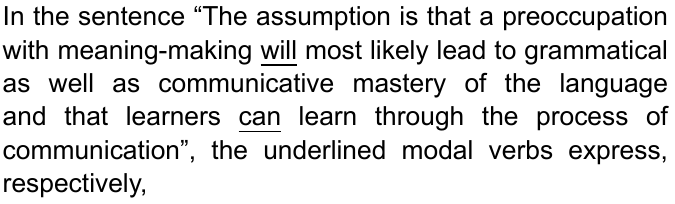
Learning-centered methods are those that are principally concerned with learning processes. These methods seek to provide opportunities for learners to participate in open-ended meaningful interaction through communicative activities or problem-solving tasks in class. The assumption is that a preoccupation with meaning-making will most likely lead to grammatical as well as communicative mastery of the language and that learners can learn through the process of communication. In this approach, unlike the other two, language development is a nonlinear process and considered more incidental than intentional. Proponents of learning-centered methods believe that language is best learned when the learner’s attention is focused on understanding, saying and doing something with language, and not when their attention is focused explicitly on linguistic features.
(Kumaravadivelu, B. Beyond Methods: Macrostrategies for language learning. Haven and London: Yale University Press. 2003. Adaptado)
One main trait of language-centered courses is theResolução comentada
Análise das alternativas
Leia o texto para responder às questões de números 54 a 57.
Language-centered methods are those that seek to provide opportunities for learners to practice preselected linguistic structures through form-focused exercises in class. The assumption is that language practice will ultimately lead to a mastery of the target language and that learners can draw from this formal repertoire whenever they wish to communicate in the target language outside the class. According to this belief, language development is largely intentional rather than incidental; and language learning seen as a linear, additive process.
Learner-centered methods are those that are principally concerned with language use and learner needs. These methods seek to provide opportunities for learners to practice preselected, presequenced grammatical structures as well as communicative functions (i.e., speech acts such as apologizing, requesting, etc.) through meaning-focused activities. Proponents of learner-centered methods believe in accumulated entities, represented by structures plus notions and functions.
Learning-centered methods are those that are principally concerned with learning processes. These methods seek to provide opportunities for learners to participate in open-ended meaningful interaction through communicative activities or problem-solving tasks in class. The assumption is that a preoccupation with meaning-making will most likely lead to grammatical as well as communicative mastery of the language and that learners can learn through the process of communication. In this approach, unlike the other two, language development is a nonlinear process and considered more incidental than intentional. Proponents of learning-centered methods believe that language is best learned when the learner’s attention is focused on understanding, saying and doing something with language, and not when their attention is focused explicitly on linguistic features.
(Kumaravadivelu, B. Beyond Methods: Macrostrategies for language learning. Haven and London: Yale University Press. 2003. Adaptado)
One concise way to help explain the introduction of new content in both the language-centered and language-learner methods, as mentioned in the text, would beResolução comentada
Análise das alternativas
Leia o texto para responder às questões de números 54 a 57.
Language-centered methods are those that seek to provide opportunities for learners to practice preselected linguistic structures through form-focused exercises in class. The assumption is that language practice will ultimately lead to a mastery of the target language and that learners can draw from this formal repertoire whenever they wish to communicate in the target language outside the class. According to this belief, language development is largely intentional rather than incidental; and language learning seen as a linear, additive process.
Learner-centered methods are those that are principally concerned with language use and learner needs. These methods seek to provide opportunities for learners to practice preselected, presequenced grammatical structures as well as communicative functions (i.e., speech acts such as apologizing, requesting, etc.) through meaning-focused activities. Proponents of learner-centered methods believe in accumulated entities, represented by structures plus notions and functions.
Learning-centered methods are those that are principally concerned with learning processes. These methods seek to provide opportunities for learners to participate in open-ended meaningful interaction through communicative activities or problem-solving tasks in class. The assumption is that a preoccupation with meaning-making will most likely lead to grammatical as well as communicative mastery of the language and that learners can learn through the process of communication. In this approach, unlike the other two, language development is a nonlinear process and considered more incidental than intentional. Proponents of learning-centered methods believe that language is best learned when the learner’s attention is focused on understanding, saying and doing something with language, and not when their attention is focused explicitly on linguistic features.
(Kumaravadivelu, B. Beyond Methods: Macrostrategies for language learning. Haven and London: Yale University Press. 2003. Adaptado)
É proposta consistente com o método centrado na aprendizagem:Resolução comentada
Análise das alternativas
Leia o texto para responder às questões de números 54 a 57.
Language-centered methods are those that seek to provide opportunities for learners to practice preselected linguistic structures through form-focused exercises in class. The assumption is that language practice will ultimately lead to a mastery of the target language and that learners can draw from this formal repertoire whenever they wish to communicate in the target language outside the class. According to this belief, language development is largely intentional rather than incidental; and language learning seen as a linear, additive process.
Learner-centered methods are those that are principally concerned with language use and learner needs. These methods seek to provide opportunities for learners to practice preselected, presequenced grammatical structures as well as communicative functions (i.e., speech acts such as apologizing, requesting, etc.) through meaning-focused activities. Proponents of learner-centered methods believe in accumulated entities, represented by structures plus notions and functions.
Learning-centered methods are those that are principally concerned with learning processes. These methods seek to provide opportunities for learners to participate in open-ended meaningful interaction through communicative activities or problem-solving tasks in class. The assumption is that a preoccupation with meaning-making will most likely lead to grammatical as well as communicative mastery of the language and that learners can learn through the process of communication. In this approach, unlike the other two, language development is a nonlinear process and considered more incidental than intentional. Proponents of learning-centered methods believe that language is best learned when the learner’s attention is focused on understanding, saying and doing something with language, and not when their attention is focused explicitly on linguistic features.
(Kumaravadivelu, B. Beyond Methods: Macrostrategies for language learning. Haven and London: Yale University Press. 2003. Adaptado)
Leia o texto para responder às questões de números 58 a 60.
Quanto às distinções entre tipos de texto e gêneros de texto/discurso, a mais famosa a esse respeito é a de Marcuschi (2002), que os define como
I. Usamos a expressão tipo textual para designar uma espécie de construção teórica definida pela natureza linguística de sua composição {aspectos lexicais, sintáticos, tempos verbais, relações lógicas}. Em geral, os tipos textuais abrangem cerca de meia dúzia de categorias conhecidas: descrição, narração, dissertação/argumentação, exposição e injunção.
II. Usamos a expressão gênero textual como uma noção propositalmente vaga para referir os textos materializados que encontramos em nossa vida diária e que apresentam características sócio-comunicativas definidas por conteúdos, propriedades funcionais, estilo e composição característica. Se os tipos textuais são apenas meia dúzia, os gêneros são inúmeros.
Tipos de textos vem sendo ensinados na escola há pelo menos uma centena de anos, o que faz deles gêneros escolares. Na escola, escrevemos narrações, na vida, lemos notícias, relatamos nossa vida, recontamos um filme. Na escola, redigimos “uma composição à vista de gravura” (descrição) fora dela, contamos como decoramos nosso apartamento, instruímos uma pessoa como chegar a um lugar desconhecido. Os gêneros de texto, ao contrário, não são classes gramaticais para classificar textos: são entidades da vida.
(ROJO, R. H. R.; BARBOSA, J. P. Hipermodernidade, multiletramentos e gêneros discursivos. São Paulo: Parábola Editorial, 2015. Adaptado)
No que tange o planejamento de ensino-aprendizagem da língua inglesa:Resolução comentada
Análise das alternativas
Leia o texto para responder às questões de números 58 a 60.
Quanto às distinções entre tipos de texto e gêneros de texto/discurso, a mais famosa a esse respeito é a de Marcuschi (2002), que os define como
I. Usamos a expressão tipo textual para designar uma espécie de construção teórica definida pela natureza linguística de sua composição {aspectos lexicais, sintáticos, tempos verbais, relações lógicas}. Em geral, os tipos textuais abrangem cerca de meia dúzia de categorias conhecidas: descrição, narração, dissertação/argumentação, exposição e injunção.
II. Usamos a expressão gênero textual como uma noção propositalmente vaga para referir os textos materializados que encontramos em nossa vida diária e que apresentam características sócio-comunicativas definidas por conteúdos, propriedades funcionais, estilo e composição característica. Se os tipos textuais são apenas meia dúzia, os gêneros são inúmeros.
Tipos de textos vem sendo ensinados na escola há pelo menos uma centena de anos, o que faz deles gêneros escolares. Na escola, escrevemos narrações, na vida, lemos notícias, relatamos nossa vida, recontamos um filme. Na escola, redigimos “uma composição à vista de gravura” (descrição) fora dela, contamos como decoramos nosso apartamento, instruímos uma pessoa como chegar a um lugar desconhecido. Os gêneros de texto, ao contrário, não são classes gramaticais para classificar textos: são entidades da vida.
(ROJO, R. H. R.; BARBOSA, J. P. Hipermodernidade, multiletramentos e gêneros discursivos. São Paulo: Parábola Editorial, 2015. Adaptado)
Considering the excerpt, it is correct to state that the “Letter to the editor” in newspapers is aResolução comentada
Análise das alternativas
Leia o texto para responder às questões de números 58 a 60.
Quanto às distinções entre tipos de texto e gêneros de texto/discurso, a mais famosa a esse respeito é a de Marcuschi (2002), que os define como
I. Usamos a expressão tipo textual para designar uma espécie de construção teórica definida pela natureza linguística de sua composição {aspectos lexicais, sintáticos, tempos verbais, relações lógicas}. Em geral, os tipos textuais abrangem cerca de meia dúzia de categorias conhecidas: descrição, narração, dissertação/argumentação, exposição e injunção.
II. Usamos a expressão gênero textual como uma noção propositalmente vaga para referir os textos materializados que encontramos em nossa vida diária e que apresentam características sócio-comunicativas definidas por conteúdos, propriedades funcionais, estilo e composição característica. Se os tipos textuais são apenas meia dúzia, os gêneros são inúmeros.
Tipos de textos vem sendo ensinados na escola há pelo menos uma centena de anos, o que faz deles gêneros escolares. Na escola, escrevemos narrações, na vida, lemos notícias, relatamos nossa vida, recontamos um filme. Na escola, redigimos “uma composição à vista de gravura” (descrição) fora dela, contamos como decoramos nosso apartamento, instruímos uma pessoa como chegar a um lugar desconhecido. Os gêneros de texto, ao contrário, não são classes gramaticais para classificar textos: são entidades da vida.
(ROJO, R. H. R.; BARBOSA, J. P. Hipermodernidade, multiletramentos e gêneros discursivos. São Paulo: Parábola Editorial, 2015. Adaptado)
Examples of academic genres would beResolução comentada
Análise das alternativas
Texto-base:
Texto-base:
Texto-base:
Texto-base:
Texto-base:
Texto-base:
Texto-base:
Texto-base:
Texto-base:
Texto-base:
Texto-base:
Texto-base:
Texto-base:
Texto-base:
Texto-base:
Texto-base:
Texto-base:
Texto-base:
Texto-base:
Texto-base: