Pular para o conteúdo

Provas

← Voltar para a lista de provas

EEAR — Exame de Admissão ao CFS 1/2023 — Aeronavegantes e Não-Aeronavegantes — Português, Inglês, Matemática e Física — Código 81

Comando da Aeronáutica — Escola de Especialistas de Aeronáutica · Curso de Formação de Sargentos da Aeronáutica (CFS 1/2023) — Aeronavegantes e Não-Aeronavegantes

Escola de Especialistas de Aeronáutica (EEAR)Médio

96 questões nesta prova · página 2 de 5 · 96 com gabarito

Língua Portuguesa Figuras de Linguagem

Escola de Especialistas de Aeronáutica (EEAR) Médio

Comando da Aeronáutica — Escola de Especialistas de Aeronáutica · Curso de Formação de Sargentos da Aeronáutica (CFS 1/2023) — Aeronavegantes e Não-Aeronavegantes · Caderno Código 81

Gabarito disponível

Assinale a alternativa cuja frase não contém a mesma figura apresentada em “De um lado, a pobreza que todos repelem; de outro, a riqueza que todos almejam”.
Selecione uma alternativa

Resolução comentada

Identificar a alternativa sem antítese, figura presente na frase-modelo.

A frase-modelo opõe ideias contrárias (pobreza x riqueza, repelem x almejam), o que caracteriza a antítese. B (vida x morte), C (cedo x tarde) e D (demasiado/pouco x pouco/muito) também têm essa oposição. A frase A traz apenas personificação, ao atribuir às armas a ação de descansar, e não opõe ideias.

Análise das alternativas

B: antítese vida/morte. C: antítese cedo/tarde, naturalmente/artificialmente. D: antítese entre sofrer muito pelo pouco e alegrar-se pouco pelo muito. A: não há oposição de ideias, só personificação, por isso é a correta.

Referência: Figuras de linguagem: antítese e personificação.

Resolução comentada do VaiConcursos.

Língua Portuguesa Orações Coordenadas

Escola de Especialistas de Aeronáutica (EEAR) Médio

Comando da Aeronáutica — Escola de Especialistas de Aeronáutica · Curso de Formação de Sargentos da Aeronáutica (CFS 1/2023) — Aeronavegantes e Não-Aeronavegantes · Caderno Código 81

Gabarito disponível

Leia:
“O livro é um conselheiro silencioso e paciente. Traz-nos ensinamentos preciosos, aumenta nossa cultura, tem um tempo inesgotável, portanto não nos apressa a leitura, e, além do mais, pode atravessar várias gerações.” (Josué Solar)
Assinale a alternativa incorreta sobre o texto acima.
Selecione uma alternativa

Resolução comentada

Há apenas uma coordenada sindética aditiva, então D é a incorreta.

'Traz-nos…', 'aumenta…' e 'tem…' são três assindéticas; 'portanto não nos apressa…' é sindética conclusiva; e 'e, além do mais, pode atravessar…' é a única sindética aditiva. O primeiro período ('O livro é um conselheiro…') é simples, e o segundo é composto. Logo, dizer que há duas aditivas é incorreto.

Análise das alternativas

A) correta: três assindéticas. B) correta: um período simples e um composto. C) correta: 'portanto' introduz a conclusiva. D) incorreta: há só uma aditiva.

Referência: Período composto por coordenação: orações assindéticas e sindéticas.

Resolução comentada do VaiConcursos.

Língua Portuguesa Orações Subordinadas Adjetivas

Escola de Especialistas de Aeronáutica (EEAR) Médio

Comando da Aeronáutica — Escola de Especialistas de Aeronáutica · Curso de Formação de Sargentos da Aeronáutica (CFS 1/2023) — Aeronavegantes e Não-Aeronavegantes · Caderno Código 81

Gabarito disponível

Leia:
“Sempre havia alguém que possuía um parente que enriquecera em São Paulo. Um até tinha um tio que emigrara há doze anos e estava tão rico que possuía casa na capital e ganhara o título de coronel.” (Jorge Amado)
É correto afirmar que, no texto acima, há
Selecione uma alternativa

Resolução comentada

As quatro orações iniciadas por 'que' são adjetivas restritivas, segundo o gabarito.

As orações 'que possuía um parente', 'que enriquecera em São Paulo', 'que emigrara há doze anos' e 'que possuía casa na capital' são introduzidas por 'que' e são ligadas a antecedentes sem vírgulas, ou seja, sem pausa. Por isso são restritivas, e nenhuma é explicativa, já que não há vírgulas isolando o termo. O gabarito oficial considera as quatro como adjetivas restritivas, embora a última poderia ser vista como consecutiva ('tão rico que').

Análise das alternativas

A) e B) afirmam haver explicativas, mas não há nenhuma oração isolada por vírgulas. C) contabiliza apenas três restritivas, mas o gabarito considera quatro.

Referência: Período composto: orações subordinadas adjetivas restritivas e explicativas.

Resolução comentada do VaiConcursos.

Língua Portuguesa Tempos e Modos Verbais

Escola de Especialistas de Aeronáutica (EEAR) Médio

Comando da Aeronáutica — Escola de Especialistas de Aeronáutica · Curso de Formação de Sargentos da Aeronáutica (CFS 1/2023) — Aeronavegantes e Não-Aeronavegantes · Caderno Código 81

Gabarito disponível

Leia:
“Todas as manhãs, antes de a aurora anunciar o dia, o galo-da-campina punha-se a cantar emitindo notas maviosas, ritmadas.”(Adalberon C. Lins)
O verbo da segunda conjugação, na frase acima, encontra-se no
Selecione uma alternativa

Resolução comentada

'Punha-se' (pôr, 2ª conjugação) está no pretérito imperfeito do indicativo.

'Pôr' pertence à 2ª conjugação, pois vem de 'poer'. 'Punha' é o pretérito imperfeito do indicativo, e a ideia de hábito ('todas as manhãs') confirma o imperfeito. Os outros verbos são 'anunciar' e 'cantar', da 1ª conjugação, e 'emitindo', gerúndio de verbo da 1ª.

Análise das alternativas

A) 'punha' não é presente (seria 'põe'). B) o perfeito seria 'pôs'. D) o imperfeito do subjuntivo seria 'pusesse'.

Referência: Verbos: conjugações e tempos verbais.

Resolução comentada do VaiConcursos.

Língua Inglesa Conectivos (Linking Words)

Escola de Especialistas de Aeronáutica (EEAR) Médio

Comando da Aeronáutica — Escola de Especialistas de Aeronáutica · Curso de Formação de Sargentos da Aeronáutica (CFS 1/2023) — Aeronavegantes e Não-Aeronavegantes · Caderno Código 81

Gabarito disponível

Texto-base:
Read the text and answer questions 25, 26 and 27.
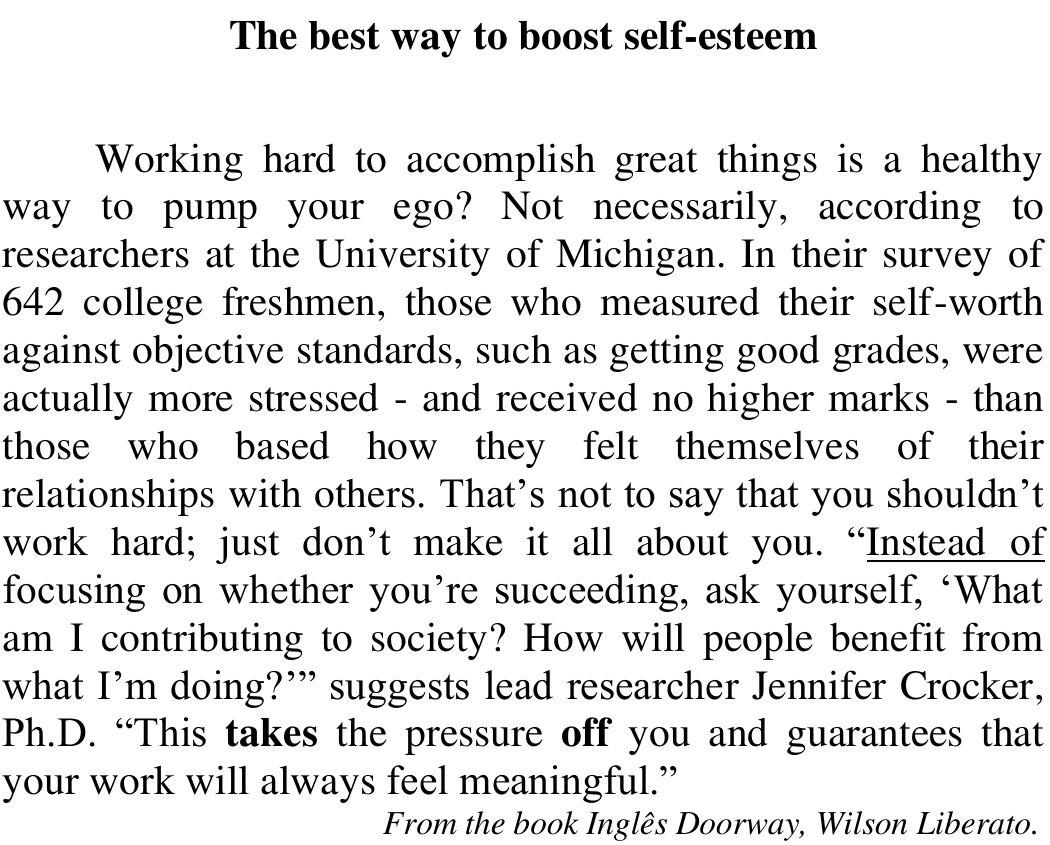
Texto “The best way to boost self-esteem”: Working hard to accomplish great things is a healthy way to pump your ego? Not necessarily, according to researchers at the University of Michigan. In their survey of 642 college freshmen, those who measured their self-worth against objective standards, such as getting good grades, were actually more stressed - and received no higher marks - than those who based how they felt themselves of their relationships with others. That’s not to say that you shouldn’t work hard; just don’t make it all about you. “Instead of focusing on whether you’re succeeding, ask yourself, ‘What am I contributing to society? How will people benefit from what I’m doing?’” suggests lead researcher Jennifer Crocker, Ph.D. “This takes the pressure off you and guarantees that your work will always feel meaningful.” From the book Inglês Doorway, Wilson Liberato. Sublinhado: Instead of. Em negrito: takes e off.

The underlined word in the text can be replaced by:
Selecione uma alternativa

Língua Inglesa Phrasal Verbs

Escola de Especialistas de Aeronáutica (EEAR) Médio

Comando da Aeronáutica — Escola de Especialistas de Aeronáutica · Curso de Formação de Sargentos da Aeronáutica (CFS 1/2023) — Aeronavegantes e Não-Aeronavegantes · Caderno Código 81

Gabarito disponível

Texto-base:
Read the text and answer questions 25, 26 and 27.
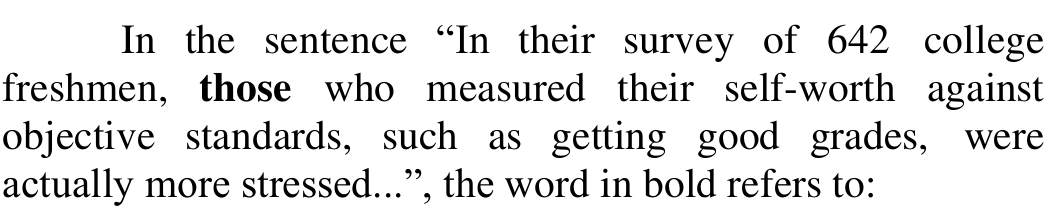
Texto “The best way to boost self-esteem”: Working hard to accomplish great things is a healthy way to pump your ego? Not necessarily, according to researchers at the University of Michigan. In their survey of 642 college freshmen, those who measured their self-worth against objective standards, such as getting good grades, were actually more stressed - and received no higher marks - than those who based how they felt themselves of their relationships with others. That’s not to say that you shouldn’t work hard; just don’t make it all about you. “Instead of focusing on whether you’re succeeding, ask yourself, ‘What am I contributing to society? How will people benefit from what I’m doing?’” suggests lead researcher Jennifer Crocker, Ph.D. “This takes the pressure off you and guarantees that your work will always feel meaningful.” From the book Inglês Doorway, Wilson Liberato. Sublinhado: Instead of. Em negrito: takes e off.

The phrasal verb in bold in the text means:
Selecione uma alternativa

Língua Inglesa Pronomes — Referência

Escola de Especialistas de Aeronáutica (EEAR) Médio

Comando da Aeronáutica — Escola de Especialistas de Aeronáutica · Curso de Formação de Sargentos da Aeronáutica (CFS 1/2023) — Aeronavegantes e Não-Aeronavegantes · Caderno Código 81

Gabarito disponível

Texto-base:
Read the text and answer questions 25, 26 and 27.
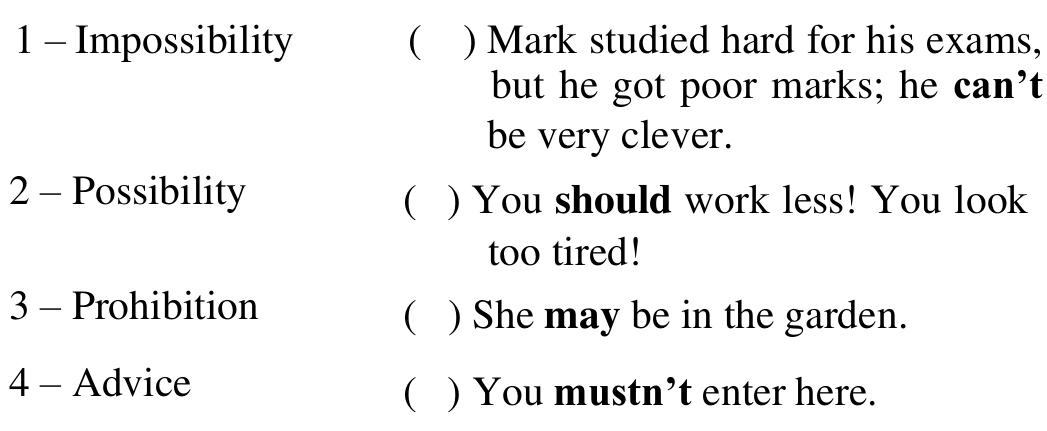
Texto “The best way to boost self-esteem”: Working hard to accomplish great things is a healthy way to pump your ego? Not necessarily, according to researchers at the University of Michigan. In their survey of 642 college freshmen, those who measured their self-worth against objective standards, such as getting good grades, were actually more stressed - and received no higher marks - than those who based how they felt themselves of their relationships with others. That’s not to say that you shouldn’t work hard; just don’t make it all about you. “Instead of focusing on whether you’re succeeding, ask yourself, ‘What am I contributing to society? How will people benefit from what I’m doing?’” suggests lead researcher Jennifer Crocker, Ph.D. “This takes the pressure off you and guarantees that your work will always feel meaningful.” From the book Inglês Doorway, Wilson Liberato. Sublinhado: Instead of. Em negrito: takes e off.

Comando: In the sentence “In their survey of 642 college freshmen, those who measured their self-worth against objective standards, such as getting good grades, were actually more stressed...”, the word in bold refers to: — Em negrito: those.
Selecione uma alternativa

Língua Inglesa Verbos Modais

Escola de Especialistas de Aeronáutica (EEAR) Médio

Comando da Aeronáutica — Escola de Especialistas de Aeronáutica · Curso de Formação de Sargentos da Aeronáutica (CFS 1/2023) — Aeronavegantes e Não-Aeronavegantes · Caderno Código 81

Gabarito disponível

Match the columns according to the meaning of the modal verb in bold in each sentence below.
Colunas para associação. Coluna 1: 1 – Impossibility; 2 – Possibility; 3 – Prohibition; 4 – Advice. Coluna 2: ( ) Mark studied hard for his exams, but he got poor marks; he can’t be very clever. ( ) You should work less! You look too tired! ( ) She may be in the garden. ( ) You mustn’t enter here. Em negrito: can’t, should, may, mustn’t.
Selecione uma alternativa

Língua Inglesa Tempos Verbais

Escola de Especialistas de Aeronáutica (EEAR) Médio

Comando da Aeronáutica — Escola de Especialistas de Aeronáutica · Curso de Formação de Sargentos da Aeronáutica (CFS 1/2023) — Aeronavegantes e Não-Aeronavegantes · Caderno Código 81

Gabarito disponível

Texto-base:
Read the text and answer questions 29 and 30.

Letra da canção “Ben”, de Michael Jackson: Ben, the two of us need look no more / We both found what we were looking for / with a friend to call my own / I will never be alone / And you, my friend, will see / you have got a friend in me / Ben, you are always running here and there / You feel you are not wanted anywhere / If you ever look behind and don’t like what you will find / There’s something you should know / You have got a place to go / I used to say “I” and “Me” / Now it’s us, now it’s we / Ben, most people would turn you away... (www.vagalume.com.br). Sublinhados: we were looking for; You have got a place to go; most people would turn you away.

The underlined sentences in the text are in the following tenses:
Selecione uma alternativa

Língua Inglesa Interpretação de Texto

Escola de Especialistas de Aeronáutica (EEAR) Médio

Comando da Aeronáutica — Escola de Especialistas de Aeronáutica · Curso de Formação de Sargentos da Aeronáutica (CFS 1/2023) — Aeronavegantes e Não-Aeronavegantes · Caderno Código 81

Gabarito disponível

Texto-base:
Read the text and answer questions 29 and 30.

Letra da canção “Ben”, de Michael Jackson: Ben, the two of us need look no more / We both found what we were looking for / with a friend to call my own / I will never be alone / And you, my friend, will see / you have got a friend in me / Ben, you are always running here and there / You feel you are not wanted anywhere / If you ever look behind and don’t like what you will find / There’s something you should know / You have got a place to go / I used to say “I” and “Me” / Now it’s us, now it’s we / Ben, most people would turn you away... (www.vagalume.com.br). Sublinhados: we were looking for; You have got a place to go; most people would turn you away.

According to the text, we can affirm that:
Selecione uma alternativa

Língua Inglesa Simple Past — Verbos Irregulares

Escola de Especialistas de Aeronáutica (EEAR) Médio

Comando da Aeronáutica — Escola de Especialistas de Aeronáutica · Curso de Formação de Sargentos da Aeronáutica (CFS 1/2023) — Aeronavegantes e Não-Aeronavegantes · Caderno Código 81

Gabarito disponível

Texto-base:
Read the text and answer questions 31 and 32.

We saw the movie last night.
Marjorie Fuchs and Margaret Bonner

The year was 1912. The Titanic was a new, very large ship. People thought it ________ (to be) safe. But, on April 15, 1912, the Titanic hit an iceberg and ________ (to sink). More than 1,500 people lost their lives.
From the book Grammar Express Basic.

Choose the alternative that best completes the blanks with the verbs in parentheses.
Selecione uma alternativa

Resolução comentada

Sujeito singular no passado: 'was'; sink no passado simples: 'sank'.

'it' é singular, então o verbo to be no passado é 'was': 'People thought it was safe'. A segunda lacuna pede o passado simples irregular de 'sink', que é 'sank': 'hit an iceberg and sank'.

Análise das alternativas

A) usa 'sunk', que é o particípio, não o passado simples. C) e D) usam 'were', que não concorda com 'it'. C) ainda mantém 'sink' no infinitivo.

Referência: Simple past: to be e verbos irregulares.

Resolução comentada do VaiConcursos.

Língua Inglesa Interpretação de Texto

Escola de Especialistas de Aeronáutica (EEAR) Médio

Comando da Aeronáutica — Escola de Especialistas de Aeronáutica · Curso de Formação de Sargentos da Aeronáutica (CFS 1/2023) — Aeronavegantes e Não-Aeronavegantes · Caderno Código 81

Gabarito disponível

Texto-base:
Read the text and answer questions 31 and 32.

We saw the movie last night.
Marjorie Fuchs and Margaret Bonner

The year was 1912. The Titanic was a new, very large ship. People thought it ________ (to be) safe. But, on April 15, 1912, the Titanic hit an iceberg and ________ (to sink). More than 1,500 people lost their lives.
From the book Grammar Express Basic.

According to the text, we can affirm that:
Selecione uma alternativa

Resolução comentada

O Titanic bateu num iceberg, uma enorme massa de gelo flutuante.

O texto diz que o Titanic 'hit an iceberg'. Um iceberg é uma massa de gelo muito grande que flutua no mar, o que corresponde à alternativa D.

Análise das alternativas

A) contradiz o texto, que diz 'very large ship'. B) contradiz o texto, que diz que mais de 1.500 pessoas morreram. C) distorce o texto, que diz que as pessoas achavam o navio seguro (safe).

Referência: Interpretação de texto em inglês.

Resolução comentada do VaiConcursos.

Língua Inglesa Phrasal Verbs

Escola de Especialistas de Aeronáutica (EEAR) Médio

Comando da Aeronáutica — Escola de Especialistas de Aeronáutica · Curso de Formação de Sargentos da Aeronáutica (CFS 1/2023) — Aeronavegantes e Não-Aeronavegantes · Caderno Código 81

Gabarito disponível

Read the sentence below:
Frase: “I nearly passed out when I saw all the blood.” Sublinhado: passed out.
The phrasal verb underlined means:
Selecione uma alternativa

Língua Inglesa Advérbios de Frequência

Escola de Especialistas de Aeronáutica (EEAR) Médio

Comando da Aeronáutica — Escola de Especialistas de Aeronáutica · Curso de Formação de Sargentos da Aeronáutica (CFS 1/2023) — Aeronavegantes e Não-Aeronavegantes · Caderno Código 81

Gabarito disponível

Texto-base:
Read the text and answer questions 34, 35, 36 and 37.
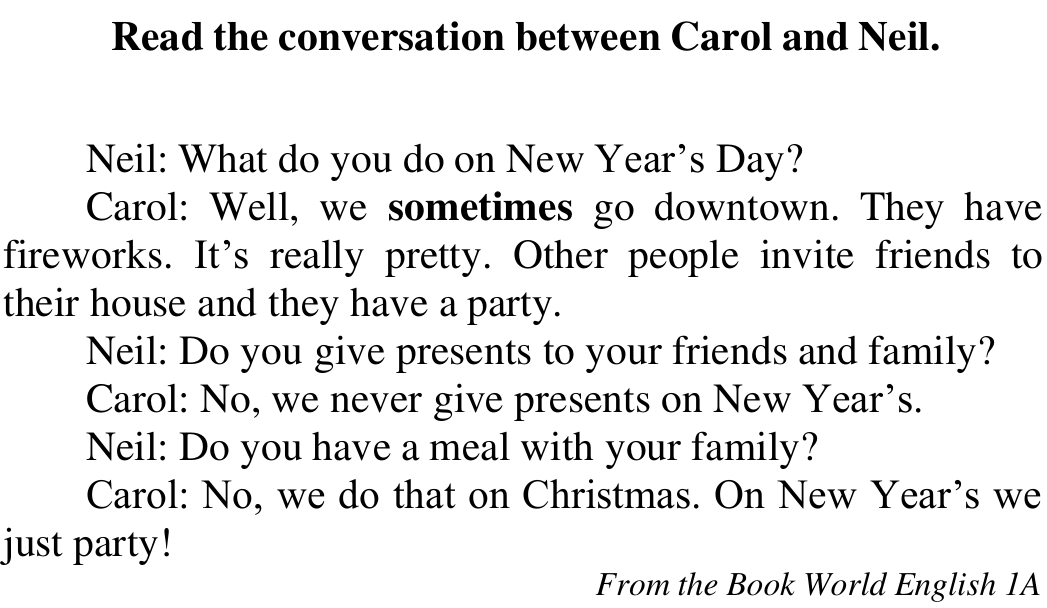
Texto “Read the conversation between Carol and Neil.”: Neil: What do you do on New Year’s Day? Carol: Well, we sometimes go downtown. They have fireworks. It’s really pretty. Other people invite friends to their house and they have a party. Neil: Do you give presents to your friends and family? Carol: No, we never give presents on New Year’s. Neil: Do you have a meal with your family? Carol: No, we do that on Christmas. On New Year’s we just party! From the Book World English 1A. Em negrito: sometimes.

Choose the alternative that best replaces the word in bold without changing the meaning of the adverb.
Selecione uma alternativa

Língua Inglesa Vocabulário — Sinônimos

Escola de Especialistas de Aeronáutica (EEAR) Médio

Comando da Aeronáutica — Escola de Especialistas de Aeronáutica · Curso de Formação de Sargentos da Aeronáutica (CFS 1/2023) — Aeronavegantes e Não-Aeronavegantes · Caderno Código 81

Gabarito disponível

Texto-base:
Read the text and answer questions 34, 35, 36 and 37.

Texto “Read the conversation between Carol and Neil.”: Neil: What do you do on New Year’s Day? Carol: Well, we sometimes go downtown. They have fireworks. It’s really pretty. Other people invite friends to their house and they have a party. Neil: Do you give presents to your friends and family? Carol: No, we never give presents on New Year’s. Neil: Do you have a meal with your family? Carol: No, we do that on Christmas. On New Year’s we just party! From the Book World English 1A. Em negrito: sometimes.

The word “really” can be replaced by the words below, EXCEPT by:
Selecione uma alternativa

Língua Inglesa Vocabulário

Escola de Especialistas de Aeronáutica (EEAR) Médio

Comando da Aeronáutica — Escola de Especialistas de Aeronáutica · Curso de Formação de Sargentos da Aeronáutica (CFS 1/2023) — Aeronavegantes e Não-Aeronavegantes · Caderno Código 81

Gabarito disponível

Texto-base:
Read the text and answer questions 34, 35, 36 and 37.
Texto “Read the conversation between Carol and Neil.”: Neil: What do you do on New Year’s Day? Carol: Well, we sometimes go downtown. They have fireworks. It’s really pretty. Other people invite friends to their house and they have a party. Neil: Do you give presents to your friends and family? Carol: No, we never give presents on New Year’s. Neil: Do you have a meal with your family? Carol: No, we do that on Christmas. On New Year’s we just party! From the Book World English 1A. Em negrito: sometimes.

The word “meal” in the text is related to:
Selecione uma alternativa

Língua Inglesa Pronomes — Referência

Escola de Especialistas de Aeronáutica (EEAR) Médio

Comando da Aeronáutica — Escola de Especialistas de Aeronáutica · Curso de Formação de Sargentos da Aeronáutica (CFS 1/2023) — Aeronavegantes e Não-Aeronavegantes · Caderno Código 81

Gabarito disponível

Texto-base:
Read the text and answer questions 34, 35, 36 and 37.

Texto “Read the conversation between Carol and Neil.”: Neil: What do you do on New Year’s Day? Carol: Well, we sometimes go downtown. They have fireworks. It’s really pretty. Other people invite friends to their house and they have a party. Neil: Do you give presents to your friends and family? Carol: No, we never give presents on New Year’s. Neil: Do you have a meal with your family? Carol: No, we do that on Christmas. On New Year’s we just party! From the Book World English 1A. Em negrito: sometimes.

Comando: In the sentence “Other people invite friends to their house and they have a party...”, the underlined word is related to: — Sublinhado: their.
Selecione uma alternativa

Língua Inglesa Tempos Verbais — Simple Present

Escola de Especialistas de Aeronáutica (EEAR) Médio

Comando da Aeronáutica — Escola de Especialistas de Aeronáutica · Curso de Formação de Sargentos da Aeronáutica (CFS 1/2023) — Aeronavegantes e Não-Aeronavegantes · Caderno Código 81

Gabarito disponível

Read the sentences below.
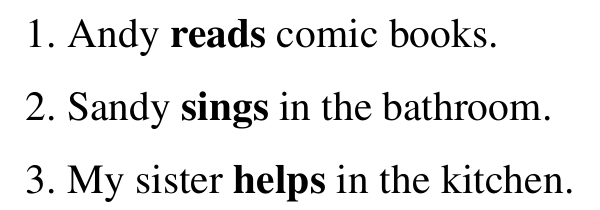
Frases: 1. Andy reads comic books. 2. Sandy sings in the bathroom. 3. My sister helps in the kitchen. Em negrito: reads, sings, helps.
The verbs in bold are in the:
Selecione uma alternativa

Língua Inglesa Tempos Verbais — Present Progressive

Escola de Especialistas de Aeronáutica (EEAR) Médio

Comando da Aeronáutica — Escola de Especialistas de Aeronáutica · Curso de Formação de Sargentos da Aeronáutica (CFS 1/2023) — Aeronavegantes e Não-Aeronavegantes · Caderno Código 81

Gabarito disponível

Texto-base:
Read the text and answer questions 39 and 40.
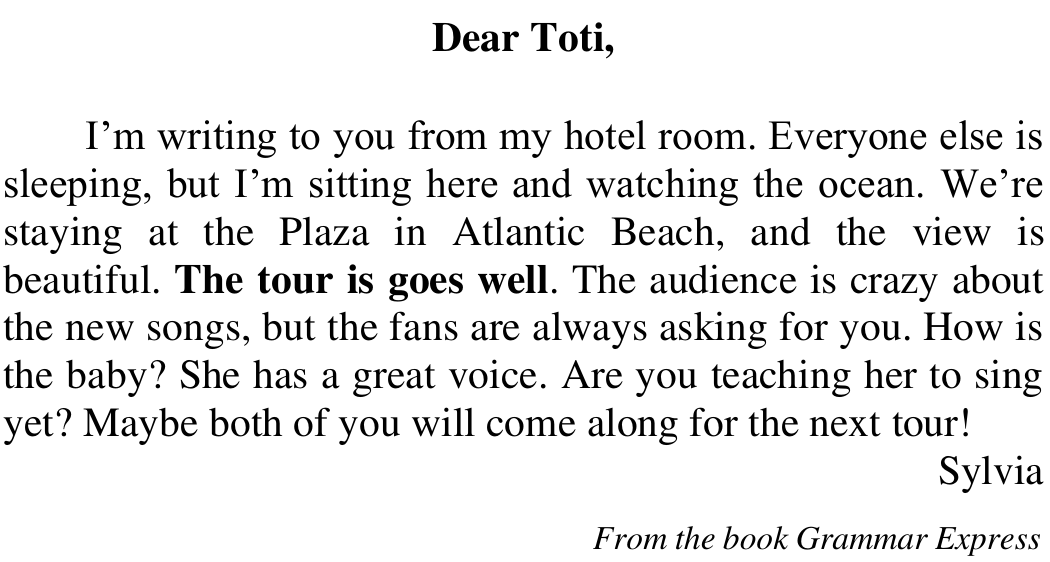
Carta “Dear Toti,”: I’m writing to you from my hotel room. Everyone else is sleeping, but I’m sitting here and watching the ocean. We’re staying at the Plaza in Atlantic Beach, and the view is beautiful. The tour is goes well. The audience is crazy about the new songs, but the fans are always asking for you. How is the baby? She has a great voice. Are you teaching her to sing yet? Maybe both of you will come along for the next tour! Sylvia. From the book Grammar Express. Em negrito: The tour is goes well.

In the letter, the sentence in bold is wrong. The correct form of the sentence is:
Selecione uma alternativa

Língua Inglesa Interpretação de Texto

Escola de Especialistas de Aeronáutica (EEAR) Médio

Comando da Aeronáutica — Escola de Especialistas de Aeronáutica · Curso de Formação de Sargentos da Aeronáutica (CFS 1/2023) — Aeronavegantes e Não-Aeronavegantes · Caderno Código 81

Gabarito disponível

Texto-base:
Read the text and answer questions 39 and 40.

Carta “Dear Toti,”: I’m writing to you from my hotel room. Everyone else is sleeping, but I’m sitting here and watching the ocean. We’re staying at the Plaza in Atlantic Beach, and the view is beautiful. The tour is goes well. The audience is crazy about the new songs, but the fans are always asking for you. How is the baby? She has a great voice. Are you teaching her to sing yet? Maybe both of you will come along for the next tour! Sylvia. From the book Grammar Express. Em negrito: The tour is goes well.

In the end of the letter, the sentence “both of you” means:
Selecione uma alternativa
