← Voltar para a lista de provas Exército Brasileiro — Escola de Saúde e Formação Complementar do Exército (ESFCEx) · Oficial do Quadro Complementar do Exército 60 questões nesta prova · página 3 de 3 · 60 com gabarito Gabarito disponível O texto é um abstract de uma pesquisa sobre abstracts. O texto resume objetivo, lacuna, método (125 abstracts de cinco periódicos), resultados e conclusão, que é a estrutura de um abstract. Como o objeto de análise são abstracts de artigos, trata-se de um abstract sobre pesquisa sobre abstracts (C). A) Não convoca a submissão de trabalhos. B) Não é um resumo argumentativo sobre escrita acadêmica melhorada. D) Não é um folheto. E) Não é uma resenha de artigo, e sim o resumo da própria pesquisa. Referência: Gêneros acadêmicos: abstract. Resolução comentada do VaiConcursos. Gabarito disponível Gabarito disponível Gabarito disponível A palavra com fricativa dental surda inicial é 'thing'. Em 'thing', o 'th' inicial é /θ/, fricativa dental surda, como em 'thin'. As demais têm /ð/, sonoro, como em 'thus'. B) 'their' começa com /ð/, sonoro. C) 'this' começa com /ð/. D) 'there' começa com /ð/. E) 'thus' começa com /ð/ (o próprio texto o dá como exemplo de sonoro). Referência: Roach, English Phonetics and Phonology (2003). Resolução comentada do VaiConcursos. Gabarito disponível Gabarito disponível O som [tʃ] de 'charm' aparece em 'attachment'. Em 'attachment', o 'ch' é pronunciado /tʃ/, igual ao de 'charm'. Em 'monarch' e 'stomach' o 'ch' soa /k/, em 'brochure' e 'champagne' soa /ʃ/. A) Monarch tem /k/. C) Brochure tem /ʃ/. D) Champagne tem /ʃ/. E) Stomach tem /k/. Referência: Fonética do inglês: dígrafo 'ch'. Resolução comentada do VaiConcursos. Gabarito disponível O argumento central é que o tipo de tarefa e a forma de avaliação determinam o uso do ChatGPT. O texto afirma que a decisão de trapacear se relaciona a como tarefas e provas são construídas e avaliadas, e não à disponibilidade da tecnologia. Isso corresponde à alternativa C. A) O texto não defende banir usos ruins da tecnologia. B) Não afirma que a tecnologia sempre foi boa parceira. D) Não trata de ser inadmissível ensinar sem tecnologia. E) Não afirma que os chatbots já tenham melhorado as salas de aula. Referência: Xie & Anderman, The Conversation (2023), texto-base. Resolução comentada do VaiConcursos. Gabarito disponível O prefixo 'out-' de 'outperform' (superar) aparece em 'outlive'. Em 'outperform', 'out-' significa 'mais/melhor do que', 'superar'. O mesmo sentido está em 'outlive' (viver mais que alguém), alternativa E. A) Outburst: 'out' indica movimento para fora, explosão. B) Outfit: sentido não ligado a superar. C) Outrage: indignação ou ultraje, sem esse sentido. D) Outlaw: aquele fora da lei, sentido de exterior. Referência: Morfologia do inglês: prefixos. Resolução comentada do VaiConcursos. Gabarito disponível A discussão crítica pós-leitura deve relacionar o conteúdo à realidade brasileira. Uma reação crítica ao conteúdo pede que os alunos relacionem as ideias do texto à sua realidade. Refletir se as preocupações com o uso de ChatGPT para trapacear também existem no contexto educacional brasileiro (C) faz isso, ao contrário das demais opções, que tratam de leitura ou de língua. A) Foca estratégias de leitura, não reação ao conteúdo. B) Questiona a fonte, mas não discute o conteúdo. D) Trata do gênero textual e da compreensão. E) Trata de dificuldades linguísticas, não de reação crítica. Referência: Ensino de leitura crítica em língua estrangeira. Resolução comentada do VaiConcursos. Gabarito disponível Deduzir o sentido de 'boost' pelo contexto é inferência. Inferência é a estratégia de deduzir o significado de uma palavra desconhecida a partir do contexto, sem dicionário. Aqui, 'boost confidence' junto de 'opportunities to experience success' indica o sentido de aumentar ou reforçar (A). B) Anticipation é prever o conteúdo antes de ler. C) Interlanguage é o sistema linguístico do aprendiz, não uma estratégia. D) Reviewing é revisar o aprendido. E) Scanning é buscar informação específica no texto. Referência: Estratégias de leitura em língua estrangeira. Resolução comentada do VaiConcursos. Gabarito disponível A tarefa de dividir o problema em etapas menores ilustra metas de curto prazo a serviço de uma meta maior. O ChatGPT divide o grande projeto em tarefas menores (conceito, tamanho, peso, combustível), gerando pequenas conquistas que levam ao objetivo maior. Isso corresponde ao estabelecimento de metas de curto prazo que contribuem para uma meta mais ampla (A), ligado a 'goals and goal setting' de Harmer. B) O foco da tarefa está nas etapas imediatas, não em metas de longo prazo. C) Nada indica tópicos ligados a interesses pessoais. D) Não se trata de adaptar a tarefa para manter a atenção. E) Não há criação de um ambiente linguístico desafiador. Referência: Harmer, The Practice of English Language Teaching, 4th ed. (2007). Resolução comentada do VaiConcursos. Gabarito disponível Gabarito disponível O primeiro parágrafo critica a globalização cultural no ensino de inglês. O parágrafo questiona suposições de que a orientação comunicativa serve a qualquer contexto global, como a ideia de que todos querem preencher o silêncio. Isso é uma crítica à imposição de pressupostos culturais (europeus) em contextos globais (E). A) O 'information gap' é apenas um exemplo, e não o alvo geral. B) A crítica é às suposições de universalidade, não ao ensino comunicativo em si. C) O texto não diz que a ausência de silêncio prejudique a aprendizagem. D) Estereótipos de gênero não são o foco do primeiro parágrafo. Referência: Pennycook (2017), texto-base. Resolução comentada do VaiConcursos. Gabarito disponível O segundo parágrafo implica tratar diferenças culturais respeitando contextos e realidades individuais. O autor diz que a linguagem é prática cultural situada e que abordagens baseadas numa só visão podem ser inaplicáveis em outro contexto. Para o ensino no Brasil, isso implica tratar as diferenças culturais respeitando contextos e realidades específicos (B). A) O autor questiona visões universais, e não defende a escolha do Inglês como Língua Internacional por não ter contexto. C) Nada no texto fala de orientações gerais para a escola regular. D) O texto não propõe priorizar a multiculturalidade em vez da língua. E) O autor vê a sala de aula como espaço de disputa e não pede abstenção. Referência: Pennycook (2017), texto-base. Resolução comentada do VaiConcursos. Gabarito disponível Gabarito disponível 'Such practices' retoma as práticas exportadas como as melhores, expressão do poder do conhecimento global. 'Such practices' retoma as práticas de ensino anunciadas e exportadas como as melhores, mais novas e mais científicas, que apoiam certas visões de linguagem. O texto as associa a uma política cultural particular, ou seja, ao poder de um conhecimento globalmente difundido (A). B) O texto diz 'advertised as' the best; é a propaganda, não uma constatação de que sejam as melhores. C) A disputa é consequência dessas práticas, não aquilo que elas refletem. D) O texto fala em práticas novas e exportadas, não tradicionais. E) Inovação é só uma característica anunciada, e não o que as práticas refletem. Referência: Pennycook (2017), texto-base. Resolução comentada do VaiConcursos. Gabarito disponível O texto de Pennycook leva a discutir práticas de linguagem e diversidade cultural. O texto afirma que a linguagem é prática cultural e que o uso do silêncio, da fala e da paralinguagem varia entre contextos culturais e de gênero. Assim, o tema mais direto é a relação entre práticas de linguagem e diversidade cultural (E). A) Não há contraste entre práticas tradicionais e novas. B) O foco não é ensinar cultura, mas questionar a universalidade de métodos. C) Multimodalidade não é abordada. D) Multiletramentos e multilinguismo não aparecem no texto. Referência: Pennycook, The Cultural Politics of English as an International Language (texto-base). Resolução comentada do VaiConcursos. Gabarito disponível As citações ilustram a necessidade de conteúdo cultural adequado nos materiais didáticos. As três falas (Costa do Marfim, Brasil, Iraque) mostram que o contexto cultural dos materiais pode ser inadequado, ameaçador, motivador ou exótico. O autor fala em 'appropriate contextual realisation', ou seja, a necessidade de conteúdo cultural adequado ao público. Por isso a alternativa C sintetiza a ideia central. A) Reduz a questão à falta de familiaridade com os temas, e o autor trata do contexto cultural, não só do tema; além disso, o caso do iraquiano mostra que o desconhecido pode ser curioso e exótico, não apenas inadequado. B) Autenticidade dos materiais não é discutida. D) Fala em expectativas e urgência, o que o texto não afirma; o foco é o conteúdo cultural. E) Descreve apenas as reações das pessoas, mas o ponto do autor é o que os materiais devem conter. Referência: Jolly & Bolitho, in Tomlinson (ed.), Materials Development in Language Teaching (texto-base). Resolução comentada do VaiConcursos. Gabarito disponível 'I can't do making wine' indica que fazer vinho é proibido naquele país. O professor diz que país quente e com muitos muçulmanos não permite fazer vinho nem fumar maconha, ou seja, é proibido. A frase 'I can't do ... in my country' expressa proibição cultural e legal, não incapacidade. A) Interpreta como incapacidade por falta de uvas, mas o contexto fala de religião. B) Não há erro nem despreparo do professor. C) Não se trata de erro de redundância. E) Não é questão de habilidade pessoal. Referência: Jolly e Bolitho, A framework for materials writing, 1998/2011. Resolução comentada do VaiConcursos. Gabarito disponível 'Likely' é adjetivo no quarto parágrafo. Em 'the student is curious and likely to regard the material', 'likely' é adjetivo (provável/propenso), coordenado a 'curious'. Os demais terminam em -ly mas são advérbios. A) Conversely, C) possibly, D) simply e E) merely são advérbios. Referência: Gramática inglesa: adjetivos e advérbios. Resolução comentada do VaiConcursos.EsFCEx — Concurso de Admissão 2023 — Curso de Formação de Oficiais do Quadro Complementar — Área: Magistério em Inglês — 012. Prova Objetiva — Versão A
Leia o texto para responder às questões de números 41 e 42.
To share knowledge in the academic world, researchers might need to publish their research articles (RAs) in high-impact journals. And, to do that, they should improve their writing skills. Many investigations have analyzed the distribution of metadiscourse markers in RA, but no study has yet investigated the use of metadiscourse markers in RAs abstracts of applied linguistics. To bridge this gap, the present study has analyzed distribution of metadiscourse markers in 125 RA abstracts, which were extracted from five main journals. Findings show the high frequency of transitions and large use of hedges in the abstracts analyzed. Academic writing instruction is then claimed to be of utmost importance for novice authors taking graduate and post-graduate courses.
(Journal of Language and Linguistic Studies, 16(4), 2077-2096; 2020. Adaptado)
The text isResolução comentada
Análise das alternativas
Leia o texto para responder às questões de números 41 e 42.
To share knowledge in the academic world, researchers might need to publish their research articles (RAs) in high-impact journals. And, to do that, they should improve their writing skills. Many investigations have analyzed the distribution of metadiscourse markers in RA, but no study has yet investigated the use of metadiscourse markers in RAs abstracts of applied linguistics. To bridge this gap, the present study has analyzed distribution of metadiscourse markers in 125 RA abstracts, which were extracted from five main journals. Findings show the high frequency of transitions and large use of hedges in the abstracts analyzed. Academic writing instruction is then claimed to be of utmost importance for novice authors taking graduate and post-graduate courses.
(Journal of Language and Linguistic Studies, 16(4), 2077-2096; 2020. Adaptado)
Written genres in the academic and scientific spheres make large use of the impersonal passive voice. Select, from the following fragments in bold, the correct impersonal passive construction such as the one found in “Academic writing instruction is claimed to be of utmost importance”:
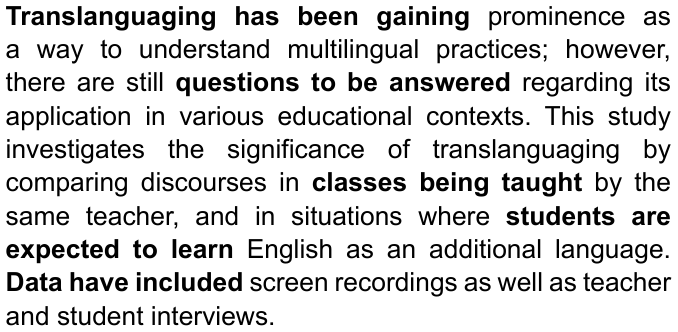
(https://www.uv.uio.no. Adaptado)
Leia o texto para responder às questões de números 44 e 45.
Fricatives are consonants with the characteristic that air escapes through a narrow passage and makes a hissing sound. The dental fricatives are sometimes described as if the tongue were placed between the front teeth, and it is common for teachers to make their students do this when they are trying to teach them the sound. The thing is, however, that the tongue is normally placed behind the teeth; the air escapes through the gaps between the tongue and the teeth. There is a distiction between fortis (unvoiced) fricatives, as in the word “thin”, and lenis (voiced) fricatives, as in “thus”. (Roach 2003)
(Mark Roach,. English Phonetics and Phonology. Cambridge: CUP, 2003. Adaptado)
There are several words with fricatives in the preceding text. The word with an unvoiced initial fricative isResolução comentada
Análise das alternativas
Leia o texto para responder às questões de números 44 e 45.
Fricatives are consonants with the characteristic that air escapes through a narrow passage and makes a hissing sound. The dental fricatives are sometimes described as if the tongue were placed between the front teeth, and it is common for teachers to make their students do this when they are trying to teach them the sound. The thing is, however, that the tongue is normally placed behind the teeth; the air escapes through the gaps between the tongue and the teeth. There is a distiction between fortis (unvoiced) fricatives, as in the word “thin”, and lenis (voiced) fricatives, as in “thus”. (Roach 2003)
(Mark Roach,. English Phonetics and Phonology. Cambridge: CUP, 2003. Adaptado)

Resolução comentada
Análise das alternativas
Leia o texto para responder às questões de números 47 a 52.
Since ChatGPT can engage in conversation and generate essays and graphs that closely resemble those created by humans, educators worry students may use it to cheat. The main reason students cheat is their academic motivation. Sometimes they are just motivated to get a high grade, whereas other times they wish to learn all that they can about a topic. The decision to cheat or not often relates to how academic assignments and tests are constructed and assessed, not on the availability of technological shortcuts.
Research demonstrates that students are more likely to cheat when assignments are designed in ways that encourage them to outperform their classmates. There is less cheating when teachers assign academic tasks that prompt them to work collaboratively and to focus on mastering content instead of getting a good grade.
An important way to boost students’ confidence is to provide them with opportunities to experience success. For example, suppose students are asked to attempt to design a hypothetical vehicle that can use gasoline more efficiently than a traditional car. Students who struggle with the project can use ChatGPT to break down the larger problem into smaller challenges or tasks. ChatGPT might suggest they first develop an overall concept for the vehicle before determining the size and weight of the vehicle and deciding what type of fuel will be used. Teachers could also ask students to compare the steps suggested by ChatGPT with steps that are recommended by other sources.
(Kui Xie e Eric M. Anderman. http://www.theconversation.com. 06.06.2023. Adaptado)
It is a main argument in the text:Resolução comentada
Análise das alternativas
Leia o texto para responder às questões de números 47 a 52.
Since ChatGPT can engage in conversation and generate essays and graphs that closely resemble those created by humans, educators worry students may use it to cheat. The main reason students cheat is their academic motivation. Sometimes they are just motivated to get a high grade, whereas other times they wish to learn all that they can about a topic. The decision to cheat or not often relates to how academic assignments and tests are constructed and assessed, not on the availability of technological shortcuts.
Research demonstrates that students are more likely to cheat when assignments are designed in ways that encourage them to outperform their classmates. There is less cheating when teachers assign academic tasks that prompt them to work collaboratively and to focus on mastering content instead of getting a good grade.
An important way to boost students’ confidence is to provide them with opportunities to experience success. For example, suppose students are asked to attempt to design a hypothetical vehicle that can use gasoline more efficiently than a traditional car. Students who struggle with the project can use ChatGPT to break down the larger problem into smaller challenges or tasks. ChatGPT might suggest they first develop an overall concept for the vehicle before determining the size and weight of the vehicle and deciding what type of fuel will be used. Teachers could also ask students to compare the steps suggested by ChatGPT with steps that are recommended by other sources.
(Kui Xie e Eric M. Anderman. http://www.theconversation.com. 06.06.2023. Adaptado)
Mark the alternative in which the prefix “out” means the same as in “outperform” (paragraph 2).Resolução comentada
Análise das alternativas
Leia o texto para responder às questões de números 47 a 52.
Since ChatGPT can engage in conversation and generate essays and graphs that closely resemble those created by humans, educators worry students may use it to cheat. The main reason students cheat is their academic motivation. Sometimes they are just motivated to get a high grade, whereas other times they wish to learn all that they can about a topic. The decision to cheat or not often relates to how academic assignments and tests are constructed and assessed, not on the availability of technological shortcuts.
Research demonstrates that students are more likely to cheat when assignments are designed in ways that encourage them to outperform their classmates. There is less cheating when teachers assign academic tasks that prompt them to work collaboratively and to focus on mastering content instead of getting a good grade.
An important way to boost students’ confidence is to provide them with opportunities to experience success. For example, suppose students are asked to attempt to design a hypothetical vehicle that can use gasoline more efficiently than a traditional car. Students who struggle with the project can use ChatGPT to break down the larger problem into smaller challenges or tasks. ChatGPT might suggest they first develop an overall concept for the vehicle before determining the size and weight of the vehicle and deciding what type of fuel will be used. Teachers could also ask students to compare the steps suggested by ChatGPT with steps that are recommended by other sources.
(Kui Xie e Eric M. Anderman. http://www.theconversation.com. 06.06.2023. Adaptado)
An English teacher believes this is a good text to give their more advanced students to read, since it is about a recent and polemic topic. A post-reading classroom discussion aimed at helping students critically react to the text’s content could include reflecting aboutResolução comentada
Análise das alternativas
Leia o texto para responder às questões de números 47 a 52.
Since ChatGPT can engage in conversation and generate essays and graphs that closely resemble those created by humans, educators worry students may use it to cheat. The main reason students cheat is their academic motivation. Sometimes they are just motivated to get a high grade, whereas other times they wish to learn all that they can about a topic. The decision to cheat or not often relates to how academic assignments and tests are constructed and assessed, not on the availability of technological shortcuts.
Research demonstrates that students are more likely to cheat when assignments are designed in ways that encourage them to outperform their classmates. There is less cheating when teachers assign academic tasks that prompt them to work collaboratively and to focus on mastering content instead of getting a good grade.
An important way to boost students’ confidence is to provide them with opportunities to experience success. For example, suppose students are asked to attempt to design a hypothetical vehicle that can use gasoline more efficiently than a traditional car. Students who struggle with the project can use ChatGPT to break down the larger problem into smaller challenges or tasks. ChatGPT might suggest they first develop an overall concept for the vehicle before determining the size and weight of the vehicle and deciding what type of fuel will be used. Teachers could also ask students to compare the steps suggested by ChatGPT with steps that are recommended by other sources.
(Kui Xie e Eric M. Anderman. http://www.theconversation.com. 06.06.2023. Adaptado)
While reading the text, students mention they do not understand the word “boost” in “An important way to boost students’ confidence”. One of the ways to arrive at meaning of the word without resorting to the dictionary is by means of the compensatory strategy namedResolução comentada
Análise das alternativas
Leia o texto para responder às questões de números 47 a 52.
Since ChatGPT can engage in conversation and generate essays and graphs that closely resemble those created by humans, educators worry students may use it to cheat. The main reason students cheat is their academic motivation. Sometimes they are just motivated to get a high grade, whereas other times they wish to learn all that they can about a topic. The decision to cheat or not often relates to how academic assignments and tests are constructed and assessed, not on the availability of technological shortcuts.
Research demonstrates that students are more likely to cheat when assignments are designed in ways that encourage them to outperform their classmates. There is less cheating when teachers assign academic tasks that prompt them to work collaboratively and to focus on mastering content instead of getting a good grade.
An important way to boost students’ confidence is to provide them with opportunities to experience success. For example, suppose students are asked to attempt to design a hypothetical vehicle that can use gasoline more efficiently than a traditional car. Students who struggle with the project can use ChatGPT to break down the larger problem into smaller challenges or tasks. ChatGPT might suggest they first develop an overall concept for the vehicle before determining the size and weight of the vehicle and deciding what type of fuel will be used. Teachers could also ask students to compare the steps suggested by ChatGPT with steps that are recommended by other sources.
(Kui Xie e Eric M. Anderman. http://www.theconversation.com. 06.06.2023. Adaptado)
Read this short except.
There are three areas where our behaviour can directly influence our students’ continuing participation: goals and goal setting; learning environment; interesting classes.
(J. Harmer, The practice of English language teaching. 4th ed. Essex: Pearson Longman, 2007. Adaptado)
The task proposed in the last paragraph of the text on ChatGPT illustrates the following motivational behavior on the part of teachers:Resolução comentada
Análise das alternativas
Leia o texto para responder às questões de números 47 a 52.
Since ChatGPT can engage in conversation and generate essays and graphs that closely resemble those created by humans, educators worry students may use it to cheat. The main reason students cheat is their academic motivation. Sometimes they are just motivated to get a high grade, whereas other times they wish to learn all that they can about a topic. The decision to cheat or not often relates to how academic assignments and tests are constructed and assessed, not on the availability of technological shortcuts.
Research demonstrates that students are more likely to cheat when assignments are designed in ways that encourage them to outperform their classmates. There is less cheating when teachers assign academic tasks that prompt them to work collaboratively and to focus on mastering content instead of getting a good grade.
An important way to boost students’ confidence is to provide them with opportunities to experience success. For example, suppose students are asked to attempt to design a hypothetical vehicle that can use gasoline more efficiently than a traditional car. Students who struggle with the project can use ChatGPT to break down the larger problem into smaller challenges or tasks. ChatGPT might suggest they first develop an overall concept for the vehicle before determining the size and weight of the vehicle and deciding what type of fuel will be used. Teachers could also ask students to compare the steps suggested by ChatGPT with steps that are recommended by other sources.
(Kui Xie e Eric M. Anderman. http://www.theconversation.com. 06.06.2023. Adaptado)
Read the cover of the book by A.A. Kabir.

(amazon.com)
Ajudar seu aluno a desenvolver a habilidade de leitura em inglês significa, entre outros, ajudá-lo a comparar diferentes textos. Ao confrontar o artigo sobre ChatGPT e a capa do livro de A.A. Kabir, ele deverá perceber que ambos mencionam
Leia o texto para responder às questões de números 53 a 57.
Many assumptions of a communicative orientation towards language teaching need questioning in a global context. Ozóg (1989) discusses the idea of the ‘information gap’, which is supposed to induce students to speak. ‘Are we as Europeans’, he asks, ‘not making a cultural assumption that speakers the world over are uneasy in silence and that they have an overwhelming desire to fill gaps which occur in natural discourse?’ (p.399). Silence is a salient feature of conversation in the Malay world, he points out, a feature that has also been noted in Japan and a number of other cultures.
Indeed, the whole question of requiring others to speak needs to be questioned in terms of both cultural and gender differences. The point here is not to exoticize some notion of cultural difference, but rather to suggest that language is a cultural practice, that both language and thinking about language are always located in very particular social, cultural and political contexts. How language (including silence, paralanguage, and so on) is used, therefore, differs extensively from one context to another, and thus any approach to language teaching based on one particular view of language may be completely inapplicable in another context. If particular language teaching practices (advertised and exported as the best, newest and most scientific) support certain views of language, then such practices clearly present a particular cultural politics and make the English language classroom a site of struggle over different ways of thinking about and dealing with language.
(A. Pennycook, The Cultural Politics of English as an International Language.London and New York: Routledge. 2017. Adaptado)
The first paragraph criticizesResolução comentada
Análise das alternativas
Leia o texto para responder às questões de números 53 a 57.
Many assumptions of a communicative orientation towards language teaching need questioning in a global context. Ozóg (1989) discusses the idea of the ‘information gap’, which is supposed to induce students to speak. ‘Are we as Europeans’, he asks, ‘not making a cultural assumption that speakers the world over are uneasy in silence and that they have an overwhelming desire to fill gaps which occur in natural discourse?’ (p.399). Silence is a salient feature of conversation in the Malay world, he points out, a feature that has also been noted in Japan and a number of other cultures.
Indeed, the whole question of requiring others to speak needs to be questioned in terms of both cultural and gender differences. The point here is not to exoticize some notion of cultural difference, but rather to suggest that language is a cultural practice, that both language and thinking about language are always located in very particular social, cultural and political contexts. How language (including silence, paralanguage, and so on) is used, therefore, differs extensively from one context to another, and thus any approach to language teaching based on one particular view of language may be completely inapplicable in another context. If particular language teaching practices (advertised and exported as the best, newest and most scientific) support certain views of language, then such practices clearly present a particular cultural politics and make the English language classroom a site of struggle over different ways of thinking about and dealing with language.
(A. Pennycook, The Cultural Politics of English as an International Language.London and New York: Routledge. 2017. Adaptado)
A exposição do autor no segundo parágrafo traz a seguinte implicação para o ensino de inglês no contexto brasileiro:Resolução comentada
Análise das alternativas
Leia o texto para responder às questões de números 53 a 57.
Many assumptions of a communicative orientation towards language teaching need questioning in a global context. Ozóg (1989) discusses the idea of the ‘information gap’, which is supposed to induce students to speak. ‘Are we as Europeans’, he asks, ‘not making a cultural assumption that speakers the world over are uneasy in silence and that they have an overwhelming desire to fill gaps which occur in natural discourse?’ (p.399). Silence is a salient feature of conversation in the Malay world, he points out, a feature that has also been noted in Japan and a number of other cultures.
Indeed, the whole question of requiring others to speak needs to be questioned in terms of both cultural and gender differences. The point here is not to exoticize some notion of cultural difference, but rather to suggest that language is a cultural practice, that both language and thinking about language are always located in very particular social, cultural and political contexts. How language (including silence, paralanguage, and so on) is used, therefore, differs extensively from one context to another, and thus any approach to language teaching based on one particular view of language may be completely inapplicable in another context. If particular language teaching practices (advertised and exported as the best, newest and most scientific) support certain views of language, then such practices clearly present a particular cultural politics and make the English language classroom a site of struggle over different ways of thinking about and dealing with language.
(A. Pennycook, The Cultural Politics of English as an International Language.London and New York: Routledge. 2017. Adaptado)
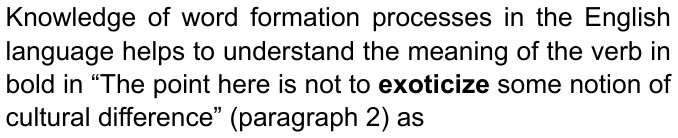
Leia o texto para responder às questões de números 53 a 57.
Many assumptions of a communicative orientation towards language teaching need questioning in a global context. Ozóg (1989) discusses the idea of the ‘information gap’, which is supposed to induce students to speak. ‘Are we as Europeans’, he asks, ‘not making a cultural assumption that speakers the world over are uneasy in silence and that they have an overwhelming desire to fill gaps which occur in natural discourse?’ (p.399). Silence is a salient feature of conversation in the Malay world, he points out, a feature that has also been noted in Japan and a number of other cultures.
Indeed, the whole question of requiring others to speak needs to be questioned in terms of both cultural and gender differences. The point here is not to exoticize some notion of cultural difference, but rather to suggest that language is a cultural practice, that both language and thinking about language are always located in very particular social, cultural and political contexts. How language (including silence, paralanguage, and so on) is used, therefore, differs extensively from one context to another, and thus any approach to language teaching based on one particular view of language may be completely inapplicable in another context. If particular language teaching practices (advertised and exported as the best, newest and most scientific) support certain views of language, then such practices clearly present a particular cultural politics and make the English language classroom a site of struggle over different ways of thinking about and dealing with language.
(A. Pennycook, The Cultural Politics of English as an International Language.London and New York: Routledge. 2017. Adaptado)
In the last sentence of the text, the expression “such practices” refers to language teaching practices which reflectResolução comentada
Análise das alternativas
Leia o texto para responder às questões de números 53 a 57.
Many assumptions of a communicative orientation towards language teaching need questioning in a global context. Ozóg (1989) discusses the idea of the ‘information gap’, which is supposed to induce students to speak. ‘Are we as Europeans’, he asks, ‘not making a cultural assumption that speakers the world over are uneasy in silence and that they have an overwhelming desire to fill gaps which occur in natural discourse?’ (p.399). Silence is a salient feature of conversation in the Malay world, he points out, a feature that has also been noted in Japan and a number of other cultures.
Indeed, the whole question of requiring others to speak needs to be questioned in terms of both cultural and gender differences. The point here is not to exoticize some notion of cultural difference, but rather to suggest that language is a cultural practice, that both language and thinking about language are always located in very particular social, cultural and political contexts. How language (including silence, paralanguage, and so on) is used, therefore, differs extensively from one context to another, and thus any approach to language teaching based on one particular view of language may be completely inapplicable in another context. If particular language teaching practices (advertised and exported as the best, newest and most scientific) support certain views of language, then such practices clearly present a particular cultural politics and make the English language classroom a site of struggle over different ways of thinking about and dealing with language.
(A. Pennycook, The Cultural Politics of English as an International Language.London and New York: Routledge. 2017. Adaptado)
As part of a teacher education course, the reading of this text could most directly raise a relevant discussion on the topic ofResolução comentada
Análise das alternativas
Leia o texto para responder às questões de números 58 a 60.
“It’s a very nice book and very lively, but in the section on ‘Processes’ for example all the exercises are about unusual things for our country. We are a hot country and also have many Muslims. The exercises are about snow, ice, cold mornings, and making wine. I can tell you I can’t do making wine and smoking pot in my country!” (Experienced school teacher from the Ivory Coast, Africa)
“Previous materials were not based on life in Brazil which is why I don’t think they worked very well …” (Brazilian teacher of English in school)
“Sir … what is opera?” (Iraqi student in mixed nationality class using materials designed to practise reading narrative)
The implications of these three quotations are not simply linguistic; rather, they address the problem of appropriate contextual realisation for materials. For the teacher in the Ivory Coast, the materials offered would be outside the cultural experience of his students (possibly even threatening) and thus effectively useless; conversely, for the Brazilian teacher, the choice of Brazilian settings and familiar mores would have clear advantages over distant foreign contexts as they are essentially more motivating. The quote from the Iraqi student suggests that complete unfamiliarity with the notion of opera may reduce the efficacy of the reading exercises, but in this case the student is curious and likely to regard the material as exotic rather than merely alien.
(D. Jolly e R. Bolitho, A framework for materials writing. In B. Tomlinson, (ed). Material Development in Language Teaching. Cambridge: CUP. 1998/2011. Adaptado)
The three quotations and the subsequent comments by the author illustrateResolução comentada
Análise das alternativas
Leia o texto para responder às questões de números 58 a 60.
“It’s a very nice book and very lively, but in the section on ‘Processes’ for example all the exercises are about unusual things for our country. We are a hot country and also have many Muslims. The exercises are about snow, ice, cold mornings, and making wine. I can tell you I can’t do making wine and smoking pot in my country!” (Experienced school teacher from the Ivory Coast, Africa)
“Previous materials were not based on life in Brazil which is why I don’t think they worked very well …” (Brazilian teacher of English in school)
“Sir … what is opera?” (Iraqi student in mixed nationality class using materials designed to practise reading narrative)
The implications of these three quotations are not simply linguistic; rather, they address the problem of appropriate contextual realisation for materials. For the teacher in the Ivory Coast, the materials offered would be outside the cultural experience of his students (possibly even threatening) and thus effectively useless; conversely, for the Brazilian teacher, the choice of Brazilian settings and familiar mores would have clear advantages over distant foreign contexts as they are essentially more motivating. The quote from the Iraqi student suggests that complete unfamiliarity with the notion of opera may reduce the efficacy of the reading exercises, but in this case the student is curious and likely to regard the material as exotic rather than merely alien.
(D. Jolly e R. Bolitho, A framework for materials writing. In B. Tomlinson, (ed). Material Development in Language Teaching. Cambridge: CUP. 1998/2011. Adaptado)
Considering the whole context of the first quotation (paragraph 1), the expression “I can´t do making wine” meansResolução comentada
Análise das alternativas
Leia o texto para responder às questões de números 58 a 60.
“It’s a very nice book and very lively, but in the section on ‘Processes’ for example all the exercises are about unusual things for our country. We are a hot country and also have many Muslims. The exercises are about snow, ice, cold mornings, and making wine. I can tell you I can’t do making wine and smoking pot in my country!” (Experienced school teacher from the Ivory Coast, Africa)
“Previous materials were not based on life in Brazil which is why I don’t think they worked very well …” (Brazilian teacher of English in school)
“Sir … what is opera?” (Iraqi student in mixed nationality class using materials designed to practise reading narrative)
The implications of these three quotations are not simply linguistic; rather, they address the problem of appropriate contextual realisation for materials. For the teacher in the Ivory Coast, the materials offered would be outside the cultural experience of his students (possibly even threatening) and thus effectively useless; conversely, for the Brazilian teacher, the choice of Brazilian settings and familiar mores would have clear advantages over distant foreign contexts as they are essentially more motivating. The quote from the Iraqi student suggests that complete unfamiliarity with the notion of opera may reduce the efficacy of the reading exercises, but in this case the student is curious and likely to regard the material as exotic rather than merely alien.
(D. Jolly e R. Bolitho, A framework for materials writing. In B. Tomlinson, (ed). Material Development in Language Teaching. Cambridge: CUP. 1998/2011. Adaptado)
No quarto parágrafo, é um adjetivo a palavraResolução comentada
Análise das alternativas
Texto-base:
Texto-base:
Texto-base:
Texto-base:
Phonetic transcription contains a lot of information about the exact quality of the sounds The phonetic symbol for the initial consonant sound in “charm” is [tʃ]. The same [tʃ] sound is found in alternative:
Texto-base:
Texto-base:
Texto-base:
Texto-base:
Texto-base:
Texto-base:
Texto-base:
Texto-base:
Texto-base:
Texto-base:
Texto-base:
Texto-base:
Texto-base:
Texto-base: