← Voltar para a lista de provas Comando da Aeronáutica · Exame de Admissão aos CFOAV, CFOINT e CFOINF 2025 65 questões nesta prova · página 3 de 4 · 60 com gabarito Questão anulada Gabarito disponível Sequência correta: T-T-F-T-F-T. 1) V: 27% dos entrevistados estão afastados de algum familiar, inclusive irmãos. 2) V: Skye diz lidar com isso sendo direta ("straightforward"). 3) F: o texto não diz que a discussão envolve pessoas de gerações diferentes, apenas membros da família. 4) V: pessoas de gerações diferentes exibem comportamentos distintos. 5) F: a tecnologia teve efeito marcante no modo de vida. 6) V: comentários nas redes sociais inflamam queixas e levam a rupturas. B, C e D divergem do gabarito em itens como o 2º (verdadeiro), o 3º (falso), o 5º (falso) e o 4º (verdadeiro), por isso estão erradas. Só a A é compatível com o texto. Referência: Texto II, linhas 5-14, 20-27, 31-32 e 47-50. Resolução comentada do VaiConcursos. Gabarito disponível A "epidemia silenciosa" é o grande número de pessoas afastadas de familiares. A expressão aparece logo após os dados da pesquisa: 27% dos americanos, cerca de 67 milhões de pessoas, estão afastados de um familiar. A "silent epidemic" são, portanto, os rompimentos familiares, ou seja, pessoas que perderam contato com parentes. A) Errada: o texto não trata de desistir de ter filhos. C) Errada: não há menção a divórcios nem a aniversários de casamento. D) Errada: o texto não fala em queda da natalidade nem em famílias menores. Referência: Texto II, linhas 16-28. Resolução comentada do VaiConcursos. Gabarito disponível O autor mostra mudança rápida de hábitos entre gerações, com reflexo nos laços familiares. O texto liga a aceleração da mudança tecnológica a comportamentos, valores e crenças muito diferentes entre gerações. Depois mostra que isso, junto com rivalidades ideológicas, leva ao afastamento (estrangement) dentro das famílias. Por isso a conclusão é a da alternativa B. A) Errada: o texto não fala em criar filhos "nonchalant" nem em famílias futuras. C) Errada: o texto não atribui o afastamento à tecnologia em si, e sim a ideologias e conflitos de valores. D) Errada: o texto não fala em esforço para manter a proximidade familiar, mas em rompimentos. Referência: Texto II, linhas 1-14 e 41-50. Resolução comentada do VaiConcursos. Gabarito disponível O texto afirma que a tecnologia afeta como vivemos, além de valores e crenças. No primeiro parágrafo, o autor diz que a tecnologia (televisão, internet, smartphone) tem um efeito marcante em "how we live" e em valores e crenças. Logo, o uso de dispositivos tecnológicos mudou nosso estilo de vida. A) Errada: o texto não diz que as gerações mudam a cada 15 anos desde 1925. A Silent durou 21 anos e a Millennial, 15. C) Errada: o texto diz que pessoas nascidas com poucos anos de diferença podem viver ambientes bem distintos, ou seja, os efeitos não são iguais para todos. D) Errada: quem dança e faz lip-sync são adolescentes da era do smartphone, e a tecnologia não ensinou as gerações antigas a fazer isso. Referência: Texto II, linhas 1-14. Resolução comentada do VaiConcursos. Gabarito disponível Os filhos pertencem a si mesmos como pessoas independentes e acharão seu caminho. O poema diz que os filhos são "filhos e filhas da ânsia da Vida por si mesma", vindos através dos pais, mas não deles. Pertencem a si mesmos e seguirão seu próprio caminho. A restringe a ideia a uma visão de mundo diferente. B afirma que nunca seguirão os pais, o que o texto não diz. C diz que os filhos são destinados a um modo de vida que sempre sobrepujará os pais, o que não aparece no texto. Referência: Gibran, "On Children"; interpretação de texto poético. Resolução comentada do VaiConcursos. Gabarito disponível Os pais abrigam o corpo dos filhos, mas não podem impor sua vontade ao espírito deles. O trecho diz que os pais podem abrigar os corpos, mas as almas vivem no futuro, que eles não podem visitar. Os pais, mesmo sendo parentes biológicos, não podem impor suas vontades aos filhos. A está errada porque os filhos não são propriedade dos pais. B está errada porque o texto não fala de geração "diferente" ou estranha. D está errada porque o trecho não compara oportunidades nem fala de sonhar mais. Referência: Gibran, "On Children"; interpretação de texto poético. Resolução comentada do VaiConcursos. Gabarito disponível Em "For life goes not backward", "for" significa "because" e não "towards". Na linha 18, "For life goes not backward nor tarries with yesterday" explica a frase anterior, então "for" é conjunção com sentido de "because". Não é preposição indicando direção, como "towards". B está errada porque "through" (por meio de) e "from" (origem) têm sentidos diferentes. C está errada porque "tarries with yesterday" não forma um phrasal verb. D está errada porque "may" e "might" não são intercambiáveis em todo contexto, e o texto usa "may" para possibilidade e permissão no presente. Referência: Gibran, "On Children"; conjunções e preposições. Resolução comentada do VaiConcursos. Gabarito disponível Gabarito disponível Questão anulada Gabarito disponível Gabarito disponível Gabarito disponível Gabarito disponível Gabarito disponível A onda resultante tem amplitude 20 e é constante apenas se Y2 for idêntica a Y1. Para que a amplitude resultante seja constante e o dobro da de Y1, as ondas devem interferir construtivamente em todos os pontos e instantes. Isso só ocorre se Y2 tiver mesmo k, mesmo ω, mesmo sentido e mesma fase, ou seja, Y2 = Y1. A soma é 20 sen(10x - 20πt). A e C têm k e ω diferentes de Y1, o que produz batimentos (A) ou onda estacionária (C), com amplitude que varia. D está defasada de π, então cancela Y1 e a resultante é nula. Referência: Superposição de ondas harmônicas e interferência construtiva. Resolução comentada do VaiConcursos. Gabarito disponível Gabarito disponível Só o fenômeno I, da emissão de ondas por cargas aceleradas, é explicado pela teoria clássica. A emissão de ondas eletromagnéticas por cargas aceleradas, com a mesma frequência do movimento e velocidade c, decorre das equações de Maxwell. Corpo negro (II), efeito fotoelétrico (III) e estados estacionários do átomo (IV) exigem a quantização da energia, que a física clássica não explica. II exige quantização para evitar a catástrofe do ultravioleta. III mostra energia cinética independente da intensidade, o que contraria a teoria ondulatória clássica. IV é o modelo de Bohr, que viola o eletromagnetismo clássico (cargas aceleradas deveriam irradiar). Referência: Limites da física clássica: radiação do corpo negro, efeito fotoelétrico e modelo de Bohr. Resolução comentada do VaiConcursos. Gabarito disponível Gabarito disponívelComando da Aeronáutica — Exames de Admissão aos CFOAV, CFOINT e CFOINF 2025 — Língua Portuguesa, Matemática, Língua Inglesa, Física e Redação — Versão A
Directions: Read text II to answer questions 39-45.
TEXT II
Generational conflict
(...)
The generations are turning over faster than ever before.
While the Silent generation (1925 to 1945) was a strech of
21 years, the Millennial generation (1980 – 1994) ended
5 just 15 years after it began. As technological change
accelerates, people born a mere ten years apart can be
released into an utterly different environment. A person
born into the era of the smartphone, for example, will exhibit
different behaviours to one who predates it, helping explain
10 those teenagers lip-syncing pop songs and pacing out
dance trots in supermarkets and carparks. Technology, like
the television, the internet, and the smartphone, have a
marked effect on not only how we live but on our values
and beliefs.
15 (...)
In his 2020 book Fault Lines: Fractured Families and How
to Mend Them, Karl Pillemar surveyed 1,340 Americans
aged 18 and over, asking them the question: “Do you have
any family members from whom you are currently
20 estranged? He discovered that more than a quarter of
Americans, surveyed, or 27 per cent, reported being
estranged from a family member – a parent, grandparent,
sibling, child, and so on. Extrapolated to the US adult
population, that amounts to some 67 million people who are
25 estranged from a family member. Pillemar found that ten
per cent are estranged from a parent or child and eight per
cent are no longer talking to a sibling. Some in the media
are calling it a “silent epidemic” of family break-ups.
“When we meet people, it’s devastating to tell the truth,”
30 Skye Ferrero laments, a mother quoted in Pillemar’s book.
“We deal with it by being straightforward: ‘Oh, there are
problems... we don’t see each other’.” Five years ago, Skye
and her husband were cut off from their daughter and
nothing they have done since has brought the couple any
35 closer to her. “I’ve been approached by former neighbours
and they say, ‘Well, you seem like such nice people. How
come it’s like this? We’ve been labelled with this black
cloud.” Skye thinks the issue is more widespread than it
appears, it’s just that people don’t wish to talk it. “This is
40 happening in many families,” she says.
Family estrangement can happen for any number of
reasons, notwithstanding highly justifiable ones for why
someone may wish to cut contact. But such serious offenses
aside, fissures in the nuclear family can also happen as
45 family members squabble over rival ideologies: politics,
Brexit, vaccinations, conspiracy theories, pronouns, and
any number of headline-grabbing social issues. Nasty
comments on social media can inflame grievances,
prompting one member to declare, “I’m done. I never want
50 to see or speak to them again.”
Adapted from: https://www.newphilosopher.com/articles/generational-conflict accessed on March 21ˢᵗ, 2024.
About family estrangement, we can assume that
Directions: Read text II to answer questions 39-45.
TEXT II
Generational conflict
(...)
The generations are turning over faster than ever before.
While the Silent generation (1925 to 1945) was a strech of
21 years, the Millennial generation (1980 – 1994) ended
5 just 15 years after it began. As technological change
accelerates, people born a mere ten years apart can be
released into an utterly different environment. A person
born into the era of the smartphone, for example, will exhibit
different behaviours to one who predates it, helping explain
10 those teenagers lip-syncing pop songs and pacing out
dance trots in supermarkets and carparks. Technology, like
the television, the internet, and the smartphone, have a
marked effect on not only how we live but on our values
and beliefs.
15 (...)
In his 2020 book Fault Lines: Fractured Families and How
to Mend Them, Karl Pillemar surveyed 1,340 Americans
aged 18 and over, asking them the question: “Do you have
any family members from whom you are currently
20 estranged? He discovered that more than a quarter of
Americans, surveyed, or 27 per cent, reported being
estranged from a family member – a parent, grandparent,
sibling, child, and so on. Extrapolated to the US adult
population, that amounts to some 67 million people who are
25 estranged from a family member. Pillemar found that ten
per cent are estranged from a parent or child and eight per
cent are no longer talking to a sibling. Some in the media
are calling it a “silent epidemic” of family break-ups.
“When we meet people, it’s devastating to tell the truth,”
30 Skye Ferrero laments, a mother quoted in Pillemar’s book.
“We deal with it by being straightforward: ‘Oh, there are
problems... we don’t see each other’.” Five years ago, Skye
and her husband were cut off from their daughter and
nothing they have done since has brought the couple any
35 closer to her. “I’ve been approached by former neighbours
and they say, ‘Well, you seem like such nice people. How
come it’s like this? We’ve been labelled with this black
cloud.” Skye thinks the issue is more widespread than it
appears, it’s just that people don’t wish to talk it. “This is
40 happening in many families,” she says.
Family estrangement can happen for any number of
reasons, notwithstanding highly justifiable ones for why
someone may wish to cut contact. But such serious offenses
aside, fissures in the nuclear family can also happen as
45 family members squabble over rival ideologies: politics,
Brexit, vaccinations, conspiracy theories, pronouns, and
any number of headline-grabbing social issues. Nasty
comments on social media can inflame grievances,
prompting one member to declare, “I’m done. I never want
50 to see or speak to them again.”
Adapted from: https://www.newphilosopher.com/articles/generational-conflict accessed on March 21ˢᵗ, 2024.
Read the sentences and check T (TRUE) or F (FALSE).
( ) More than a quarter of the interviewed people are getting apart from family members including siblings.
( ) A person told the author that she tries to deal with being estranged through a simple perspective.
( ) Controversial topics discussed on social media make people estranged when the argument involves people from different generations.
( ) People that were born in different generations are prone to behave and see things differently.
( ) The technological nuences did not change people´s ways of living.
( ) Social media might cause break-ups to be even worse.
Mark the correct option.Resolução comentada
Análise das alternativas
Directions: Read text II to answer questions 39-45.
TEXT II
Generational conflict
(...)
The generations are turning over faster than ever before.
While the Silent generation (1925 to 1945) was a strech of
21 years, the Millennial generation (1980 – 1994) ended
5 just 15 years after it began. As technological change
accelerates, people born a mere ten years apart can be
released into an utterly different environment. A person
born into the era of the smartphone, for example, will exhibit
different behaviours to one who predates it, helping explain
10 those teenagers lip-syncing pop songs and pacing out
dance trots in supermarkets and carparks. Technology, like
the television, the internet, and the smartphone, have a
marked effect on not only how we live but on our values
and beliefs.
15 (...)
In his 2020 book Fault Lines: Fractured Families and How
to Mend Them, Karl Pillemar surveyed 1,340 Americans
aged 18 and over, asking them the question: “Do you have
any family members from whom you are currently
20 estranged? He discovered that more than a quarter of
Americans, surveyed, or 27 per cent, reported being
estranged from a family member – a parent, grandparent,
sibling, child, and so on. Extrapolated to the US adult
population, that amounts to some 67 million people who are
25 estranged from a family member. Pillemar found that ten
per cent are estranged from a parent or child and eight per
cent are no longer talking to a sibling. Some in the media
are calling it a “silent epidemic” of family break-ups.
“When we meet people, it’s devastating to tell the truth,”
30 Skye Ferrero laments, a mother quoted in Pillemar’s book.
“We deal with it by being straightforward: ‘Oh, there are
problems... we don’t see each other’.” Five years ago, Skye
and her husband were cut off from their daughter and
nothing they have done since has brought the couple any
35 closer to her. “I’ve been approached by former neighbours
and they say, ‘Well, you seem like such nice people. How
come it’s like this? We’ve been labelled with this black
cloud.” Skye thinks the issue is more widespread than it
appears, it’s just that people don’t wish to talk it. “This is
40 happening in many families,” she says.
Family estrangement can happen for any number of
reasons, notwithstanding highly justifiable ones for why
someone may wish to cut contact. But such serious offenses
aside, fissures in the nuclear family can also happen as
45 family members squabble over rival ideologies: politics,
Brexit, vaccinations, conspiracy theories, pronouns, and
any number of headline-grabbing social issues. Nasty
comments on social media can inflame grievances,
prompting one member to declare, “I’m done. I never want
50 to see or speak to them again.”
Adapted from: https://www.newphilosopher.com/articles/generational-conflict accessed on March 21ˢᵗ, 2024.
The “silent epidemic” (ℓ. 28) talks about theResolução comentada
Análise das alternativas
Directions: Read text II to answer questions 39-45.
TEXT II
Generational conflict
(...)
The generations are turning over faster than ever before.
While the Silent generation (1925 to 1945) was a strech of
21 years, the Millennial generation (1980 – 1994) ended
5 just 15 years after it began. As technological change
accelerates, people born a mere ten years apart can be
released into an utterly different environment. A person
born into the era of the smartphone, for example, will exhibit
different behaviours to one who predates it, helping explain
10 those teenagers lip-syncing pop songs and pacing out
dance trots in supermarkets and carparks. Technology, like
the television, the internet, and the smartphone, have a
marked effect on not only how we live but on our values
and beliefs.
15 (...)
In his 2020 book Fault Lines: Fractured Families and How
to Mend Them, Karl Pillemar surveyed 1,340 Americans
aged 18 and over, asking them the question: “Do you have
any family members from whom you are currently
20 estranged? He discovered that more than a quarter of
Americans, surveyed, or 27 per cent, reported being
estranged from a family member – a parent, grandparent,
sibling, child, and so on. Extrapolated to the US adult
population, that amounts to some 67 million people who are
25 estranged from a family member. Pillemar found that ten
per cent are estranged from a parent or child and eight per
cent are no longer talking to a sibling. Some in the media
are calling it a “silent epidemic” of family break-ups.
“When we meet people, it’s devastating to tell the truth,”
30 Skye Ferrero laments, a mother quoted in Pillemar’s book.
“We deal with it by being straightforward: ‘Oh, there are
problems... we don’t see each other’.” Five years ago, Skye
and her husband were cut off from their daughter and
nothing they have done since has brought the couple any
35 closer to her. “I’ve been approached by former neighbours
and they say, ‘Well, you seem like such nice people. How
come it’s like this? We’ve been labelled with this black
cloud.” Skye thinks the issue is more widespread than it
appears, it’s just that people don’t wish to talk it. “This is
40 happening in many families,” she says.
Family estrangement can happen for any number of
reasons, notwithstanding highly justifiable ones for why
someone may wish to cut contact. But such serious offenses
aside, fissures in the nuclear family can also happen as
45 family members squabble over rival ideologies: politics,
Brexit, vaccinations, conspiracy theories, pronouns, and
any number of headline-grabbing social issues. Nasty
comments on social media can inflame grievances,
prompting one member to declare, “I’m done. I never want
50 to see or speak to them again.”
Adapted from: https://www.newphilosopher.com/articles/generational-conflict accessed on March 21ˢᵗ, 2024.
According to the author’s persperctive, it can be concluded thatResolução comentada
Análise das alternativas
Directions: Read text II to answer questions 39-45.
TEXT II
Generational conflict
(...)
The generations are turning over faster than ever before.
While the Silent generation (1925 to 1945) was a strech of
21 years, the Millennial generation (1980 – 1994) ended
5 just 15 years after it began. As technological change
accelerates, people born a mere ten years apart can be
released into an utterly different environment. A person
born into the era of the smartphone, for example, will exhibit
different behaviours to one who predates it, helping explain
10 those teenagers lip-syncing pop songs and pacing out
dance trots in supermarkets and carparks. Technology, like
the television, the internet, and the smartphone, have a
marked effect on not only how we live but on our values
and beliefs.
15 (...)
In his 2020 book Fault Lines: Fractured Families and How
to Mend Them, Karl Pillemar surveyed 1,340 Americans
aged 18 and over, asking them the question: “Do you have
any family members from whom you are currently
20 estranged? He discovered that more than a quarter of
Americans, surveyed, or 27 per cent, reported being
estranged from a family member – a parent, grandparent,
sibling, child, and so on. Extrapolated to the US adult
population, that amounts to some 67 million people who are
25 estranged from a family member. Pillemar found that ten
per cent are estranged from a parent or child and eight per
cent are no longer talking to a sibling. Some in the media
are calling it a “silent epidemic” of family break-ups.
“When we meet people, it’s devastating to tell the truth,”
30 Skye Ferrero laments, a mother quoted in Pillemar’s book.
“We deal with it by being straightforward: ‘Oh, there are
problems... we don’t see each other’.” Five years ago, Skye
and her husband were cut off from their daughter and
nothing they have done since has brought the couple any
35 closer to her. “I’ve been approached by former neighbours
and they say, ‘Well, you seem like such nice people. How
come it’s like this? We’ve been labelled with this black
cloud.” Skye thinks the issue is more widespread than it
appears, it’s just that people don’t wish to talk it. “This is
40 happening in many families,” she says.
Family estrangement can happen for any number of
reasons, notwithstanding highly justifiable ones for why
someone may wish to cut contact. But such serious offenses
aside, fissures in the nuclear family can also happen as
45 family members squabble over rival ideologies: politics,
Brexit, vaccinations, conspiracy theories, pronouns, and
any number of headline-grabbing social issues. Nasty
comments on social media can inflame grievances,
prompting one member to declare, “I’m done. I never want
50 to see or speak to them again.”
Adapted from: https://www.newphilosopher.com/articles/generational-conflict accessed on March 21ˢᵗ, 2024.
Regarding the text choose the correct option:Resolução comentada
Análise das alternativas
Direction: Read text III to answer questions 46-48.
TEXT III
On Children – Kalil Gibran
And a woman who held a babe against her bosom said,
Speak to us of Children.
05 And he said:
Your children are not your children.
They are the sons and daughters of Life’s longing for itself.
They come through you but not from you,
And though they are with you and yet they belong not to
10 you.
You may give them your love but not your thoughts.
For they have their own thoughts.
You may house their bodies but not their souls,
For their souls dwell in the house of tomorrow, which you
15 cannot visit, not even in your dreams.
You may strive to be like them, but seek not make them like
you.
For life goes not backward nor tarries with yesterday.
You are the bows from which your children as living arrows
20 are sent forth.
The archer sees the mark upon the path of the infinite, and
He bends you with His might that His arrows may go swift
and far.
Let your bending in the archer’s hand be for gladness;
25 For even He loves the arrow that flies, so He loves also the
bow that is stable.
From The Prophet (Knopf, 1923). This poem is in Public Domain. Avalible on http:poets.org/poem/children-1. Accessed on June 10ᵗʰ, 2024.
It is possible to understand that kidsResolução comentada
Análise das alternativas
Direction: Read text III to answer questions 46-48.
TEXT III
On Children – Kalil Gibran
And a woman who held a babe against her bosom said,
Speak to us of Children.
05 And he said:
Your children are not your children.
They are the sons and daughters of Life’s longing for itself.
They come through you but not from you,
And though they are with you and yet they belong not to
10 you.
You may give them your love but not your thoughts.
For they have their own thoughts.
You may house their bodies but not their souls,
For their souls dwell in the house of tomorrow, which you
15 cannot visit, not even in your dreams.
You may strive to be like them, but seek not make them like
you.
For life goes not backward nor tarries with yesterday.
You are the bows from which your children as living arrows
20 are sent forth.
The archer sees the mark upon the path of the infinite, and
He bends you with His might that His arrows may go swift
and far.
Let your bending in the archer’s hand be for gladness;
25 For even He loves the arrow that flies, so He loves also the
bow that is stable.
From The Prophet (Knopf, 1923). This poem is in Public Domain. Avalible on http:poets.org/poem/children-1. Accessed on June 10ᵗʰ, 2024.
Check the sentence that best explains the passage:
“You may house their bodies but not their souls,
For their souls dwell in the house of tomorrow, which you cannot visit, not even in your dreams.” (ℓ. 13-15)Resolução comentada
Análise das alternativas
Direction: Read text III to answer questions 46-48.
TEXT III
On Children – Kalil Gibran
And a woman who held a babe against her bosom said,
Speak to us of Children.
05 And he said:
Your children are not your children.
They are the sons and daughters of Life’s longing for itself.
They come through you but not from you,
And though they are with you and yet they belong not to
10 you.
You may give them your love but not your thoughts.
For they have their own thoughts.
You may house their bodies but not their souls,
For their souls dwell in the house of tomorrow, which you
15 cannot visit, not even in your dreams.
You may strive to be like them, but seek not make them like
you.
For life goes not backward nor tarries with yesterday.
You are the bows from which your children as living arrows
20 are sent forth.
The archer sees the mark upon the path of the infinite, and
He bends you with His might that His arrows may go swift
and far.
Let your bending in the archer’s hand be for gladness;
25 For even He loves the arrow that flies, so He loves also the
bow that is stable.
From The Prophet (Knopf, 1923). This poem is in Public Domain. Avalible on http:poets.org/poem/children-1. Accessed on June 10ᵗʰ, 2024.
Concerning the use of words in the text, it is correct to say thatResolução comentada
Análise das alternativas
Nas questões de Física, quando necessário, utilize:
• aceleração da gravidade: g = 10 m/s²;
• cos 30º = sen 60º = √3/2;
• cos 60º = sen 30º = 1/2;
• π = 3;
• fator de Lorentz: γ = 1/√(1 - V²/c²).
Duas partículas A e B se deslocam ao longo de eixos retilíneos paralelos tendo suas posições, em função do tempo, dadas pelo gráfico a seguir.
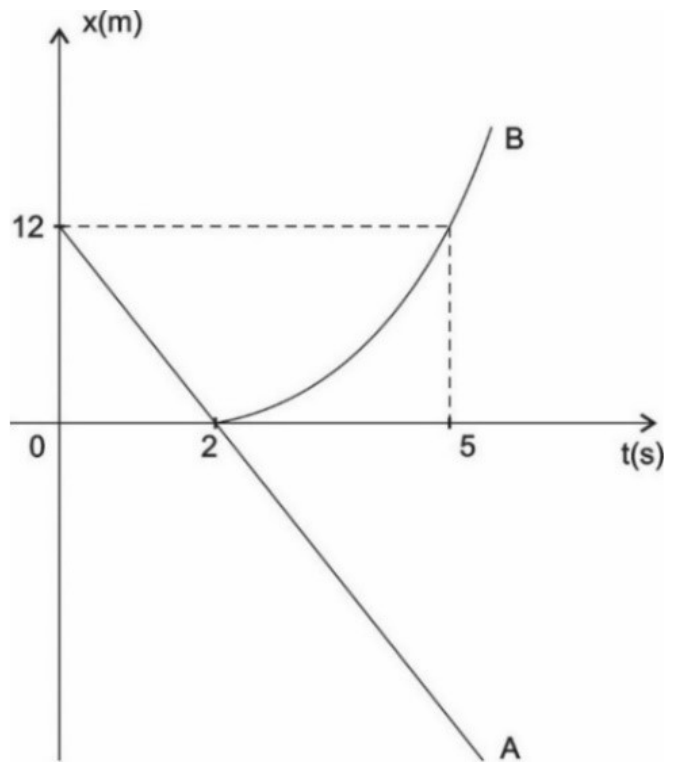
Observa-se que a partícula A se encontra em movimento uniforme desde t = 0 e que a partícula B só inicia seu movimento uniformemente variado a partir do repouso, em t = 2,0 s.
Nessas condições, a distância, em metros, que separa as duas partículas, A e B, no instante t = 8,0 s, vale
Nas questões de Física, quando necessário, utilize:
• aceleração da gravidade: g = 10 m/s²;
• cos 30º = sen 60º = √3/2;
• cos 60º = sen 30º = 1/2;
• π = 3;
• fator de Lorentz: γ = 1/√(1 - V²/c²).
Um plano, perfeitamente liso, é inclinado em relação à horizontal. Em t = 0, duas partículas, A e B, de massas iguais, são colocadas, respectivamente, na base e no topo desse plano, e passam a se movimentar de acordo com as funções horárias S_A = - 2 + 6t - 2,5t² e S_B = 4 - 2,5t², escritas em relação à origem dos espaços (0), e em unidades do SI, conforme ilustra a figura a seguir.
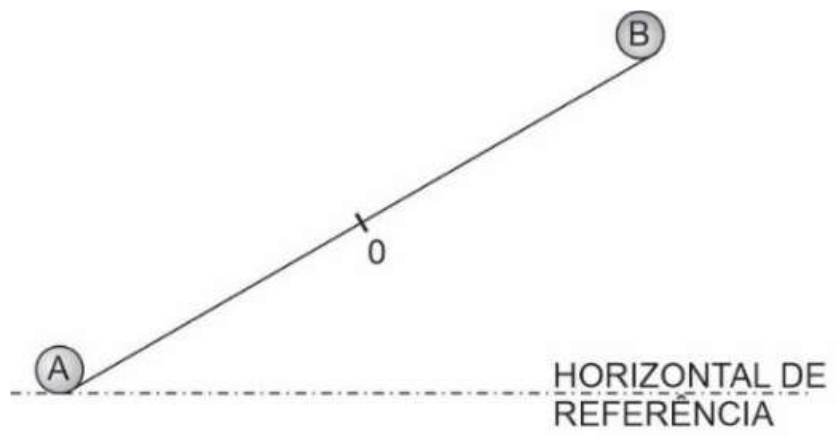
Em determinado instante A e B sofrem uma colisão perfeitamente elástica. Após essa colisão, B atinge uma altura vertical máxima, medida em metros e em relação à horizontal de referência, igual a
Nas questões de Física, quando necessário, utilize:
• aceleração da gravidade: g = 10 m/s²;
• cos 30º = sen 60º = √3/2;
• cos 60º = sen 30º = 1/2;
• π = 3;
• fator de Lorentz: γ = 1/√(1 - V²/c²).
Dois vetores de mesma direção e sentidos opostos, A⃗ e B⃗, quando somados resultam em um vetor cujo módulo vale 1,0 u. Ao se calcular a diferença entre A⃗ e B⃗, obtém-se um vetor cujo módulo vale 5,0 u.
Considere um vetor C⃗ com módulo igual ao do vetor A⃗ e formando um ângulo de 120° em relação ao vetor B⃗.
Nessas condições, a soma dos vetores A⃗ e C⃗ resultará em um vetor de módulo igual a
Nas questões de Física, quando necessário, utilize:
• aceleração da gravidade: g = 10 m/s²;
• cos 30º = sen 60º = √3/2;
• cos 60º = sen 30º = 1/2;
• π = 3;
• fator de Lorentz: γ = 1/√(1 - V²/c²).
Sobre um plano, inicialmente na direção horizontal, é apoiado um bloco de massa 1 kg e de dimensões desprezíveis, conforme figura 1.

Figura 1
Em seguida, o plano é inclinado para 30°, conforme figura 2; sendo que, nesse momento o bloco fica na iminência de descer ao longo do plano.
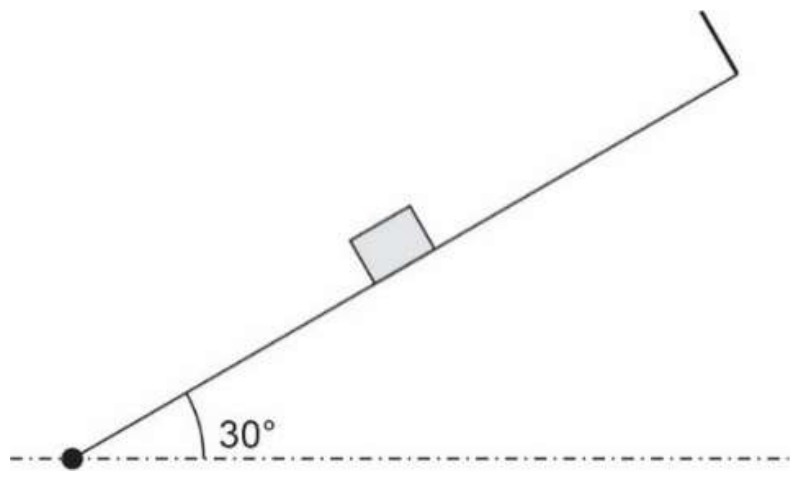
Figura 2
Posteriormente, uma mola ideal é presa ao topo do plano inclinado; deforma-se de 5 cm essa mola e prende-se a outra extremidade dela ao bloco, conforme figura 3.
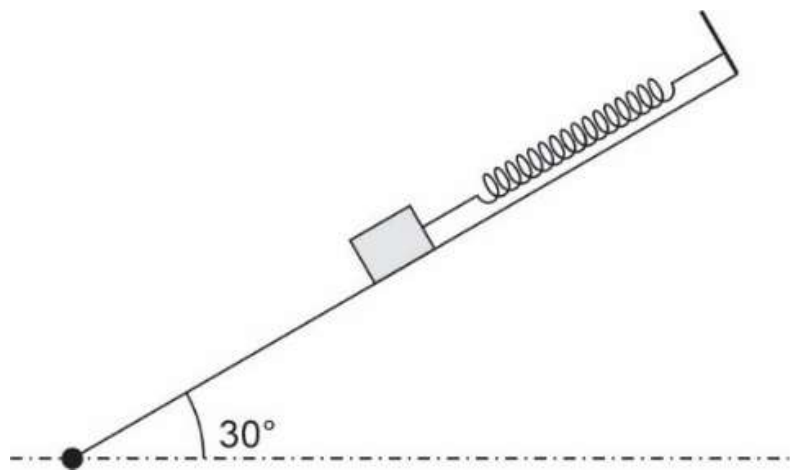
Figura 3
Observa-se, então, que o bloco permanece em repouso, porém, agora na iminência de subir ao longo do plano inclinado.
Nessas condições, a constante elástica da mola, em N/m, vale
Nas questões de Física, quando necessário, utilize:
• aceleração da gravidade: g = 10 m/s²;
• cos 30º = sen 60º = √3/2;
• cos 60º = sen 30º = 1/2;
• π = 3;
• fator de Lorentz: γ = 1/√(1 - V²/c²).
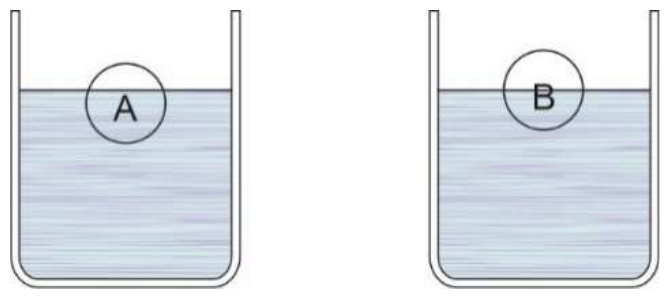
Duas esferas maciças, A e B, de mesmo volume, são colocadas, sucessivamente, dentro de um recipiente contendo certo líquido. Em condições de equilíbrio hidrostático observa-se que a esfera A fica com 2/3 de seu volume submerso, enquanto a B, por sua vez, fica com 1/2 de seu volume submerso, como representado nas figuras a seguir.
Em outro momento, essas mesmas esferas, A e B, se comportam como partículas que se movimentam inicialmente em sentidos opostos, sobre um plano liso e horizontal, conforme figura a seguir, e sofrem uma colisão frontal parcialmente elástica, com coeficiente de restituição igual a 1/3.
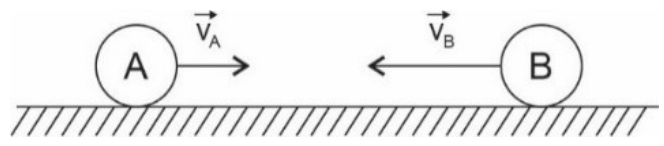
Considerando que antes da colisão a razão entre os módulos das velocidades de B e A valia 2, V_B/V_A = 2, tem-se que, após a colisão, a razão entre as velocidades de B e A, V'_B/V'_A, será igual a
Nas questões de Física, quando necessário, utilize:
• aceleração da gravidade: g = 10 m/s²;
• cos 30º = sen 60º = √3/2;
• cos 60º = sen 30º = 1/2;
• π = 3;
• fator de Lorentz: γ = 1/√(1 - V²/c²).
Um êmbolo móvel, situado a uma altura de 15 cm da base de um cilindro de paredes adiabáticas e de raio R = 10 cm, confina uma porção de um gás ideal monoatômico, conforme indicado na figura a seguir.
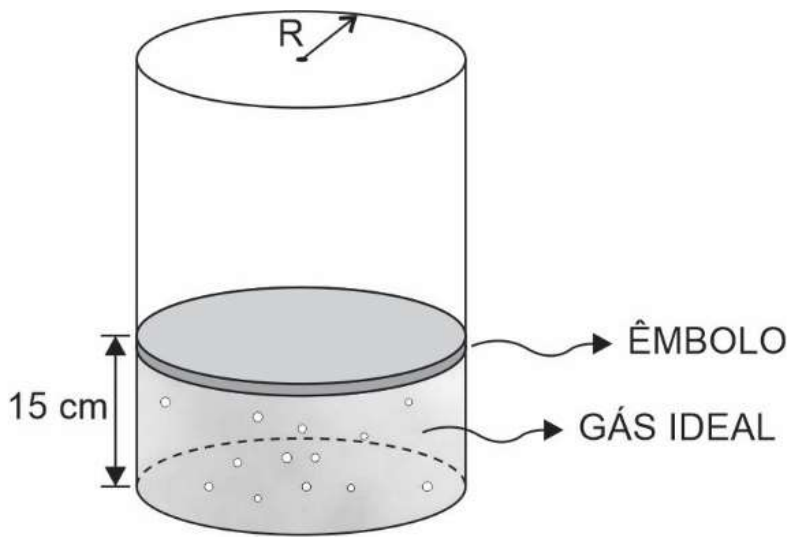
Inicialmente, o gás está à temperatura ambiente e sob a pressão de 1 · 10⁵ Pa. Mantendo-se a pressão constante, uma quantidade de calor Q é fornecida ao gás que expande de forma lenta e constante, enquanto sua temperatura é elevada. Imediatamente após retirar a fonte externa de calor, verifica-se que a temperatura do gás aumenta e o êmbolo fica posicionado a uma altura de 25 cm. Sob essas condições, a quantidade de calor, em joules, fornecida ao gás foi igual a
Nas questões de Física, quando necessário, utilize:
• aceleração da gravidade: g = 10 m/s²;
• cos 30º = sen 60º = √3/2;
• cos 60º = sen 30º = 1/2;
• π = 3;
• fator de Lorentz: γ = 1/√(1 - V²/c²).
Uma máquina térmica, operando entre as temperaturas T₁ e T₂ pode realizar quaisquer ciclos indicados no diagrama p x v abaixo.
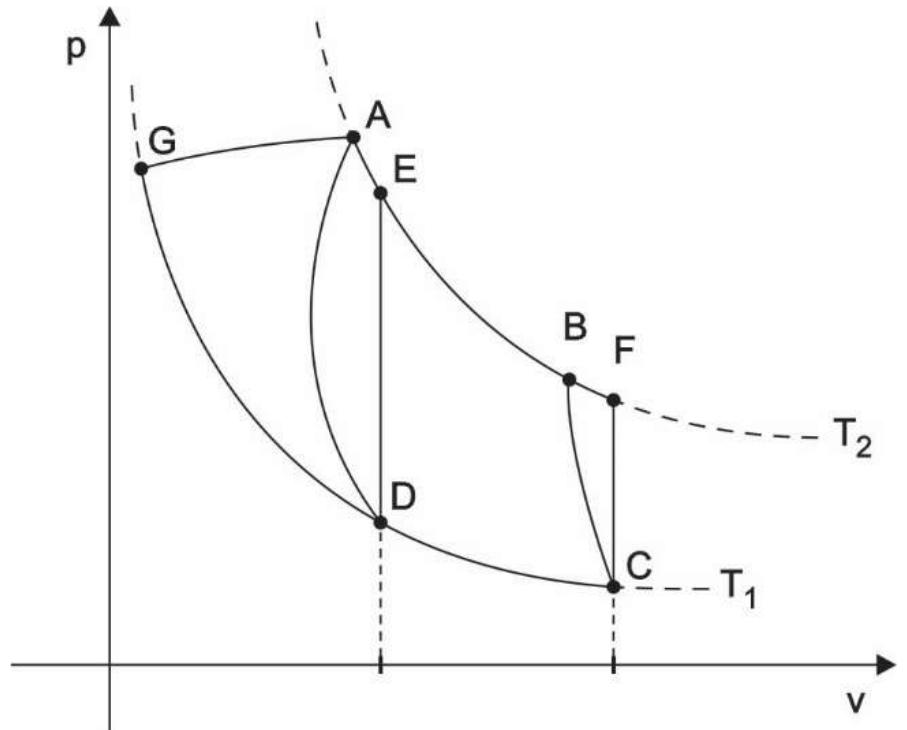
Sabendo-se que o Ciclo de Carnot é representado por A → E → B → C → D → A, analise as assertivas a seguir.
I - A quantidade de calor rejeitada para a fonte fria no ciclo B → F → C → B é menor que a quantidade de calor rejeitada no ciclo A → E → D → A.
II - O trabalho desenvolvido pela máquina no ciclo A → E → B → C → D → A é maior que o trabalho no ciclo A → E → B → C → D → G → A.
III - O ciclo que apresenta o maior trabalho desenvolvido pela máquina é o Ciclo de Carnot.
IV - A energia recebida pela máquina, sob a forma de trabalho, do meio externo nos ciclos A → E → D → A e B → F → C → B tem o mesmo módulo.
Pode-se afirmar que
Nas questões de Física, quando necessário, utilize:
• aceleração da gravidade: g = 10 m/s²;
• cos 30º = sen 60º = √3/2;
• cos 60º = sen 30º = 1/2;
• π = 3;
• fator de Lorentz: γ = 1/√(1 - V²/c²).
Uma onda periódica harmônica se propaga em uma corda homogênea, tensa e infinita de acordo com a função de onda, em unidades do SI, dada por
Y₁(x, t) = 10 sen [10 x - 20 π t]
Uma segunda onda, Y₂(x,t), também periódica harmônica, é sobreposta à onda inicial, de tal forma que a onda resultante na corda tem amplitude constante e igual ao dobro da amplitude da onda descrita por Y₁(x,t).
Considere que a velocidade de propagação das ondas na corda é constante.
Nessas condições, das opções a seguir, a função de onda que melhor descreve a onda Y₂(x,t) é dada porResolução comentada
Análise das alternativas
Nas questões de Física, quando necessário, utilize:
• aceleração da gravidade: g = 10 m/s²;
• cos 30º = sen 60º = √3/2;
• cos 60º = sen 30º = 1/2;
• π = 3;
• fator de Lorentz: γ = 1/√(1 - V²/c²).
No alojamento de um Cadete, está presente uma janela de vidro, cuja condutibilidade térmica é Kᵥ = 0,8 W·m⁻¹·K⁻¹.
Em dias de inverno observa-se uma diferença pequena entre as temperaturas dos ambientes interno e externo a esse alojamento. Com o intuito de minimizar a perda de calor e aumentar essa diferença de temperatura entre os ambientes, através da janela de vidro, o Cadete aderiu uma placa de isopor completamente lisa sobre ela, conforme a ilustração a seguir.
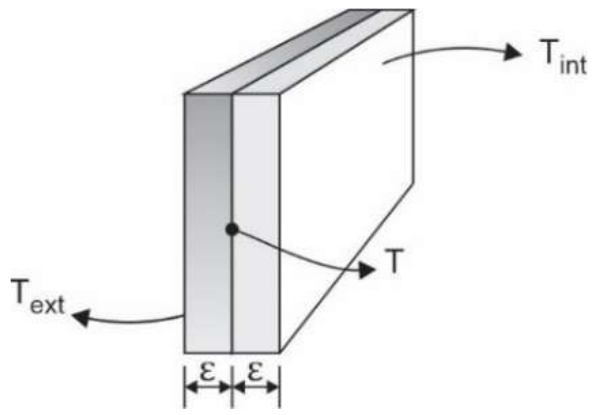
Essa placa de isopor tem uma condutibilidade térmica K_ISO = 0,4 W·m⁻¹·K⁻¹ e possui área e espessura idênticas às da janela de vidro. Após atingir o regime estacionário, o Cadete aferiu a temperatura da superfície do vidro em contato com o ambiente externo Tₑₓₜ = 5 ºC, e a temperatura interna, na superfície do isopor em contato com o ambiente interno, Tᵢₙₜ = 26 ºC. Considerando que o fluxo de calor ocorra apenas perpendicularmente à superfície do isopor e da janela de vidro, a temperatura T, em Kelvin, na interface entre o vidro e o isopor, vale
Nas questões de Física, quando necessário, utilize:
• aceleração da gravidade: g = 10 m/s²;
• cos 30º = sen 60º = √3/2;
• cos 60º = sen 30º = 1/2;
• π = 3;
• fator de Lorentz: γ = 1/√(1 - V²/c²).
Entre o final do século XIX e início do século XX várias questões da física estavam sem respostas. A física clássica não era suficiente para explicar todos os comportamentos observáveis da matéria. A teoria eletromagnética clássica, fundamentada nas equações de Maxwell, apesar de amplamente aplicável, não conseguia explicar alguns fenômenos.
Observe a descrição suscinta de alguns fenômenos:
I - Ondas eletromagnéticas são geradas por cargas aceleradas. Assim, quando um elétron, por exemplo, realiza um movimento de frequência f, a onda eletromagnética emitida também tem frequência f. Além disso, a velocidade de propagação dessa onda, no vácuo, vale aproximadamente 3,0 · 10⁸ m/s.
II - Um corpo bom absorvedor é um bom emissor de radiação térmica, assim como um mau absorvedor é um mau emissor. Um corpo negro é um corpo ideal, capaz de absorver toda a radiação térmica incidente nele e, portanto, emitir totalmente essa radiação. As moléculas na superfície de um corpo negro se comportam como osciladores harmônicos, que só admitem determinados valores de energia. Dessa forma, a emissão e absorção de energia em um corpo negro se dá em quantidades quantizadas.
III - Quando radiações eletromagnéticas incidem numa placa metálica, cargas elétricas podem absorver energia suficiente para escaparem. Essas cargas “arrancadas”, chamadas de fotoelétrons, possuem energias cinéticas que independem da intensidade da radiação incidente, mas que dependem da frequência dessa radiação.
IV - Em um estado estacionário, o átomo não emite radiação eletromagnética. No entanto, quando o átomo passa de um estado estacionário para outro, ele acaba por emitir uma quantidade discreta de energia, igual à diferença entre as energias correspondentes aos dois estados.
Dos fenômenos citados acima, o único explicado satisfatoriamente pela teoria eletromagnética clássica é o descrito emResolução comentada
Análise das alternativas
Nas questões de Física, quando necessário, utilize:
• aceleração da gravidade: g = 10 m/s²;
• cos 30º = sen 60º = √3/2;
• cos 60º = sen 30º = 1/2;
• π = 3;
• fator de Lorentz: γ = 1/√(1 - V²/c²).
Defeitos da visão, dependendo de sua gravidade, podem interromper o sonho de muitos jovens de se tornarem militares da Força Aérea Brasileira.
Considere que um desses jovens, ainda receoso com a possibilidade cirúrgica para correção de seu defeito visual, siga usando óculos de lentes corretivas. Observe, nos desenhos a seguir, a diferença no tamanho aparente dos olhos desse jovem, primeiro sem o uso dos óculos e depois com os óculos.
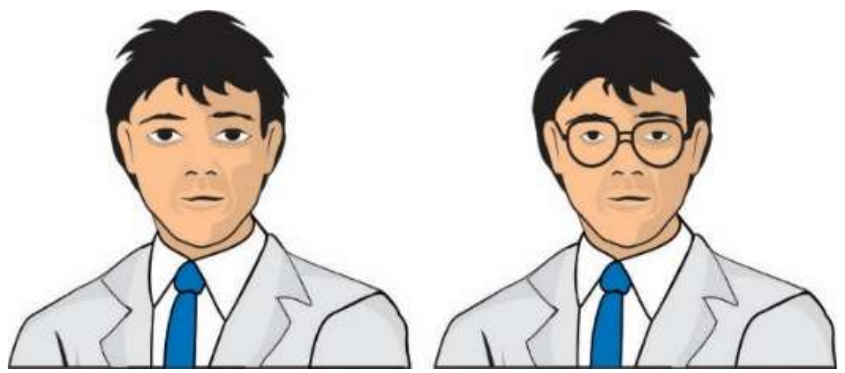
A partir da análise desses desenhos conclui-se que a formação da imagem no olho desse jovem, quando se encontra sem os óculos de correção, está melhor indicada na figura, fora de escala, mostrada na alternativa
Nas questões de Física, quando necessário, utilize:
• aceleração da gravidade: g = 10 m/s²;
• cos 30º = sen 60º = √3/2;
• cos 60º = sen 30º = 1/2;
• π = 3;
• fator de Lorentz: γ = 1/√(1 - V²/c²).
Duas placas A e B, idênticas e condutoras, dispostas horizontalmente e fixas, conforme figura a seguir, geram na região entre elas um campo elétrico uniforme.
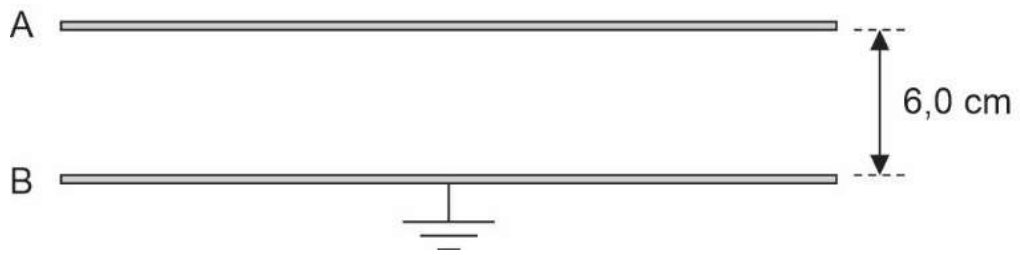
A densidade superficial de cargas da placa A é + 3 µC/cm², enquanto a placa B, a 6,0 cm da placa A, está aterrada.
Uma partícula, de massa m, eletrizada com carga – 12 pC, foi abandonada entre as placas e permaneceu em repouso.
A permissividade absoluta do meio entre as placas é igual a 9,0 · 10⁻¹² N⁻¹ m⁻² C².
Nessas condições, o potencial elétrico da placa A, em volts, e a massa m da partícula, em gramas, são, respectivamente
Texto-base:
Texto-base:
Texto-base:
Texto-base:
Texto-base:
Texto-base:
Texto-base:
Texto-base:
Texto-base:
Texto-base:
Texto-base:
Texto-base:
Texto-base:
Texto-base:
Texto-base:
Texto-base:
Texto-base:
Texto-base:
Texto-base:
Texto-base: