← Voltar para a lista de provas Escola Preparatória de Cadetes do Ar (EPCAR) — Comando da Aeronáutica · Exame de Admissão ao CPCAR 2025 (Curso Preparatório de Cadetes do Ar) 49 questões nesta prova · página 1 de 3 · 47 com gabarito Gabarito disponível Gabarito disponível Gabarito disponível Gabarito disponível Gabarito disponível O apelido 'girl hawk' vem de suas características pessoais: ousadia e destreza. O texto diz que ela era conhecida como 'girl hawk' porque era a piloto mais ousada e talentosa de sua época. Trata-se, portanto, de traços pessoais. A) Errada: os voos solo não são citados como causa. C) Errada: ser mulher piloto não explica o apelido. D) Errada: não há relação com Bessie Coleman. B) Correta. Referência: Interpretação de texto: informação explícita. Resolução comentada do VaiConcursos. Gabarito disponível Ordem dos eventos: escolheu voar em vez do piano, o pai desaprovou, superou as falhas e depois se isolou. Primeiro, ela escolheu a aviação em vez de ser pianista (3). Depois, o pai a desencorajou (1). Em seguida, superou duas tentativas fracassadas e conseguiu o voo (4). Por fim, tornou-se reclusa (2). A sequência é 3-1-4-2. B, C e D colocam os eventos fora da ordem cronológica do texto. Por exemplo, a reclusão (2) só ocorre no fim da vida, depois da guerra. Referência: Interpretação de texto: sequência de eventos. Resolução comentada do VaiConcursos. Gabarito disponível Inferência: Batten provavelmente ficou desanimada por não conseguir voar na Segunda Guerra. O texto diz que, sem conseguir emprego de piloto na Segunda Guerra, ela abandonou a aviação e se tornou reclusa. Isso permite inferir que provavelmente ficou desanimada num momento histórico importante. A) Errada: o pai não aprovava a aviação. B) Errada: ela não conseguiu emprego de piloto na guerra. C) Errada: o texto só fala do desejo de ser pianista, sem tocar em festas. D) Correta. Referência: Interpretação de texto: inferência. Resolução comentada do VaiConcursos. Gabarito disponível 'Narrowly escaped death' = escapou por pouco, por um triz. 'Narrowly' indica por pouco, por uma margem estreita. Assim, ela quase morreu duas vezes, mas se salvou, o que corresponde a 'although it was a close call, she got by'. A) Errada: não se fala em 'segunda chance de viver', e sim em escapar da morte duas vezes. C) Errada: a frase relata um fato, não uma reflexão sobre a linha entre vida e morte. D) Errada: o texto não diz que foi o momento mais difícil da carreira. B) Correta. Referência: Vocabulário em contexto: advérbio 'narrowly'. Resolução comentada do VaiConcursos. Gabarito disponível Gabarito disponível Gabarito disponível Gabarito disponível Gabarito disponível Gabarito disponível Os dois trechos expressam o desejo de realizar feitos marcantes e ser lembrada. Deixar pegadas na areia do tempo e deixar algo para ser lembrado indicam o desejo de realizar algo notável, que perdure. A alternativa C expressa isso. Os trechos são complementares. A) Errada: não há preocupação com morrer em breve. B) Errada: o desejo de tocar vidas e ser lembrada pelos outros não é egocêntrico. D) Errada: os trechos se conectam pelo tema de deixar um legado. C) Correta. Referência: Interpretação de texto: inferência. Resolução comentada do VaiConcursos. Gabarito disponível A autora sabe o que quer da vida: deixar uma marca e fazer diferença. A letra mostra alguém que afirma ter vivido cada dia, deseja deixar sua marca e ter feito diferença na vida de outras pessoas. Isso revela clareza sobre o que busca da vida, como diz a alternativa D. A) Errada: o texto não trata de problemas de memória, e 'remember' se refere a ser lembrada. B) Errada: ela diz que foi 'more than I thought it would be', ou seja, superou as expectativas. C) Errada: não há sonhos desfeitos, e sim determinação. D) Correta. Referência: Interpretação de texto: ideia central. Resolução comentada do VaiConcursos. Gabarito disponível Os pronomes 'it' do verso 11 não têm antecedente explícito no texto. Em 'it was more than I thought it would be', o 'it' não retoma nenhuma palavra citada antes. Ele se refere de forma geral à vida ou à experiência do eu lírico, que não foi nomeada. Por isso, o gabarito é a alternativa D. A) Errada: 'was' é verbo comum e só o segundo 'it' é seguido de modal ('would'). B) Errada: 'regrets' está no plural e não é o referente dos pronomes. C) Errada: 'it' é pronome neutro para coisas ou ideias, e não se troca por he/she. D) Correta. Referência: Pronomes pessoais (it) e referência pronominal em inglês. Resolução comentada do VaiConcursos. Gabarito disponível Gabarito disponível Só a afirmação II é verdadeira. A distância de O à corda AB é √(10² − 6²) = 8, então a área de OAB = 12·8/2 = 48. O triângulo OCD é semelhante a OAB na razão 5/10 = 1/2, então sua altura é 4 (II verdadeira) e sua área é 12. Assim a área de OAB é 4 vezes a de OCD (I falsa), e o trapézio ABCD tem 48 − 12 = 36 cm² (III falsa). A e D são incorretas porque II é verdadeira e I e III são falsas. C está errada pois não há duas verdadeiras. B está correta. Referência: Semelhança de triângulos e áreas. Resolução comentada do VaiConcursos. Gabarito disponível Gabarito disponívelEPCAR — Exame de Admissão ao CPCAR 2025 — Língua Inglesa, Matemática, Língua Portuguesa e Redação — Versão A
Direction: Consider text I to answer questions 01 to 04.
TEXT I
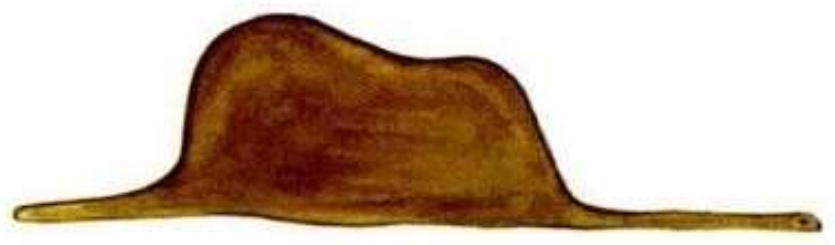
Drawing Number One
“I showed the grown-ups my masterpiece, and I asked
them if my drawing scared them. They answered, ‘Why be
scared of a hat?’ My drawing was not a picture of a hat. It
was a picture of a boa constrictor digesting an elephant.
5 Then I drew the inside of the boa constrictor, so the grown-
ups could understand. They always need explanations. My
Drawing Number Two looked like this:
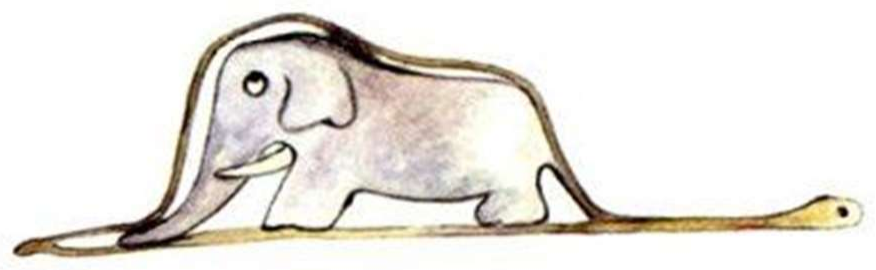
Drawing Number Two
The grown-ups' advised me to put away my drawings
of boa constrictors, outside or inside, and apply myself
10 instead to geography, history, arithmetic, and grammar. That
is why, I abandoned, at the age of six, a magnificent career
as an artist. I had been discouraged by the failure of my
Drawing Number One and of my Drawing Number Two.
Grown-ups never understand anything by themselves, and it
15 is exhausting for children to have to provide explanations
over and over again. So then I had to choose another career,
and I learned to pilot airplanes. I have flown almost
everywhere in the world. And, as a matter of fact, geography
has been a big help to me. I could tell China from Arizona at
20 first glance, which is very useful if you get lost during the
night. So I have had in the course of my life, lots of
encounters with lots of serious people. I have spent lots of
time with grown-ups. I have seen them at close range...
which hasn’t much improved my opinion of them.”
Source: SAINT-EXUPÉRY, Antoine. The little Prince. New York: Mariner Books, 1943. Translated from French by Richard Howard.
About the career change portrayed in the text, it is possible to say that the narrator was
Direction: Consider text I to answer questions 01 to 04.
TEXT I
Drawing Number One
“I showed the grown-ups my masterpiece, and I asked
them if my drawing scared them. They answered, ‘Why be
scared of a hat?’ My drawing was not a picture of a hat. It
was a picture of a boa constrictor digesting an elephant.
5 Then I drew the inside of the boa constrictor, so the grown-
ups could understand. They always need explanations. My
Drawing Number Two looked like this:
Drawing Number Two
The grown-ups' advised me to put away my drawings
of boa constrictors, outside or inside, and apply myself
10 instead to geography, history, arithmetic, and grammar. That
is why, I abandoned, at the age of six, a magnificent career
as an artist. I had been discouraged by the failure of my
Drawing Number One and of my Drawing Number Two.
Grown-ups never understand anything by themselves, and it
15 is exhausting for children to have to provide explanations
over and over again. So then I had to choose another career,
and I learned to pilot airplanes. I have flown almost
everywhere in the world. And, as a matter of fact, geography
has been a big help to me. I could tell China from Arizona at
20 first glance, which is very useful if you get lost during the
night. So I have had in the course of my life, lots of
encounters with lots of serious people. I have spent lots of
time with grown-ups. I have seen them at close range...
which hasn’t much improved my opinion of them.”
Source: SAINT-EXUPÉRY, Antoine. The little Prince. New York: Mariner Books, 1943. Translated from French by Richard Howard.
Grown-ups are not scared of the little prince’s drawings because
Direction: Consider text I to answer questions 01 to 04.
TEXT I
Drawing Number One
“I showed the grown-ups my masterpiece, and I asked
them if my drawing scared them. They answered, ‘Why be
scared of a hat?’ My drawing was not a picture of a hat. It
was a picture of a boa constrictor digesting an elephant.
5 Then I drew the inside of the boa constrictor, so the grown-
ups could understand. They always need explanations. My
Drawing Number Two looked like this:
Drawing Number Two
The grown-ups' advised me to put away my drawings
of boa constrictors, outside or inside, and apply myself
10 instead to geography, history, arithmetic, and grammar. That
is why, I abandoned, at the age of six, a magnificent career
as an artist. I had been discouraged by the failure of my
Drawing Number One and of my Drawing Number Two.
Grown-ups never understand anything by themselves, and it
15 is exhausting for children to have to provide explanations
over and over again. So then I had to choose another career,
and I learned to pilot airplanes. I have flown almost
everywhere in the world. And, as a matter of fact, geography
has been a big help to me. I could tell China from Arizona at
20 first glance, which is very useful if you get lost during the
night. So I have had in the course of my life, lots of
encounters with lots of serious people. I have spent lots of
time with grown-ups. I have seen them at close range...
which hasn’t much improved my opinion of them.”
Source: SAINT-EXUPÉRY, Antoine. The little Prince. New York: Mariner Books, 1943. Translated from French by Richard Howard.
The sentence that expresses disappointment is
Direction: Consider text I to answer questions 01 to 04.
TEXT I
Drawing Number One
“I showed the grown-ups my masterpiece, and I asked
them if my drawing scared them. They answered, ‘Why be
scared of a hat?’ My drawing was not a picture of a hat. It
was a picture of a boa constrictor digesting an elephant.
5 Then I drew the inside of the boa constrictor, so the grown-
ups could understand. They always need explanations. My
Drawing Number Two looked like this:
Drawing Number Two
The grown-ups' advised me to put away my drawings
of boa constrictors, outside or inside, and apply myself
10 instead to geography, history, arithmetic, and grammar. That
is why, I abandoned, at the age of six, a magnificent career
as an artist. I had been discouraged by the failure of my
Drawing Number One and of my Drawing Number Two.
Grown-ups never understand anything by themselves, and it
15 is exhausting for children to have to provide explanations
over and over again. So then I had to choose another career,
and I learned to pilot airplanes. I have flown almost
everywhere in the world. And, as a matter of fact, geography
has been a big help to me. I could tell China from Arizona at
20 first glance, which is very useful if you get lost during the
night. So I have had in the course of my life, lots of
encounters with lots of serious people. I have spent lots of
time with grown-ups. I have seen them at close range...
which hasn’t much improved my opinion of them.”
Source: SAINT-EXUPÉRY, Antoine. The little Prince. New York: Mariner Books, 1943. Translated from French by Richard Howard.
The narrator concludes that
Direction: Consider text II to answer questions 05 to 08.
TEXT II
Around the World with Barrier Breaking Women Pilots
Oct 31, 2021
By Dorothy Cochrane and P. Ramirez
5 We know the names of early American women pilots like
Bessie Coleman and Amelia Earhart. However, across the
globe, women pilots were also taking to the skies and
setting records. Travel across with these stories of two such
pilots.
10
Part I
Hélène Dutrieu, Belgium
Hélène Dutrieu of Belgium was known as the "girl hawk" of
15 aviation because she was the most daring and
accomplished woman pilot of her time. She first soloed in
France in 1909 and within a year was setting altitude and
distance records. She thrilled the world in September of
1910 by flying non-stop from Ostend to Bruges, Belgium,
20 and she became the first Belgian woman to receive a pilot
license on November 25, 1910. During her second year as
an aviator she narrowly escaped death twice. She visited
the United States in 1911, making her American debut at
the Nassau Boulevard Aviation meeting. Back in Europe,
25 Dutrieu won France's Coupe Femina for the women's world
nonstop light record on December 31, 1911, flying 158 miles
(254 kilometers) in 178 minutes. In Florence, Italy, she was
the only woman in a field of 15 and outflew all of her male
competitors to win the King's Cup. In 1913 the French
30 government awarded Dutrieu the Legion of Honor for her
achievements. She also became an ambulance driver and
later a director of a military hospital.
Part II
35
Jean Batten, New Zealand
Jean Batten grew up in New Zealand and developed a love
for aviation that overcame her desire to be a concert pianist.
40 Her interest in flying stemmed from the 1919 England to
Australia flight by Ross and Keith Smith, and later solo
flights. Batten's father did not approve of her aviation
enthusiasm but she convinced her mother to move to
England with her and help her become a pilot. She received
45 her license and her commercial rating at the London
Aeroplane Club at Stag Lane and then began planning for a
flight from England to Australia. Her first two attempts failed,
but she succeeded in 1934, flying a Gipsy Moth. Batten
became an instant sensation in Australia, New Zealand, and
50 in England upon her return flight the next year (it was the
first roundtrip by a woman). In 1935, she broke James
Mollison's records for England to Brazil and Dakar to Natal
while becoming the first woman to solo across the South
Atlantic. Then, in 1936, she realized her dream of flying solo
55 from England to New Zealand in a Percival Gull in 11 days
and earned her second consecutive Harmon Trophy, having
shared the first one in 1935 with Amelia Earhart. In 1937,
she set another record for an Australia to England flight.
Unable to obtain a flying job during World War II, Batten
60 gave up flying and eventually became a recluse, living with
her mother in Majorca, Spain, and appearing in public only
for a few anniversary events. In 1937, she published her
autobiography, My Life.
Adapted from: RAMIREZ. Around the World with Barrier Breaking Women Pilots:https://airandspace.si.edu /stories/editorial/around-world-barrier-breaking-women-pilotshttps://airandspace.si.edu/stories/editorial/around-world-barrier-breaking-women-pilots. Accessed on February 20th 2024
Hélène Dutrieu received a nickname that was given to her due toResolução comentada
Análise das alternativas
Direction: Consider text II to answer questions 05 to 08.
TEXT II
Around the World with Barrier Breaking Women Pilots
Oct 31, 2021
By Dorothy Cochrane and P. Ramirez
5 We know the names of early American women pilots like
Bessie Coleman and Amelia Earhart. However, across the
globe, women pilots were also taking to the skies and
setting records. Travel across with these stories of two such
pilots.
10
Part I
Hélène Dutrieu, Belgium
Hélène Dutrieu of Belgium was known as the "girl hawk" of
15 aviation because she was the most daring and
accomplished woman pilot of her time. She first soloed in
France in 1909 and within a year was setting altitude and
distance records. She thrilled the world in September of
1910 by flying non-stop from Ostend to Bruges, Belgium,
20 and she became the first Belgian woman to receive a pilot
license on November 25, 1910. During her second year as
an aviator she narrowly escaped death twice. She visited
the United States in 1911, making her American debut at
the Nassau Boulevard Aviation meeting. Back in Europe,
25 Dutrieu won France's Coupe Femina for the women's world
nonstop light record on December 31, 1911, flying 158 miles
(254 kilometers) in 178 minutes. In Florence, Italy, she was
the only woman in a field of 15 and outflew all of her male
competitors to win the King's Cup. In 1913 the French
30 government awarded Dutrieu the Legion of Honor for her
achievements. She also became an ambulance driver and
later a director of a military hospital.
Part II
35
Jean Batten, New Zealand
Jean Batten grew up in New Zealand and developed a love
for aviation that overcame her desire to be a concert pianist.
40 Her interest in flying stemmed from the 1919 England to
Australia flight by Ross and Keith Smith, and later solo
flights. Batten's father did not approve of her aviation
enthusiasm but she convinced her mother to move to
England with her and help her become a pilot. She received
45 her license and her commercial rating at the London
Aeroplane Club at Stag Lane and then began planning for a
flight from England to Australia. Her first two attempts failed,
but she succeeded in 1934, flying a Gipsy Moth. Batten
became an instant sensation in Australia, New Zealand, and
50 in England upon her return flight the next year (it was the
first roundtrip by a woman). In 1935, she broke James
Mollison's records for England to Brazil and Dakar to Natal
while becoming the first woman to solo across the South
Atlantic. Then, in 1936, she realized her dream of flying solo
55 from England to New Zealand in a Percival Gull in 11 days
and earned her second consecutive Harmon Trophy, having
shared the first one in 1935 with Amelia Earhart. In 1937,
she set another record for an Australia to England flight.
Unable to obtain a flying job during World War II, Batten
60 gave up flying and eventually became a recluse, living with
her mother in Majorca, Spain, and appearing in public only
for a few anniversary events. In 1937, she published her
autobiography, My Life.
Adapted from: RAMIREZ. Around the World with Barrier Breaking Women Pilots:https://airandspace.si.edu /stories/editorial/around-world-barrier-breaking-women-pilotshttps://airandspace.si.edu/stories/editorial/around-world-barrier-breaking-women-pilots. Accessed on February 20th 2024
Regarding Jean Batten’s life, she
1. was discouraged by someone.
2. turned out to be a homebody.
3. choose one thing over another.
4. successfully overcame failure.
The correct sequence of events according to the text isResolução comentada
Análise das alternativas
Direction: Consider text II to answer questions 05 to 08.
TEXT II
Around the World with Barrier Breaking Women Pilots
Oct 31, 2021
By Dorothy Cochrane and P. Ramirez
5 We know the names of early American women pilots like
Bessie Coleman and Amelia Earhart. However, across the
globe, women pilots were also taking to the skies and
setting records. Travel across with these stories of two such
pilots.
10
Part I
Hélène Dutrieu, Belgium
Hélène Dutrieu of Belgium was known as the "girl hawk" of
15 aviation because she was the most daring and
accomplished woman pilot of her time. She first soloed in
France in 1909 and within a year was setting altitude and
distance records. She thrilled the world in September of
1910 by flying non-stop from Ostend to Bruges, Belgium,
20 and she became the first Belgian woman to receive a pilot
license on November 25, 1910. During her second year as
an aviator she narrowly escaped death twice. She visited
the United States in 1911, making her American debut at
the Nassau Boulevard Aviation meeting. Back in Europe,
25 Dutrieu won France's Coupe Femina for the women's world
nonstop light record on December 31, 1911, flying 158 miles
(254 kilometers) in 178 minutes. In Florence, Italy, she was
the only woman in a field of 15 and outflew all of her male
competitors to win the King's Cup. In 1913 the French
30 government awarded Dutrieu the Legion of Honor for her
achievements. She also became an ambulance driver and
later a director of a military hospital.
Part II
35
Jean Batten, New Zealand
Jean Batten grew up in New Zealand and developed a love
for aviation that overcame her desire to be a concert pianist.
40 Her interest in flying stemmed from the 1919 England to
Australia flight by Ross and Keith Smith, and later solo
flights. Batten's father did not approve of her aviation
enthusiasm but she convinced her mother to move to
England with her and help her become a pilot. She received
45 her license and her commercial rating at the London
Aeroplane Club at Stag Lane and then began planning for a
flight from England to Australia. Her first two attempts failed,
but she succeeded in 1934, flying a Gipsy Moth. Batten
became an instant sensation in Australia, New Zealand, and
50 in England upon her return flight the next year (it was the
first roundtrip by a woman). In 1935, she broke James
Mollison's records for England to Brazil and Dakar to Natal
while becoming the first woman to solo across the South
Atlantic. Then, in 1936, she realized her dream of flying solo
55 from England to New Zealand in a Percival Gull in 11 days
and earned her second consecutive Harmon Trophy, having
shared the first one in 1935 with Amelia Earhart. In 1937,
she set another record for an Australia to England flight.
Unable to obtain a flying job during World War II, Batten
60 gave up flying and eventually became a recluse, living with
her mother in Majorca, Spain, and appearing in public only
for a few anniversary events. In 1937, she published her
autobiography, My Life.
Adapted from: RAMIREZ. Around the World with Barrier Breaking Women Pilots:https://airandspace.si.edu /stories/editorial/around-world-barrier-breaking-women-pilotshttps://airandspace.si.edu/stories/editorial/around-world-barrier-breaking-women-pilots. Accessed on February 20th 2024
According to the text it is possible to state that Jean BattenResolução comentada
Análise das alternativas
Direction: Consider text II to answer questions 05 to 08.
TEXT II
Around the World with Barrier Breaking Women Pilots
Oct 31, 2021
By Dorothy Cochrane and P. Ramirez
5 We know the names of early American women pilots like
Bessie Coleman and Amelia Earhart. However, across the
globe, women pilots were also taking to the skies and
setting records. Travel across with these stories of two such
pilots.
10
Part I
Hélène Dutrieu, Belgium
Hélène Dutrieu of Belgium was known as the "girl hawk" of
15 aviation because she was the most daring and
accomplished woman pilot of her time. She first soloed in
France in 1909 and within a year was setting altitude and
distance records. She thrilled the world in September of
1910 by flying non-stop from Ostend to Bruges, Belgium,
20 and she became the first Belgian woman to receive a pilot
license on November 25, 1910. During her second year as
an aviator she narrowly escaped death twice. She visited
the United States in 1911, making her American debut at
the Nassau Boulevard Aviation meeting. Back in Europe,
25 Dutrieu won France's Coupe Femina for the women's world
nonstop light record on December 31, 1911, flying 158 miles
(254 kilometers) in 178 minutes. In Florence, Italy, she was
the only woman in a field of 15 and outflew all of her male
competitors to win the King's Cup. In 1913 the French
30 government awarded Dutrieu the Legion of Honor for her
achievements. She also became an ambulance driver and
later a director of a military hospital.
Part II
35
Jean Batten, New Zealand
Jean Batten grew up in New Zealand and developed a love
for aviation that overcame her desire to be a concert pianist.
40 Her interest in flying stemmed from the 1919 England to
Australia flight by Ross and Keith Smith, and later solo
flights. Batten's father did not approve of her aviation
enthusiasm but she convinced her mother to move to
England with her and help her become a pilot. She received
45 her license and her commercial rating at the London
Aeroplane Club at Stag Lane and then began planning for a
flight from England to Australia. Her first two attempts failed,
but she succeeded in 1934, flying a Gipsy Moth. Batten
became an instant sensation in Australia, New Zealand, and
50 in England upon her return flight the next year (it was the
first roundtrip by a woman). In 1935, she broke James
Mollison's records for England to Brazil and Dakar to Natal
while becoming the first woman to solo across the South
Atlantic. Then, in 1936, she realized her dream of flying solo
55 from England to New Zealand in a Percival Gull in 11 days
and earned her second consecutive Harmon Trophy, having
shared the first one in 1935 with Amelia Earhart. In 1937,
she set another record for an Australia to England flight.
Unable to obtain a flying job during World War II, Batten
60 gave up flying and eventually became a recluse, living with
her mother in Majorca, Spain, and appearing in public only
for a few anniversary events. In 1937, she published her
autobiography, My Life.
Adapted from: RAMIREZ. Around the World with Barrier Breaking Women Pilots:https://airandspace.si.edu /stories/editorial/around-world-barrier-breaking-women-pilotshttps://airandspace.si.edu/stories/editorial/around-world-barrier-breaking-women-pilots. Accessed on February 20th 2024
The sentence “she narrowly escaped death twice.” (Part I - ℓ. 22) means thatResolução comentada
Análise das alternativas
Direction: Read texts I and II to answer question 9.
Direction: Consider text I to answer questions 01 to 04.
TEXT I
Drawing Number One
“I showed the grown-ups my masterpiece, and I asked
them if my drawing scared them. They answered, ‘Why be
scared of a hat?’ My drawing was not a picture of a hat. It
was a picture of a boa constrictor digesting an elephant.
5 Then I drew the inside of the boa constrictor, so the grown-
ups could understand. They always need explanations. My
Drawing Number Two looked like this:
Drawing Number Two
The grown-ups' advised me to put away my drawings
of boa constrictors, outside or inside, and apply myself
10 instead to geography, history, arithmetic, and grammar. That
is why, I abandoned, at the age of six, a magnificent career
as an artist. I had been discouraged by the failure of my
Drawing Number One and of my Drawing Number Two.
Grown-ups never understand anything by themselves, and it
15 is exhausting for children to have to provide explanations
over and over again. So then I had to choose another career,
and I learned to pilot airplanes. I have flown almost
everywhere in the world. And, as a matter of fact, geography
has been a big help to me. I could tell China from Arizona at
20 first glance, which is very useful if you get lost during the
night. So I have had in the course of my life, lots of
encounters with lots of serious people. I have spent lots of
time with grown-ups. I have seen them at close range...
which hasn’t much improved my opinion of them.”
Source: SAINT-EXUPÉRY, Antoine. The little Prince. New York: Mariner Books, 1943. Translated from French by Richard Howard.
Direction: Consider text II to answer questions 05 to 08.
TEXT II
Around the World with Barrier Breaking Women Pilots
Oct 31, 2021
By Dorothy Cochrane and P. Ramirez
5 We know the names of early American women pilots like
Bessie Coleman and Amelia Earhart. However, across the
globe, women pilots were also taking to the skies and
setting records. Travel across with these stories of two such
pilots.
10
Part I
Hélène Dutrieu, Belgium
Hélène Dutrieu of Belgium was known as the "girl hawk" of
15 aviation because she was the most daring and
accomplished woman pilot of her time. She first soloed in
France in 1909 and within a year was setting altitude and
distance records. She thrilled the world in September of
1910 by flying non-stop from Ostend to Bruges, Belgium,
20 and she became the first Belgian woman to receive a pilot
license on November 25, 1910. During her second year as
an aviator she narrowly escaped death twice. She visited
the United States in 1911, making her American debut at
the Nassau Boulevard Aviation meeting. Back in Europe,
25 Dutrieu won France's Coupe Femina for the women's world
nonstop light record on December 31, 1911, flying 158 miles
(254 kilometers) in 178 minutes. In Florence, Italy, she was
the only woman in a field of 15 and outflew all of her male
competitors to win the King's Cup. In 1913 the French
30 government awarded Dutrieu the Legion of Honor for her
achievements. She also became an ambulance driver and
later a director of a military hospital.
Part II
35
Jean Batten, New Zealand
Jean Batten grew up in New Zealand and developed a love
for aviation that overcame her desire to be a concert pianist.
40 Her interest in flying stemmed from the 1919 England to
Australia flight by Ross and Keith Smith, and later solo
flights. Batten's father did not approve of her aviation
enthusiasm but she convinced her mother to move to
England with her and help her become a pilot. She received
45 her license and her commercial rating at the London
Aeroplane Club at Stag Lane and then began planning for a
flight from England to Australia. Her first two attempts failed,
but she succeeded in 1934, flying a Gipsy Moth. Batten
became an instant sensation in Australia, New Zealand, and
50 in England upon her return flight the next year (it was the
first roundtrip by a woman). In 1935, she broke James
Mollison's records for England to Brazil and Dakar to Natal
while becoming the first woman to solo across the South
Atlantic. Then, in 1936, she realized her dream of flying solo
55 from England to New Zealand in a Percival Gull in 11 days
and earned her second consecutive Harmon Trophy, having
shared the first one in 1935 with Amelia Earhart. In 1937,
she set another record for an Australia to England flight.
Unable to obtain a flying job during World War II, Batten
60 gave up flying and eventually became a recluse, living with
her mother in Majorca, Spain, and appearing in public only
for a few anniversary events. In 1937, she published her
autobiography, My Life.
Adapted from: RAMIREZ. Around the World with Barrier Breaking Women Pilots:https://airandspace.si.edu /stories/editorial/around-world-barrier-breaking-women-pilotshttps://airandspace.si.edu/stories/editorial/around-world-barrier-breaking-women-pilots. Accessed on February 20th 2024
Check an event that is common for both texts:
Direction: Read text III to answer questions 10 to 12.
TEXT III
The world is changing
Posted on April 4, 2020 by Sandy Millin
The title of this week’s post is inspired by this cartoon from Michael Leunig which appeared on my Facebook stream this week:
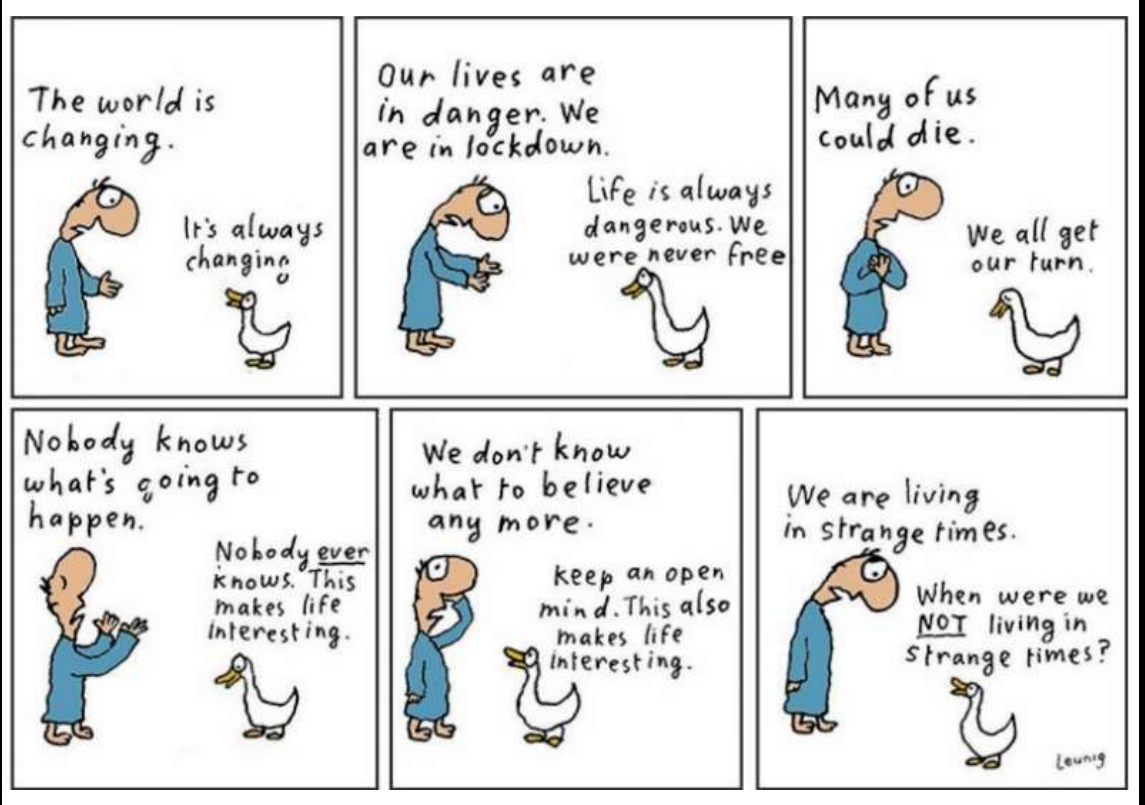
Adapted from: https://sandymillin.wordpress.com/2020/04/04 /the-world-is-changing/ Accessed on March 06th, 2024
Read the sentences and choose TRUE or FALSE:
( ) one of them is afraid of death, the other treats the topic as ordinary.
( ) life’s unpredictability is seen as positive by one of the characters.
( ) according to the characters, life is more dangerous now than in the past.
( ) the man is skeptical whereas the duck is realistic.
( ) both characters are trying to cheer each other up.
Mark the correct option:
Direction: Read text III to answer questions 10 to 12.
TEXT III
The world is changing
Posted on April 4, 2020 by Sandy Millin
The title of this week’s post is inspired by this cartoon from Michael Leunig which appeared on my Facebook stream this week:
Adapted from: https://sandymillin.wordpress.com/2020/04/04 /the-world-is-changing/ Accessed on March 06th, 2024
The duck from the comic strip thinks life is
Direction: Read text III to answer questions 10 to 12.
TEXT III
The world is changing
Posted on April 4, 2020 by Sandy Millin
The title of this week’s post is inspired by this cartoon from Michael Leunig which appeared on my Facebook stream this week:
Adapted from: https://sandymillin.wordpress.com/2020/04/04 /the-world-is-changing/ Accessed on March 06th, 2024
The underlined word “e̲v̲e̲r̲”
Direction: Consider texts I and III to answer question 13.
Direction: Consider text I to answer questions 01 to 04.
TEXT I
Drawing Number One
“I showed the grown-ups my masterpiece, and I asked
them if my drawing scared them. They answered, ‘Why be
scared of a hat?’ My drawing was not a picture of a hat. It
was a picture of a boa constrictor digesting an elephant.
5 Then I drew the inside of the boa constrictor, so the grown-
ups could understand. They always need explanations. My
Drawing Number Two looked like this:
Drawing Number Two
The grown-ups' advised me to put away my drawings
of boa constrictors, outside or inside, and apply myself
10 instead to geography, history, arithmetic, and grammar. That
is why, I abandoned, at the age of six, a magnificent career
as an artist. I had been discouraged by the failure of my
Drawing Number One and of my Drawing Number Two.
Grown-ups never understand anything by themselves, and it
15 is exhausting for children to have to provide explanations
over and over again. So then I had to choose another career,
and I learned to pilot airplanes. I have flown almost
everywhere in the world. And, as a matter of fact, geography
has been a big help to me. I could tell China from Arizona at
20 first glance, which is very useful if you get lost during the
night. So I have had in the course of my life, lots of
encounters with lots of serious people. I have spent lots of
time with grown-ups. I have seen them at close range...
which hasn’t much improved my opinion of them.”
Source: SAINT-EXUPÉRY, Antoine. The little Prince. New York: Mariner Books, 1943. Translated from French by Richard Howard.
Direction: Read text III to answer questions 10 to 12.
TEXT III
The world is changing
Posted on April 4, 2020 by Sandy Millin
The title of this week’s post is inspired by this cartoon from Michael Leunig which appeared on my Facebook stream this week:
Adapted from: https://sandymillin.wordpress.com/2020/04/04 /the-world-is-changing/ Accessed on March 06th, 2024
According to both texts we CANNOT state that
Direction: Read text IV to answer questions 14 to 16.
TEXT IV
I Was Here – Daine Warren
I wanna leave my footprints on the sands of time
Know there was something that meant something that I left
behind
When I leave this world, I'll leave no regrets
5 Leave something to remember, so they won't forget
I was here
I lived, I loved
I was here
10 I did, I've done everything that I wanted
And i̲t̲ was more than I thought i̲t̲ would be
I will leave my mark so everyone will know lt
I was here
15 I wanna say I lived each day until I die
And know that I meant something in somebody's life
The hearts that I have touched will be the proof that I leave
That I made a difference, and this world will see
Adapted from: (https://www.letrasdemusicas.fm/beyonce/i-was-here.) Accessed on March 06th, 2024
Consider the passages below:
“I wanna leave my footprints on the sands of time” (ℓ. 1)
“Leave something to remember, so they won’t forget” (ℓ. 5)
It’s possible to understand thatResolução comentada
Análise das alternativas
Direction: Read text IV to answer questions 14 to 16.
TEXT IV
I Was Here – Daine Warren
I wanna leave my footprints on the sands of time
Know there was something that meant something that I left
behind
When I leave this world, I'll leave no regrets
5 Leave something to remember, so they won't forget
I was here
I lived, I loved
I was here
10 I did, I've done everything that I wanted
And i̲t̲ was more than I thought i̲t̲ would be
I will leave my mark so everyone will know lt
I was here
15 I wanna say I lived each day until I die
And know that I meant something in somebody's life
The hearts that I have touched will be the proof that I leave
That I made a difference, and this world will see
Adapted from: (https://www.letrasdemusicas.fm/beyonce/i-was-here.) Accessed on March 06th, 2024
Choose the sentence that best relates to the text:Resolução comentada
Análise das alternativas
Direction: Read text IV to answer questions 14 to 16.
TEXT IV
I Was Here – Daine Warren
I wanna leave my footprints on the sands of time
Know there was something that meant something that I left
behind
When I leave this world, I'll leave no regrets
5 Leave something to remember, so they won't forget
I was here
I lived, I loved
I was here
10 I did, I've done everything that I wanted
And i̲t̲ was more than I thought i̲t̲ would be
I will leave my mark so everyone will know lt
I was here
15 I wanna say I lived each day until I die
And know that I meant something in somebody's life
The hearts that I have touched will be the proof that I leave
That I made a difference, and this world will see
Adapted from: (https://www.letrasdemusicas.fm/beyonce/i-was-here.) Accessed on March 06th, 2024
Concerning the underlined pronouns (ℓ. 11),Resolução comentada
Análise das alternativas
Internamente à circunferência maior e externa à circunferência menor, traça-se uma corda A̅B̅ de 12 cm. Unindo o centro O das circunferências aos pontos A e B, construímos o triângulo AOB. Os lados AO e OB desse triângulo intersectam a circunferência menor nos pontos C e D, respectivamente.
Analisando a figura gerada pela situação descrita acima, julgue as afirmações abaixo em verdadeiro ou falso e marque a alternativa correta.
I) A área do triângulo OAB é o dobro da área do triângulo OCD.
II) A altura do triângulo OCD mede 4 cm.
III) A área do trapézio ABCD mede 45 cm².Resolução comentada
Análise das alternativas
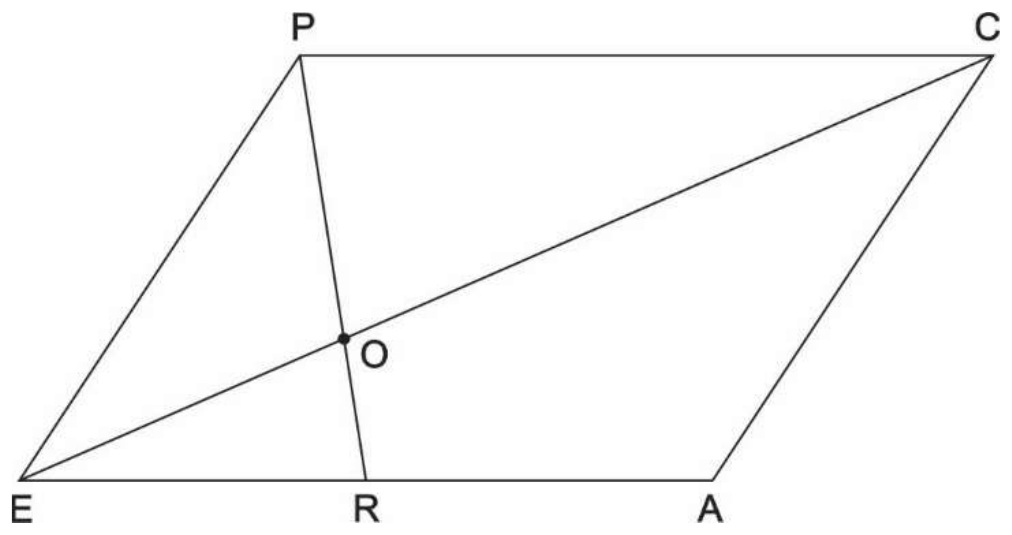
Sabendo que a área do quadrilátero ROCA vale 10 cm², analise as afirmações abaixo.
I) A área do triângulo OPC é igual a 6 cm².
II) A área do triângulo EPO é o dobro da área do triângulo EOR.
III) A área do triângulo ECA é igual a 12 cm².
Sobre as afirmações, assinale a alternativa correta.
O castelo será construído no centro do terreno e terá, em sua volta, um fosso de 1 metro de profundidade, que ficará completamente cheio de água, conforme os croquis abaixo.
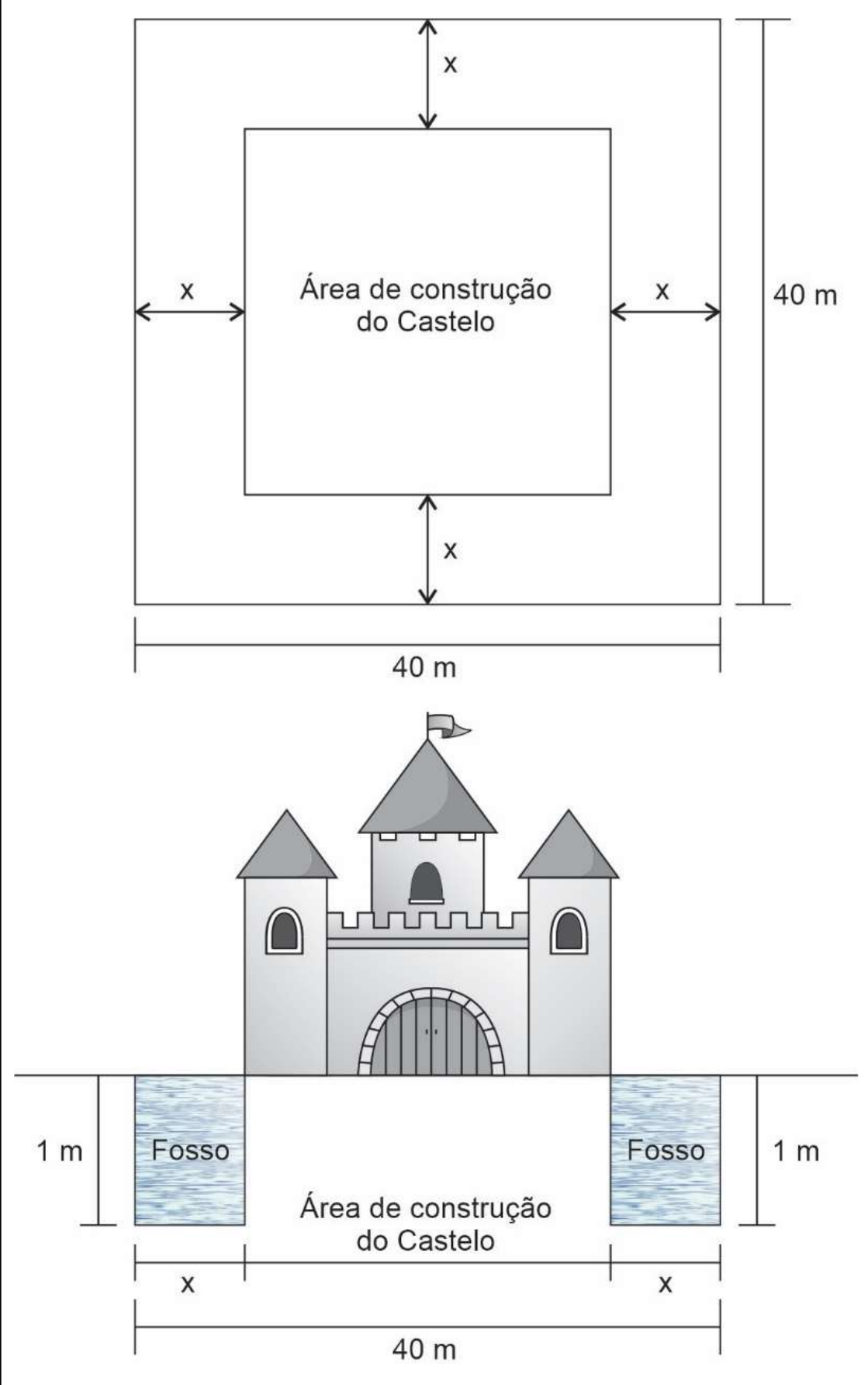
O engenheiro responsável pela construção solicitou que fosse feito um recuo de “x” metros para a construção do fosso, conforme os croquis acima, e, por questões construtivas, decidiu-se que “x” seria um número natural.
Porém, exigiu que a área de construção do castelo fosse menor que 1024 m².
O dono do parque, por questões financeiras, também exigiu que para encher o fosso de água, seu volume fosse menor que 816.000 litros.
Para atender todas as exigências e desconsiderando as espessuras das paredes e muros, assinale a alternativa correta.
Texto-base:
Texto-base:
Texto-base:
Texto-base:
Texto-base:
Texto-base:
Texto-base:
Texto-base:
Texto-base:
Texto-base:
Texto-base:
Texto-base:
Texto-base:
Texto-base:
Texto-base:
Texto-base:
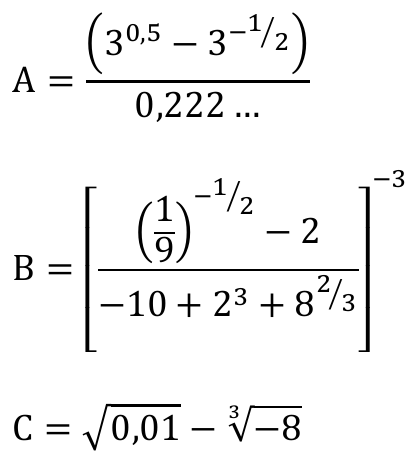
Considerando os números A, B e C, representados pelas expressões abaixo, marque a alternativa correta.
Considere duas circunferências concêntricas de raios 10 e 5 centímetros.
Na figura abaixo, EPCA é um paralelogramo, e R é o ponto médio do segmento EA.
Um arquiteto foi contratado para projetar uma nova atração no parque “O Castelo Sombrio”. Essa atração será construída em um terreno quadrado e plano com 40 metros de lado.