← Voltar para a lista de provas Escola Preparatória de Cadetes do Exército (EsPCEx) — Exército Brasileiro · Concurso de Admissão à EsPCEx 56 questões nesta prova · página 3 de 3 · 56 com gabarito Gabarito disponível A Reação Republicana foi dissidência de estados contra o café com leite. Bahia, Pernambuco, Rio Grande do Sul e Rio de Janeiro se opuseram ao domínio de São Paulo e Minas Gerais lançando Nilo Peçanha contra Artur Bernardes. Foi uma dissidência de estados relevantes contra a política do café com leite. A) O programa criticava privilégios a um só produto, como o café. B) Ela contestou a aliança oligárquica. C) Não propunha centralização política. D) O voto secreto só veio em 1932. Referência: República Velha – eleição de 1922 Resolução comentada do VaiConcursos. Gabarito disponível Gabarito disponível Bandung foi marco anticolonial e precursora do Movimento dos Não-Alinhados. A conferência reuniu países afro-asiáticos recém-independentes ou em luta pela independência, defendendo autodeterminação e não interferência. Ela afirmou o Terceiro Mundo diante da bipolaridade e levou à criação do Movimento dos Não-Alinhados. A) O neoliberalismo não está associado ao evento. C) Não houve determinação de desmilitarização. D) A não proliferação não foi o foco. E) Não foi a conferência que definiu zonas de influência das superpotências, e ela as rejeitava. Referência: Guerra Fria – Descolonização Resolução comentada do VaiConcursos. Gabarito disponível O Plano de Metas combinou capital estatal, privado nacional e estrangeiro. O governo JK fez do desenvolvimentismo a base do Plano de Metas, com investimentos estatais em energia e transportes e atração de multinacionais, sobretudo na indústria automobilística. Daí o crescimento industrial. A) Houve aumento de gastos e déficit. B) Não houve desestatização nem liberalismo estrito. C) As reformas de base ficaram para o governo seguinte. E) A inflação subiu e não houve política de juros altos. Referência: Brasil República – Governo JK Resolução comentada do VaiConcursos. Gabarito disponível Gabarito disponível Gabarito disponível Gabarito disponível Gabarito disponível Gabarito disponível Gabarito disponível Gabarito disponível Gabarito disponível Gabarito disponível Gabarito disponível Gabarito disponívelEsPCEx — Concurso de Admissão 2026/2027 — Exame Intelectual, 2º Dia (Matemática, Geografia, História e Inglês) — Versão 1
No contexto da República Velha, a Reação RepublicanaResolução comentada
Análise das alternativas
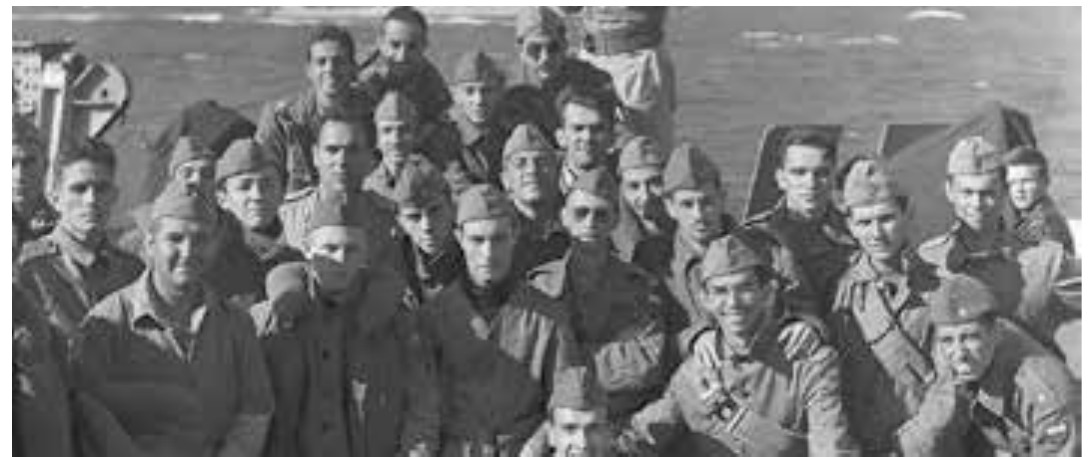
(https://aventurasnahistoria.com.br. Adaptado.)
No contexto da Segunda Guerra Mundial, a FEB
(https://history.state.gov. Adaptado.)
Durante a Guerra Fria, a Conferência de BandungResolução comentada
Análise das alternativas
Resolução comentada
Análise das alternativas
Read the poster for a campaign launched by an organization in the United Kingdom to answer questions from 45 to 47.

(https://actiononsugar.org, 2025. Adaptado.)
¹ sweet talk: persuasive language.
The campaign poster primarily encourages consumers to
Read the poster for a campaign launched by an organization in the United Kingdom to answer questions from 45 to 47.
(https://actiononsugar.org, 2025. Adaptado.)
¹ sweet talk: persuasive language.
The phrase from the poster “Needlessly high in protein” indicates that protein
Read the poster for a campaign launched by an organization in the United Kingdom to answer questions from 45 to 47.
(https://actiononsugar.org, 2025. Adaptado.)
¹ sweet talk: persuasive language.
The sentence from the poster “Isn’t it time food labels told the whole story?” is questioning whether
Leia o texto para responder às questões de 48 a 54.
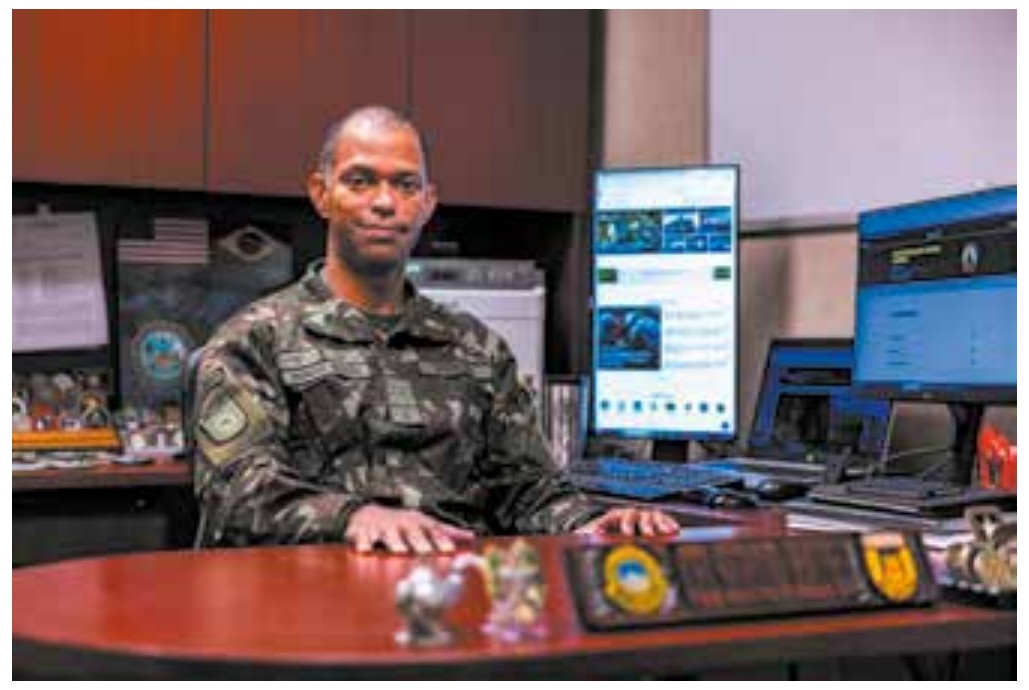
1 Brazilian Army Colonel Sergio Reis Matos serves as one of four United States Army South’s (USARSOUTH) partner nation liaison officers, or PNLO. Since July 2023, Matos has worked to strengthen the historic partnership between Brazil and the United States (US), focusing on enhancing military collaboration and interoperability.
Matos’ journey into the military began with two key influences: his father, a decorated non-commissioned officer in the Brazilian Navy, and his own early experience at a military middle school. “My father earned the rank of sergeant major and was able to travel the world to 23 countries,” said Matos. “He was a brilliant example of the opportunities to be had by serving my homeland.”
In 1987, Matos was accepted into a military middle school which was overseen by the Brazilian Army, which Matos said is very similar to the junior reserve officers’ training corps. His experience there laid the foundation for values and discipline needed for a career in the army.
Matos began his military career in 1993 at the Brazilian Army Cadets’ Preparatory School in São Paulo. Over nearly 32 years, he has held several distinguished roles, including commanding a border detachment in the Amazon, securing military venues during the 2016 Olympic Games in Brazil and leading an infantry battalion steeped in historical ties to the US Fifth Army. “The most memorable period of my career was when I commanded the 11th Mountain Infantry Battalion,” he reflected. “It was one of the units that integrated with US forces during World War II.”
5 His assignment as the Brazilian PNLO at USARSOUTH is not his first encounter with the US Army. In 2007, he attended the Captain’s Career Course at Fort Moore (US) where he earned the Distinguished International Honor Graduate award for excellence in academics and the Order of Saint Maurice Medallion in the rank of Peregrinus, for his notable contributions to the US infantry.
During his tenure at USARSOUTH, he facilitated military coordination between the Brazilian and US armies, focusing on combined operations, joint exercises and strategic engagements. His efforts as the Brazilian PNLO have been central to enhancing interoperability and fostering deeper collaboration.
(Joshua Taeckens. www.army.mil, 11.01.2025. Adaptado.)
The text mainly aims at
Leia o texto para responder às questões de 48 a 54.
1 Brazilian Army Colonel Sergio Reis Matos serves as one of four United States Army South’s (USARSOUTH) partner nation liaison officers, or PNLO. Since July 2023, Matos has worked to strengthen the historic partnership between Brazil and the United States (US), focusing on enhancing military collaboration and interoperability.
Matos’ journey into the military began with two key influences: his father, a decorated non-commissioned officer in the Brazilian Navy, and his own early experience at a military middle school. “My father earned the rank of sergeant major and was able to travel the world to 23 countries,” said Matos. “He was a brilliant example of the opportunities to be had by serving my homeland.”
In 1987, Matos was accepted into a military middle school which was overseen by the Brazilian Army, which Matos said is very similar to the junior reserve officers’ training corps. His experience there laid the foundation for values and discipline needed for a career in the army.
Matos began his military career in 1993 at the Brazilian Army Cadets’ Preparatory School in São Paulo. Over nearly 32 years, he has held several distinguished roles, including commanding a border detachment in the Amazon, securing military venues during the 2016 Olympic Games in Brazil and leading an infantry battalion steeped in historical ties to the US Fifth Army. “The most memorable period of my career was when I commanded the 11th Mountain Infantry Battalion,” he reflected. “It was one of the units that integrated with US forces during World War II.”
5 His assignment as the Brazilian PNLO at USARSOUTH is not his first encounter with the US Army. In 2007, he attended the Captain’s Career Course at Fort Moore (US) where he earned the Distinguished International Honor Graduate award for excellence in academics and the Order of Saint Maurice Medallion in the rank of Peregrinus, for his notable contributions to the US infantry.
During his tenure at USARSOUTH, he facilitated military coordination between the Brazilian and US armies, focusing on combined operations, joint exercises and strategic engagements. His efforts as the Brazilian PNLO have been central to enhancing interoperability and fostering deeper collaboration.
(Joshua Taeckens. www.army.mil, 11.01.2025. Adaptado.)
No trecho do primeiro parágrafo “Since July 2023”, o termo sublinhado é empregado com o mesmo sentido do termo sublinhado em:
Leia o texto para responder às questões de 48 a 54.
1 Brazilian Army Colonel Sergio Reis Matos serves as one of four United States Army South’s (USARSOUTH) partner nation liaison officers, or PNLO. Since July 2023, Matos has worked to strengthen the historic partnership between Brazil and the United States (US), focusing on enhancing military collaboration and interoperability.
Matos’ journey into the military began with two key influences: his father, a decorated non-commissioned officer in the Brazilian Navy, and his own early experience at a military middle school. “My father earned the rank of sergeant major and was able to travel the world to 23 countries,” said Matos. “He was a brilliant example of the opportunities to be had by serving my homeland.”
In 1987, Matos was accepted into a military middle school which was overseen by the Brazilian Army, which Matos said is very similar to the junior reserve officers’ training corps. His experience there laid the foundation for values and discipline needed for a career in the army.
Matos began his military career in 1993 at the Brazilian Army Cadets’ Preparatory School in São Paulo. Over nearly 32 years, he has held several distinguished roles, including commanding a border detachment in the Amazon, securing military venues during the 2016 Olympic Games in Brazil and leading an infantry battalion steeped in historical ties to the US Fifth Army. “The most memorable period of my career was when I commanded the 11th Mountain Infantry Battalion,” he reflected. “It was one of the units that integrated with US forces during World War II.”
5 His assignment as the Brazilian PNLO at USARSOUTH is not his first encounter with the US Army. In 2007, he attended the Captain’s Career Course at Fort Moore (US) where he earned the Distinguished International Honor Graduate award for excellence in academics and the Order of Saint Maurice Medallion in the rank of Peregrinus, for his notable contributions to the US infantry.
During his tenure at USARSOUTH, he facilitated military coordination between the Brazilian and US armies, focusing on combined operations, joint exercises and strategic engagements. His efforts as the Brazilian PNLO have been central to enhancing interoperability and fostering deeper collaboration.
(Joshua Taeckens. www.army.mil, 11.01.2025. Adaptado.)
No trecho do segundo parágrafo  o termo sublinhado pode ser substituído, sem alteração de sentido, por
Leia o texto para responder às questões de 48 a 54.
1 Brazilian Army Colonel Sergio Reis Matos serves as one of four United States Army South’s (USARSOUTH) partner nation liaison officers, or PNLO. Since July 2023, Matos has worked to strengthen the historic partnership between Brazil and the United States (US), focusing on enhancing military collaboration and interoperability.
Matos’ journey into the military began with two key influences: his father, a decorated non-commissioned officer in the Brazilian Navy, and his own early experience at a military middle school. “My father earned the rank of sergeant major and was able to travel the world to 23 countries,” said Matos. “He was a brilliant example of the opportunities to be had by serving my homeland.”
In 1987, Matos was accepted into a military middle school which was overseen by the Brazilian Army, which Matos said is very similar to the junior reserve officers’ training corps. His experience there laid the foundation for values and discipline needed for a career in the army.
Matos began his military career in 1993 at the Brazilian Army Cadets’ Preparatory School in São Paulo. Over nearly 32 years, he has held several distinguished roles, including commanding a border detachment in the Amazon, securing military venues during the 2016 Olympic Games in Brazil and leading an infantry battalion steeped in historical ties to the US Fifth Army. “The most memorable period of my career was when I commanded the 11th Mountain Infantry Battalion,” he reflected. “It was one of the units that integrated with US forces during World War II.”
5 His assignment as the Brazilian PNLO at USARSOUTH is not his first encounter with the US Army. In 2007, he attended the Captain’s Career Course at Fort Moore (US) where he earned the Distinguished International Honor Graduate award for excellence in academics and the Order of Saint Maurice Medallion in the rank of Peregrinus, for his notable contributions to the US infantry.
During his tenure at USARSOUTH, he facilitated military coordination between the Brazilian and US armies, focusing on combined operations, joint exercises and strategic engagements. His efforts as the Brazilian PNLO have been central to enhancing interoperability and fostering deeper collaboration.
(Joshua Taeckens. www.army.mil, 11.01.2025. Adaptado.)
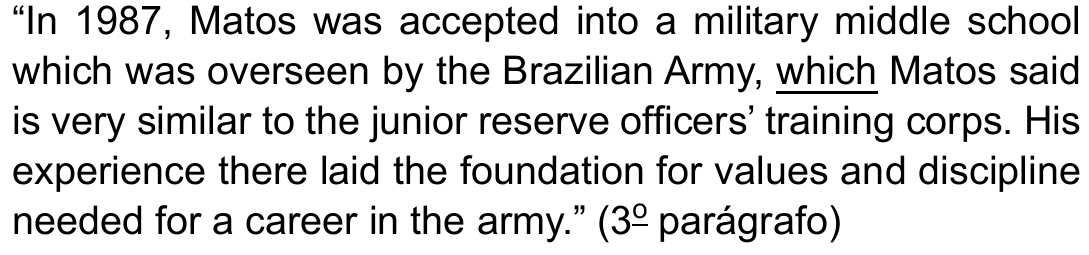
Nesse trecho, o termo sublinhado refere-se, no contexto apresentado,
Leia o texto para responder às questões de 48 a 54.
1 Brazilian Army Colonel Sergio Reis Matos serves as one of four United States Army South’s (USARSOUTH) partner nation liaison officers, or PNLO. Since July 2023, Matos has worked to strengthen the historic partnership between Brazil and the United States (US), focusing on enhancing military collaboration and interoperability.
Matos’ journey into the military began with two key influences: his father, a decorated non-commissioned officer in the Brazilian Navy, and his own early experience at a military middle school. “My father earned the rank of sergeant major and was able to travel the world to 23 countries,” said Matos. “He was a brilliant example of the opportunities to be had by serving my homeland.”
In 1987, Matos was accepted into a military middle school which was overseen by the Brazilian Army, which Matos said is very similar to the junior reserve officers’ training corps. His experience there laid the foundation for values and discipline needed for a career in the army.
Matos began his military career in 1993 at the Brazilian Army Cadets’ Preparatory School in São Paulo. Over nearly 32 years, he has held several distinguished roles, including commanding a border detachment in the Amazon, securing military venues during the 2016 Olympic Games in Brazil and leading an infantry battalion steeped in historical ties to the US Fifth Army. “The most memorable period of my career was when I commanded the 11th Mountain Infantry Battalion,” he reflected. “It was one of the units that integrated with US forces during World War II.”
5 His assignment as the Brazilian PNLO at USARSOUTH is not his first encounter with the US Army. In 2007, he attended the Captain’s Career Course at Fort Moore (US) where he earned the Distinguished International Honor Graduate award for excellence in academics and the Order of Saint Maurice Medallion in the rank of Peregrinus, for his notable contributions to the US infantry.
During his tenure at USARSOUTH, he facilitated military coordination between the Brazilian and US armies, focusing on combined operations, joint exercises and strategic engagements. His efforts as the Brazilian PNLO have been central to enhancing interoperability and fostering deeper collaboration.
(Joshua Taeckens. www.army.mil, 11.01.2025. Adaptado.)
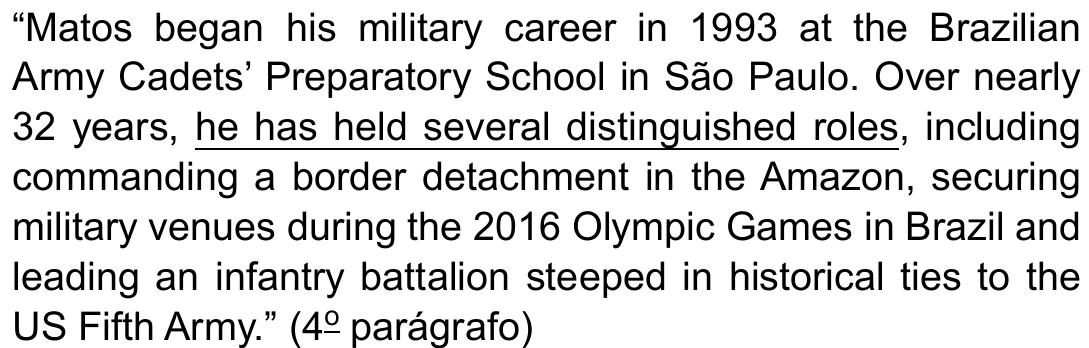
No contexto em que se insere, o trecho sublinhado indica que, ao longo da carreira, Cel Matos
Leia o texto para responder às questões de 48 a 54.
1 Brazilian Army Colonel Sergio Reis Matos serves as one of four United States Army South’s (USARSOUTH) partner nation liaison officers, or PNLO. Since July 2023, Matos has worked to strengthen the historic partnership between Brazil and the United States (US), focusing on enhancing military collaboration and interoperability.
Matos’ journey into the military began with two key influences: his father, a decorated non-commissioned officer in the Brazilian Navy, and his own early experience at a military middle school. “My father earned the rank of sergeant major and was able to travel the world to 23 countries,” said Matos. “He was a brilliant example of the opportunities to be had by serving my homeland.”
In 1987, Matos was accepted into a military middle school which was overseen by the Brazilian Army, which Matos said is very similar to the junior reserve officers’ training corps. His experience there laid the foundation for values and discipline needed for a career in the army.
Matos began his military career in 1993 at the Brazilian Army Cadets’ Preparatory School in São Paulo. Over nearly 32 years, he has held several distinguished roles, including commanding a border detachment in the Amazon, securing military venues during the 2016 Olympic Games in Brazil and leading an infantry battalion steeped in historical ties to the US Fifth Army. “The most memorable period of my career was when I commanded the 11th Mountain Infantry Battalion,” he reflected. “It was one of the units that integrated with US forces during World War II.”
5 His assignment as the Brazilian PNLO at USARSOUTH is not his first encounter with the US Army. In 2007, he attended the Captain’s Career Course at Fort Moore (US) where he earned the Distinguished International Honor Graduate award for excellence in academics and the Order of Saint Maurice Medallion in the rank of Peregrinus, for his notable contributions to the US infantry.
During his tenure at USARSOUTH, he facilitated military coordination between the Brazilian and US armies, focusing on combined operations, joint exercises and strategic engagements. His efforts as the Brazilian PNLO have been central to enhancing interoperability and fostering deeper collaboration.
(Joshua Taeckens. www.army.mil, 11.01.2025. Adaptado.)
No trecho do quinto parágrafo  o termo sublinhado, nesse contexto, é empregado para indicar
Leia o texto para responder às questões de 48 a 54.
1 Brazilian Army Colonel Sergio Reis Matos serves as one of four United States Army South’s (USARSOUTH) partner nation liaison officers, or PNLO. Since July 2023, Matos has worked to strengthen the historic partnership between Brazil and the United States (US), focusing on enhancing military collaboration and interoperability.
Matos’ journey into the military began with two key influences: his father, a decorated non-commissioned officer in the Brazilian Navy, and his own early experience at a military middle school. “My father earned the rank of sergeant major and was able to travel the world to 23 countries,” said Matos. “He was a brilliant example of the opportunities to be had by serving my homeland.”
In 1987, Matos was accepted into a military middle school which was overseen by the Brazilian Army, which Matos said is very similar to the junior reserve officers’ training corps. His experience there laid the foundation for values and discipline needed for a career in the army.
Matos began his military career in 1993 at the Brazilian Army Cadets’ Preparatory School in São Paulo. Over nearly 32 years, he has held several distinguished roles, including commanding a border detachment in the Amazon, securing military venues during the 2016 Olympic Games in Brazil and leading an infantry battalion steeped in historical ties to the US Fifth Army. “The most memorable period of my career was when I commanded the 11th Mountain Infantry Battalion,” he reflected. “It was one of the units that integrated with US forces during World War II.”
5 His assignment as the Brazilian PNLO at USARSOUTH is not his first encounter with the US Army. In 2007, he attended the Captain’s Career Course at Fort Moore (US) where he earned the Distinguished International Honor Graduate award for excellence in academics and the Order of Saint Maurice Medallion in the rank of Peregrinus, for his notable contributions to the US infantry.
During his tenure at USARSOUTH, he facilitated military coordination between the Brazilian and US armies, focusing on combined operations, joint exercises and strategic engagements. His efforts as the Brazilian PNLO have been central to enhancing interoperability and fostering deeper collaboration.
(Joshua Taeckens. www.army.mil, 11.01.2025. Adaptado.)
According to the sixth paragraph, the actions of Colonel Matos have primarily resulted in
Leia a tirinha do cartunista Daniel Shelton para responder às questões 55 e 56.
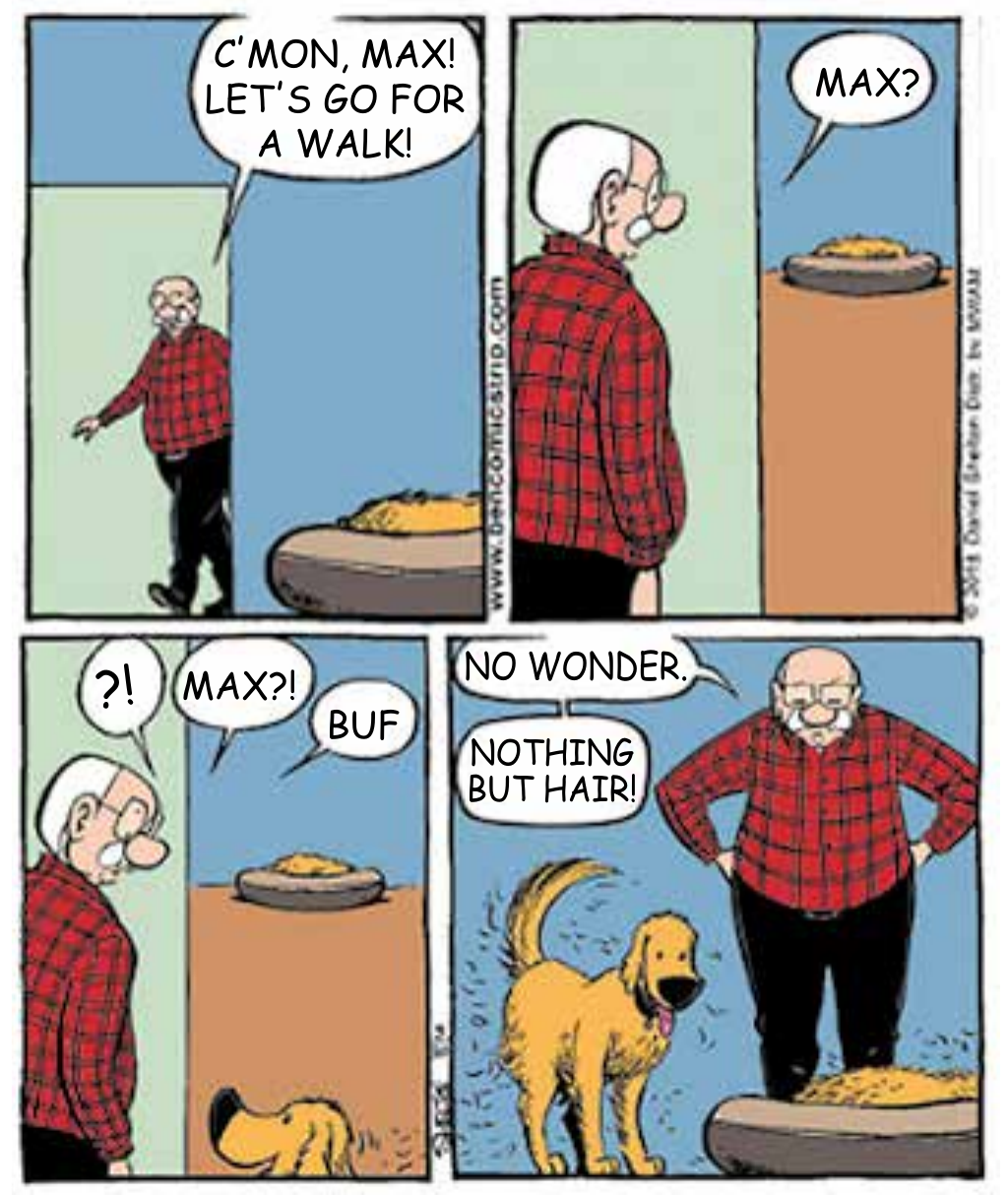
(Daniel Shelton. Ben on the Run, 2018.)
In the context of the comic strip, the expression “No wonder”, in the fourth panel, means:
Leia a tirinha do cartunista Daniel Shelton para responder às questões 55 e 56.
(Daniel Shelton. Ben on the Run, 2018.)
No contexto da tirinha, a expressão do quarto quadrinho “Nothing but hair” pode ser substituída, sem alteração de sentido, por:
Nas eleições presidenciais de 1922, os estados da Bahia, Pernambuco, Rio Grande do Sul e Rio de Janeiro formaram a Reação Republicana, que apresentou o candidato Nilo Peçanha para disputar contra Artur Bernardes, candidato a presidente indicado por São Paulo e Minas Gerais. O programa da Reação Republicana baseava-se no controle da inflação e na defesa de finanças equilibradas para o Estado brasileiro. Ela também reivindicava uma política econômica que protegesse as mercadorias nacionais de exportação em geral, sem privilégios a qualquer produto em particular.
Analise a fotografia que mostra pracinhas da Força Expedicionária Brasileira (FEB) reunidos no navio General Mann em 1944.
Em abril de 1955, representantes de vinte e nove governos de nações asiáticas e africanas reuniram-se em Bandung, na Indonésia. Os princípios fundamentais da Conferência de Bandung foram a autodeterminação política, o respeito mútuo pela soberania, a não agressão, a não interferência em assuntos internos e a igualdade.
O Plano de Metas do governo de Juscelino Kubitschek (1956-1961) previa um desenvolvimento acelerado do país sob o slogan “50 anos em 5”. Os resultados do Plano de Metas foram expressivos, principalmente no que diz respeito à produção industrial, que cresceu cerca de 80% nesse período. As medidas do Plano de Metas
Texto-base:
Texto-base:
Texto-base:
Texto-base:
Texto-base:
Texto-base:
Texto-base:
Texto-base:
Texto-base:
Texto-base:
Texto-base:
Texto-base: